Thursday, August 23, 2007

Southern Summer's final week

Both the Red and Black and the Athens Flagpole gave mention to the Georgia Museum of Art's final weekend of the "Southern Summer" series.

From Beth Sale's Flagpole "Art Notes":

Southern Summer: The concluding event of the Georgia Museum of Art’s "Southern Summer" program is Sunday, Aug. 26 at 3 p.m. Collectors Lynn Barstis Williams and Stephen J. Goldfarb, along with James C. Cobb and Paul Manoguerra, will participate in a forum “examining the social context of art in the South in the 1920s through the 1940s.” Works on paper from the collection of Barstis and Goldfarb are currently on view in the exhibit “Imprinting the South.” With traditional printmaking techniques such as aquatints, etchings, lithographs and woodcuts, artists have created views of Southern towns and landscapes. New Orleans architecture is prominently featured in the work of several artists. Hale Woodruff’s “Returning Home” is a bold linoleum cut typical of the artist’s style. The exhibit is up through Sept. 16.

(The Flagpole also gives nice mention to the John Grabach and Smithsonian's Archives of American Art exhibitions at GMOA.)

Plus, listen for that Manoguerra guy tomorrow morning on 1340 AM WGAU during an interview by Barbara Dooley.

Image: Clarence Millet, Claiborne Court, n.d. Hand-colored woodcut on white paper, 5 7/8 x 6 1/2 inches.

Thursday, August 16, 2007

Manipulating the Commonplace

GMOA curator of exhibitions Dennis Harper has several paintings included in a group exhibition at the Swan Coach House Gallery, in Atlanta on the grounds of the Atlanta History Center. The exhibition? Manipulating the Commonplace: Nine Southern Artists Reinterpret Realism. It is open now through September 22.

Creative Loafing.com in Atlanta has a review of the show:

Manipulating the Commonplace: Nine Southern Artists Reinterpret Realism is a show with two faces.

On one hand, it's a visually appealing, colorful, technically accomplished exhibition varied enough to keep viewers engaged.

For this reason, Manipulating the Commonplace is the perfect fit for the Swan Coach House Gallery, deep in ladies-who-lunch territory. Clever and idiosyncratic, the paintings and sculptures in this group show have a superficial charm you could enjoy on your way to chicken salad and sweet tea. "Wheel of Fortune!" one woman laughed as she passed by a particularly haunting painting by Silas Durant and recognized the cheese-ball game show playing on a television in the work. Another group of women chatted merrily as they moved through the gallery. One woman laughed to her friends at the plaster-and-wood ice-cream cone by Greely Myatt, "Dammit," that looked like it had fallen off the wall. There is no reason why art can't delight on this purely whimsical level, and Manipulating the Commonplace does.

The show focuses on artists who put a newfangled spin on realism, such as Joanna Catalfo's sorta-naughty still-life paintings of va-va-voom veggies, Myatt's more amusing faux-soap bar and Wayne Thiebaud's plaster cupcakes.

But those who dig something a little deeper will surely come away equally delighted at the exhibition's haunting, creepy, metaphysical dimensions. Complementing Scott Belville's and Durant's moody work are Dennis Harper's exquisitely skillful paintings that marry contemporary middle class dis-ease with the ecstatic realism of classical Renaissance and religious work in egg tempera and gold leaf.

Along with Philip Carpenter's wonderfully wise-ass drawings of pop-culture kiddie toys and cartoons juxtaposed with classical paintings, this quartet in particular shows how our banal surroundings can allow for both soul-destroying superficiality and spiritual striving. Like the elderly card-playing woman or the painter depicted in Durant's work, people are searching for some way of puncturing through the often lonely and dissatisfying membrane of ordinary life.

There is a desire to grasp at the eternal. Making art in Durant's "Convergence" or trusting in the Jesus night-light that illuminates a child's bedroom in Harper's "Terra Ombra" are two different ways of doing so. Often, Manipulating the Commonplace is the opposite of fun; it's instead deeply satisfying.

Images: Dennis Harper, Untitled (Encounter in a Foyer), 2007, egg tempera, gold leaf, and silverpoint over casein on panel, 16 x 20 inches; and Terra ombra, 2003, egg tempera over casein on panel, 18-1/2 x 24 inches.

Tuesday, August 14, 2007

Southern Cookin'

The Georgia Museum of Art has made available video from this past Sunday's "Southern Chefs" panel discussion.

The event was held in conjunction with the exhibition Imprinting The South: Works on Paper from the Collection of Lynn Barstis Williams and Stephen Jr. Goldfarb.

Follow the link [here] {avi file} to download.
Look for more museum-related video [here] in the near future.

In the video? Charles Ramsey, from Athens' award-winning Five & Ten; Linton Hopkins, from Atlanta's Restaurant Eugene; Lee Epting, from Athens' Epting Events; Irene Smith, author of Menus and Memories from Dixie Manor; and moderator and Athens historian, Milton Leathers.

Tuesday, August 07, 2007

More than Words and Southern Cooking

Last Saturday, the Georgia Museum of Art opened an exhibition -- More than Words: Illustrated Letters from the Smithsonian's Archives of American Art.

From the exhibition catalogue: "Words speak volumes, but, as every letter writer knows, there are times when they simply won't do. When the author happens to be a visual artist, he [or she] has an added advantage--one that transforms ordinary stationery into a canvas." More than Words "chronicles those occasions when words were not enough, and some of America's most revered artists turned their talents to illustrating their most intimate thoughts and feelings. ...Writing to wives, lovers, friends, patrons, clients, and confidants, premiere artists such as" Frederic Edwin Church, Andrew Wyeth, Thomas Hart Benton, Alexander Calder, Philip Guston, and Andy Warhol, among many others, "picture the world around them in charming vignettes, caricatures, portraits, and landscapes." There are also illustrated thank-you notes, love letters, maps and directions, "bon voyage" wishes, and more.

Details of two of my personal favorites:


On the top, a detail of a letter, dated March 7, 1870, from Frederic Edwin Church to Martin Johnson Heade. From the exhibition: "In the late nineteenth century, landscape painters traveled great distances in search of exotic terrain. In 1870...Church wrote to...Heade, who was on his third trip to South America, where he painted the local flora and fauna against the spectacular backdrop of their tropical habitat. Church teases him for not finding the Sierra Nevada de Santa Maria--the highest coastal mountain range in the world--when Heade was standing at its foothills."

Wrote Church: "I tell you--you have missed a big thing...lately an American Engineer studied the mountain and measured it--and here's one of our Artists--couldn't find it when he was actually sweltering at its foot. Perhaps the mosquitoes were in the way thus--" And Church draws the image of the view of a tiny Heade being blocked by a swarm of mosquitoes.

On the bottom, a detail of a letter, dated July 30, 1876, from landscape and marine painter William Trost Richards to his major patron George Whitney. "In his letters to Whitney, [Richards] would frequently enclose miniature landscapes such as this one, which he called 'COUPONS,' so that Whitney could see a subject in advance and order a painting."

Organized by the Smithsonian's Archives of American Art, the exhibition remains open until October 14th.

This coming Sunday, the museum will also host a panel discussion on Southern food. Julie Phillips, in the Athens Banner-Herald, has the details [here]...and from the museum's web site [here]. From the site: "Nothing sums up the Southern experience more than its food, and this panel discussion will bring together some of the top culinary minds in the region. Charles Ramsey from Athens' award-winning Five & Ten restaurant, Linton Hopkins from Atlanta's famed Restaurant Eugene, Lee Epting from Athens' own Epting Events and Irene Smith, the author of Menus and Memories from Dixie Manor: The Pleasures of Entertaining at Home, will discuss the tradition and culture behind Southern cooking. Noted Athens historian Milton Leathers will serve as the panel's moderator.

Following the event, the museum will host a reception that shines the spotlight on Southern food companies, ranging from well-known brands like Moon Pie to smaller, family operated businesses like Aunt Ruby's Peanuts in Enfield, N.C. Also, the Southern Food and Beverage Museum in New Orleans is sending over a display of menus from Southern eateries across the country, and guests are encouraged to bring their own menus to donate to the SFBM."

Monday, July 30, 2007

American Art Reveiw


The August 2007 issue of American Art Review is almost entirely dedicated to American art in Georgia museums.

Included in the issue is a 12-page spread, with 24 color illustrations, about the American collections at the Georgia Museum of Art.

The American collections at several other Georgia museums -- The Morris Museum of Art (Augusta), Brenau University Art Collection (Gainesville), the High Museum of Art (Atlanta), The Telfair Museum of Art (Savannah), Albany Museum of Art, The Columbus Museum, Booth Western Art Museum (Cartersville), and Clark University Art Galleries (Atlanta) -- are also featured in this special magazine.

American Art Review should be available amid the other art periodicals at whatever your favorite locale -- Borders, Barnes and Noble, etc. -- is to buy a magazine.

If you have an interest in American art, or a curiosity about the history of art museums in Georgia, the issue is absolutely worth a look. Lots and lots of pretty, color pictures. Go out and buy a copy.

Tuesday, July 24, 2007

ABH: The paint, and interpretations, fly at museum

Last Saturday's Athens Banner-Herald had the following story by Christopher Butler:

At the age of 4, Grayson Fraker of Winterville has drawn rainbows arching through the sky, Spiderman leaping tall buildings and spaceships hurtling toward the moon, but he faced a new artistic challenge Saturday.

Grayson and 120 other kids tried their hands at abstract painting - sort of.

They could visit the Georgia Museum of Art's Suitcase Paintings exhibit, and then it was time to let the paint fly behind the museum, where they were invited to fling paint brushes, roll paint-sodden balls or swipe paint-covered fingers across paper canvases.

Adults usually interpret abstract art in wildly different ways, and children are no different, said Cecelia Hinton, the museum's curator of education.

Hinton watched a brother and sister interpret a painting Saturday - he said two dots represented someone's eyes, while she thought the dots represented a fire.

"Children will say things that have an awful lot of truth and there's no greater opportunity to understand them than to hear what they think about abstract art," Hinton said.

Grayson was outside the museum steps drawing his first ever piece of abstract art, which he and his mother proudly put on display for anyone who passed by.

His inspiration came from the abstract paintings he saw in the museum which "were just weird and funny," Grayson said.

"I don't really know what I've drawn. I only know that it's black, green, blue, red and white," Grayson said, adding he would part with his painting for $5 and a stack of baseball cards.

Meanwhile, Isabella Jordan, 8, from Atlanta also had no idea what she was painting as she dipped a rubber ball in different colors of paint and rolled the ball around a blank sheet of paper, creating squiggly wavy lines.

"I don't know what to say about what this picture means or what people are supposed to think. It's just messy," Jordan said.

Lots of the budding artists admitted they were more into making a mess than a masterpiece, but not 8-year-old Isaac Parham of Colbert.

He usually draws pictures of Pokemon and dinosaurs, but on Saturday chose a more obscure theme.

"This picture is supposed to be my idea of what 'crazy' looks like," Parham said.

Images: (1) From left, Grayson Fraker, 4, and Emily Maynor, 7, both of Winterville, throw paint onto their paper as Gabrielle Mason of Athens watches Isabella Jordan, 8, of Atlanta paint Saturday at the Georgia Museum of Art during the "Flying Paint" family day; and (2) Yeyoung Kang, 4, of Athens paints an abstract painting using techniques of the late American painter Jackson Pollack on Saturday at the Georgia Museum of Art, during the "Flying Paint" family day. The interpretations proved as varied as the artwork. Both images from the linked article.

Thursday, July 05, 2007

Stairway: Frances de La Rosa

Installed this week in the main stairway at the Georgia Museum of Art...Frances de La Rosa's Landscape Series #1-12, 2006-07, oil on canvas, each 48" x 48".

More on her [here].

Some installation shots, including Dennis Harper (our curator of exhibitions), Larry Forte (Daura art handler), Lanora Pierce (preparator), Frances, and Frances's husband, photographer Fernando La Rosa:


Monday, June 11, 2007

Molasses Skye coming to GMOA

One of the museum's favorite guests is Kyshona Armstrong, who performed for February Figgie's@Five event.

Kyshone has joined with Rachel Cole to form Molasses Skye, and their new project will perform at the museum for Figgie's@Five on June 27 at 5 p.m.

Check out this video of them performing their song 'Hold On Me' ...

New podcasts

Feel free to check out our newest podcasts.

In this one, Paul Manoguerra leads a tour of Suitcase Paintings, while here Dennis Harper gives a brief overview of Cut Along the Grain.

Wednesday, June 06, 2007

More Suitcase Paintings

Beth Sale, in the Athens Flagpole, gives a nice summary of the Suitcase Paintings: Small Scale Work by Abstract Expressionists exhibition and our corresponding permanent collection display. Full text of the Flagpole's "Art Notes" [here]. Museum relevant section follows:

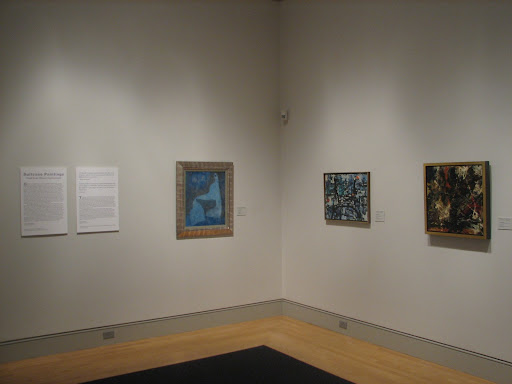
Living is Easy: “Suitcase Paintings: Small Scale Work by Abstract Expressionists, on view at the Georgia Museum of Art (GMOA), has the perfect concept for summer travel. Thomas McCormick of Chicago titled the exhibit after a story told by New York art dealer Gertrude Stein about collector Larry Aldrich’s habit of traveling with paintings he could fit into his suitcase. Abstract Expressionists are known for creating large-scale works (such as Jackson Pollack’s canvases of dripped paint), but as a quote by Robert Motherwell, included in the exhibition’s text, mentions, “It’s possible to paint a monumental picture that’s only 10 inches wide, if one has a sense of scale, which is very different from a sense of size.” This exhibit highlights works which contain the energy and vibrancy of Abstract Expressionism in a small scale. The exhibit is populated by thick paint; broad, generous brushstrokes, such as in Alfonso Ossorio’s painting; and the bold shapes of Robert Richenburg (to whom the exhibit is dedicated), who died while the exhibit was being assembled in October of 2006. Collages in muted colors by Ronald Ahlstrom, Fred Berman and Robert Nickle exude a heavy, aged authority, while Frank Lodbell and Robert Natkin’s light and airy paintings have a more summery palette. Well-known artists of the Abstract Expressionists are also included in the exhibit: Elaine de Kooning, Perle Fine, Phillip Guston, Franz Kline, Conrad Marca-Relli, Joan Mitchell, Robert Motherwell and Jack Tworkov.

One viewer suggested that a blue painting by William Baziotes resembled a woman playing piano until she read the title “Moon Dream.” Herman Cherry’s “No Title (Black Slash)” vaguely resembles a car going downhill, with a black line of asphalt on a red hill with an olive-green car and yellow sky. See what you can find. The exhibit will be on view through July 22, after which it will travel to other museum venues. A series of documentary films complements the exhibit on Wednesday nights during the month of June. “Stroke of Genius: De Kooning on de Kooning” begins the series on June 6. Check Movie Dope for more information.

Sense of Permanence: Paintings from the Permanent Collection currently on display include large-scale works by Howard Thomas and Carl Holty, who use squares and rectangles to build their compositions. Lamar Dodd and Jack Kehoe, both essential UGA instructors, have work in the exhibit. Joan Mitchell’s “Close” steals the show with an amazing amount of light pouring both on the painting and coming from it. Her large rectangles of light orange ochre drip down the surface like a cat’s tail on a sunny windowsill. If you missed the recent exhibit of Mariska Karasz’s work, you can get a taste of it now; one of her pieces is included in this exhibit.

Images: Two views of the Dodd Gallery, Georgia Museum of Art, showing the Kehoe, Mitchell, and Dodd mentioned in the "Art Notes" text.

Thursday, May 31, 2007

Donald Keyes (1940-2007)

Donald D. Keyes
(December 24, 1940 – May 19, 2007)
former curator of paintings, Georgia Museum of Art

Original Athens Banner-Herald article about Dr. Keyes's death [here].
Arizona Daily Star article [here].
Flagpole article [here].
Athens Banner-Herald brief article on the museum's memorial effort [here].
Link to Dr. Keyes's ABH obituary [here].

“We are all distraught around here at the museum. It’s a piece of our history that’s gone with Donald’s death. He was very important to the museum and to the Athens art scene.” – William U. Eiland, director, Georgia Museum of Art.

“He was a very creative curator. He came up with wonderful ideas and had connections with curators throughout the country to allow us to secure excellent shows. He was also great at keeping in touch with artists in Georgia.” – Bonnie Ramsey, director of communications, Georgia Museum of Art.

The Georgia Museum of Art and the arts community of Athens mourn the loss of Dr. Donald Keyes, curator of paintings at the museum from 1984 to 2001. Dr. Keyes died Saturday, May 19, after suffering a heart attack while hiking in the Grand Canyon in Arizona.

Born on Christmas Eve in 1940 in New York City, Keyes graduated from Yale University, and earned his doctorate in art history from New York University. Besides his time at the museum, he taught at Ohio State University and Smith College and was director of the Marietta Cobb Museum. Keyes was very active in the cultural life of the state as one of the founding members of Atlanta Photography Gallery and Five Art in Athens which houses Athens Institute for Contemporary Art (ATHICA) and artists’ studios. He also coordinated the artists’ market for AthFest, the annual music and art extravaganza, and was the auctioneer for the annual Mental Health Benefit Auction. As curator at the Georgia Museum of Art, Keyes organized numerous exhibitions and published articles, books, and exhibition catalogues. These included studies about American Impressionism, art and artists in the White Mountains of New Hampshire, Stuart Davis, the nineteenth-century Southern itinerant painter George Cooke, the Woodstock painter AndrĂ©e Ruellan, Impressionism in California, and European and American photography.

One of Dr. Keyes’s many personal and professional interests was photography. He collected contemporary photography for more than three decades, and was responsible for numerous acquisitions and gifts to the museum’s collection of photographs. In memory of Dr. Keyes, the museum is presenting a temporary display of three photographs that entered the American collections here through his dedication, diligence, and knowledge. Also, through funds from M. Smith Griffith, the staff of the museum, and the museum’s American art department, the Georgia Museum of Art has purchased a photograph, Church, Havana, Alabama (1964) by renowned American photographer, William Christenberry (b. 1936), to be added to the collection in memory of Dr. Keyes.

In an essay he wrote for the exhibition To See a World in 1997, Donald Keyes described the power of photography: “Photography, more than any other medium, reminds the viewer of its subject while simultaneously removing him/her from that subject. …Most modern photography utilizes this tension between what is represented and what the viewer knows or believes to have been the original subject. Thus, most art photography exists as a nexus between reality and fantasy.”

Images: Tom Zetterstrom (American, born 1945), Coast Oak, n.d. From the Portrait of Trees series. Gelatin silver print. Georgia Museum of Art, University of Georgia; museum purchase through funds provided by the Friends of the Museum GMOA 1996.18


William Christenberry (American, born 1936), Church, Havana, Alabama, 1964. Vintage color Brownie print mounted to board. Georgia Museum of Art, University of Georgia; museum purchase, in memory of Donald D. Keyes, through funds provided by M. Smith Griffith, the staff of the Georgia Museum of Art, and the American art department at the Georgia Museum of Art, Accession pending 2007

Friday, May 18, 2007

Suitcase Paintings

This week...post-war/contemporary art set auction records: $72.8 million for Mark Rothko’s White Center (Yellow, Pink and Lavender on Rose) [from a Rockefeller , via Sotheby's, to a mysterious bearded collector!]; $52.6 million for a Francis Bacon; even $5.8 million for a Tom Wesselman.

This week here in Athens...post-war/contemporary art is on display. Blog posts already exist about the Jay Bolotin exhibition [here] and [here]. Tonight, we open to the public Suitcase Paintings: Small Scale Work by Abstract Expressionists. The show will remain open until July 22, and then will travel to five other museum venues.

From the Georgia Museum of Art's website:

"Big. That is how most of us think about Abstract Expressionism of the mid-20th century. The artists worked with big ideas, big emotions, big action and on big scale. This group of ground-breaking artists, sometimes referred to as the New York School, pushed the limits of scale, using the canvas as a field to act upon. However, most also created small-scale works of intense beauty and intimate size, while losing none of the bravura and energy.

Suitcase Paintings, organized by Art Enterprises, Ltd., Chicago, is designed to show this other side of the movement. The exhibition will also introduce to many viewers some artists who, while important at the height of Abstract Expressionism, may be less known today. Suitcase Paintings include[s] work by Franz Kline and Elaine de Kooning, among several others."

The primacy of the paint itself, and the role of Surrealism and the the free expression of the unconscious mind are themes throughout. Emphasis is on New York in the show, but Chicago and San Francisco Abstract Expressionists get a gallery. The exhibition is intense, made more concentrated by the small size of the objects.


“It’s possible to paint a monumental picture that’s only 10 inches wide, if one has a sense of scale, which is very different from a sense of size.” -- Robert Motherwell

“I don’t feel that it’s necessary to get a painting that large to have impact. I think that, with the control of whatever the medium is, you can get it, I always say, in a postage stamp size.” -- Perle Fine

Images: (l) View of the opening section of the exhibition, including paintings by William Baziotes, Buffie Johnson, and Alfonso Ossorio. (c) Franz Kline (1910-1962), Untitled, 1958, oil and collage on paper laid down on canvas, 17 3/8 x 14 7/8 inches, Collection of Art Enterprises, Ltd., Chicago. (r) View of the "Tenth Street Style" section of the show.

Wednesday, May 09, 2007

More Jackleg

This week's Athens Flagpole has lots of coverage of the Georgia Museum of Art's Jay Bolotin exhibition The Jackleg Testament. One of Bolotin's woodcuts became the cover:


The relevant section of Beth Sale's article which includes a mention of our permanent collection woodcuts:

Every now and then, someone comes along and changes the way things are done. Dreaming and then making that dream a reality are what makes an artist. Sometimes the dream takes years to come to fruition. Sometimes it requires inventing new ways of creating. Sometimes it requires new ways of displaying.

The Woodcut Bible: Jay Bolotin’s woodcut film titled The Jackleg Testament, Part One: Jack and Eve is currently on view at the Georgia Museum of Art (GMOA). The film is Bolotin’s variation of the Book of Genesis, reinterpreted as an imaginative, dark tale of theatre and adventure, involving Eve, Jack (a Jack-in-the-box freed from his box), and a godlike figure called Nobodaddy (a reference to the poetry of William Blake). Bolotin created the film by making woodcuts of the characters, landscape elements and props, and scanning them into a computer for manipulation. The woodcuts used in the production of the film are displayed in the exhibit as a supplement, offering “behind-the-scenes” access, which works on two levels. Images used to make the film are on view, as well as the plates used to create the woodcuts. Examples of large circular woodcut plates help the viewer identify the process required to make the finished product. These plates, along with the large wooden sculpture of Daniel Boone, were not originally part of the traveling exhibit; they were selected by Curator of Exhibitions Dennis Harper for inclusion in the GMOA show. The sculpture of Daniel Boone is included in the film, although the inclusion is in reference only, and serves as an example of the solidity of the world Bolotin has created. Bolotin created a woodcut of the sculpture and included it in the plot of the film. “A portfolio of prints that outlines the narrative” is also included in the exhibit. While “claymation” (stop motion animation using clay as the image-making medium) has been used for decades, this is likely the first film created using woodcuts. Bolotin, who first used the term “Woodcut Motion Picture,” is credited as having forged a new path. He wrote the script and the musical score, and performed music and the voice of Nobodaddy. The film also features the vocal talents of Karin Bergquist, and opera singers Monte Jaffe and Nigel Robson. Layers upon layers of literary and biblical references are woven into the script and imagery.

References were taken from William Blake, Shakespeare and the Bible; and literary puns and allusions are scattered throughout the film. Bolotin quotes Nietzsche in the prologue: “We were fashioned to live in paradise and paradise was destined to serve us. Our destiny has been altered; this has also happened with the destiny of paradise not stated.” Watching the film is “like reading James Joyce,” says Harper.

For example, Bolotin titles one section of the film where Eve catches the apple “the Beginnings of Irony,” alluding to both the irony of the biblical story and the first example of irony used in the film. (See this week's cover.) The imagery is dark and morose. The sound track is operatic. The characters’ movements are peculiarly like paper dolls, with only the heads and upper limbs moving. The film alternates between color and black and white, adding to the unique quality. The Georgia Museum became involved in the preparation for this traveling exhibit when the film was still in its early stages, through the introduction of a mutual friend. The hour-long film will run continuously throughout the duration of the exhibit, starting on the hour. Just in time for the summer, sit and watch the film in the cool, dark, air-conditioned museum. The exhibit will be on display through July 8. There will be an opening reception for the summer exhibitions on Friday, May 18, from 6:30 p.m. to 8:30 p.m. Keep your eyes open for a local musical performance by Jay Bolotin. See www.uga.edu/gamuseum or call 706-542-GMOA.

Carved in Wood: Also on view in the Georgia Museum of Art is an exhibit of woodcuts dating from the late-15th century to the 20th century, from the museum’s permanent collection. These prints were chosen by Dennis Harper to illustrate the history and process of the woodcut. Included in the exhibit are Japanese Ukiyo-e prints, such as Hokusai’s “The Great Wave off Kanagawa” from the “36 Views of Mt. Fuji.” The iconic look of woodcuts is seen in Emile Bernard’s “Christ, or Crucifixion” from 1894. A page from Wassily Kandinsky’s collection of poems and woodcuts called “KlĂ„nge” (translates as “sounds”) is in the exhibit. Leonard Baskin’s “Florentine” from 1952 shows a dark angel with wings. The variety of woodcut images in the exhibit provides an overview of the technique. Visit www.uga.edu/gamuseum to see more.

Tuesday, May 01, 2007

The Jackleg Testament, Part One

Georgia Museum of Art's exhibition page [here]. Official (pdf) press release [here]. More, including multimedia, from semantikon.com [here]. Direct link to .mov [here] and [here].


The Athens Banner-Herald has video and music links for the exhibition. Sections from Julie Phillips's article -- "Storyteller has new twist on Genesis" -- in the ABH:

It took Jay Bolotin five years to rewrite Genesis. ...But really, in the ancient tradition of storytelling, that's not a terribly long time - especially given Bolotin's version went from sketches to woodcuts to music to an animated musical film that tells his version of the story. ...

Eve is lured from the Garden of Eden, in Bolotin's version, by a jack-in-the-box named, appropriately, Jack, and takes up with a Vaudeville-style review that's run by a god figure named Nobodaddy. Every few epochs, Nobodaddy produces a play called "The Theater of the Western Regions."...

Bolotin, who lives on a farm outside of Cincinnati, created the film from extensive digital photographs of his woodcuts and prints, manipulating them into a fascinating moving world by way of motion picture software.

A gifted musician and songwriter who's worked with Dan Fogelberg and whose praises have been sung by the likes of Kris Kristofferson and famed opera director Jonathan Eaton, Bolotin also created the musical score for the film and enlisted the vocal talents of opera singers Nigel Robson and Monte Jaffe, along with vocalist Karin Bergquist (of the band Over the Rhine).

The film, titled "The Jackleg Testament, Part One" along with an exhibition featuring all of the source work that went into the process of making the film, is on display at the Georgia Museum of Art. The exhibit has been on an extensive tour across the country, making its debut in May 2005 at the Contemporary Arts Center in Cincinnati.

It follows Bolotin's previous theatrical works, which have included an opera featuring large mechanical sculptures based on his woodcut-inspired creations. That project in particular took about 10 years. ...

Images: (left) Jay Bolotin, A Prehistory to that which is, by mistake, called The Fall of Man: Jack and Eve (The Beginning of Irony), 1999. Printed by Michelle Red Elk. 12 color woodcut prints, Edition of 20. Courtesy of the artist. (right) Jay Bolotin, Elements of a Woodcut Motion Picture Titled "The Jackleg Testament: part one - Jack & Eve" (Serpent Print), 2004-2005. Printed by Krista Gregory. Portfolio of 37 black and white woodcut prints with notations, Edition of 35. Courtesy of the artist.

Thursday, April 12, 2007

MFA 2007

Details from the Georgia Museum of Art's exhibition page [here].
Official press release for this year's MFA exhibition (pdf file) [here].

Beth Sale's discussion from the April 11th edition of the Athens Flagpole [here].

What is it? Upon his appointment at the University of Georgia in 1939, Lamar Dodd set about organizing exhibitions, auctions, and lectures that increased the awareness of art both on campus and in the Athens community. Collaborating with Georgia Museum of Art founder Alfred H. Holbrook, Dodd also viewed the museum as a laboratory of ideas and aesthetics related to art. The 2007 Master of Fine Arts Candidates Exhibition continues the traditions instituted by Dodd at the university. By its very makeup, the annual exhibition operates as a vibrant, eclectic example of the depth and quality of the Lamar Dodd School of Art. The annual show serves as one of the most intriguing, challenging, and enjoyable spectacles during the museum’s active schedule of exhibitions. Each year, the audience of the Georgia Museum of Art gets the opportunity to respond to and to enjoy what the University of Georgia’s students are doing in the world of contemporary art.

If/when you visit the exhibition, open until May 6th, here are some general themes and/or recurring motifs to look for among the work of the 23 -- likely the most ever at the university -- graduating MFA students:
  • Nostalgia, and the playing/building upon our longing and understanding of persons, situations, traditions.
  • Time (and the function of time)
  • Contradictions, and the assertion and creation of opposing ideas, situations, feelings, materials.
  • Monochromatic work.
  • Hanging/dangling objects.
  • Overt and conscious lack of (clear) narrative.
  • Process (especially instead of meaning and narrative).
  • Personal identity and memory (as opposed to group identity).
  • Interiority vs. exteriority.
Last night the museum hosted "MFA Speaks," and the students spent 2-3 minutes each on the microphone giving the general public some "talking points" about the art.

The museum created a slideshow of images to accompany the talk. The slideshow follows as a youtube video.

The artists, in slideshow order, are: Jim Norton (jewelry/metals), Kathlene Moyer (interior design), Deborah Ford (interior design), Audrey Molinare (printmaking), Rylan Steele (photography), Shawn Eisenach (printmaking), Nick Gagliardi (painting), Teddy Johnson (painting), Nara Kim (fabric design), Meghan Moser (fabric design), Brook Reynolds (photography), Susannah Zucker (ceramics), Kate Windley (painting), Andy Anzardo (sculpture), Amanda Burk (printmaking), Erin Burke (sculpture), Danielle Benson (printmaking), Chris Merz (painting), Natasha Seedorf (jewelry/metals), Zamila Karimi (interior design), Susan Gunter (fabric design), Jenn Manzella (printmaking), and Krista Coleman-Silvers (jewelry/metals).


The "opening" reception for the 2007 show is at the Georgia Museum of Art on Friday the 13th, 7 - 9pm.

Friday, March 23, 2007

New banner

Curator's Corner, the web blog for the Georgia Museum of Art, now has a header with images.

So...what is on the header?


Starting at the top left and moving down the first column:

1. George Cooke's Tallulah Falls, 1841. Oil on canvas, 35 3/4 x 28 3/4 inches. Georgia Museum of Art, University of Georgia; gift of Will Moss. GMOA 1959.646. Cooke's painting was the subject of a presentation and essay at the museum's Second Henry D. Green Symposium of the Decorative Arts. You can read that essay [here].

2. Art Rosenbaum, and curator of exhibitions at GMOA, Dennis Harper. Rosenbaum's art was recently the subject of an exhibition, curated by Harper.

3. Pierre Daura (American, b. Spain, 1896-1976), Martha at Thirteen, 1943-44. Oil on canvas. Georgia Museum of Art, University of Georgia; gift of Martha R. Daura. Established at GMOA with a gift from Ms. Daura in honor of her father, the Pierre Daura Center contains a collection of paintings, prints, drawings and sculptures by the Catalan-American artist Pierre Daura, who co-founded the artists' group Cercle et Carré.

4. A student enjoying one of GMOA's podguides.

5. Richard Weisman in front of the portrait Andy Warhol painted of Mr. Wesiman...at GMOA last April.

6. Lamar Dodd (American, 1909-1996), Copperhill, 1938. Oil and egg tempera on linen canvas. Georgia Museum of Art, University of Georgia; extended loan from the University of Georgia Foundation, gift of Mary and Lamar Dodd. GMOA 1974.3F. The School of Art at UGA is named for Dodd.

7. Cheever Meaders (American, 1887-1967), face jug, ca. 1920s. Stoneware and quartz. Georgia Museum of Art, University of Georgia; gift of Roy Ward. GMOA 2006.131.

Moving to the right-hand column...

8. Detail of J. Alden Weir (American, 1852-1919), Farm in Winter, 1895. Oil on canvas. Georgia Museum of Art, University of Georgia; extended loan from the collection of Jason Schoen, Miami, Florida. GMOA 1998.13E.

9. Curator of decorative arts, Ashley Callahan, working on the exhibition Modern Threads: Fashion and Art by Mariska Karasz.

10. Curator of European art, Giancarlo Fiorenza, working in his office.

11. Robert Henri (American, 1865-1929), Sissy, 1924. Oil on canvas. Georgia Museum of Art, University of Georgia; Eva Underhill Holbrook Memorial Collection of American Art, gift of Alfred H. Holbrook. GMOA 1947.103. One of the more popular paintings at GMOA.

12. Curator of American art, Paul Manoguerra, in the Dodd Gallery.

13. John H. Twachtman (American, 1853-1902), The Little Bridge, c.1896. Oil on canvas. Georgia Museum of Art, University of Georgia; Eva Underhill Holbrook Memorial Collection of American Art, gift of Alfred H. Holbrook. GMOA 1945.90.

Tuesday, February 27, 2007

Spring, a bit early, is in the air

Maybe it's global warming, maybe it isn't ... but the weather has definitely taken a spring-like turn as of late. And there's signs of life among the trees, bushes and other plantlife that line the campus of the University of Georgia.


Such beautiful scenes, particularly after the cold weather that's gripped the area the past few months, bring to mind other bright images, such as John Twachtman's The Little Bridge, which is a part of the museum's permanent collection.


A native of Cincinnati, Twachtman first began dabbling in art by painting floral window shades for his father's business. These initial efforts spurred his interest, and he would study at the Academie Julian in Paris. It was there that he was heavily influced by the work of James Abbott McNeill Whistler and the French Impressionists. Working with fellow artists and friends Childe Hassam and J. Alden Weir, he helped to found "The Ten" - an American Impressionist group in the late 1890s.

For an interesting biography of Twachtman, click here.

Friday, February 23, 2007

Comprehensive crafting?

One of the Georgia Museum of Art’s most publicized exhibited works of art last year was Theresa Sporer’s knitted motorcycle in the 2006 MFA Degree Candidates’ exhibition. Craft blogs, websites and magazines picked up on its bright colors and interestingly subversive use of traditional and feminized handwork.

Now, the Museum of Arts and Design in New York is presenting an exhibition titled Radical Lace and Subversive Knitting, which is up through June. The New York Times review of the exhibition is interesting in that the author, Martha Schwendener, thinks that its failing is in not being comprehensive or contemporary enough. Still, the pictures on both MAD’s site and alongside the NYT article present new ways of looking at crafts.


Theresa has also posted photographs of some of her recent work online, including a knit jackhammer.

Thursday, February 22, 2007

Figgie's@Five update

We've had a change in programming for next week's Figgie's@Five here at the museum. Gabriel Kelley will be performing for us. He's a local folk musician who regularly plays around town. Check out his web site, and be sure to come listen to him on Wednesday, Feb. 28 at 5 p.m.

Monday, February 19, 2007

New podcast

Giancarlo Fiorenza, the museum's Pierre Daura Curator of European Art, has just recorded a podcast where he leads a tour of the exhibition he organized - Spanish Works on Paper.