Thursday, September 29, 2016

Guided Mini-Tour: “Gifts and Prayers: The Romanovs and Their Subjects”

On your way to view the newly arranged permanent collection, be sure to stop in the Dorothy Alexander Roush and Martha Thompson Dinos Galleries. They’ll be easy to spot because they’re the ones painted verdant green. They feature highlights drawn from an extensive collection of 2,217 objects on extended loan to the museum and make up “Gifts and Prayers: The Romanovs and Their Subjects,” on display through December 31. The exhibition illuminates a culture of gift-giving in the Russian Empire, where rulers could maintain their benevolent image and their subjects could appease those in power.

Vasilii, F. Timm (1820–1895) [Georg Wilhelm Timm], chromolithograph. From the coronation album of
Alexander II: Alexander II receiving felicitations from the Cossacks in Saint Andrew Hall
of the Great Palace in the Moscow Kremlin


With just over 140 objects ranging from miniscule medals to towering trophies, it’s easy to feel lost in the grandeur, so we’ve put together this guided mini-tour to help you make the most of your visit. As you first enter the Roush Gallery, take in the presence of the silver trophy from a distance, then begin to notice the masterful craftsmanship in its details. It is topped with the doubled-headed eagle, an important feature in the Russian coat of arms; its two heads represent the Russian Empire as the great bridge between East and West. You might recognize it multiple times throughout the exhibition. In this case, the double-headed eagle was used to call attention to the valor of a commander during the Crimean War.

Breastplate with the imperial
double-headed eagle, ca. 1900
In the middle of the room sits a large, wooden cigar box covered in miniatures to represent the empire’s territories. It was given to Alexander II at his coronation to commemorate a specific moment in which the tsar and his people blessed and prayed for one another. Opening the box was like reliving the experience.

Presentation cigar box with a coronation scene and coats of arms, 1856

Now, turn toward the doorway where you entered to view a silver snuffbox with a portrait of Alexander I. The relief depicts him wearing the traditional laurels of victory in reference to his triumph over Napoleon’s forces. His profile sits atop a pedestal surrounded by weapons, armor and imagery resembling the Ark of the Covenant. As you move back toward the entrance, notice a painting of a little boy. This 1827 portrait was a previously unknown and undocumented work created by the famed painter Aleksei Venetsianov, and it shows a delicate sensitivity for the vibrancy of youth. It demonstrates the power of portraiture, and its placement in the exhibition shows the diverse use of portraits in 19th-century Russia. To the right, a pair of luminous objects feathered with gold will surely catch your attention. The first, a triptych, was presented to the Lifeguard Volinsky Regiment by the last imperial couple in 1907. It shows gratitude for the unit’s safeguard, complemented by the prayers of protection written on the outside. The other object showcases the opposite direction of giving gifts. It was presented by a monastery to the court of Saint Petersburg, and it speaks praises and prayers for the ruling family through the select use of Christian saints. In the corner opposite to the icons is a document of particular importance, a Charter of Ennoblement signed by Alexander I. It was gifted to a civil servant whose dedication in service progressed him to a status of nobility; the charter includes his new coat of arms, verified by the emperor’s seal and signature.

Making your way into the second gallery, you’ll see a vast array of jaw-dropping, brilliant medals and orders made with the highest degree of precision and beauty. Each object displays exacting craftsmanship with precious metals, enamel, and guilloché (a mechanical decoration technique that engraves patterns into materials such as metal). Every one is superb on its own, but imagine the men decorated with a mass of them as seen in the portrait of Alexander II in the first gallery. Last, three ribbon-shaped decorations known as cockades sit next to the helmets on the corner pedestal. They were placed on the front of helmets to reward exceptionality in battle, and they represented the divine in subtle ways. The ribbon suggests the iconography angels, and the ephemeral tips were meant to invoke the Holy Spirit.

This selection represents highlights in the exhibition, but there is much more for all to see and learn. An accompanying catalogue, published by the museum, will be available for purchase in the Museum Shop or by phone at 706.542.0450.

Benjamin Thrash
Publications Intern

Thursday, September 22, 2016

"Living Color: Gary Hudson in the 1970s"

Gary Hudson, Pi Kuan, 1970
This exhibition, now showing through January 8, 2017, showcases the 1970s work of painter Gary Hudson, who was associated with the lyrical abstraction movement. Hudson received a master’s of fine art degree from Yale University in the 1960s and studied there with famed artist and teacher Hans Hofmann. In the late 1970s, Hudson created works of lyrical abstraction. In contrast to minimalism, the lyrical abstractionists took a looser, more painterly approach to abstract art. Hudson experimented with the importance of color and line in composition. Sometimes he soaked cloth with paint, then pulled it across a canvas, allowing color to saturate the surface randomly. Hudson's works are in public collections including the Whitney Museum of American Art and the San Diego Museum of Fine Arts as well as in many private collections.

Gary Hudson, Silver Plaque, ca. 1971
Sarah Kate Gillespie, curator of the exhibition, said, “This exhibition offers us the opportunity to appreciate and examine a pivotal moment in Hudson’s career. With these works, we can clearly see the legacy of both abstract expressionism and minimalism, but also how the artist took these movements and reshaped them in new ways in the 1970s.”

Related events include:

• Family Day: Express Yourself
September 17, 10 a.m. to noon

• Teen Studio: Abstract Expressionism
November 3, 5:30–8:30 p.m. (free but registration required via 706-542-8863 or email callan@uga.edu)

• Tour at Two
November 16 at 2 p.m.

All events are free and open to the public unless otherwise indicated.

Thursday, September 15, 2016

“Icon of Modernism: Representing the Brooklyn Bridge, 1883–1950”

William Louis Sonntag Jr., Brooklyn Bridge, ca. 1895

Opening this Saturday and on view through December 11, “Icon of Modernism: Representing the Brooklyn Bridge, 1883–1950” is a rich survey of paintings, watercolors, works on paper and photographs that all take the Brooklyn Bridge as a subject and were created between the completion of the bridge (1883) and the mid-20th century. “Icon of Modernism” aims to show how artistic representations of the structure evolved over time even as it symbolized modernity for different generations. From American impressionism to abstract expressionism, the details of how artists presented the bridge may have changed, but its ability to stand for the modern era remained.

“Icon of Modernism” features 42 works of art, including from painters Joseph Stella, John Marin, Yun Gee, Georgia O’Keeffe and Reginald Marsh and photographers Edward Steichen, Walker Evans, Weegee and Consuelo Kanaga. Four works in the exhibition come from the museum’s own collection, but the remainder are on loan from museums, corporate collections and private collections across the country.

Glenn O. Coleman, Bridge Tower, 1929
“When it opened, the Brooklyn Bridge was a phenomenon, and many commemorative objects featuring the bridge were produced. Other museums have shown the wide variety of these objects, but we decided to focus on the aesthetic portion alone,” explains Sarah Kate Gillespie, the museum’s curator of American art, chose Gillespie, who was tasked with organizing the exhibition when the museum hired her in 2014.

Many of our visitors and readers will be surprised to hear of the connection between a structure so tied to New York City and Athens, Georgia. As it turns out, direct descendants of John A. Roebling, who designed the bridge, lived in Athens for many years, and portraits of Roebling's son and daughter-in-law, Ferdinand William and Margaret Allison Roebling, have been on view in the museum’s permanent collection galleries.

In addition, the museum’s collection overlaps strongly with the span of time the exhibition covers; an exhibition of related works that shows the city in the same time period from that collection, titled “Man’s Canyons: New York City on Paper,” will be on view through December 31 in the adjoining Boone and George-Ann Knox Gallery I. An illustrated catalogue, published by the museum and available at the Museum Shop, accompanies “Icon of Modernism,” with scholarly essays by Gillespie, Janice Simon (Josiah Meigs Distinguished Teaching Associate Professor of Art History in the Lamar Dodd School of Art, UGA), Meredith Ward and Kimberly Orcutt, Andrew W. Mellon Curator of American Art of the Brooklyn Museum.

Related programs include:

• 90 Carlton: Autumn, the museum’s quarterly reception (free for members of the Friends of the Georgia Museum of Art, $5 nonmembers)
Friday, September 16, 5:30–8:30 p.m.

• Brooklyn Bridge Film Series: 'Neath Brooklyn Bridge”
Thursday, October 6, 7 p.m.

• Tour at Two: public tour with curator Sarah Kate Gillespie
Wednesday, October 12, 2 p.m.

• Gallery talk by curator Sarah Kate Gillespie and Stephan Durham, associate professor in the UGA College of Engineering
Thursday, October 13, 5:30 p.m.

• Brooklyn Bridge Film Series: It Happened in Brooklyn”
Thursday, October 13, 7 p.m.

• Brooklyn Bridge Film Series: “Brooklyn Bridge”
Thursday, October 20, 7 p.m.

• Emerging Scholars Symposium, co-organized with UGA’s Association of Graduate Art Students, October 21 and 22, with Richard Haw as the keynote speaker on Friday, October 21, 5:30 p.m.

• Brooklyn Bridge Film Series: “Kate and Leopold”
Thursday, October 27, 7 p.m.

• Family Day: Building Bridges
Saturday, November 5, 10 a.m. to 1 p.m. (as part of UGA’s Spotlight on the Arts festival).

All events are free and open to the public unless otherwise indicated.

Thursday, September 08, 2016

New Acquisitions: "Die Gänsemagd" (The Goose Girl) by Paula Modersohn-Becker

A pioneer of European modern art, Paula Modersohn-Becker was an influential participant in the artistic community in Worpswede, in northern Germany, at the start of the 20th century. Trained in Berlin, she became acquainted with the formal innovations of post-impressionists like Paul Cézanne and Paul Gauguin during a trip to Paris in 1900. Her paintings are often discussed in the scholarship on the period as important precursors to the German expressionist style.

Paula Modernsohn-Becker, Die Gänsemagd (The Goose Girl), ca. 1900

Artists of the Worpswede community sought escape from the industrialization of German cities, often romanticizing rural life in their images. Modersohn-Becker usually selected local children, old women or farmers’ wives as models for her portraits and figure studies, while emphasizing abstract patterns within the forms. Her subject for "Die Gänsemagd" is based on a German fairy tale of the same name from the Brothers Grimm. The exaggerated limbs and contours of her figures recall storybook illustrations and also point to the expressive distortion of forms found in later expressionistic styles. Modersohn-Becker’s career was cut short when she died of an embolism in 1907 at the age of 31. The poet Ranier Maria Rilke, also in Worpswede at this time, wrote “Requiem for a Friend” in her memory in 1908.

"Die Gänsemagd" is currently on display through October 9 in the exhibition "Recent: Acquisitions."

Lynn Boland
Pierre Daura Curator of European Art

Thursday, September 01, 2016

"Gifts and Prayers: The Romanovs and Their Subjects"

Beginning this Saturday through December 31, 2016, visitors to the Georgia Museum of Art will have the chance to see objects of Russian art never before shown in public. “Gifts and Prayers: The Romanovs and Their Subjects” highlights a collection on long-term loan to the museum that is also a promised gift. Assembled by a single private collector, the collection has been virtually unknown for decades. Curator Asen Kirin, professor of art history at the Lamar Dodd School of Art, has selected nearly 200 objects to introduce the collection and its presence at the museum, which will promote its study in years to come.

“It is truly remarkable that a collection like this was formed in the United States in the midst of the Cold War and is now made public through the generosity of a private collector,” said Kirin. “This is only the first step in a long-term process of research that will result in the thorough publication of the entire set of 1,226 objects. Even at this initial step we plan to unwrap the many layers of meaning they convey.”

Cigar box with enamel miniatures celebrating the coronation of Alexander II, 1856

Kirin has already been studying many of the objects. With the help of UGA’s College of Veterinary Medicine, he used an x-ray machine to look more closely at a portrait by Russian court painter Alexey Venetsianov, to help authenticate its signature. A fully illustrated catalogue, published by the museum, accompanies the exhibition and includes details of Kirin’s discoveries so far.

Among the objects are military decorations such as medals, badges and awards from the Russian Imperial Orders of Chivalry. Many of these insignia, beautifully rendered in gold, translucent enamel and jewels, were presented by the tsars in recognition of military service. Also showcased are ceremonial swords including a diamond-encrusted sword awarded by Alexander I, armor, helmets topped with double-headed eagles and an intricately designed silver trophy from the Crimean War. The House of Romanov ruled imperial Russia for 300 years, until the Russian Revolution, in 1917, which replaced the tsars with a Communist government. The court created elaborate gifts for military leaders, attendants, noble families and others, as part of a system of patronage that helped it maintain its power. Those gifts make up this display, which includes such treasures as the personal cigar box of Alexander II commemorating his coronation (which features individually painted miniatures covering its top), a miniature Fabergé rendition of Peter the Great’s boat, diamond-encrusted brooches worn by ladies of the court, the 1802 Charter of Ennoblement, a luxurious folio volume presented to Lord Durham by Tsar Nicholas I, portraits, statues, photographs of the Romanov family and silver icons.

Plan your next trip to the Georgia Museum of Art with programs related to “Gifts and Prayers: The Romanovs and Their Subjects.”

Tour at Two: “Gifts and Prayers: The Romanovs and Their Subjects” with curator Asen Kirin. Wednesday, September 7, 2 p.m.

90 Carlton: Autumn. Friday, September 16, 5:30–8:30 p.m.

Shouky Shaheen Lecture: Suzanne Massie. Friday, September 23, 5:30–6:30 p.m.

International Scholarly Symposium: “Gifts and Prayers: The Romanovs and Their Subjects”. Friday and Saturday, September 23 and 24, 8 a.m.

Lecture: “The Russian Imperial Awards and their Recipients” with Ulla Tillander-Godenhielm. Tuesday, November 1, 5:30–6:30 p.m.

Family Day: Royal Treasure. Saturday, December 3, 10 a.m.–noon

Tour at Two: “Gifts and Prayers: The Romanovs and Their Subjects” with curator Asen Kirin, Wednesday, December 7, 2 p.m.

Thursday, August 25, 2016

Spotlight on Studio Workshops: Q&A with Instructor Kristen Ashley

This September, Athens-based artist and educator Kristen Ashley will be leading "Studio Workshop: Abstraction," a four week course that explores abstraction and non-representational art through various techniques and materials. We got to learn more about Kristen and her work with a brief Q&A.

Kristen Ashley
1. What are some of your favorite works at the Georgia Museum of Art?

Some of my favorites are Josef Albers' "Goldengate", Elaine DeKooning's "Bacchus #81", and Edgar Degas' self portrait.

2. How does a visit to the museum inspire you as an artist?

An art museum is a holy place for me. Just being around the centuries' worth of artwork inspires me, and in spirit, I feel closer to the artists themselves. Getting to see the works up close, trying to figure out how the artists worked and what influenced them, gives me new ideas for my own work and a sublime feeling of my place in art making's long history.

3. Is there something you are currently working on or are excited about starting that you can tell us about?

Right now [K. A. Artist Shop] is my work of art! We are a young art space, and I take great pride in how the environment is set up and organized, as well as in the overall visual experience I'm creating for my shoppers, students, and gallery visitors. I'm also working on a series of oil paintings, where I take imagery from textiles and weavings and translate them into two-dimensional works on wood.

4. What do you read, listen to, or look at to fuel your work?

I love podcasts and books on tape. My favorite authors du jour are Oscar Wilde and G. K. Chesterton. I listen religiously to "Science Friday," "99% Invisible," "Radiolab" and "My History Can Beat Up Your Politics." I even sleep with headphones on ... I'm not happy unless I'm learning.

5. What advice or words of wisdom have influenced you as an artist?

"Art is never finished, only abandoned" (various attributions, usually DaVinci) has stuck with me since I first heard it. The trick for me is finding the exact right moment to abandon a painting ... I usually go too far and start looking for an eraser!

"Studio Workshop: Abstraction" runs Thursdays, September 1 through 22, from 6:30 to 8:30 p.m. This workshop is open to artists of all levels and experience, from enthusiastic beginners to more seasoned practitioners. The sessions will draw inspiration from the museum’s collection, including works from the archives and many not currently on display. The cost of the course is a $15 materials fee, which will cover all necessary supplies for the four sessions. Call 706.542.8863 or email callan@uga.edu to register. Limited to 15 participants.

Thursday, August 18, 2016

New Acquisitions: "A Ride Home at Sunset" by Lyell Carr

Lyell Carr, A Ride Home at Sunset (1891)

This scene was painted on Tolburt Plantation in Haralson County, Georgia, by Lyell Carr, a painter to be recognized for his scenes that accurately and charmingly portray life in the South at the close of the 19th century. Born in 1857 in Chicago, Illinois, Carr studied in Paris for one year at the Ecole des Beaux-Arts, where his teachers were Jules Joseph Lefebvre and Gustave Boulanger. These masters emphasized the importance of drawing to good painting. Their training had a lasting effect on Carr’s style, which is characterized by the firm definition of form and a realistic handling of space.

Throughout Georgia’s early history, the predominant demographic group was ordinary white families who farmed for a living. With abundant natural resources and less class-ridden social structures than their European counterparts, these families were often prosperous and enjoyed their American liberty and bounty. Their existence was distinctly different than that of enslaved African Americans who were denied most of the American bounty and founding doctrines of personal freedom, but the families came to share many agrarian values with emancipated enslaved people later. The visual culture of the white “yeomanry” produced few artists, and most representations of these people are fraught with condescension and caricature. The museum has long wished to present a worthy image of ordinary Georgians with our collection of plain-style furniture from yeoman homes; this image by Lyell Carr is a rare and gratifying image that depicts two children of the yeoman class with realism and dignity.

“A Ride Home at Sunset” was purchased in memory of Samuel “Sam” Marvin Griffin Jr.

Dale Couch
Curator of Decorative Arts

Thursday, August 11, 2016

Curator Chronicles and Upcoming Tours at Two

The latest research and scholarship by our museum’s curators has attracted audiences beyond the walls of the Georgia Museum of Art. Sarah Kate Gillespie, curator of American art, recently completed a book, "The Early American Daguerreotype: Cross-currents in Art and Technology," published by the MIT Press, and delivered a talk and hosted a book signing at the National Museum of American History, Smithsonian Institution. At the lecture, Gillespie traced the activities of a unique mix of artists, scientists and mechanical tinkerers who took the daguerreotype and turned it, in the words of the MIT Press, into "something wholly and remarkably new: a product of science and innovative technology that resulted in a visual object." Gillespie also participated as a panelist at “New Eyes on Alice Austen,” a roundtable discussion held earlier this year at the Whitney Museum of American Art in honor of Women’s History Month and Austen’s 150th birthday.

Book signing with Sarah Kate Gillepie, curator of American art


In June, Lynn Boland, Pierre Daura Curator of European Art, presented a paper at Stockholm University titled "The Politics of Technology in the New York Collection [for Stockholm], 1973," for the European Society for Literature, Science and the Arts. The collection was donated to the Moderna Museet in Stockholm in 1973 at the height of U.S. involvement in Vietnam. Although many of the artists — and even the works of art themselves — were decidedly antiwar, the donation of the collection ignited fierce debate within the Swedish artistic community.

Also this summer, Dale Couch, curator of decorative arts, served as a juror for the critique of the Instant Gallery for the American Association of Woodturners, which exhibits the work of hundreds of intermediate and advanced wood artists during the annual Wood Art Symposium. Couch also sat on a panel at the Collectors of Wood Art Forum to discuss how artists can learn and benefit from critiques.

For local audiences who wish to tap into the talent and inside knowledge of our resident experts, join us for our upcoming Tours at Two. On Wednesday, August 17 at 2 p.m., Boland will lead a tour of the exhibition "Paper in Profile: Mixografia and Taller de Gráfica Mexicana," and Gillespie will lead a tour of the newly reinstalled permanent collection galleries on Wednesday, August 31 at 2 p.m. At this week's Tour at Two, "Visitors' Choice," Boland will speak on "Folded Squares," a neon light sculpture by Nils Folke Anderson. For a full list of our programs, including lectures, tours and family activities, visit our monthly calendar.

Stella Tran
Editor, Department of Communications

Thursday, August 04, 2016

Tour at Two: Visitors' Choice

Running now through October 9 in the Boone and George-Ann Knox Gallery II is our Recent Acquisitions exhibition, which features more than two dozen works of art, including works on paper, decorative arts, paintings and a neon light sculpture by Nils Folke Anderson. All four of the museum's fine-art curators — Dale Couch, curator of decorative arts; Shawnya Harris, Larry D. and Brenda A. Thompson Curator of African American and African Diasporic Art; Lynn Boland, Pierre Daura Curator of European Art; and Sarah Kate Gillespie, curator of American art — collaborated to select the works on display.

Now it's your turn: We are looking for input to select one of these works to be featured in our next gallery talk/tour — to be led by whichever curator picked the work. Vote for your favorite by clicking on and “liking” the photo on our Facebook photo album. (As you click through the album, the wall text for each is shown after the image.) If you are in the museum, you can vote using the box in the exhibition's gallery. The tour will be held at 2 p.m., Wednesday, August 10, and is free and open to the public.

Thursday, July 28, 2016

Guided Mini-Tour: “Paper in Profile: Mixografia and Taller de Gráfica Mexicana”

Although our permanent collection is currently undergoing some new changes, there are still plenty of things to see at the Georgia Museum of Art. Our exhibition “Paper in Profile: Mixografia and Taller de Gráfica Mexicana,” which runs through August 21, focuses on the artistic processes of the Mixografia workshop, a print studio that takes traditional art making outside of the box.

With 60 artists and over 130 works, you might find yourself short on time or lacking direction; so we’ve put together this guided mini-tour of this extensive exhibition to help you make the most of your visit.

Pablo O'Higgins, Dos Mujeres, 1973
The exhibition begins in the Boone and George-Ann Knox Gallery I. Many different prints line the walls, but focus on the first print to your right: Pablo O’Higgins’ “Dos Mujeres.” O’Higgins was the first artist to encourage the Rembas on their journey into the art world. His work with their printing business was a precursor to the birth of Mixografia.

Continuing into the Rachel Cosby Conway Gallery, you’ll find many works by Mexican artist Rufino Tamayo. Luis Remba worked with Tamayo to create a process to show texture and depth. From this collaboration, Mixografia was born. Due to its sheer size, you won’t have any trouble noticing the work hanging on the center wall to your right: Tamayo’s “Dos Personajes Atacados por Perros” For the print, the workshop made the world's largest lithographic stone, which weighs more than four tons (a record it still holds).

Next, in the Alfred Heber Holbrook Gallery, if you look to your right you’ll see two large works by Helen Frankenthaler: “Guadeloupe” and “Hermes.” Frankenthaler was well known for her large abstract works, and she often used unconventional materials when applying her strong, flowing colors. For these, she used warm wax.

On the left wall of the Charles B. Presley Family Gallery, you’ll see a 3D work from French artist Arman. “To Garcia Lorca (Red)” was based on a model made by dismantling a guitar and reassembling them on a canvas in eccentric ways. Federico Garcia Lorca was a poet executed in Spain by fascist militia in the 1930s. Colored resin drips down the pieces of the instruments, emphasizing the 3D effects and recalling the blood spilled by the firing squad.

The Lamar Dodd Gallery leads you to its left wall where you’ll see Karel Appel’s “The Cry.” While Mixografia specializes in paper prints, they also make sculptural multiples like Appel's cast metal sculpture here. Appel moved to making sculpture in the latter part of his career. Prior to this time, Appel was known for rejecting conventional ideas about art and creating paintings that were colorful and abstract. “The Cry” features unusual materials cast in copper and bronze, with some items tipped in glowing red.

John Baldessari, Stonehenge (With
Two Persons) Yellow
, 2005
In the Philip Henry Alston Jr. Gallery, you’ll find two works by American artist Frank Stella: on the left wall, “Bamboo Trophy II,” and in the center of the room, “Dadap I,” both made in the early 2000s. These are examples of assembled sculptural multiple. Stella adopted the curved shapes of his works from previous decades for these sculptures. Both “Bamboo Trophy II” and “Dadap I” use curved bamboo and metal hardware to create fluid shapes that suggest movement.

The last space, the Virginia and Alfred Kennedy Gallery, showcases Ed Ruscha and John Baldessari, two big names in contemporary art and longtime collaborators with Mixografia. On the wall to the left hangs Ed Ruscha’s “Ghost Station,” a revision of his popular work “Standard Station.” “Ghost Station” uses the same composition of “Standard Station” but with raised shapes instead of color, to create a more haunting effect.

Past the temporary wall and to the right, you’ll see the “Stonehenge” series from artist John Baldessari, which uses his trademark dots over the faces of people. By covering the faces, Baldessari takes away the individuality of each person and renders them as indistinct units of a crowd or group. Here, the work is duplicated six times with varying colors of dots and a contrasting colored Stonehenge in the background. Each of the six versions also has a different arrangement of depths.

This guided mini-tour ends with the “Stonehenge” series and we hope you enjoyed the highlights from this exhibition. An accompanying catalogue, published by the museum, can be purchased in the Museum Shop or by phone at 706.542.0450.

Benjamin Thrash
Publications Intern

Thursday, July 21, 2016

Table No. 25: The Georgia Museum of Art at UGA’s Freshman Orientation

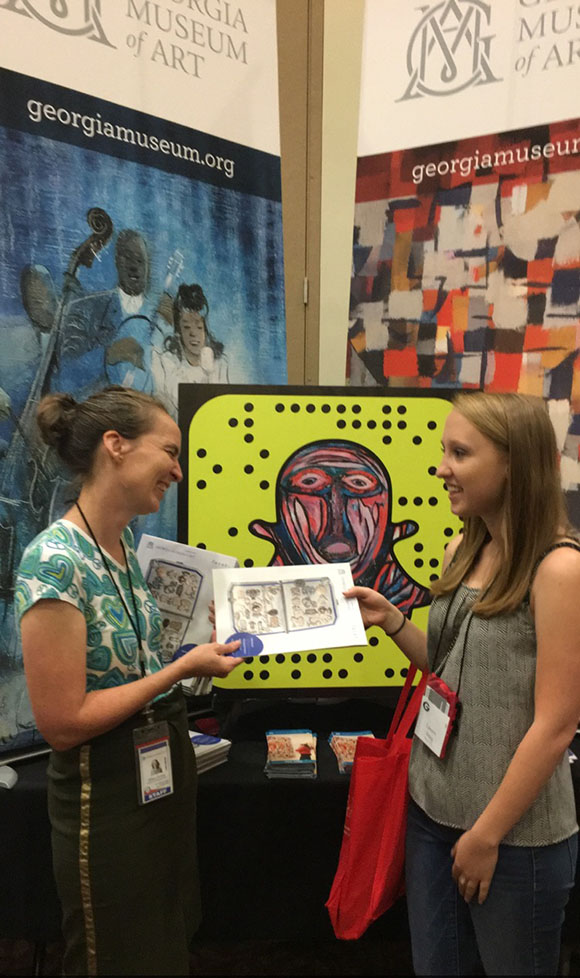
Over the summer, eager “baby dawgs” and their parents pour onto the University of Georgia campus for their first official look at the life of a college student: Freshman Orientation. Recognizable by their red lanyards, nametags and red tote bags, the soon-to-be UGA students walk into the Grand Hall at the Tate Student Center to learn about all of the new opportunities the university has to offer. 

UGA Orientation with student
Lawson Boling (right)
Bright and early twice a week, the museum’s communications team and I head to the Tate Student Center for UGA Freshman Orientation. We grab our cart of supplies from a meeting room, ride the elevator to the fifth floor and make our way to table number 25 in the Grand Hall. Ten minutes later, the Georgia Museum of Art table is ready to go.

We stand at attention and either greet students or let them approach us. Accompanying our table are two large banners, a large display of the museum’s Snapcode for Snapchat and an abundance of brochures and publications. When one of us catches the eye of a parent or student, a simple “Hi, how are you doing?” draws them to the table.

Once I have sparked their interest, I hand them a museum brochure or a copy of Facet, our quarterly publication, then give them a quick rundown about the location, current and upcoming exhibitions, the opportunities for students and the fact that entry to the museum is free (which tends to be the most surprising part).

My favorite, yet most challenging, part of this experience is to call out “Follow us on Snapchat!” to the students passing by the museum’s orientation table. I will either get a laugh and some sincere interest, or be blatantly ignored. The museum team gets a good kick out of it, but it works.

All in all, being present at UGA’s Freshman Orientation has been great. If the new freshmen and their parents did not know the museum existed before, they do now. We have met many parents at orientation with interest in our collection, exhibitions, opportunities for their child or children and questions about that strange poster in the middle of our table. The incoming students love the Snapchat poster and show enthusiasm for opportunities for student involvement at the museum.

Morgan Tickerhoof
Public Relations Intern

Thursday, July 14, 2016

Volunteer Spotlight: Linda Chesnut Receives 2016 Smitty Award

Linda has chaired the museum’s Decorative Arts Advisory Committee (DAAC) since 1999, and she has been a tireless advocate for the power of the decorative arts. Every year, at the annual meeting of the Friends of the Georgia Museum of Art, one special person receives the M. Smith Griffith Volunteer of the Year Award (the Smitty, for short). In 2016, the award committee, which is made up of Friends members and Friends board members, was astonished to discover from nominations by staff that Linda Chesnut had never received the award.

Linda Chesnut with Dale Couch, curator of decorative arts
Linda has chaired the museum’s Decorative Arts Advisory Committee (DAAC) since 1999, and she has been a tireless advocate for the power of the decorative arts. Her contributions as its leader have helped the Henry D. Green Center for the Decorative Arts grow into a regional and national voice in the field. Linda is always willing to write a letter, make a phone call, donate a treasured object or talk another collector into doing so. She is both strategic in her aims and unafraid of doing the nitty- gritty grunt work that often needs to take place to ensure lofty goals become reality.

Linda’s leadership is a huge part of the Green Center’s success. In previous years, she received both an award for volunteerism from the Georgia Association of Museums and Galleries and the Governor’s Award for the Arts and Humanities, presented to her by Governor Nathan Deal. She has lent her time and efforts to the DeKalb County Historical Society, the Georgia Archives, the Georgia Trust and alumni groups from regional colleges and universities, as well as to our museum, and they are equally appreciative of her hard work.

Upon hearing that she had won the 2016 Smitty, those DAAC members who were unable to attend the annual meeting chimed in with enthusiastic congratulations via email, repeatedly using the word “gracious” to describe Linda’s manner and leadership style. It is that willingness to yield the spotlight and focus on the mission of the museum rather than on herself that makes Linda Chesnut a most deserving addition to the list of those volunteers who have received the Smitty.

Thursday, July 07, 2016

Pardon the Mess: Reinstallation of the Permanent Collection

Five years ago, the Georgia Museum of Art opened a wing dedicated to its permanent collection as part of a large expansion and renovation project that also added the Jane and Harry Willson Sculpture Garden, enlarged the museum’s public spaces and expanded storage. On stark white walls, the museum laid out highlights from its American and European collections, including many old favorites. It was clean. It was fresh. It was something new for us.


But 5 years is a long time. Since January 2011, we have welcomed hundreds of thousands of visitors into those galleries, our curatorial staff has changed and expanded, and our collection has grown by about 25 percent. We have new priorities and new visions. It’s time for us to shed our old skin in favor of a new one. This August, after a two-month closure of the eight galleries on the south side of what the staff still call the “new wing,” we will reveal a reimagined look at our permanent collection. The white walls will get some colored paint, and removable walls will create defined spaces within the galleries. We’re doing away with the hard line between American and European artists, partially because it feels somewhat arbitrary (where would you put Mary Cassatt?) and partially because incorporating them all into the same art historical timeline just makes sense.

One thing we’ve realized in the past 5 years is that many of our visitors are first-timers not only to our museum but to any museum, which means that we need to do a better job of explaining why particular works of art are grouped together. If you have an art history degree, it’s not hard to recognize a wall of American impressionist paintings, but if you don’t, you may not understand why our Paul Revere spoons are next to 18th-century portraits. New wall text will make these connections clear, and new labels should be easier to read for everyone.

Inclusivity is a buzzword in the museum community these days, but in our position as the official state museum of art, we feel very strongly about its value to what we do. If you feel unwelcome somewhere, it is unlikely you will come back. To develop and diversify the next generation of museum lovers, we need to meet them where they are, not where we wish they would be.

Are you worried that your favorite painting is going into storage? You probably don’t need to be. Although works will be shifted around among galleries, the most well- known ones will still be on view. More works by African American artists, especially those from the collection given by Brenda and Larry Thompson in 2012, will join the story, creating a richer narrative of art history. The museum also has an especially strong collection of works on paper, and more prints, watercolors and photography will be on display. Though these fragile, light-sensitive objects cannot stay on view for as long as hardier oil paintings or works of decorative art, the upside of having a regular rotation is that the look of the galleries will change frequently, rewarding return visitors with new discoveries.

Check in with us through our Tumblr and other social media for updates on our progress, and we hope you’ll enjoy the results.

Hillary Brown
Director of Communications

Thursday, June 30, 2016

New Acquisitions: "Patchwork/Terry" by Sam Gilliam


Created by abstract painter Sam Gilliam in 1980, “Patchwork/Terry” was commissioned by Rita Curran Morgan, Teresa Friedlander’s mother, as a college graduation gift for her daughter, whom she called “Terry.” Teresa has enjoyed this work for over three decades and, through her generous gift, has extended this opportunity to countless new visitors to the Georgia Museum of Art, in memory of her mother. Morgan was an administrative assistant to Gilliam and his wife, Dorothy, during the late 1970s and early 1980s.

Gilliam is a significant figure in the development of abstract color field painting. A prolific painter currently active in the Washington, D.C., area, Gilliam gained initial recognition in the late 1960s for his large and colorful, unstretched — or “draped” — canvases. In the 1980s, his techniques included putting large pieces of canvas on the floor and pouring or throwing acrylic paint on them to build thick layers. The artist then used a rake, broom or fingers to move the paint to add texture and reveal the various colors. When the canvases dried, Gilliam cut them into geometric shapes and pieced them together into three-dimensional paintings over polygonal wooden stretchers, as with “Patchwork/Terry.” Here, Gilliam exposes its painted edges, suggesting spatial qualities akin to sculpture, with the work itself appearing as colorful, textured fragments reminiscent of quiltmaking.

Shawnya Harris
Larry D. and Brenda A. Thompson Curator
of African American and African Diasporic Art

Thursday, June 23, 2016

Can’t Get Enough of the Georgia Museum of Art? Join Us on Snapchat!

This week we’d like to share our Georgia Museum of Art Snapchat account with you, where our staff posts daily, behind-the-scenes pictures and videos from museum life. We are proud to be the third museum in the nation to acquire a Snapchat and are excited about exploring this platform further as a way to stay in touch with art lovers in the Athens community and beyond.

Point your phone at this image, this is our unique Snapcode.
For the uninitiated, Snapchat is a smartphone application that allows users to post updates of their life that only stay online for 24 hours and show other users how they have experienced their day. We use our Snapchat account to inform our followers about events, exhibitions and exciting developments. For example, our past snaps have included videos of the preparatory crew putting together an exhibition in the museum galleries, a photo series about current pieces on display, videos of group tours and other related art-lifestyle posts.

Snapchat comes as the newest addition to the museum’s growing social media presence that currently includes Facebook, TwitterInstagram and this blog.

To add the Georgia Museum of Art to your Snapchat, open the Snapchat app and point your Snapchat camera at our unique Snapcode, which is shown here in the blog post. Then tap the screen. Your app will register the museum’s account and you can start viewing our content immediately. Alternatively, you can follow the museum by adding our username, @georgiamuseum, directly in the app.

Madison Bledsoe
Public Relations Intern

Thursday, June 16, 2016

The Museum Installs Public Art: The Do Good Fund Teen Photography Workshop


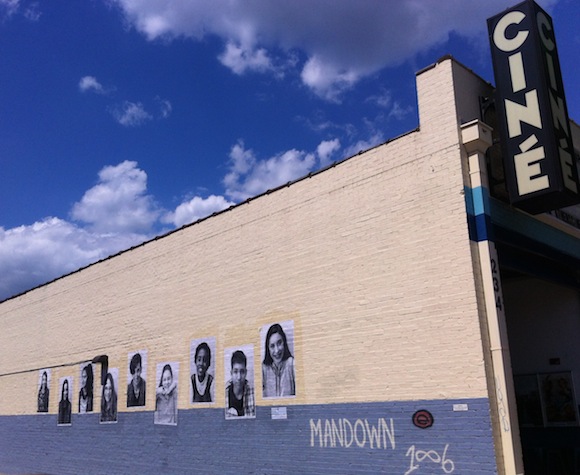
Last Tuesday, June 7, two educators, one preparator and an intern from the Georgia Museum of Art took a break from the galleries to install a new exhibition on an exterior wall of Ciné, the local community-based cinema and arts venue in downtown Athens, Georgia (234 W. Hancock Avenue). This installation is the culmination of the Do Good Fund Teen Photography Workshop, in which a group of local teens learned about the art of photography through the Do Good Fund's exhibition of photographs by Southern artists. In response, the young artists created work to influence community engagement. In conjunction with Inside Out, a worldwide outdoor photography project, the display of eleven teen portraits honors the contributions of young adults to our community’s well-being.

Time-lapse video of the installation by Larry Forte

At the museum, we pride ourselves in preserving works of art to ensure their long existence for the public. For this outdoor installation, we faced a number of challenges that rarely threaten an exhibition indoors. The final large-scale photographs were printed on paper and adhered to the public wall space with a homemade wheat paste made from a mixture of flour and water. Although we always understood this installation was ephemeral and to last for one month, torrential rain and wind quickly disintegrated many of the photographs in just one week, with only two photos managing to stay intact.

But not to fret. The damaged work will be replaced in time to celebrate teen artists at the Athens Farmers Market on Wednesday, June 22, across from Ciné at Creature Comforts from 4 to 7 p.m. The public is invited to create their own self-portrait and continue the young artists’ message that, together, we add life to the Athens community in all of our beautifully individual ways.

Brittany Ranew
Education Program Specialist

* * *

We are the next wave of thinkers, inventors, and astronauts; the ones who will make Athens proud. We are curious, brave, active, smart, shy, busy, loving, daring and different in many ways. We are the quiet ones with books under desks, the bold ones who stand up for what's right, and some of us aren't quite sure who we in are yet.

In these photos you can see our origins our eyes. 
Together, we add life to the Athens community.


Artists on view (from left to right): Piper, Crystal, Savannah, Eva, Stacy, Jessa, Kamron, Annesly, Tina, Umberto and Angelina

Contributing artists: Don, Madison, Michael and Sofy

Thursday, June 09, 2016

The Georgia Museum of Art and Museums for All

On April 14, 2016, the Georgia Museum of Art at the University of Georgia became the first museum in the state to commit officially to serving low-income families through the Museums for All program. Organized by the Association of Children’s Museums and the Institute of Museum and Library Services (IMLS), Museums for All encourages families of all backgrounds to visit museums regularly and build lifelong museum habits. A study featured in the New York Times concluded that “visiting an art museum exposes students to a diversity of ideas that challenge them with different perspectives on the human condition.” The study showed that students who visited Crystal Bridges Museum of American Art on school tours “demonstrated stronger critical thinking skills, displayed higher levels of social tolerance, exhibited greater historical empathy and developed a taste for art museums and cultural institutions.” In addition, “most of the benefits … observed are significantly larger for minority students, low-income students and students from rural schools.”

Young visitors examine a rare Japanese
three-paneled screen at the Georgia Museum of Art.
With Museums for All, museums with an admission charge offer reduced or free admission to visitors who present an Electronic Benefits Transfer (EBT) card. The Georgia Museum of Art is pleased to join this group of institutions. As part of the state’s flagship land-grant university, the museum has a strong commitment to service and outreach and already offers free admission to all visitors, thereby removing the need to present a card or an ID. About 15 percent of families living in Athens-Clarke County have incomes below the poverty line. By participating in Museums for All, the museum hopes to make low-income visitors aware of this fact and further broaden and diversify its audience.

“I’m pleased to welcome the Georgia Museum of Art into the family of Museums for All participants,” said IMLS director Dr. Kathryn K. Matthew. “As the first museum in Georgia to sign on to the program, the Georgia Museum of Art is leading by example. Through its community outreach and Museums for All participation, the museum will establish its credentials as a true community cornerstone that is accessible to all.”

A full list of participating institutions is available at http://childrensmuseums.org/participating-museums.

For museum hours, location and directions, visit our website.

Hillary Brown
Director of Communications


Thursday, June 02, 2016

"Turned and Sculpted": Wood Art Photography by Michael McKelvey

Hot off the press is the catalogue for the museum's spring exhibition "Turned and Sculpted: Wood Art from the Collection of Arthur and Jane Mason," on display from May 14 to August 7. The exhibition features 30 objects, all made entirely of sculpted wood, by some of the most renowned contemporary artists in the form. The word “turned” in the title of the exhibition reflects the fact that many of the artists used a lathe to sculpt the wood, rotating the material on its axis to create a symmetrical, rounded form.

For the catalogue photography, capturing the intricate textures of wood and the three-dimensionality of wood art poses a unique set of challenges, and photographer Michael McKelvey has done an exceptional job in conveying the tactile nature of the wood sculptures as well as their beauty. Assistant registrar Sarina Rousso, who was present at the photography shoot, said, "I've been working with Michael for about ten years and during all this time it's still an honor to assist someone with such a keen eye for detail and a great appreciation for all art mediums. Some of the bowls were 'tricky,' as he put it, to honor the true piece and deal with the high gloss, but I think he was quite successful!"

Watch the video below for a look at the photographs featured inside the publication.


Thursday, May 26, 2016

Schedule Your Group's Art Adventure Today!

In the summer, hundreds of young children bring their ideas and creativity to the Georgia Museum of Art for the program Art Adventures. Originally an outreach program called Art Excursions, the program grew into what it is today: a free in-house art experience for community organizations, day care centers and summer camps. Carissa DiCindio, curator of education, has worked with the program since its onset and said, “Art Adventures has always been one of my favorite programs because we are able to reach a wide group of children in the community, from preschool students to teens, and engage them in the museum with gallery and studio activities that are a lot of fun.”


This June and July, Art Adventures will examine contemporary art created at the Mixografia Workshop, a collaborative studio established in 1968 in Mexico City and now based in Los Angeles. In the Mixografia studio, invited artists create three-dimensional prints and use experimental techniques to create handmade paper in relief. Our 90-minute Art Adventure program includes a tour of the exhibition “Paper in Profile: Mixografia and Taller de Gráfica Mexicana” with trained museum guides. Children will investigate the galleries through games that promote close looking and inquiry with museum educators and UGA students who volunteer as education interns. Each participant will also have the opportunity to create a work of art inspired by the exhibition to take home.

Reservations for Art Adventures 2016 are now being accepted. Morning (10–11:30 a.m.) and afternoon (1–2:30 p.m.) time slots are available every Wednesday and Thursday from June 8 to July 28. Each 90-minute session can accommodate up to 30 children, with one chaperone for every 10 children. To schedule your group’s Art Adventure, contact Brittany Ranew at branew@uga.edu or 706.542.0448.

Thursday, May 19, 2016

On View: "Refining Realities" by VolvoxLabs

VolvoxLabs is a new media design studio run by Kamil Nawratil, Pa Her and Javier Cruz. “Refining Realities” was created in conjunction with VVOX collaborators, Ryan Kilpatrick, Zyia Zhang and Mariusz Navratil, Kamil’s father. Today’s post is written from the perspective of Benjamin, our Department of Publications intern, about the installation currently on display through June 19 on the Patsy Dudley Pate Balcony.

VolvoxLabs, Refining Realities, 2016
As an art student at the University of Georgia, I particularly enjoy delving into the complexities of obscure and intellectually challenging works of art such as “Refining Realities.” In this case, I find it fitting to address the installation through the lens of an individual’s evolving experience. Through this personal journey to find meaning in the work, I hope to explicate paths of understanding to emotionally connect with an installation with a life as complex as our own.

The jarring complexity of “Refining Realities” overwhelmed me, and I was so absorbed by theory that I lost sight of the underlying themes. With Kinect sensors placed above each screen, it was easy enough to understand that my interaction with the installation was significant, but the odd patterns only seemed to quiver in response to my sporadic, and sometimes embarrassing, movements. I felt powerless to really manipulate the images even though I knew they were dependent on my actions, but I slowly realized my movements were being dwarfed by a greater influence. Real-time data drawn from undisclosed locations (randomized every 15 minutes) supplies changes in temperature, wind values and cloud coverage; in reaction to these observations, the installation undergoes multiple shifts that add up to a grand, emotional metamorphosis. For instance, when wind speed increases, the LEDs become more energetic. When the temperature rises, the LEDs turn pink. Similarly, when the warm sun begins to shine through the clouds, the ambient music sounds more optimistic and all the panels seem to resonate with a renewed sense of vitality and energy. Upon this enlightenment, I realized it wasn’t just me that was subtly influencing the installation, it was also the fleeting characteristics of the environment that were subtly influencing me through the installation. Additionally, not knowing where the real-time weather data came from universalized that sensation, as though I was being affected by the entire world as a grand idea.

As hinted at by the title, the installation is designed to reduce and repurpose what its sensors describe to it, and this is where “Refined Realities” became increasingly perplexing to me. The way the screens react is simple enough, but the complex, formal mathematical algorithms used to fabricate the initial pattern, followed by the synthesis of the pattern with live data, are something on the forefront of technology. In fact, the computational demands were so extraordinary that the Kinect sensor above the central panel is no longer in place due to limited processing capacity. Several of the monitors were assigned a Voronoi system. Most simply, Voronoi systems are shapes created by the space closest to a particular point on a plane. For clarity, each line in the image below marks locations that are equidistance between a black dot and its closest neighbors, and the space within those lines represent the locations which are closest to the black dots.

Voronoi systems are important because the approximation is useful in understanding complex distributions in real life, such as your very skin’s cells. And that is part of the point of “Refining Realities”: to manifest the forms and patterns underlying life. When I move along the installation, I am reduced to become part of the image, and because of the way it “refines reality,” I am assimilated into the environment. With this came a humble feeling of oneness with nature and art, a wondrous insight into my connection with the surroundings.

After gaining more understanding of the content within the screens, I sought an understanding of how the digital realities presented by the screens related to the intricate frame surrounding them. Most noticeably, the hexagonal patterning created by the Voronoi diagrams and the wave pattern in the central screen is echoed in the frames. I originally perceived it as design for the sake of cohesion, but I later considered it a comment on the difference between the digital and the physical. I began to think about our digital age and how our realities have become increasingly distanced from the physical world. Even as I write this, I consider the intangibility of my words and their loose representation of something real. Here, the environment being monitored is only a digital suggestion of reality, while the frame establishes a connection to the physical environment of the museum. There is also a contrast between the depth created by the frame and the illusion of depth established by the line drawings of Mariusz Navratil. I later learned that the line drawings were spontaneous responses to the forms of the frame, including the shadows the frame casts on the wall. Whether geometric versus organic, digital versus physical or real versus illusion, “Refining Realities” addresses many characteristics of what constitutes our surroundings.

Still, the prevailing influence remains the transitory emotions created by the dynamic environment, and as I tried to dissect my role as viewer in the work, I abandoned my thoughts and surrendered to the influence of how it made me feel. I can get caught up in the idea that art is meant to cater to the viewer, but “Refining Realities” was independent; it became a meditative experience to consciously allow myself to be influenced. Much as the undisclosed source locations were reduced to data points for this installation, I felt reduced by the Kinect sensors until the landscape and I merged into an engulfing singularity on the screens. Some abstract and baffling forms, at once stupefying and unwelcoming, began to take shape as the most poetic reduction of life itself. Sometimes, I irrationally convince myself that I’m some sort of entity outside the system, but my inevitable influence on the environment and the environment’s influence on me inundated my self-centeredness until I felt a sort of engrossing oneness that simultaneously diminished my concerns and assimilated my being into a greater entity of existence.

Benjamin Thrash
Publications Intern