Thursday, May 25, 2017

Highlights from the Permanent Collection: “White House — Summer” by Maurice Prendergast

As summer comes upon us, we highlight “White House  — Summer” by Maurice Brazil Prendergast. Born in Canada and raised in Boston, Prendergast was greatly influenced as an artist by French Impressionism, Paul Cézanne, the decorative patterns of the French post-Impressionist Nabis and Fauvism. Prendergast studied at the Académie Julian and at the Académie Colarossi in Paris during the early 1890s. In 1898, he traveled to Italy, visiting Siena, Florence, Rome, Capri, and Venice. In 1908, he participated in the exhibition of the Eight at Macbeth Gallery in New York — a display of eight “independent” artists organized by Robert Henri following his dismissal from the National Academy of Design. Prendergast served on the organizing committee of the Armory Show of 1913, and seven of his paintings appeared in the exhibition, which introduced Futurism, Fauvism, and Cubism to a mass U.S. audience. Prendergast’s works are in the collections of many major institutions, including the Metropolitan Museum of Art, the Whitney Museum of American Art, the Smithsonian American Art Museum, and the Museum of Modern Art, New York.

Maurice Prendergast, White House – Summer, ca. 1910–13
Like many of Prendergast’s large oil paintings and watercolors dating after 1910, “White House — Summer” depicts leisure in a modern and idyllic New England landscape populated by young women. In the immediate foreground, two females adorned in green and yellow converse with each other while a third woman, in pink, reads while strolling. Prendergast communicates the vibrancy of the day and the lush vegetation of midsummer through rich, broad brushstrokes in various shades of green. Billowy pink and white clouds fill the azure sky. In “White House — Summer,” Prendergast juxtaposes “old” New England with the industrialization of the region by visually linking a vertical cypress with a factory smokestack in the distance.

Artist and critic Walter Pach, Prendergast’s friend and a supporter of American modernism, published a tribute to the artist in 1922: “When he comes nearest to creating a new world in his joyous fancy of a summer all of light — clear and radiant. His picture is real for us and consonant with our experience: a thing in harmony with the law that we are conscious of in all art, even though we are never able to formulate it.”

Adapted from “One Hundred American Paintings” by Paul Manoguerra

Thursday, May 18, 2017

Martin Johnson Heade and Cherokee Roses

Beginning June 3, the Georgia Museum of Art at the University of Georgia will present the exhibition “The Genius of Martin Johnson Heade,” organized by the Museum of Fine Arts, Boston. Although the exhibition includes landscapes, seascapes and Heade’s trademark paintings of tropical birds and flowers, it does not include any of his Cherokee Rose images. The Cherokee Rose (Rosa laevigata) is the state flower of Georgia.

To remedy this situation, Mrs. Deen Day Sanders, a noted art collector, gardener, philanthropist and Georgian, has agreed to lend Heade’s painting of two Cherokee Roses to the museum, along with four other works by Heade. Mrs. Sanders’ paintings will make up a small supplementary exhibition, on view the same dates as “The Genius of Martin Johnson Heade.”

Martin Johnson Heade, Cherokee Roses, n.d.
Nearly forgotten for the first part of the 20th century, Heade’s paintings were rediscovered around World War II and Heade is now recognized as one of the most important American painters of the 19th century. His works are in the collections of many major museums, including the Museum of Fine Arts, Boston, which has the largest public collection of Heade’s paintings.

Botanical illustration of the 
Cherokee Rose engraved by 
Pierre Joseph Redouté (1759–1840).
Image: New York Public 
Library Digital Collections 
Heade devoted equal time to landscape, marine and still-life subjects, but is best known for his studies of tropical birds and flowers. He began painting still lifes of flowers native to the southeastern United States when he moved to Florida, in 1884. Heade’s paintings of magnolias (two of which are included in the MFA Boston’s exhibition) date from the same era.

T.E. Stebbins, author of the catalogue raisonné on Heade, writes, “These paintings of Cherokee Roses . . . have a lushness and an aggressive confidence that far surpass [Heade’s] accomplishment in landscape during the same years and are more successful than those of northern roses in the same setting.”

Mrs. Sanders will also lend Heade’s paintings “Apple Blossoms,” “The Meadow,” “Still Life with Glass of Roses” and “A Red Rose” from her collection.

Sarah Kate Gillespie, the museum’s curator of American art, said, “The loan of these important works from Mrs. Sanders beautifully augments the pieces in the MFA Boston’s exhibition, as they feature Heade’s other well-known floral subjects: the rose and the apple blossom. The rose in particular was a significant subject for Heade, as he painted both the red rose and the Cherokee Rose more than any other American artist in the 19th century, and we are thrilled to be able to share these works, as well as the meticulously rendered landscape, with our visitors.”

Hillary Brown
Director of Communications

Thursday, May 11, 2017

New Acquisitions: "Minnehaha" by Edmonia Lewis

Edmonia Lewis, Minnehaha, 1868
The museum recently purchased a significant 19th-century neoclassical work with funds from the Collectors of the Georgia Museum of Art. “Minnehaha” is a petite marble sculptural bust carved by artist Mary Edmonia Lewis (1844–1907). Born in Greenbush, New York, Lewis was an artist of mixed African American and Chippewa (Ojibwe) ancestry who was among the few female artists to have worked actively in Rome, Italy. Prior, she studied at Oberlin College in Oberlin, Ohio, and then moved to Boston. She gained a following there creating busts of prominent anti-slavery activists. Lewis also often portrayed American Indian subjects.

In Rome, Lewis produced several commissioned busts of prominent abolitionists and biblical and mythical figures. She was also known for her American Indian subjects drawn from the popular literature. Henry Wadsworth Longfellow’s epic poem “The Song of Hiawatha” (1855) inspired her to produce several figural groups, of which “Minnehaha” is an example. In Longfellow’s fictional poem, Minnehaha, a Dakota, was the lover of Hiawatha, a warrior among the once enemy nation of the Ojibwe.

Unveiling of "Minnehaha" as part of the annual Black History Month dinner.
This Minnehaha bust represented a rare opportunity to acquire a quality sculpture by this 19th-century pioneer. The purchase fills a major gap in the collection for both American and African diasporic artists who worked in the U.S. and abroad.

Shawnya L. Harris
Larry D. and Brenda A. Thompson Curator of
African American and African Diasporic Art

Thursday, May 04, 2017

“Kristen Casaletto: The Past is Never Dead” and Contemporary Art

The exhibition “Kristen Casaletto: The Past is Never Dead” opens this Saturday, May 6, and will be on view through Sunday, July 30. The exhibition highlights the works of Kristin Casaletto, a contemporary artist based in Augusta, Georgia, and features many of her prints as well as one three-dimensional object.

Kristen Casaletto, Apocalypse, 2008

Casaletto’s work deals with contemporary American culture and identity by combining visual motifs from both the past and the present. She draws upon a historic and mythic past, employing a complex iconography of American images and ideas. Through these means, she produces an allegorically imagined exploration of life in the 21st century. The title of the exhibition comes from a quote from William Faulkner: “The past is never dead. It's not even past.” Like Faulkner, Casaletto’s work insists on the overwhelming impact of the past on the present.

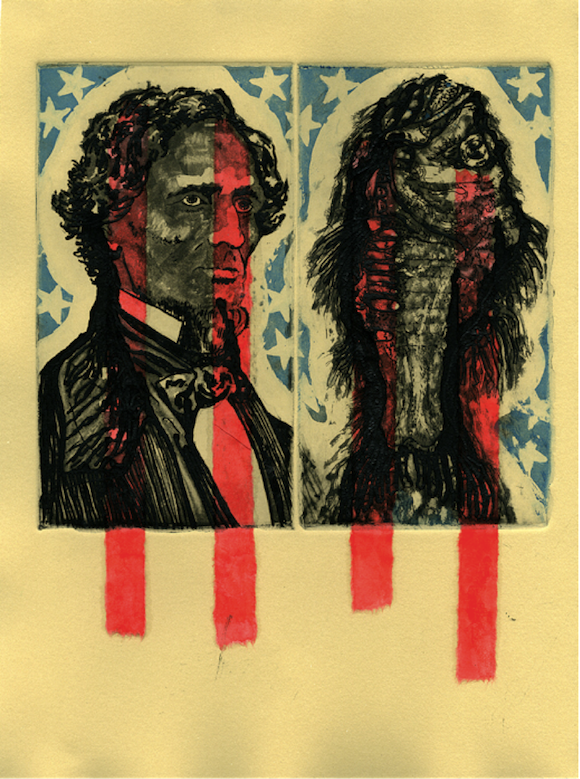
Kristen Casaletto, Lost Cause: Jefferson Davis / Dead Fish, 2010

“Lost Cause: Jefferson Davis / Dead Fish” (not featured in the exhibition but shown here) exemplifies this idea. The piece currently belongs to the collection of the Georgia Museum of Art and was released in Casaletto’s “American Parable” series. The color etching features a depiction of the president of the secessionist Confederacy, Jefferson Davis, next to a dead fish, all embedded within the stars and stripes of the American flag. By positioning the visage of Davis and the form of the dead fish in parallel arrangements, Casaletto introduces a strong juxtaposition of imagery. By doing so, she presents a work open to multiple interpretations. The composition might emphasize Jefferson Davis’s now obsolete position in American culture — like that of a dead fish — while still reinforcing the way in which certain ideas and symbols become a part of a grander cultural narrative. The Confederate States of America, to most a dark part of American history, still looms large in the narrative of the American South. The stars and stripes of the American flag emphasize the role of America’s dark past in its current culture. There are many layers of allusion to the piece, each enhancing its referentially rich yet semantically ambiguous wealth of iconography.

Kristin Casaletto is a quintessential contemporary artist, which we tend to think of as an artist living and working in the 21st century. By nature, contemporary artists are engaged with the present and its cultural dialogue. They often look to current issues in their society and produce art that is engrossed in these problems. Contemporary art in the greater historical context is also defined by a lack of overarching narrative or stylistic form between artists. In other words, there is no singular, cohesive way of producing art but rather a diverse mix of individual practices. For visitors, “Kristen Casaletto: The Past is Never Dead” is an opportunity to contemplate the complex politics of the past and where we are today.

Jamie Brener
Publications Intern

Thursday, April 27, 2017

Art+Feminism’s Wikipedia Edit-a-thon at the University of Georgia

Art+Feminism aims to improve the representation of female
artists on Wikipedia. Image: Museum of Modern Art

Art+Feminism is a global initiative that aims to improve the representation of female artists in articles on Wikipedia through Edit-a-thon events. In March of this year, the Lamar Dodd School of Art and the Georgia Museum of Art at the University of Georgia partnered to sponsor an Edit-a-thon here in Athens. An Edit-a-thon is a community-based event that instructs people on how to edit, improve or create new articles on Wikipedia. Since Art+Feminism was founded in 2014, events like these are held worldwide every March and have resulted in the creation or improvement of over 4,600 Wikipedia articles.

Art+Feminism logo. Image: Art+Feminism
This global effort was prompted by the release of some troubling statistics. According to a 2012 editor survey conducted by the Wikimedia Foundation, just 10% of Wikipedia editors are female. This gender imbalance means that although this online encyclopedia is open to the public for editing, that doesn’t necessarily mean it is representative of the population at large. The skewed editorship has a great effect on the content produced. Editors naturally choose to work on subjects they’re most familiar with, and in art history, this often results in neglect for already-underrepresented female artists. Many female artists have pages that lack sources and crucial information, and many more female artists don’t have a page at all.

Additionally, most Wikipedia editors live in the Global North (the richer, more developed region of the globe), resulting in a website tilted towards one perspective. According to Adeline Koh and Roopika Risam of Post-Colonial Digital Humanities, "Wikipedia reproduces forms of knowledge already implicit in older forms of print knowledge, in which marginalized groups (see: not white, poor, female, queer, disabled) are considered less worthy of representation." The skewed perspective inherent to the existing editorship of Wikipedia has a direct impact on the content that is produced, and the content produced has a direct impact on public perception.

The reproduction and propagation of these biases is dangerous on a site as widely used as Wikipedia. According to a survey conducted by the Pew Research Center, as of May 2010, 53% of Internet users look for information on the site. This shows that U.S. adults (in 2010) used Wikipedia at a significantly higher rate than sites like Instagram, Twitter, Facebook and LinkedIn. This gives Wikipedia a large amount of authority in conveying information online, so when women are left out of its pages, it influences what people perceive to be meaningful subjects to learn and discover.

Elizabeth Jane Gardner, La Confidence, ca. 1880

This is where Art+Feminism comes in. The organization aims to tackle the gender gap on Wikipedia by encouraging new editorship amongst people of all gender expressions and identities. The Edit-a-thon held in Athens included the participation of several volunteers who had little to no experience editing Wikipedia and who, by attending the event, now have the skills to continue editing pages on the website. Effectively, the events have lasting impact beyond the month of March, as new editors are equipped and inspired to combat the male perspective on Wikipedia and to give due representation to female artists.

This event held by the Georgia Museum of Art and the Lamar Dodd School of Art was preceded by a brief tour highlighting works by female artists in the museum. In terms of square footage, the Georgia Museum of Art features a proportionately large amount of female artists. The Jane and Harry Willson Sculpture Garden, for example, only features work by female artists. The space most recently held the exhibition “Driving Forces: Sculpture by Lin Emery,” which are works by the New Orleans–based sculptor. Indoors, “La Confidence” by Elizabeth Jane Gardner is a painting from the permanent collection that was also highlighted on the tour. It features two modest, youthful women sitting and exchanging a secret. Despite the efforts of institutions like the Georgia Museum of Art, the historical exclusion of women from the art world still results in a proportionately low representation of female artists. This makes events like the Wikipedia Edit-a-thons all the more important. Art+Feminism recognizes that mobilizing female editorship on Wikipedia will have lasting effects on biases against female artists.

Jamie Brener
Publications Intern

Thursday, April 20, 2017

New Acquisitions: "Shad, Altamaha River, Georgia" by Warren Cushman

Warren Cushman, Shad, Altamaha River,
Georgia
, 1895. Oil on canvas.
As Earth Day approaches, we reflect on this new acquisition, which touches upon the subject of the ecology of Georgia’s rivers. Through the generosity of Greg and Jennifer Holcomb, the Georgia Museum of Art reeled this work in to its permanent collection. The image is of a shad fish. By the time Warren Cushman painted this image in 1895, the fish may have been something of a rarity, for the shad species had disappeared in the upper waterways of the state, though it played a significant role in the human experience of Georgia, from prehistoric times into the late antebellum period.

Shad fish had been a prominent part of the food culture for early American Indians as well as later settlers. Interestingly, Athens was found to be an attractive settlement site in part because the Oconee River had a “shad run,” but by 1807, the Augusta Chronicle reported that the shad had ceased to “run” on the upper Oconee River. By 1812, the Georgia legislature tried to secure open rivers as part of some of the first environmental legislation in this region. Writing in 1877, W.L. Jones observed the radical demise of various species of Georgia fish: “It is lamentable fact that our food fisheries are so rapidly decreasing in numbers, and, unless the State, in a few years, shall take the matter in hand, and resort to artificial propagation to replenish our nearly exhausted streams, our grand children will have to refer to a book on Natural History to ascertain the kinds of fish upon which our fathers fed so bountifully on.”

Books of natural history were created from works of art such as this depiction, a visual description designed to catch the observable physical characteristics of this species. Cushman’s work, however, also betrays a genre of decorative still life. Within the image, he uses decorative wood “graining,” a technique used to simulate either wood on nonwood surfaces or expensive woods on cheaper ones. While Georgia’s children can now have a shad fish image to view, thankfully they are not restricted to it. Ecological restoration to Georgia’s rivers has since resulted in increased runs of shad. Happily, objects like this one point to cross-disciplinary study and collaboration, one of our sustained educational goals. We extend our appreciation to the Holcombs for their generosity in making this gift.

Dale L. Couch
Curator of Decorative Arts

Thursday, April 13, 2017

Spotlight on Studio Workshops: Q&A with Instructor Heather Foster

Open to artists of all levels of experience as well as new artists, “Studio Workshop: The Human Figure” is a month-long series of two-hour studio sessions focused on the human figure. The workshop runs Thursdays at 6:30 p.m. from May 4 through May 25. Led by Heather Foster, an Athens-based alumna of the UGA MFA program, students will try their hand at gesture drawings, paper shadow portraits, live model drawings and abstracted paintings. The sessions will also draw inspiration from examples of figurative works in the museum’s collection, including works from the archives not currently on display.

For this week’s edition of “Holbrook’s Trunk,” we caught up with Heather to learn more about the upcoming workshop and about her work as an artist.

1. What are some of your favorite works at the Georgia Museum of Art?

“The Playground” tempera painting by Paul Cadmus is my absolute favorite. I love the grotesque look Cadmus gives his characters. Something about their rigid postures and caricatured physiques — wilted and gangly, round and protruding, beady-eyed, dog-eyed — reminds me of Byzantine and Romanesque figures. Like these medieval draughtsmen, Cadmus is more concerned with the spirit behind the corporeal vessel; the spirits he portrays aren't the austere, ethereal sort, but comic, lewd and humane. In “The Playground,” Cadmus’s invasive attention to texture, the infinitely gritty bricks, and the opalescent skin of the pale, butt-rubbing protagonist wraps Cadmus's imaginative take on human characters with uncanny tangibility. 

Paul Cadmus, The Playground, 1948
2. How does a visit to the museum inspire you as an artist?

For me, experiencing work in person is like an intimate conversation with a fellow artist. The indentations an artist makes with his or her pencil, the way paint absorbs or reflects light, the saturated, velvet surface of gouache or pastel, etc. do not translate through cellphone and computer screens. Apart from net art, or consciously digital media, which deftly navigates technology, physical artwork is much more eloquent in the flesh. Experiencing drawings, paintings or sculptures face-to-face hugely expands their vocabulary. The museum offers a guttural, communicative experience that reminds me why I make art. 

3. What are some of the pieces from the museums collection that you have selected to show in the studio workshop “The Human Figure,” and why did you choose these?

A lot of work that I have chosen for us to examine at the Human Figure workshop is sketchy, simple and obviously hand-wrought. I want to embolden participants by making it evident that figure drawing is an instinctual, responsive ability accessible to everyone. As a young artist, I was hugely intimidated by the human figure. However, I was forced to create gesture drawings under a minute for a community college art class. These rapid gestures did not give me the time to convince myself that I could not draw people. Discovering that I could create a decent gesture emboldened me — I have been drawing and developing my understanding for the human figure ever since.

With this personal experience in mind, I decided that we would study and emulate phenomena such as Alberto Giacometti’s searching lines in his lithographs “Annete” and “Derriere Le Mirior: Seated Woman.” Giacometti made mistake after mistake when studying his sitter, however, he eventually carved out a semblance of the person with his persistent marks. We will also be looking at figural studies by Richard Diebenkorn, Rodin and Lamar Dodd, along with Kathe Kollwitz’s tremendously emotive, yet palpably drawn prints.    

4. Is there something you are currently working on or are excited about starting that you can tell us about?

Studio instructor Heather Foster visiting the offices
of the Georgia Museum of Art
I am currently working on a series of line drawings called “Vanishing Mountains.” While studying Chinese silk paintings for an art appreciation that class I'm teaching, I was struck by the scholar painters. Rather than saying that he was going to paint for a session, a scholar painter said he was going to “write.” Also, scholar painters used a monochromatic black and white palette, stressing that painting ought not be encumbered with visual delights, such as color, but ought to be immediate, closer to the mind than the eye. Black ink was the scholar painter’s limit. What contemplative landscapes they produced with ink alone!

When making my own “Vanishing Mountains” drawings, I like to think that I’m writing too. I have confined myself to materials that are prescribed for creating documents, not art: ballpoint pens and printer paper. For me, using pen and paper activates a part of my mind that jots down the vanishing fragments of my dreams just when I’ve woken up. As with the Chinese scholar painters, my use of simpler material closes the gap between the mental and drawn image. My subject matter draws from my experiences at the Grand Tetons in Wyoming. Thanks to the experience volunteering as a docent at the Georgia Museum of Art, I was privileged to intern at the National Museum of Wildlife Art in Jackson Hole, Wyoming.

5. What do you read, listen to, or look at to fuel your work?

When creating, I love to listen to audiobooks and lectures on YouTube. The last book that I’ve listened to was “The Name of the Rose” by Umberto Eco. I am currently listening to World Science Festival panels — topics include black holes, holograms and multiverses.

6. What advice or words of wisdom have influenced you as an artist?

Atlanta-based artist Eric Mac told a group of us UGA artists to “keep your hands busy” — that’s been my mantra for now!

“Studio Workshop: The Human Figure” runs Thursdays, May 5 through 26, from 6:30 to 8:30 p.m. The cost of the course is a $15 materials fee, which covers all necessary supplies for the four sessions. Space is limited, call 706.542.8863 or email callan@uga.edu to reserve a spot.

Thursday, April 06, 2017

Introducing the 2017 Master of Fine Arts Degree Candidates

Every spring, as the cherry trees on North Campus begin to bloom and the school year comes to a frantic close, the Georgia Museum of Art has the pleasure of exhibiting the annual exit show for the Lamar Dodd School of Art’s master of fine arts degree candidates. This spring is no exception, and it is with much excitement that we present this year’s artists.

An accomplished group, many of these candidates have been exhibiting their work in galleries and shows across the country for the past few years. While it may be difficult to draw conceptual similarities between the pieces in the show, these candidates almost completely favor installation work. Drawing and painting appear not just on canvas, but are more often incorporated into video and sculpture. This move towards creating pieces that are tactile, engaging and 3-dimensional is indicative of current and upcoming trends in contemporary art practice.

Dan Ba Vu, Breathing Room, 2016. Wedged into tight spaces, the concrete overflows and bends to the rigid
structures that contain it, illustrating Dan Ba Vu’s experience assimilating to American culture as a child
immigrating to the United States from Vietnam. Photo: Michael Lachowski

From Meirav Goldhour-Shvorin’s interior designs wrought with special attention to the ways in which design can facilitate a safe, mindful and functional experience for those afflicted with post-traumatic stress disorder to Amanda Scheutzow’s grotesque, humorous monster sculptures crafted from disparate, thrifted objects, this show reflects the wide-ranging capabilities of this talented group of artists.

Conceptually rich pieces dominate the show, and Ellie Dent’s interest in themes of the body, the abject and pain as well as trauma are particularly thought-provoking. Dent cuts into surgical paper, inflicting wounds then stitching them with real medical tools. The wounds appear in various stages of healing, and within these cuts and sutures, Dent discovers danger, fragility, intimacy, repulsion and obsession. And as Dent slashes the body, Ariel Lockshaw slashes the land. She paints ravaged, empty landscapes in order to explore the way politics and the economy inform the way we view, use and exploit our surroundings. In her swirling representations of places and non-places, Lockshaw highlights the consequences of both man-afflicted and natural abuses.

Like Dent, Stephanie Sutton is incredibly interested in the body, and her own body appears as the subject in many of her pieces. Sutton simultaneously defends the fat body and employs it as an offensive measure; by doing so, she explores the complex societal associations attached to fatness. Her videos suggest that the fat body is a place where pleasure is indulged — the body then becomes a source of power and an expression of identity rather than a site of weakness.

In preparation for the exhibition, Reid Blechner installs his work 
In the Absence of Unproductive Fiction, 2017. Photo: Michael Lachowski

Thomas Bosse’s metalsmith work explores the lifespan of handmade metal objects. Much of his research involves keeping detailed logs and video recording the process; this leads to a comprehensive study of his process of creation. When viewing/interacting with his works in tandem with the videos that Bosse creates, the viewer can draw connections between an object, its past, and the artist’s hand. Found in the same gallery space are Zachary Harris and Jonathan Nowell. Harris’s work is made of concrete, marble and steel. His tactile approach to engineering appears in this mix of materials, and his formal arrangements are created with soft, sweeping shapes. Nowell’s work is comparatively rugged; his interest in vernacular architecture manifests in his work through objects such as deer stands, Home Depot tubs and Carhartt jackets.

Dan Ba Vu and Julia Megan Burchett are both artists who contemplate transformation and play into the unexpected potential of seemingly rigid materials. Vu’s bulbous concrete sculptures appear as acquiescent as silly putty. Wedged into tight spaces, the concrete overflows and bends to the rigid structures that contain it, illustrating Vu’s experience assimilating to American culture as a child immigrating to the United States from Vietnam. Burchett’s materials display a similar kind of malleability. A cracked car windshield drapes softly over a metal structure as a meditation on renewal and identity.  

Inspired by mathematics, Reid Brechner looks to illustrate concepts by exploring the complicated nature of duality. The tension necessary to his work arises in the challenge of representing purely conceptual ideas. Through printmaking, Arron Foster’s work inhabits a similar realm in its effort to represent the relationship between time, space and consciousness. Foster opens associations to a comprehensible, familiar world through representational images and leaves his work open-ended through more abstract marks.

Jamie Diaz (ceramics) sits with her work, Within, 2016–2017. Photo: Michael Lachowski
Shuk Han Lui’s multidisciplinary interests are evident in both medium and style, and the pale colors and organic geometric shapes present in much of her work exemplify the meditative calmness with which she approaches the creative process. Lui sees art as a way of being, and her studio practice focuses on the spiritual journey of creation to address moments of ephemerality. Jamie Diaz’s large vases inspire a similar kind of meditative reflection. The bulbous sculptures beg to be seen from all angles, and a walk around the installation shows the rich texture of the pieces.

The exhibition, which runs from April 8 through May 14, is a stunning show of talent, innovation and contemporary practice. Each gallery, each artist, presents a new way of seeing, and when viewed together, the works both encourage and challenge one another. The opening reception tomorrow, Friday, April 7, from 5:30–8:30 p.m. We encourage you to come out and celebrate this accomplished group of artists.

Sarah Dotson
Publications Intern

Thursday, March 30, 2017

Pasaquan: After Extended Conservation Efforts, Georgia's Visionary Art Site Reopens

As the official state museum of art, the Georgia Museum of Art is fundamentally engaged with artistic developments happening throughout the state of Georgia. Recently, Pasaquan, an important Georgian visionary art site, has reopened. Located in rural Georgia, about seven miles outside of Buena Vista and about 30 miles outside of Columbus, Pasaquan is a psychedelic, pseudo-religious art complex featuring over 900 feet of painted walls and situated on more than seven acres of land. The site was conceived of and constructed by visionary artist Eddie Owens Martin (or St. EOM as he referred to himself) in the late 1950s. After St. EOM’s death in 1986 the site fell into relative disrepair with fading paint and structural concerns, but as of October 2016, the environment has been reopened to the public in a newly restored form, now reflecting its original state and Owens’s original artistic vision.
Pasaquan, 2017. Photo: Hillary Brown
“I’d recommend people go ‘while the paint’s fresh.’ That’s what Alan Rothschild, the chair of the museum’s Board of Advisors and a Columbus resident, told me, and I think it was smart advice.” 

Eddie Owens Martin

Owens was born in Buena Vista, Georgia, in 1908 to a poor sharecropping family. He ran away at age 14 to live in New York City where he first began studying and creating art. In his 20s, Owens experienced the first of his fever-induced dreams in which he was visited by giant figures from the future. In this first vision, the figures told him, “You’re gon’ be the start of somethin’ new, and you’ll call yourself Saint EOM, and you’ll be a Pasaquoyan — the first one in the world.” In 1957 after his mother’s death, the newly consecrated St. EOM moved back to his mother’s 18th century farmhouse and there began constructing the Pasaquan site onto existing structures. St. EOM explained that he “built this place to have something to identify with. Here I can be in my own world, with my temples and designs and the spirit of God. I can have my own spirits and my own thoughts.”

St. EOM (Eddie Owens Martin). Photo: Columbus State University
Pasaquan

St. EOM’s Pasaquoyan aesthetic and spiritualism is defined by an interesting blend of various cultural motifs. His wall paintings reference both eastern and western major religions, featuring large-scale mandalas and crosses. He used masonry and bright colors to depict human forms and geometric patterns, a practice reminiscent of the bright colors and angular geometry found in ancient Aztec and other pre-Columbian works of art. He was also inspired by Edward Churchward’s writing on the fabled “Lost Continent of Mu” and the concept of a singular and peaceful ancient civilization. He created Pasaquan as a representation of his optimistic vision of the future as a cultural blend of peoples in a state of bright and fantastic unity. St. EOM has stated that his one-man religion, Pasaquoyanism, “has to do with the Truth, and with Nature, and the Earth, and man’s lost rituals.”1 He funded and built Pasaquan almost single-handedly with money he received from fortune-telling.

Great Goddess mural from the site of Teotihuacán, Mexico. St. EOM's work resembles
that of the ancient Aztecs and Mesoamericans. Image: Wikipedia
Unfortunately, although skilled, St. EOM was not a trained construction worker and painter, and much of his work was left damaged after long exposure to the elements. When he passed away in 1986, the Pasaquan Preservation Society (PPS) took over the site in a non-profit effort to conserve this valuable work of art. Despite continuous efforts, the PPS lacked the funds to properly conserve the complex and it gradually deteriorated. In 2014, the Kohler Foundation stepped in to help with the renovations, bringing conservators from all over the U.S. to help with termite damage, fading paint and structural concerns in each of the six main buildings and surrounding walls. The project took roughly two years to complete and in late 2015, the conservators completed the process and donated the site to Columbus State University, which now oversees its preservation.

Wall under conservation, 2015. Photo: David Anderson, Columbus State University Archives
After conservation, 2017. Photo: Hillary Brown
Pasaquan is currently open for public visits from 10 a.m. to 5 p.m. on Fridays, Saturdays, and Sundays. The site is closed during holidays and for the months of December and July. Visitors are asked for a suggested contribution of $10 for adults, $5 for seniors and $3 for students. Hillary Brown, our director of communications, recently visited the renovated site after wanting to visit for years. “I’m really glad I waited until after the restoration was complete. It’s a truly special place and worth a long drive from anywhere,” Hillary recounts, “I’d recommend people go ‘while the paint’s fresh.’ That’s what Alan Rothschild, the chair of the museum’s Board of Advisors and a Columbus resident, told me, and I think it was smart advice.”

Jamie Brener 
Publications Intern

Tom Patterson, St. EOM in the Land of Pasaquan: The Life and Time and Art of Eddie Owens Martin (Jargon Society: Winston-Salem, North Carolina, 1987).

Thursday, March 23, 2017

Highlights from the Permanent Collection: "Medicine Woman" by Beverly Buchanan

Beverly Buchanan died in 2015, but her art lives on. Born in Fuquay, North Carolina, in 1940, she pursued a career in science and medicine, with master’s degrees in parasitology and public health from Columbia University, New York. In the early 1970s, she shifted to a different path, studying at the Art Students League and beginning to make paintings and sculptures in a variety of media. Her success, especially with her series of works depicting shacks in the rural South, led her to pursue art full time and move back to the South. Among other places, she lived in Athens, Georgia, from 1987 to 2003.

Installation view of "Medicine Woman" at Brooklyn Museum, 2016. Photo: Jonathan Dorado

"Medicine Woman" is gift from the artist, facilitated by her friend and fellow Athenian Prudence Lopp before Buchanan’s death. It stands out among her work even as it clearly comes from the same hand, for “Medicine Woman” is much larger than the scale at which Buchanan usually worked. It uses found objects as in her other sculptures, but in wider variety, and she applied copious decoration to the figure, which also has a name: Evelyn.

In 1993, the artist wrote: “I was always looking for something for ‘HER.’ Something to add and mix [to this] ‘Healer.’” The sculpture took the artist almost seven months to complete and includes wood, glass, textile, paper, plastic, paint, stone, ceramic, foam core, masking tape, metal wire and aluminum foil. Some of these objects were adhered with glue that was failing regularly, but Buchanan was elderly and unable to perform the conservation herself. For this reason, "Medicine Woman" has never been on view at the Georgia Museum of Art. When the Brooklyn Museum approached the Georgia Museum of Art about borrowing “Medicine Woman” for its large retrospective exhibition “Beverly Buchanan—Ruins and Rituals,” which closed earlier this month, its staff agreed to cover the costs of conservation.

Amy Jones Abbe (pictured left), a professional conservator based in Athens who has performed conservation on many other objects for the Georgia Museum of Art, agreed to undertake the job. Working from a few historic photographs and consulting extensively with Shawnya Harris, the museum’s Larry D. and Brenda A. Thompson Curator of African American and African Diasporic Art, Jones Abbe first stabilized the sculpture and then used different glues to reattach objects that had fallen off. She then added a few minimally invasive screws and a piece of heat-treated pine
to hold the work firmly in place. A bit of sleuthing allowed her and Harris to determine where nearly every detached element had been placed originally and, essentially, put the jigsaw puzzle back together. Jones Abbe’s painstaking work should pay dividends, not only for visitors to the Brooklyn Museum, but also for future visitors to the Georgia Museum of Art, where “Medicine Woman” can now be displayed.

Thursday, March 16, 2017

Althea Sumpter: Recipient of the 2017 Lilian C. Lynch Citation

Each year, the Georgia Museum of Art at the University of Georgia presents the Lilian C. Lynch Citation to an African American leader for his or her contributions to African-American cultural education and service. This year, at the annual Black History Month Dinner, the award was given to Althea Sumpter for her work as a professor, artist, Emmy-nominated producer and ethnographer. 

Althea Sumpter at the 2004 Fellowship of Friends
of African Descent gathering. Photo credit: Vanessa Julye
Sumpter, a native of St. Helena Island, South Carolina, uses digital media technology to combine stories of her own Gullah Geechee culture with traditional historical, genealogical and documentary research. She is a founding member of the Gullah Geechee Cultural Heritage Corridor Commission and has served as its vice-chair and chair. She holds a doctoral degree (with concentrations in African/African American Studies and New Media Technology) from Clark Atlanta University, as well as bachelor’s and master’s degrees from the University of South Carolina. Formerly the director of media services and production at the Martin Luther King Jr. Center in Atlanta, Sumpter has also taught at Georgia Institute of Technology, Georgia State University and Clark Atlanta University.

Sumpter with curator Dale Couch
At the awards ceremony, Dale Couch, the museum’s curator of decorative arts and long-time friend of Sumpter, had the privilege of presenting her with the award. In her acceptance speech, Sumpter urged the audience to listen to their elders and record the stories they tell to create continuity between generations and document underrepresented cultures.

The late Ms. Lynch was a charter member of the Athens chapter of The Links, Incorporated and was dedicated to the arts as an advocate for cultural education in the Athens community. The Links, Incorporated, is a national volunteer service organization for African American women that focuses on the arts as one of its five key areas of service.

Previous recipients of the Lynch citation include Natasha Trethewey, Jeanne Cyriaque, Rudolph Byrd and Michael Thurmond.

Thursday, March 09, 2017

Larry Walker: Thompson Award Winner of 2017

Larry Walker, Search Through Time, 2002–2004
The Georgia Museum of Art is pleased to present artist Larry Walker with the Larry D. and Brenda A. Thompson Award. The prize is given annually to an African American leader from Athens or northeast Georgia who has supported his or her community and the arts.

Walker is an esteemed professor emeritus and former director of the Ernest G. Welch School of Art and Design at Georgia State University. An artist and an educator born in Franklin, Georgia, he has participated in more than 200 group exhibitions and more than 40 solo exhibitions, which featured his abstract paintings, drawings and mixed-media works. One of his mixed-media works is on display in the Georgia Museum of Art’s permanent collection galleries. Walker is also a recipient of Atlanta Contemporary’s Nexus Award.

Shawnya Harris and artist Larry Walker
... the arts are about learning to live ...

At the awards ceremony, curator Shawnya Harris discussed Walker’s importance as an artist and a life-long educator before presenting him with the award in front of a sold-out crowd of more than 200 attendees. Walker then delivered remarks in which he addressed the power of art and said “the arts are about learning to live,” receiving a standing ovation.

Brenda and Larry Thompson
The Larry D. and Brenda A. Thompson Award is named for the couple who donated 100 works by African American artists from their collection to the museum and endowed a curatorial position (held by Shawnya L. Harris) to focus on art by African American and African artists. Larry Thompson teaches at the University of Georgia School of Law and is a UGA Foundation Trustee. Brenda Thompson is the chair-elect of the museum’s Board of Advisors. Previous recipients of the Thompson award include artists Emma Amos, Harold Rittenberry, Charles Pinckney and Amalia Amaki.


Thursday, March 02, 2017

"To Spin a Yarn": A Brief History of Women and Distaffs

With Women’s History Month upon us, it seems an ideal moment to feature one of our current exhibits, “To Spin a Yarn: Distaffs, Folk Art and Material Culture,” on view through Sunday, April 16. Distaffs are inherently feminine objects; the word acts as both a noun, giving a name to the tool used to hold unspun fiber in the spinning process, and an adjective, to define a feminine aspect or association. Featured in the exhibition are about 40 distaffs hailing from Russia, Lithuania, Finland, Sweden, France, Germany, Albania, Greece, Serbia and Bosnia. Despite the geographic lines and design differences that separate these objects, the distaff retains its cultural significance across borders.

To better understand the cultural importance of the distaff, it may be helpful to consider representations of women and distaffs throughout history. Images of women spinning are not unfamiliar — they appear in paintings, carvings, stained glass windows, frescoes and illuminated manuscripts, among other artistic mediums. Frances Biscoglio, in her research on medieval representations of women spinning, parses out two separate perceptions of spinners: one created by the “hierarchal ordering of the medieval world” that views the spinner as an “ideal woman: charitable, industrious, obedient, a model of virtue, her time and space circumscribed by the patriarchal society that asserted its power”; and the other a more mythical interpretation of spinning that perceives the spinner as “the creator, life-giver, intermediary, and source of wisdom.”1

Karl Müller, Holy Family with John the Baptist, 1866

The notion of spinning as a sort of cosmic act, of taking formless fiber and creating something from it, is one that appears in classical mythology and also in the bible. The Virgin Mary is commonly portrayed spinning and is an interesting figure with which to consider the two separate representations Biscoglio discusses. Proverbs 31:19–22 says:

She stretches out her hands to the distaff,
And her hands grasp the spindle.

She extends her hand to the poor,
And she stretched out her hands to the needy.

She is not afraid of the snow for her household,
For all her household are clothed with scarlet.

She makes coverings for herself;
Her clothing is fine linen and purple.

A Serbian painted distaff
with circular inset mirror.

This excerpt follows the heading, “Description of a Worthy Woman.” The association of spinning to altruism and diligence is not new, and is the mark of a worthy woman both in the bible and in medieval times. Paintings in which Mary spins are interesting, then, for the ways in which she seems to fulfill both archetypes of the hard working, obedient woman and the cosmic woman holding fate in her hands. In Karl Müller’s painting, Holy Family with John the Baptist, Mary sits to the side spinning while Joseph performs the duties of a carpenter. They are engaged in their menial daily tasks, but Mary gazes towards the center of the scene in contemplation. Biscoglio suggests that Mary inhabits a “role as intermediary between God and man, binding the divine and human together to forge a new reality” and that “portraits of the Virgin which show the spun thread passing across the center of her body demonstrate her powerful role in the divine plan.”2 For this reason, she is a unique representation of a spinner.

The distaff during this time, and continuing throughout history, manages to assume two almost contradictory meanings. It is on one hand a symbol of obedient domesticity at the hands of a patriarchal society and, on the other, a symbol of female power. The woman holding a distaff in art, then, is an intentional, yet difficult to interpret, representation of femininity.

Considering the many (distinctly feminine) associations attached with spinning, it is unsurprising that distaffs themselves occupy such an important space within different cultures. While the style and décor may change from Russia to France to Serbia, distaffs are items of great importance — women might receive two in their lifetime, and they were passed down between generations. Commissioned oftentimes as engagement gifts, a market emerged for the creation of distaffs, and they became increasingly elaborate. In the original exhibition catalogue, Michael Ricker says of the decorative element of the distaff: “a beautiful distaff reminds the spinner, in a sense, that they too are beautiful and appreciated.”3 When engrossed in such a tedious task, this reminder was probably much appreciated. An interesting addition to a couple of Serbian distaffs is the incorporation of a mirror — maybe this was a way to more explicitly remind a spinner of her beauty.

Ultimately tools of great womanly strength, Ricker remarks that distaffs are simultaneously “a tool, sculpture, and a work of architecture.”4 As a tool in their utility, distaffs increased the functionality and productivity of spinning. As a sculpture in its beautiful decor and three-dimensionality, a distaff is artful. As a work of architecture, distaffs contributed to the structure of both the home and the textile market. These are objects that paint portraits of many different cultures’ women and their fortitude.

Sarah Dotson
Publications Intern

1. Biscoglio, Frances M., “’Unspun’ Heroes: Iconography of the Spinning Woman in the Middle Ages.” Journal of Medieval And Renaissance Studies 25, no. 2 (1995): 163–176.
2. Ibid., 171.
3. Ricker, Michael T., To Spin a Yarn: Distaffs, Folk Art and Material Culture (Nacogdoches, TX: Stephen F. Austin State University Press, 2013).
4. Ibid.