Showing posts with label Dale Couch. Show all posts

Thursday, October 11, 2018

Museum Acquires Work by Douglas Finkel

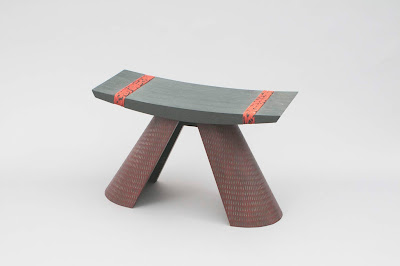
Source Bench by Douglas Finkel

The Georgia Museum of Art has impressive holdings of 20th- and 21st-century wood art thanks to the expansive gift of Jane and Arthur Mason a few years back. Despite its wide variety of craft, the museum did not have an example from prominent artist Douglas Finkel until a recent gift by the Center for Art in Wood.

Finkel is known, in part, for a series of benches, of which he has created 42 since 1997. French designer Pierre-Emile Legrain (1889–1929), who introduced these African forms to Western culture in the 1920s, is a noted influence of Finkel. According to the artist, “[Source bench’s] form and surface detail are inspired by Japanese architecture and, in particular, Samurai helmets.” The example recently added to the collection is an exemplary expression of this series. The recently acquired work has legs that are painted and carved, with a wire-brushed, painted and inlayed seat with kente cloth. Finkel has been both a woodworking artist and teacher for the past 21 years, and his work can be found in a number of collections, including the Renwick Gallery of the Smithsonian
American Art Museum.

We sincerely thank our friends at the Center for Art in Wood as well as the original donors, Bruce and Marina Kaiser, for this gift. It serves as a wonderful addition to our decorative arts holdings, filling an important gap in our collection.

--
Dale Couch
Curator of Decorative Arts,
Henry D. Green Center for the Study of the Decorative Arts

Thursday, March 01, 2018

Georgia Museum Curators Discuss Kehinde Wiley's Portrait of Barack Obama

Kehinde Wiley's portrait of President Obama

On February 12, the National Portrait Gallery unveiled the official portraits of former president Barack Obama and former first lady Michelle Obama. Created by Kehinde Wiley, the eye-catching portrait of President Obama garnered a large reaction across the Internet, sparking many people to give their take. Two curators at the Georgia Museum of Art — Dale Couch, curator of decorative arts, and Shawnya L. Harris, Larry D. and Brenda A. Thompson Curator of African American and African Diasporic Art — now offer their perspectives after a period of thought.

First, Couch surveys the image itself, paying attention to the deliberate choices of the artist and what they could reveal:

“Kehinde Wiley's portrait of President Obama is an intriguing work, rich in allusions. First, the remarkable verdure or millefleurs background with only the minimal suggestion of middle ground isolates the seated former President from ordinary spatial perspective. Spatial ambiguity reigns in this image as President Obama is slightly embraced by a suddenly alive foliage operating almost like ankle anchors to keep him from floating in space, as the background magically can be viewed as folding a perch for the chair — or not.

The foliage background is an intentional allusion to British pre-Raphaelite portraiture, which in turn is quoting a medieval tapestry, also intentional. He uses a similar though strikingly more modern version of this background in the image of Shantavia Beale II at the Brooklyn Museum. The chair is in a general British neo-classical style and not dissimilar to American neoclassical chairs in the White House. The result is a clear-cut portrait in the grand style for which Wiley has become known.

But grandeur takes a backseat here to the underlying sense of surreal experience, a notable mood of both pre-Raphaelite and to previous Wiley portraits. So in this historically grounded style a 21st-century president leans forward with his arms folded and his elegant, artistically rendered hands before him, as he pensively leans out to the viewers. One could say that this portrait holds his hands as a focus as much as his face. His character is as a thinker, perhaps a man of letters.

An aging Obama is presented and it is clearly a post-presidential portrait. But it is in this portrait that he emerges as a man of tradition instead of revolution, a man who would understand that reform is what makes conservatism possible. With the minimal trappings of power, this figure gains dignity and even grace.”

In addition to the details of the portrait itself, Harris considers the artist and his story.

“Although Wiley's portrait is steeped in the grandeur of decorative and fine arts tradition, the context of the Obama presidency in the 21st century and even its unfolding in the life of the artist himself illuminates other possible meanings. During the unveiling ceremony, painter Kehinde Wiley's bold and articulate remarks about the creation process were punctuated by his tearful acknowledgment of his mother, temporarily forgotten by Wiley himself.

Wiley's explanation of her undying support of his craft despite humble beginnings in a single parent household mirrored Obama's own narrative. Notions about rising ‘above the ashes’ of life or ‘beating the odds’ are inherent in the American story but resonate with many in the African American community and in the life of its artists. The Obama portrait could then symbolize the possibility of inclusion in a variety of traditions in the background foliage Wiley uses as his backdrop.

The seeming incongruity of that verdant background to the formal seated portrayal serves to highlight, in some ways, Obama's calm demeanor as alien or even magical in the midst of the natural environment over which he presided. On the other hand, the fertile backdrop could be a sly reference to his wife Michelle, whose iconic presence in his life and the White House Gardens further cements his legacy.”

Thursday, December 07, 2017

"Artful Instruments": Taking a Look at 19th-Century Weaponry Made in Georgia

Henning D. Murden, longrifle, 19th century. Walnut and silver, 52 inches long. Georgia Department of Natural Resources, A.H. Stephens State Park.

With guns dominating the news cycle, it may seem odd for an art museum to present an exhibition focused on them, but the Georgia Museum of Art at the University of Georgia is presenting the exhibition “Artful Instruments: Georgia Gunsmiths and Their Craft” through February 25. Co-organized by the museum’s curator of decorative arts, Dale Couch, and guest curator Sam Thomas, of the T.R.R. Cobb House, in Athens, the exhibition includes 18 19th-century longrifles as well as two pistols, powder horns and a miniature cannon on loan from private and public lenders.

Decorative arts, as opposed to traditional fine arts like painting and sculpture, focus on functional objects. Most often, they include furniture, silver, pottery and the like, which range from the plain versions of these items that would have been found in a yeoman farmer’s home to highly refined and decorated versions from the wealthiest estates. It may seem strange to include weaponry in this category, but early gunsmithing incorporated many crafts, including silversmithing and casting as well as woodworking.

Less prosperous than its neighbor states immediately to the North, Georgia produced decorative arts that have historically been overlooked. Couch points out that these rifles represent “the quintessence of craft in 19th-century Georgia” and says that “the objects in this exhibition are some of the finest artistic achievements in the state at the time.” The museum’s Henry D. Green Center for the Study of the Decorative Arts attempts to shed light on Georgia craft, particularly items that have received less attention.

Henning D. Murden, powder horn, ca. 1860. Inscribed M or W. Horn, unidentified ring-porous hardwood, steel, and replacement rawhide strap, 9 inches long. Collection of Mr. and Mrs. James D. Fluker Jr.   
Thomas points out that, in 1979, one of the Foxfire publications wrote, “These finest pieces work as intricately as Swiss watches, are as rugged and durable as Rolls-Royces, and are comparable artistically to fine paintings, music, or sculpture. Interestingly, they have the additional dimension that comes from their being, almost paradoxically, instruments of death—the tools by which enemies were slain, the frontier was conquered and tamed, and the table was filled with game. The fascination they hold for us is undeniable.”

Nearly 40 years later, that phrasing may now seem insensitive, but the longrifle remains a uniquely American art form. Developed in the early 18th century, it was more accurate than a musket but slower to load, and the rifles in this exhibition predate technological advances that led to quicker loading firearms. Its role in key battles in the American revolution and its association with the frontier have led to considerable mythology surrounding it, including James Fenimore Cooper’s novel “The Last of the Mohicans,” which features a character nicknamed “longrifle.”

W.T. Fluker, miniature cannon, ca. 1877. Iron and wood, approx. 10 x 21 x 11 1/2 inches. Collection of Mr. and Mrs. James D. Fluker Jr.    
Although they began as more purely functional objects, the human impulse for decoration prevailed, and the rifles on display in this exhibition feature elaborate inlay in brass and silver. Gunsmiths engraved patchboxes, trigger guards and other areas with scrollwork that often served as a kind of signature.

Thomas writes, “The history of firearms is full of examples of invention and evolution, but no gun bridges the worlds of history, technology and art like the American longrifle. Nowadays it is rare to encounter an original longrifle outside of private collections which makes it all the more important to document the ones in small museums or sitting in barns and attics.”

This exhibition is sponsored by the Community Foundation for Northern Virginia/the MOTSTA Fund, the Watson-Brown Foundation, the W. Newton Morris Charitable Foundation and the Friends of the Georgia Museum of Art. It is accompanied by a fully illustrated catalogue published by the museum that will be available for sale through the Museum Shop around January 20.

Programs related to the exhibition include 90 Carlton: Winter, the museum’s quarterly reception (free for members of the Friends of the Georgia Museum of Art, $5 non-members) on February 1 at 5:30 p.m. (the exhibition opens to the general public the following day), and a public tour with Thomas on January 24 at 2 p.m.