Showing posts with label Lamar Dodd. Show all posts

Thursday, January 10, 2019

Third Thursday Scheduled for January 17 around Athens

Yoga in the Galleries at the Georgia Museum of Art
The next Third Thursday — the monthly evening of art in Athens, Georgia — is scheduled for Thursday, January 17, from 6 to 9 p.m. All exhibitions are free and open to the public.
This Third Thursday will offer one event in addition to the exhibitions. None of the venues will be closed.
Georgia Museum of Art, University of Georgia

Yoga in the Galleries, 6 p.m. — Join us for a yoga class surrounded by works of art in the galleries. Led by instructors from Five Points Yoga, this program is free and open to both beginner and experienced yogis. Space is limited and available on a first-come, first-served basis; tickets are available at the front desk starting at 5:15 p.m. Yoga mats provided.
On view:
“The Reluctant Autocrat: Tsar Nicholas II” — This exhibition focuses on the reigns of the last two Romanov rulers: Alexander III (1881–1894) and his son and successor Nicholas II (1894–1917).
“Out of the Darkness: Light in the Depths of the Sea of Cortez” — Artist Rebecca Rutstein uses UGA marine sciences professor Samantha Joye’s research to create an interactive sculptural installation and several large paintings. 
“Richard Hunt: Synthesis” — This exhibition will focus on formative periods in the career of American sculptor Richard Hunt. 
“One Heart, One Way: The Journey of a Princely Art Collection” — Russian fine and decorative arts dating from ca. 1660 to 1952 from the family of the Russian Princes Belosselsky-Belozersky.
Permanent Collection — Thirteen galleries house a large portion of the Georgia Museum of Art’s collection, including many of the 100 American paintings that made up Alfred Heber Holbrook’s founding gift.
Lamar Dodd School of Art Galleries, University of Georgia

“La Mostra: Cortona 2018” — La Mostra, or The Show is a continuation of a 49-year-old tradition exhibiting artwork produced by students and faculty during their sojourn at UGA’s residential center in Cortona, Italy. Works produced by Cortona program participants during spring, summer and fall programs of 2018 will be displayed at the third floor of the Dodd Galleries. 
Lyndon House Arts Center

"Sitting with the Elders: Stories of Black Athenians,” an exhibition by Broderick Flanigan — When an elder dies, it’s as if a library has been burned to the ground. The stories, the voices, the history, the places and the legacy that were held inside all disappear. “Sitting with the Elders” uses art and story to capture the spirit of voices long gone and to amplify the voices of those still among us whose lessons we need today. The exhibition preserves a legacy that is vanishing, and it reminds readers of the messy, challenging, difficult obstacles in life we face in order to become thoughtful and engaged citizens of our communities and country. 
“Antoine Stewart” — Painting show in the Lounge Gallery.
ATHICA: Athens Institute for Contemporary Art

“ATHICA’s Annual Members’ Showcase” — Featuring the work of ATHICA’s membership, which has helped to sustain the all-volunteer organization for over 18 years. Open 4 – 9 p.m.
Ciné
“Cameron Lyden: The Wave Tamer’s Lullaby and Other Artifacts” — Cameron Lyden is an Athens-based artist who uses his work to construct a narrative for the viewer by creating fictional tools with ambiguous and fantastical functions. It is his goal to offer the viewer an opportunity to feel a sense of childlike wonder as they explore the faux history of these objects. 
Hotel Indigo, Athens

“Solar System (dad, you came to earth a long time ago)” — A new installation by Trevor Reese at the GlassCube. Known for his room-filling sculptural works, Reese has turned the GlassCube into a hospitality suite of miscellaneous furnishings ready to take off into outer limits. Conventional objects, ladders, chairs, stools and tables, stacked in an orderly fashion, each have their own personal multi-colored stylish disco ball. A hodge-podge of mirrors, mined from friends’ basements and collected from thrift stores, reflect the environment day and night. Working within a practice of exposing what is usually hidden, Reese’s installation is as if you have opening your storage shed and found a space age dance party. 
“Color & Comp” — Just in time for the start of school, “Color & Comp” includes artists playing with form, placement, hue, shade and pigment. Featured are shaped canvasses by Jason Matherly, the wonderful Lego compositions by Mike Landers, Shawn Campbell’s photo works of isolated football players on a field of gold, Jaime Keiter’s “Memphis”-inspired ceramic wall pieces,James Wilson’s paper collages and In Kyoung Chun, plexiglass domestic scenes.
The Classic Center

“Stitch” — A brand new, colorful, texture-filled exhibition of contemporary quilts is on view in Classic Gallery I. Featuring the smoky industrial-scapes of Elizabeth Barton, the obsessive geometric precision of Barbette Houser, the vibrant sewn gardens of Cleo Ward, the magic and mischief of Danielle Lasker and the meditative devotion of Anne Marie Vencill.
“Jaquelynn Faass” — A solo exhibition in Classic Gallery II of close-up, detailed portraiture.
–
Third Thursday was established in 2012 to encourage attendance at Athens’ established art venues through coordination and co-promotion by the organizing entities. Rack cards promoting Third Thursday and visual art in Athens are available upon request. This schedule and venue locations and regular hours can be found at 3thurs.org.
Contact: Michael Lachowski, Georgia Museum of Art, mlachow@uga.edu.

Thursday, December 29, 2016

Lamar Dodd's Odyssey, 1909–1996

On this 20th anniversary of Lamar Dodd's passing, we wish to honor his legacy by sharing with our readers a memoir by William U. Eiland, director of the Georgia Museum of Art. Originally published December 1996 in University of Georgia Magazine.

Lamar Dodd's Odyssey, 1909–1996: A Southern Artist Who Sought Majesty and Truth in the Extraordinary and the Commonplace

Lamar Dodd, Self Portrait, 1936
One of Lamar Dodd's finest paintings is based on a scene he saw not long after his arrival in Athens to join the faculty of the University. Never one to analyze his works in theoretical terms, Dodd always said that any social or political content to his art was in the eyes of the beholder rather than in the mind of the creator. And, thus, when he saw a group of women and children scavenging in the city dump, he decided to describe, to remember, what he had seen in pictorial terms. A cloud of mist or smoke hangs over the scene, the circular forms mirroring the activity below, where women bend and scrabble for life's necessities amongst other people's refuse. As Dodd later appreciated, the picture calls to mind T. S. Eliot's lines, "The worlds revolve like ancient women gathering fuel in vacant lots."

As much as Carr's Hill and the historic North Campus of the University, Dodd's world was equally the city dump, the North Georgia mountains, or his own backyard, where the loveliness of a late-blooming rose sent him scrambling for his watercolors. Elbert Hubbard remarked in the Roycroft Dictionary and Book of Epigrams of 1923, that "Little minds are interested in the extraordinary; great minds in the commonplace." In his career, Lamar Dodd sought the majesty, the truth, in both.

Influenced by LaGrange and New York


Lamar Dodd, 1995
Born on Sept. 22, 1909, in Fairburn, Dodd's first world was the small town of LaGrange, where he studied art at the women's college and where he painted and drew over and over again a lone oak tree and a boat, an image that remained with him for his entire life. Eventually, he went to the Art Students League in New York, where he studied with men and women who were defining American modernism. As early as 1933, with an acclaimed one-man exhibition in Manhattan, he added his voice to those who were seeking meaning through art. His response was in concert with the Agrarians at Vanderbilt University, who argued loudly that Southern artists must look to the rural traditions of the South for suitable subject matter; with the Ashcan artists who argued that the 19th-century academic traditions were obsolete in the 20th century; and the American scene painters, who stridently demanded an American art, one that looked not toward Europe but toward home for inspiration. When he and his wife moved to Birmingham, and as his national stature grew, Dodd became an apostle of this regionalist gospel. His world had now become, once again, the one he loved best: the South, whether the rolling hills of Alabama, the red dirt of Georgia, the tenement houses and cotton pickers and midnight carnivals he sketched and painted and proselytized for, because of the "nearness of their beauty," as he explained to James Saxon Childers. He found in the very air he breathed a challenge to translate it, and he admitted that his inspiration in painting the steel mills of Birmingham was an attempt to capture in paint the "smog that hung like a veil" over the city.

City Dump, 1939
A reviewer of his one-man exhibition in New York characterized Dodd's preoccupation with the everyday sights of the South by noting that the show contained "Not one scene of the Scottish moors with their purple heather. But a glorious painting of the washwoman hanging out the clothes. Not one scene of the fountains of Rome! But a magnificent thing showing the cabins of the tenant farmer. Nothing of Paris or London or Athens or Pompeii. But Georgia, Georgia, Georgia."

Dodd: South no cultural wasteland

And Georgia would be his next destination. By 1937, Dodd, Conrad Albrizio, Anne Goldthwaite, and a very few others, had served notice that the South was no cultural wasteland, that a growing community of Southern artists were fully engaged in the world of New Deal American artistic inquiry. Dodd received a letter from Hugh Hodgson of the School of Fine Arts at the University of Georgia, who invited the young painter, then 28 and without a formal degree, to join the faculty as artist-in-residence. The letter also held the astonishing news that, should he accept the offer, the annual budget for the visual arts program would be raised from $50 to $5,000. The invitation caused consternation in Birmingham, where Childers published in the paper a tongue-in-cheek refusal to give Hodgson a good recommendation of Dodd for the post, because Georgia's gain would be Alabama's irreparable loss.

LaGrange Hillside, 1927
The University joined a group of progressive colleges and universities in hiring leading American painters to act as artists-in-residence, without regard to higher degrees. Dodd was to give example and instruction to students as a practicing, professional artist of note, who was expected to "interest all students with the value of understanding the arts and developing taste so that this institution might serve more faithfully in influencing culturally the people of our state."

The University found itself in 1937 with just such men in the persons of Hodgson and Dodd, who set about consolidating the three teachers, scattered in various departments across campus, into a recognizable department of art, with its own budget — the promised $5,000 — its own building and, most important, students. Nine enrolled as art majors after only one year, and a graduate program was established within the next three years. Dodd's world now became an academic one, but not one confined by walls of ivory.

Student artists popped up everywhere 
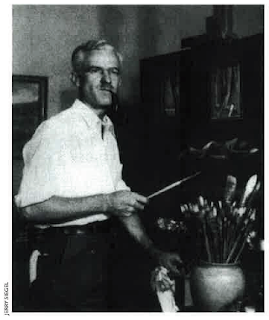
Dodd at work, 1945
Dodd became a force in the community as well. Athenians saw students sketching on Carr's Hill, designing products for local businesses, cajoling patrons to buy their works at auctions. Other artists of note arrived, lured to Athens by Dodd: Elaine de Kooning, John Held, Yasuo Kuniyoshi, Howard Thomas, Ferdinand Warren, and Carl Holty among them. Dodd had inherited an untenable situation, one he moved to rectify through a rational administrative structure. With the force of his singular personality, combined with an obstinate and almost ruthless commitment to his vision, Dodd cut through red tape and created a real department of art. Chances of success were slim: a studio in a dirt-floor basement, few slides available for teaching, and an insufficient budget. From these modest beginnings, Dodd forged one of the largest art schools in the Southeast, one that boasted at his retirement more than 700 majors, a faculty of 53, a "real" slide library, and a complex of buildings.

Lamar Dodd, Alfred Heber Holbrook, ca. 1948–49
Support craftsmen are artists, too

 Dodd was dedicated to the idea that a school of art must include the arts that until recently were defined as "support crafts, minor, or decorative." Thus, he recruited ceramicists, metalsmiths, fabric artists, and interior designers to join the more traditional painters, sculptors, printmakers, and draftsmen. The department grew and prospered through his tenure such that his contributions were recognized in 1996 when the School of Art was named after him. Of all the honors he received, the Lamar Dodd School of Art was the most personal, the most cherished, for it signified that his devotion to students would be forever remembered.

Lamar Dodd, Old Botanical Gardens, Athens, 1938
Cultural ambassador for the U.S.

Lamar Dodd, Open Heart 
Surgery, 1979–81
During his years at the helm of the department, Dodd helped to found the Georgia Museum of Art. In the 1950s, his world once again expanded with his first trips to Europe to study the Old Masters he revered and later in the 1960s as a cultural ambassador for the nation on state department-sponsored trips to Russia, Turkey, India, Korea, China, and Japan. For a time, Dodd's national stature as an administrator eclipsed his reputation as an artist. He was the first artist — and one without an earned degree — to serve as president of the country's largest and most influential professional organization for those working and teaching in the visual arts: the College Art Association. He traveled and lectured extensively on behalf of Phi Beta Kappa. And no matter how far away from Athens, he kept in his breast pocket his long-range plan for the department of art. People in far-flung corners of the world who had never heard of Georgia knew the goals of the university's department of art. Lamar Dodd wore all these hats, those of administrator, advocate, ambassador, and teacher, with equal commitment, but the one he favored most was that of artist. No matter how busy or preoccupied, he found time to sketch, to draw, to paint. His art underwent stylistic, even technical changes, as he reacted to the new vocabularies of the cubists, the abstract expressionists, the neorealists, or any of the host of voices who clamored to be heard in the polyglot 20th-century aesthetic din. Yet even at his most abstract or decorative, he never stepped over into complete nonrepresentation, because, as he remarked over and over, his art was dependent on the natural world. Pure formalism, which he found sterile and cold, a neo-academicism as it were, was the one voice to which he refused to listen.

Lamar Dodd, Turkish Bazaar, No. 2, 1995

New vistas: NASA and heart surgery 

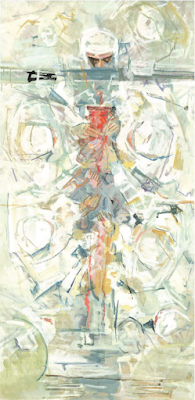
Dodd had to find new means of expression to depict the cosmos when he joined NASA's coterie of artists asked to document America's early adventures in space. His response was to fashion an art of elemental symbols, one where silver and gold emphasized the otherworldly preoccupations of scientists and artists alike. A decade later, in the 1970s, he used similar means to define another, more intimate universe: the surgical amphitheater, one that necessitated an equally novel language of sign and symbol to articulate deeply spiritual concerns about life and rebirth. In the last decade of his life, ever curious, ever impatient with infirmity, he found his subjects on the television screen or in newspapers. Restricted by illness to the community he loved, he searched his own backyard for inspiration, and found it in sunflowers, blades of grass, fossils, and, perhaps most important, in memories of the golden hillsides of Umbria, the glistening masts of sailing ships on the Bosporus, and the multicolored fantasy that is Jaipur. His drawings of this last period retain the vigor, the excitement, the surety of his first sketches of that lone oak tree and boat back in LaGrange. In the last year of his life, Dodd saw both the school of art and a new chair of art in the Athens-Clarke County School System named in his honor, a new museum building with a Lamar Dodd gallery, a major retrospective of his works from 1922 to 1996, and two books about his life and career. One day short of his birthday, he died, but the entire year had been his fellow Georgians' gift to him. The final world, therefore, for Lamar Dodd, teacher and artist, was the most important one: home.

Thursday, April 28, 2016

Master of Fine Arts Degree Candidates Exhibition

On display at the museum is the spring Master of Fine Arts Degree Candidates Exhibition, showing now through May 1. This annual exit show highlights the work by students in the MFA program at Lamar Dodd by giving them space in the museum’s galleries to share their projects. This year, 15 students have work displayed in a variety of different mediums, including photography, painting, drawing, sculpture, videography, metalwork, printmaking and interior design.

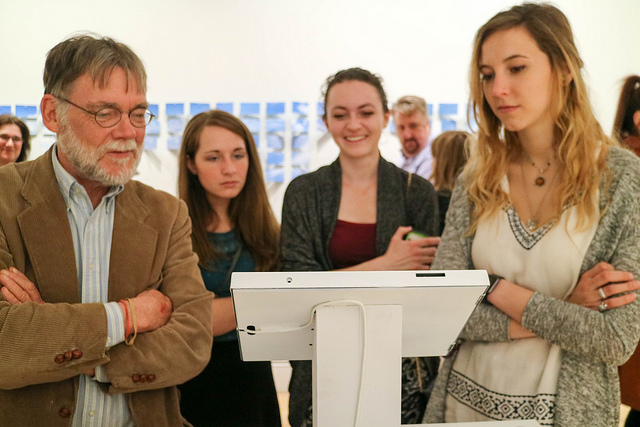
Visitors looking at at videography by Miranda Maynard
This exhibition is a special opportunity for students; for many of them, it will be the first time their artwork has been displayed in a museum. The students produced many interesting pieces, which vary greatly in style and intent to form an eclectic assemblage of talent. Erin Mazzei’s work, "Vantage Point," features a geometrically shaped, three-dimensional photo series that depicts a blue sky. In an oil painting by Michael Ross called "Crossing," historical soldiers stumble through a blurry, rainbow forest. A video by Miranda Maynard humorously portrays the actions of a woman who applauds cheerily, then uncomfortably looks around the room in "Clapping for the Amount of Time that Hillary Applauded her Husband at the Start of his 1999 State of the Union Address."

Other students featured in the MFA exhibition include Michael Benedetti, Ryan McCullough, Saegan Moran, Heather Foster, Drema Montgomery, Spence Townsend, Yongxi Wang, Janelle Young, Courtney McCracken, Aaron Obenza, Vivienne Varay and Lu Yang.

Thursday, August 20, 2015

Lamar Dodd

No visitor to the University of Georgia, or, in fact, the state of Georgia, can avoid seeing the name Lamar Dodd plastered in all kinds of locations: The Lamar Dodd School of Art (University of Georgia), The Lamar Dodd Art Center (LaGrange College), Lamar Dodd Professional Chair (a real job title), and even "Light one for Lamar" (a real anti-smoking ban protest). With his name being such a part of Georgia vernacular, Lamar Dodd’s actual identity eludes many – wealthy benefactor? Ancient regent?

Lamar Dodd at the Georgia Museum of Art

Dodd is actually one of the South’s most important and influential artists, contributing more than just his name to buildings, schools, and strange protests. His paintings are held in the collections of the Smithsonian, the Whitney, and Metropolitan Museum of Art – and of course at the Georgia Museum of Art – as exemplary pieces of Southern art. He enjoyed commissions from the likes of NASA, and his prolific output still permeates Southern culture, and particularly the Athens community, which Dodd made his home until his death in 1996.

Dodd’s beginnings are rooted in the region. He studied architecture at Georgia Tech, and then taught for a while in Alabama, but finding his greatest interest in painting and developing his own practice, he headed to New York in the late 1920s/early 1930s. This was a wise move – his stylized scenes of Southern landscapes and daily lives charmed New York crowds. Often dark in color, and with heavy black shadows, Dodd’s paintings of the American south appear sombre, yet romantic. This combination led to his first solo show in the city in 1932, and toward a name for introducing a renaissance in Southern art. He soon won the Norman Walt Harris Prize for his painting, “Railroad Cut,” which is now on display at the Georgia Museum of Art. 


Lamar Dodd, "North of Pratt City"


Following this, Dodd was invited to become the artist-in-residence at the University of Georgia, and so gladly returned to Georgia, and the South, to make art and advocate for its inclusionary sharing. He began giving lectures and teaching painting, and was appointed head of an essentially non-existent art department at the university. He expanded its programs, introducing more classes and a variety of courses, funded scholarships, saw the opening of the Georgia Museum of Art, and founded the Cortona Study Abroad program that is still enjoyed by students today, growing the art school until it was the biggest and most influential in the South. He retired in 1967, 16 years after the original residency program that was only intended to last a year. However, Dodd's legacy doesn't just lie with the school – he never ceased painting throughout these years, and exhibitions of his work continue today. The Monehegan Museum in Maine is currently showing a series of his works in an exploration of his 'artistic history.'

Lamar Dodd is an excellent figurehead for our institution as a great leader of the concept that we still work toward today – art for everyone. His name is proudly used to reflect the values that he instilled in (what he didn't know would become) the Lamar Dodd School of Art, and that they maintain in his memory. The school was renamed after him in 1994, not long before Dodd's passing, in celebration and tribute to his contributions to Southern art and its community, and you can visit the Georgia Museum of Art to see some of the paintings from the beginning of this great movement.

Friday, April 17, 2015

MFA Candidate: Lily Smith


A jewelry/metals student, Lily Smith says, “I’ve always been really interested in work that goes on the body. . . . I’ve also worked a lot with fabrics in undergrad and grad school.”

She uses the term “jewelry” loosely as work that goes on the body and talks about the body. She combines the ideas of jewelry with those of garment and fashion, finding an interest in the colliding of fields. For her piece that will be in the Georgia Museum of Art, she combines hand-dyed silks and thinned-down silicon with added pigment painted on fabric to create the textures of fleshy forms. The result is a wearable piece that recalls the feel and form of different parts of the body.

She explains her interest is not only in work that goes on the body but also is about the body. The garments she creates mimic natural forms of the human form but are exaggerated. With a skin-tone color palette and materials that resemble skin as much as worn fabrics, she makes voluptuous plump forms that hang around the figure when the piece is worn.  

“This work talks about our standards of beauty and the ideal female figure. They're like dresses but rather than accentuating a thin figure they're fatty forms with multiple breasts and bellies, celebrating the fact that maybe that can be just as beautiful as a thin more fit person. Celebrating the curves and the fat and flesh in general,” she says.

Her creations take beauty to a richly authentic level with their yearning to be seen and felt. These garments continue to evolve with her interest in the process of making as well as the intrigue of the final state. They hold the viewer captive while evoking feelings about their own personal connection to the human form.

Smith’s work will be shown at the “Master of Fine Arts Degree Candidates Exhibition” at the Georgia Museum of Art from April 11 to May 3, 2015.


http://handgrownjewelry.weebly.com/lily-smith.html