Brien’s work will be on display in the “Master of Fine Arts Degree Candidates Exhibition” at the Georgia Museum of Art from April 11 to May 3, 2015.
Tuesday, April 14, 2015
MFA Candidate: Patrick Brien
Brien’s work will be on display in the “Master of Fine Arts Degree Candidates Exhibition” at the Georgia Museum of Art from April 11 to May 3, 2015.
Friday, September 19, 2014
Art gallery tours led by new guiding voice
All images from psfk.
Monday, August 04, 2014
Artist uses 3D printing to make museum art "touchable"
Some people, like Dutch art historian and designer Maaike Roozenburg, believe that displaying art so conservatively removes works from their daily functions, isolating the objects from the lives of visitors. Many believe that not being able to touch and interact with the objects on display limits visitors' ability to appreciate those works.In an effort to remove the distance between object and viewer, Roozenburg set out to create her Smart Replica project, with touchable 3D replicas of fragile teacups that caught her eye during a trip to the Museum Boijmans Van Beuningen in Rotterdam, Netherlands.
Roozenburg partnered with the Delft University of Technology to build 3D printing models of the objects. Because of the fragile nature of the teacups, Roozenburg and TU Delft used non-contact, medical CT scans, which the university students converted into 3D models.
Then, with the help of Wim van Eck of the Augmented Reality Lab of the Royal Academy of Art and the creative agency LikeFriends, Roozenburg added extra layers to the replicas. By using the smartphone or tablet app Junaio, museum visitors can use their devices to access the augmented reality layers of the objects they are touching.
The extra layers give the visitor access to the ornate design of the original object as well as information on the works.
Roozenburg is continuing the project with her partnering organizations to make more works accessible to viewers, and, with the growing use of 3D printing, we may see this trend applied to museums in the U.S. soon enough.
Sources: PSFK, Core77, Dezeen
Wednesday, September 29, 2010
Past, Present and Future
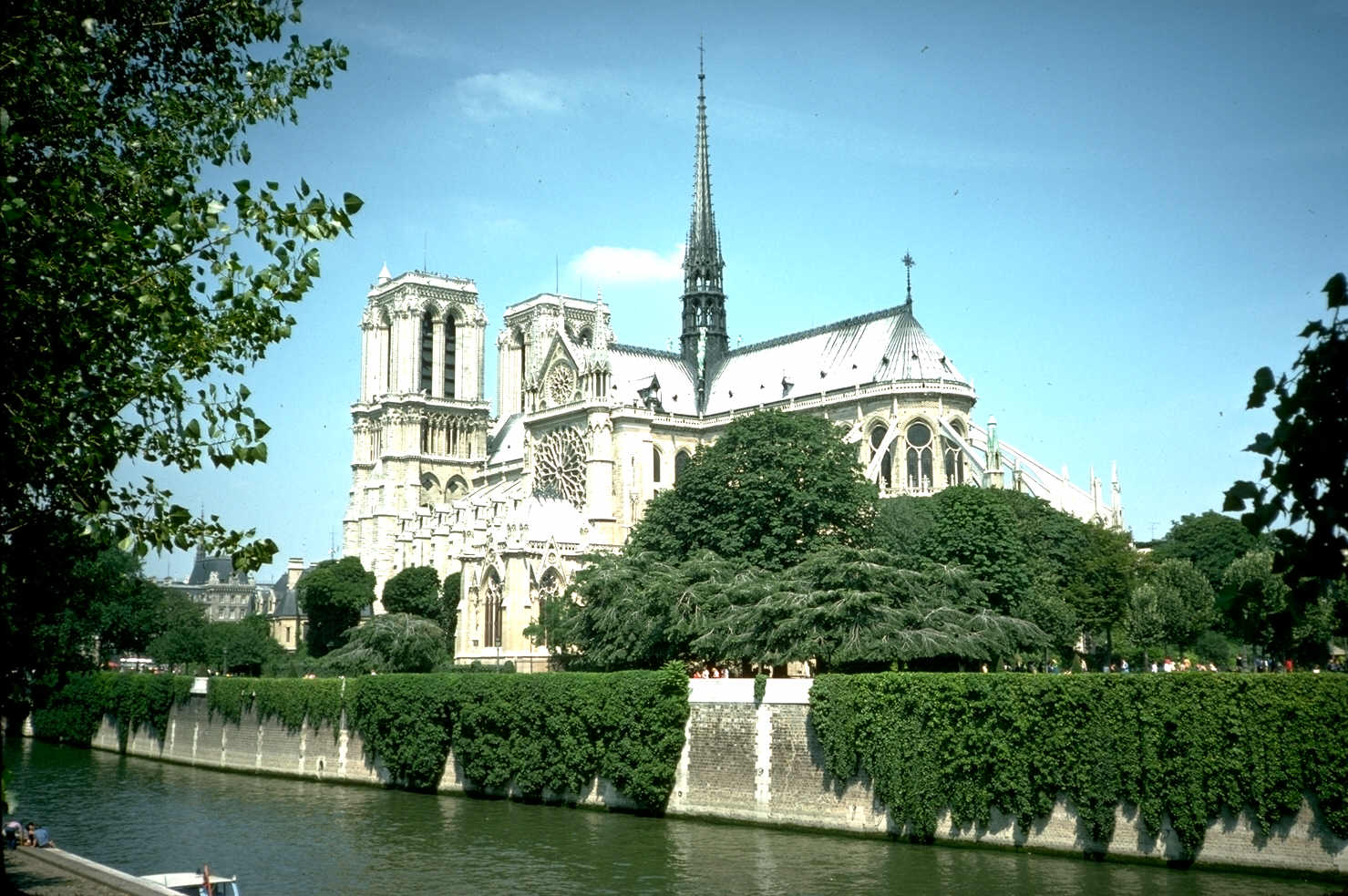
When asked what 500-year-old gothic cathedrals and artificial intelligence (A.I.) technology have in common, you would think not much, right? However, the application of this new(er) tool could help explain the architecture of these historic buildings. Providing a new method for studying building design, particularly that of medieval times, A.I. looks at how the pieces work together to create a well-built structure. In addition to studying architectural giants such as Notre Dame Cathedral, the computer can also generate those structures that have since turned to ruins.
The group running the study, which is funded by the National Endowment for the Humanities, is led by Stefaan Van Liefferinge, an assistant professor of medieval art and architecture in the Lamar Dodd School of Art at the University of Georgia, as well as Don Potter and Michael Covington, two professors from the university’s Institute for Artificial Intelligence. Van Liefferinge says, “The aim of our project is to develop an ontology or knowledge representation for architectural history that will make it possible for us to apply methods from artificial intelligence to historic descriptions of architecture,” basically meaning computerizing the structures in order to study them in a modern context and, thus, creating relationships between many different medieval buildings.
The group hopes that the research will help students learn about different architectural styles in addition to creating software that simulates parts of or entire buildings that are now lost. Starting with a simple part of a building, like a window and its surrounding supports, the research will expand to the cathedral as a whole when more information is added to the system. The application of A.I. to architecture is new, and the group recognizes its potential to investigate much simpler building structures too, such as bungalows. According to the article, “the long histories of cathedrals, though, make them perfect as a test case for this intersection of science and art.”
This makes for an exciting future in art and technology. It could lead to the study of older paintings, tapestries and more, all the while closing the daunting time-gap between then and now.
Quotes and facts taken from an article written by Philip Lee Williams.
Monday, April 26, 2010
Google Goggles' New Acquisition

Plink has joined Google Goggles! For those who don’t know what in the world Google Goggles is let alone Plink, have no fear: this new program might intrigue and fascinate even the most ardent traditionalists or at least spark debate about the role of docents and the gradual phasing out of basic human communication. In essence, Plink Art is a smartphone application created by Mark Cummins and James Philbin that lets its user take a picture of any well-known work of art and immediately discern its title, artist, which museum or collector houses it, etc. After the work is identified, the application provides a link to allposters.com, in case of adoration and absolute urge to acquire a likeness of the work.
Philbin explains how Plink's technology works: “‘It picks out repeatable elements from the image you take and comes out with a statistical representation of them.’ That process works even at different angles and different lighting conditions" Cummins adds "You can start doing some really interesting things when you have recommendation data, like personalized tours based on your favourite paintings. Museums are very interested in social sharing and Facebook."
Google Goggles, Plinkart’s buyer, is a subsidiary group of Google that works to develop instant recognition programs. That is, you take a picture with your phone of whatever object you want to find out more information on—the application currently recognizes wine, logos, places, artwork, business cards, books, and landmarks—and the application will give you a compiled list of stats, prices, and general information regarding the object or place.
Although you need a smartphone for the Plinkart application (the Google Goggles program is limited to Android phones), the concept is still pretty incredible and is most certainly an idea to watch. Both teams will be working together to develop a search engine that identifies and researches more and more of the objects, scenes, and people that make up our surroundings.
Thursday, April 01, 2010
Maqs to the Future

Sure, the objects produced by doing scale models (or maquettes) of every exhibition in advance are cool artifacts for the future and works of art in their own way, as this brief San Francisco Chronicle article shows, but doesn't it make more sense to use the 3-D modeling capacities of a computer? That's what our preps have been doing, at any rate, and it seems far faster and uses limited resources more effectively.
Thursday, January 07, 2010
F for Fake

Friday, September 11, 2009
iPhone loves GMOA
Todd Rivers, our head preparator, mentioned that, if you search "Athens, GA" on the iPhone, the first thing that comes up is the museum's calendar page of events, complete with the R.A. Miller Thursday tour at 2. Here's the evidence.
Wednesday, May 13, 2009
Art and Technology: David Hockney

Not only is David Hockney creating digital art with a tablet, but he's taken, of late, to painting with his finger on his iPhone. From his early work with photo collage to his use of Quantel Paintbox, an early graphics program, in the mid-1980s to his thesis that the Old Masters used camera obscuras to capture complex perspectival images, Hockney's career is shot through with technology, and while his newest foray into it is certainly cool, it's not really a departure.
Tuesday, May 05, 2009
Technology and Art

The Museum of Contemporary Art Chicago just opened the exhibition Take Your Time: Olafur Eliasson at the beginning of this month, and they've created a stand-alone website for it, which is kind of a trend in the museum world. The site not only gives background on the exhibition and the artist (Eliasson is a Danish/Icelandic artist who works primarily in light and water, as with the waterfalls he installed around New York last year) and a downloadable gallery guide, but also supplies images, videos and an audio tour.
The Smithsonian American Art Museum's online presence for Jean Shin: Common Threads is less extensive but still contains some interesting applications of new media, such as the Flickr group devoted to Shin's installation of her work, which deals with extremes of size and discarded materials reincorporated into new constructions.
David Hockney doesn't wait for museums and galleries to push forward technologically but instead does so himself. His latest project is limited-edition prints that he's drawn on his computer in Photoshop using a graphics tablet.
And, of course, Dia Art Foundation continues to put art online, with its newest project, by artist Dorit Margreiter, to launch May 19.