Thursday, April 28, 2016

Master of Fine Arts Degree Candidates Exhibition

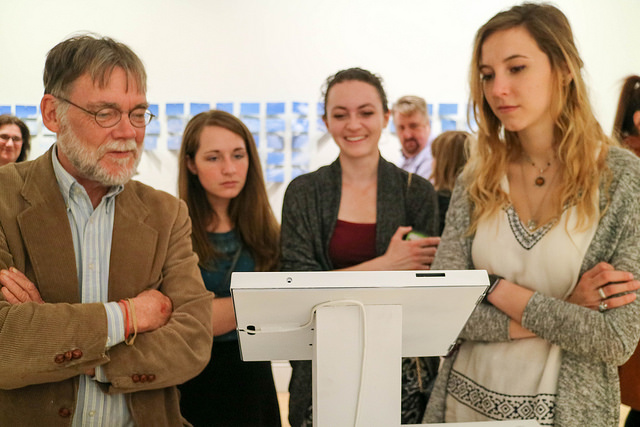
On display at the museum is the spring Master of Fine Arts Degree Candidates Exhibition, showing now through May 1. This annual exit show highlights the work by students in the MFA program at Lamar Dodd by giving them space in the museum’s galleries to share their projects. This year, 15 students have work displayed in a variety of different mediums, including photography, painting, drawing, sculpture, videography, metalwork, printmaking and interior design.

Visitors looking at at videography by Miranda Maynard
This exhibition is a special opportunity for students; for many of them, it will be the first time their artwork has been displayed in a museum. The students produced many interesting pieces, which vary greatly in style and intent to form an eclectic assemblage of talent. Erin Mazzei’s work, "Vantage Point," features a geometrically shaped, three-dimensional photo series that depicts a blue sky. In an oil painting by Michael Ross called "Crossing," historical soldiers stumble through a blurry, rainbow forest. A video by Miranda Maynard humorously portrays the actions of a woman who applauds cheerily, then uncomfortably looks around the room in "Clapping for the Amount of Time that Hillary Applauded her Husband at the Start of his 1999 State of the Union Address."

Other students featured in the MFA exhibition include Michael Benedetti, Ryan McCullough, Saegan Moran, Heather FosterDrema Montgomery, Spence TownsendYongxi WangJanelle YoungCourtney McCracken, Aaron Obenza, Vivienne Varay and Lu Yang.

Thursday, April 21, 2016

New Illumination at the Georgia Museum of Art

MFA 2016 opening reception
As a museum, one of the most fundamental things we do is conservation: to protect and preserve valuable artifacts and objects for future generations. For this reason, environmental conservation is part of the process. This year, some significant sustainability projects were completed at the museum, and in observation of Earth Day tomorrow, here’s a brief recap of some new milestones. To reduce our energy and water consumption, the museum transitioned nearly 1,600 lighting fixtures to LED lighting, installed eight new occupancy sensors and retrofitted 28 existing faucets. The University of Georgia, who spearheaded these projects, has informed us that these changes will result in approximately 270,000 fewer gallons of water used by the museum every year and cut our annual carbon emissions by about 200 metric tons, or the equivalent of 43 cars!

LEDs illuminating Vantage Point
(Sky Swap)
 by Erin Mazzei '16
In addition to these achievements, the other benefit of switching to LED bulbs is more control over gallery and exhibition lighting to highlight works, as seen above in the current annual MFA exit show, Master of Fine Arts Degree Candidates Exhibition” (showing now through May 1). Traditional lighting systems did not allow for purposeful illumination of our collections and the new LEDs do not disappoint. Staff members and repeat visitors have noticed that colors are more vibrant, paintings exhibit more depth and the frames themselves have a greater vitality to them. It is with great anticipation that we begin the reinstallation of our permanent collection this summer with new lighting configurations, so stay tuned.

To find out about upcoming events at the museum, click here.


Thursday, April 14, 2016

David Ligare and the Meaning of Xenia


David Ligare, Still Life with Grape Juice and Sandwiches (Xenia), 1994

The painting discussed in this blog post is featured in “David Ligare: California Classicist,” a retrospective exhibition on display at the Georgia Museum of Art through May 8.


Upon first sight of David Ligare’s work, it’s easy to feel transported to Homeric Greece.[1]  In a time when contemporary art is often abstract and non-representational, Ligare pulls from the traditional subject of still lifes, landscapes and nude figures. He fuses modernity and antiquity, synthesizing a new ideal that celebrates both tradition and contemporary society. Like the Renaissance artists of the 16th and 17th centuries, Ligare realizes society’s “need of a renewed desire for knowledge,” and he seeks to elevate the viewer’s intellectual growth by means of the “literate picture[2]. The Renaissance marked a period of humanism and it was highlighted by the works of Michelangelo, which synthesized contemporary religion with a renewal of classical themes.[3] Ligare’s paintings function similarly; he synthesizes classicism with objects indicative of modern society. Despite his unmistakable affiliation with unfashionable subjects and dated means of representation, David Ligare has thrived in the modern art world because he finds equilibrium between relevance and irrelevance. His paintings depict his native California landscape to substitute that of Greece or Rome, and he paints from living models rather than ancient Greek sculptures. Also, inspired by the writings of John Steinbeck and Robinson Jeffers, he very deliberately fabricates narrative paintings that speak greater truths about the subjects and the environment surrounding them, though narration is frequently omitted in modern art. In keeping with works that recede under the dominance of more nuanced paintings, Ligare’s still lifes maintain an unassuming presence, but also typical of his work, the still lifes showcase the greatest reinvention of an old practice. In “Still Life with Grape Juice and Sandwiches (Xenia),” Ligare utilizes the simplest of objects to create the deepest of meanings.

Although his still lifes lack an immediate narrative resonance, Ligare very thoughtfully chooses his objects and their lighting to provide his subjects with new life and to expand the potential of this long-forgotten practice. Be that as it may, he manages to create a semblance of allegory in the way his objects burst with meaning specific to Greek myths, like mementos of heroic journeys. Alluding Homer’s great epic, The Odyssey, “Still Life with Grapes and Sandwiches (Xenia)” directly references the Greek custom of xenia. Literally translated as “guest-friendship,” xenia refers to the tradition of hospitality when hosts would treat weary travelers with the utmost generosity, and guests would return the favor with the utmost courtesy. Integral to this practice is the offering of wine and bread, and many times throughout Odysseus’ journey, he is provided the very substances. Characteristic of Ligare, he pulls from this deeply rooted ritual and re-contextualizes it with contemporary objects. Instead of rich wine and authentic loaves, he presents a pitcher of cheap grape juice and a heap of bologna sandwiches on highly artificial bread. The grape juice is presumably of poor quality because Ligare was inspired by his time serving in a soup kitchen for the homeless in Salinas, California. There is something distinctly resonant in the difference between homeless people today, with whom most people avoid eye-contact, and the temporarily homeless travelers of ancient Greece who were treated just short of gods. Granted, the hosts feared the retribution of failing to accommodate gods in disguise, but the Greeks had a well-developed humanity that became influential to Ligare and Renaissance artists alike. Though the xenia of today functions in a dramatically different context, the heartfelt connection he felt with the homeless he served is evident. The unsettling divergence between xenia and its modern equivalent is how it has been transformed into the most menial offering of food, the minimum sustenance for life in an increasingly arduous world.

Much as the grape juice and sandwiches act as the essential substance of life for the homeless, Ligare’s still lifes resound their own essence of life. Still lifes have historically been divided into two categories: memento mori, which emphasize the remembrance of death, and vanitas, which deal with the transience (or even futility) of life. The way morning light strikes the objects and the way food connotes the preservation of life suggests the latter, entertaining a feeling of hope with a subconscious understanding of the food’s inevitable spoilage. The ephemerality of food parallels that of humanity, but Ligare typically uses fruit that suggest the abundance and prosperity of life — like plums, apples, and olives. Food has a particularly poetic quality in the way it functions both as a core component of life and as an object of love and comradery between people. In “Still Life with Grape Juice and Sandwiches (Xenia),” Ligare also capitalizes on the sacramental quality of wine and bread in the Christian religion, framing it in an altar of sorts. The Greeks frequently made offerings to gods in celebration of their prosperity, so the stage functions as an altar in which ordinary objects gain religious significance. Originally a pragmatic solution to a compositional problem, the box fulfills several artistic purposes. Primarily, he seeks a controlled space in which to conduct rigorous investigations of the objects, but it also fosters a “harmony of wholeness,” as the artist puts it, which resembles the work of old masters. The marble box is also conducive to Ligare’s heavily-controlled style, providing a space of measured precision matched only by the sculpture and architecture of Hellenism. The enigmatic, sterile background creates a sense of isolation akin to surrealism, but it merely acts as a medium through which to emphasize the allegorical potential of the grape juice and sandwiches. By granting inanimate objects the attention provided by painting and exhibition, Ligare forces ordinary commodities into the forefront of a viewer’s thoughts, fostering a greater appreciation for an object’s narrative history.

“Still Life with Grape Juice and Sandwiches (Xenia)” marks a culmination of Ligare’s most significant accomplishments in still life painting. It connotes a Greek tradition which speaks to both his humanitarian goals and his affinity for classicism. Whether it be a reference to the continuation of xenia, the practice of the Christian Eucharist, or the simple act of giving food to the homeless, Ligare capitalizes on the potential plurality of meaning within objects and expands the boundaries of still life painting by dramatizing the transience of meaning throughout the course of history.

Benjamin Thrash
Publications Intern


[1] Homer is the author of the epic poems The Iliad and The Odyssey, two defining works of the Greek people and two of the oldest pieces of literature ever known.
[2] Words from the artist in David Ligare: California Classicist by Scott A. Shields.
[3] Humanism was a concept that reemerged during the Renaissance and emphasized the intellectual and creative potential of man.


Thursday, April 07, 2016

Collectors Auction Preview: "All About Art"

For the auction: John L. Cleaveland Jr., View from Montefaucon, the Argonne France (n.d.).
Oil on panel, 13 x 15 inches, framed.

Every other year, the museum’s Collectors group (an upper-level membership group within the Friends of the Georgia Museum of Art) organizes a fabulous evening of food, fun and fundraising, the proceeds from which go toward enriching the museum’s collection. This April 23 brings “All About Art,” the latest version of the event. Chaired by Greg Barnard, the new head of the Collectors, the event gets started at 6:30 p.m. with cocktails and a silent auction at the museum, followed by dinner catered by Epting Events.

For the auction: Robert Clements, Summer Meadow (2012).
Acrylic, 24 x 30 inches, framed.

Barnard says the theme reflects the evening’s purpose: “It’s all about acquiring art for the museum and, by extension, for the state of Georgia and its residents — us, in other words.” Previous auctions have led to the purchase of works on prominent display in the museum’s permanent collection galleries, from the early Georgia portrait of William Harris Crawford to the Dorothy Dehner sculpture that joined the collection in 2014.

Barnard says, “In addition to notable works of art — paintings, drawings, photography, prints and sculpture — by both area and non-area artists, the auction will feature fashion accessories, contemporary and antique furnishings and decor, entertainment opportunities such as catered dinners and restaurant meals and personal ‘get-away’ experiences such as spa treatments.”


For the auction: Carol John, Turquoise Chrysanthemum (2015). Oil on canvas, 60 x 48 inches.

Randy Ott, a member of the museum’s Board of Advisors and a notable collector of fine art, has donated two paintings by Henry L. Roecker to the auction. June Ball, another board member and well-known artist who recently had a large work commissioned by Georgia Council for the Arts, has donated one of her own oil paintings, as has acclaimed Athens artist Carol John, whose work is in the collection of the High Museum of Art.

Heirloom Café and artist Susie Burch have donated a farmers’ market tour and four-course lunch or supper for eight people, including wine pairings, to be held in Susie’s studio, which houses portraits of local farmers. Epting Events has contributed a period dinner for a group of people at The Hill, Lee Epting’s beautiful hideaway event space in Athens. Last Resort Grill has donated a $100 gift certificate, and many more donations are still coming in.

This year, sponsors at the $1,000 level are entitled not only to four tickets to the event, but also to priority auction check-out at the end of the evening and an exclusive cocktail-hour preview starting at 5:30 p.m., with a “buy-it-now” option for auction items.


For the auction: Margie Spalding, French Bottle and Lady Apples (n.d.). Oil, 9 x 12 inches, framed.

Ticket information:

Members of Friends of the Georgia Museum of Art: $100/person, nonmembers: $125/person.

To purchase tickets or to sponsor the event, visit http://bit.ly/collectors-auction16.

It’s not too late to become a member! For more information, visit http://georgiamuseum.org/join, or call 706.542.0830 or email jointhemuseum@uga.edu.

Thursday, March 31, 2016

New Acquisitions: "Girl Sewing (The Chinese Robe)" by Frederick Carl Frieseke

Frederick Carl Frieseke, Girl Sewing (The Chinese Robe) (1931)

Among the latest additions to the Georgia Museum of Art's permanent collection is the American Impressionist painting “Girl Sewing (The Chinese Robe)” by Frederick Carl Frieseke (pronounced FREE-suh-kuh). Peaceful domestic settings were a common theme in American Impressionism. This purchase was made possible with funds given by The Chu Family Foundation. Dr. David Chu is a distinguished research professor emeritus in UGA’s College of Pharmacy. He and his wife, Jane, made this financial gift through their family foundation with the specific goal of having the museum purchase a significant American painting. The museum held a formal unveiling to commemorate the acquisition of this painting.

Gift unveiling with Jane Chu of The Chu Family Foundation 
Sarah Kate Gillespie, our curator of American art, said, “Frieseke was an important force in American Impressionism, particularly among those Americans working in the colony of Giverny, France, adjacent to Claude Monet’s gardens. He enjoyed great popularity on both sides of the Atlantic. This particular work not only fills what had been a major gap in the genre within our collection, but also very much complements our current holdings in American Impressionism.”

“Girl Sewing (The Chinese Robe)” is now on view in the Marilyn Overstreet Nalley Gallery at the museum, alongside other American Impressionist paintings from the collection by Mary Cassatt, Frank Weston Benson, Childe Hassam and William Merritt Chase.

Thursday, March 24, 2016

Highlights from Black History Month Dinner 2016

At the end of February, the Georgia Museum of Art held its annual Black History Month dinner and awards ceremony. The title of this year’s event was “Hallowed Ground: Sites of African American Memory,” in coordination with the overarching theme of Black History Month in the U.S. Guests from around the nation congregated at the museum to reflect on and celebrate the contributions of African Americans to Georgia’s culture.

At the event, museum curators Sarah Kate Gillespie and Shawnya Harris led gallery talks about pieces in the permanent collection by African American artists, including paintings by Emma Amos, winner of this year’s Thompson award. Guests were also treated to a concert by the UGA African American Choral Ensemble, followed by dinner and dessert in the M. Smith Griffith Grand Hall. At the ceremony, Michael L. Thurmond and Emma Amos’s awards were presented; both Thurmond and India Amos, daughter of Emma Amos, gave wonderful acceptance speeches. Read more about our winners here.

Curator Sarah Kate Gillespie giving a gallery talk about paintings 
by African American artists. Image: Madison Bledsoe

Two women visiting in front of the Emma Amos feature 
wall in the museum galleries. Image: Madison Bledsoe

Table of students waiting for the awards ceremony to begin. Image: Madison Bledsoe

The Thompsons and friends. Image: Madison Bledsoe

Dr. Gregory Broughton directing a concert set by the UGA 
African American Choral Ensemble. Image: Madison Bledsoe

Michael L. Thurmond accepting the 2016 Lillian C. Lynch 
Citation from Peggy Galis. Image: Madison Bledsoe

India Amos accepting the 2016 Larry D. and Brenda A. Thompson 
Award from Shawnya Harris. Image: Madison Bledsoe

Past honoree, Harold Rittenberry, congratulates 
Michael L. Thurmond. Image: Madison Bledsoe


Thursday, March 17, 2016

From the Pierre Daura Archive: Shedding Light on the Cinq Refusés

Guest post by Madeline Bates, curatorial intern at the Georgia Museum of Art:

Cinq Peintres Refusés par le Jury du Salon
Paris, Galerie Marck, November 3–15, 1928

Before my first semester as an intern of the Georgia Museum of Art’s Pierre Daura Center for European Art, I had never heard of Pierre Daura, an artist about whom very little has been published despite his lifelong artistic career and interactions with some of the major figures of European modernism, like Wassily Kandinsky and Piet Mondrian. To learn more about the artist, I turned to the Pierre Daura Archive located in the museum’s Study Center for the Humanities.

While perusing the archive, filled with letters, newspapers, photos and similar ephemera, my interest was piqued by a Parisian exhibition in which Dau
ra took part called the Cinq Peintres Refusés par le Jury du Salon, which ran concurrently with the November 1928 Salon d’Automne. This annual exhibition, established in 1903, was an important Parisian showcase for the work of modern avant-garde artists. A group of artists, including Henri Matisse, founded the exhibition in an act of creative opposition to the exclusivity of the Salon of the French Royal Academy of Painting and Sculpture; the traditionally conservative institution was not accepting of the innovations of modernism. In October of 1928, Daura and four artists with whom he worked in Paris submitted works of art that were subsequently rejected by the jury of the Salon d’Automne. The Cinq Refusés exhibition was quickly conceived and shown at the Galerie Marck in Paris. My interest in the Cinq Refusés largely sprung from the fact that the formation of the exhibition, much like the Salon d’Automne, was a response to the subjective hierarchy of fine art established via the Salons, the major artistic exhibition spaces of the period.


[Five painters rejected by the jury of the Salon d’Automne exhibit their “condemned” paintings and a few others. When a violent retrograde movement manifests itself, it is interesting—perhaps prudent—to know what trends contradict it. Here, so many among others, are five Parisian painters singled out by the flattering rejection of the jury: Torres-Garcia, Uruguayan; Aberdam, Polish; Engel-Rozier, Belgian; Daura, Catalan; Jean Hélion, French.][1]


Photo of the artists printed in Blanco y Negro, Madrid, December 9, 1928. 
From left to right: Engel-Rozier, Helion, Torres-García, Daura, and Aberdam.

This international group of Cinq Refusés artists included Daura, from the Catalan region of northern Spain; Joaquín Torres-García of Uruguay, who organized the exhibition; Ernest Engel-Rozier, also known as Engel-Pak, of Belgium; Alfred Aberdam, of Poland; and Jean Hélion of France. Each painter worked in idiosyncratic modern modes, representing very different subjects and styles. Unfortunately, because only one or two photos of the exhibition survive, today’s knowledge of the exhibition content largely derives from critical commentary. Along the same lines, it appears that the planning of the exhibition took place in person, as there are no letters from this time between Daura and the other peintres refusés present in the Daura archive.[2] Daura’s personal diary from 1928, however, extensively recounts the days during this period and thus provides unique insight into the exhibition process.

By its twenty-fifth year, the 1928 Salon d’Automne had grown virtually to the scale of the Royal Salon, exhibiting more than 2,500 paintings. Critics reported that the Salon’s jury selection must have been arbitrary, for the work of Daura and his comrades was no worse—and in many cases, more interesting or better executed—than the Salon’s accepted works of art. Perhaps this was the case, as Daura’s paintings had been accepted for the Salon d’Automne in 1922 and 1926. Interestingly, in 1928, Pierre Daura secretly submitted a painting by Louise Daura, his bride-to-be and a fellow visual artist; her work was accepted by the Salon that year, and Pierre describes the occasion that Louise received her acceptance letter with enthusiasm in his diary.

Although the Cinq Refusés have received relatively little attention in art historical studies over the years, there was a great deal of contemporary critical acclaim in France and Spain, even reaching as far as America. Wr
iters described the show with colorful language and varying degrees of compassion for the artists rejected by the Salon; some columnists embraced the show as a cheeky but well-purposed response, while others mocked and belittled the artists as failures.  Many writers suggested, in reference to the formation of the Salon d’Automne, that with the Cinq Refusés, Parisian history was repeating itself.


One contemporary Parisian review, published under the penname Nephtalie, speaks of the juried salon as a “dying institution” and expresses support for the Cinq Refusés creative mission:
 

If it is a battle to fight, I say immediately to these five men that I am by their side, because it really seems to me too that all Salons they force-feed us are really too formal and dying. Let those who have talent get up and move; we will be with them![3]

I found that Spanish publications gave the work of the artists more attention than did French newspapers, which more often provided only exhibition announcements or a critique of the Salon’s selection methods rather than reviews of the show’s artistic content. English translations of most of these articles, particularly those in Catalan, have never been published. Across Spanish and French papers alike, Daura received consistent praise for his still life paintings featured in the exhibition. I was delighted to find that Daura’s diary includes a rough sketch of the very still life Daura would later send to the Salon d’Automne and show in the Cinq Refusés exhibition. 


A sketch of a natura muerta scene from Daura’s diary, located in the Pierre Daura Archive, from August 1928.


Daura’s otherwise untitled Natura Muerta, completed by October 1928, now in a private collection.

La Publicitat de Barcelona, a Catalan newspaper, presented an especially interesting review of the exhibition. The article, entitled “Els cinc refusats de Saló de Tardor de Paris,” gives each artist careful consideration and provides extensive commentary on the role of the show within the scope of the changing nature of exhibition spaces. Concerning Daura’s Naturas Muertas, the author comments: "The great value of the Catalan Daura’s canvases lie particularly in their finesse and subtlety. This artist painted unassuming still-lifes and landscapes in an agile and nuanced manner.[4]


The exhibition of the Cinq Refusés, which reached its eighty-seventh anniversary in November 2015, represents a pivotal moment in the history of these artists’ careers. Daura’s close association with Torres-García—a lifelong friendship that began in 1926 when, connected by a mutual friend, Daura organized Torres-García first Parisian art show—would lead to his relatively short-lived experiments with abstract constructionism and his involvement in the international exhibition group Cercle et Carré. This show was particularly formative for Torres-García: the artist received significant recognition in the press for his organizing role, the first in a long course of gathering together international groups of artists, such as Cercle et Carré and its South American counterpart, Círculo y Cuadrado. Furthermore, scholars have long said that Cinq Refusés exhibition was where Torres-García first met the Dutch artist Theo van Doesburg, a founder of De Stijl who would later oppose the ideals of Cercle et Carré with his own group, Art Concret. In my research for this blog post, I came across a letter written by Torres-García that indicates he met van Doesburg at least six months prior to this exhibition; the letter, then, raises important questions for this period in Torres-García’s career. For the artists the exhibition brought together and its juxtaposition to the Salon d’Automne as well as the lingering questions surrounding it, the Cinq Peintres Refusés par le Jury du Salon remains a fascinating moment in history deserving of further scholarly examination.


[1] [Cinq Peintres Refusés par le jury du salon d’automne exposent leurs toiles “condamnées” et quelques autres. Au moment où se manifeste un violent mouvement retrograde, il est intéressant—peut-être prudent—de connaitre quelles tendances le contredisent. Voici parmi tant d’autres, 5 peintres parisiens désignés par le refus flatteur du jury: Torrès-Garcia: Uruguayen; Aberdam: Polonais; Engel-Rozier: Belge; Daura: Catalan; Jean Hélion: Français.”]
[2] The latest letter in 1928 from Torres-García to Daura dates to May 27; the next is not until May 1929. There are no letters in the museum’s archive between Daura and Engel-Rozier or Hélion during this time, or any between Daura and Aberdam at all.
[3] Published in Adam (44 rue de Bruxelles), Paris, November 16 1928: Si c’est une bataille à livrer, je dis tout de suite à ces cinq hommes que je suis à leurs côtes, car il me semble vraiment à moi aussi, que tous les Salons dont on nous gave sont vraiment trop officiels et mourants. Que ceux qui ont du talent se lèvent et bougent, nous serons avec eux!
[4] Published November 23, 1928: Es per la finesa i la subtilesa que valen sobretot les teles del català Daura. Aquest artista ha pintat natures mortes i paisatges infinitament senzills, d’una manera àgil i matisada. I am deeply grateful to Dr. Stephen Ramos and Nuria Jaumot-Pascual for the translation from Catalan.