Thursday, June 30, 2016
New Acquisitions: "Patchwork/Terry" by Sam Gilliam
Created by abstract painter Sam Gilliam in 1980, “Patchwork/Terry” was commissioned by Rita Curran Morgan, Teresa Friedlander’s mother, as a college graduation gift for her daughter, whom she called “Terry.” Teresa has enjoyed this work for over three decades and, through her generous gift, has extended this opportunity to countless new visitors to the Georgia Museum of Art, in memory of her mother. Morgan was an administrative assistant to Gilliam and his wife, Dorothy, during the late 1970s and early 1980s.
Gilliam is a significant figure in the development of abstract color field painting. A prolific painter currently active in the Washington, D.C., area, Gilliam gained initial recognition in the late 1960s for his large and colorful, unstretched — or “draped” — canvases. In the 1980s, his techniques included putting large pieces of canvas on the floor and pouring or throwing acrylic paint on them to build thick layers. The artist then used a rake, broom or fingers to move the paint to add texture and reveal the various colors. When the canvases dried, Gilliam cut them into geometric shapes and pieced them together into three-dimensional paintings over polygonal wooden stretchers, as with “Patchwork/Terry.” Here, Gilliam exposes its painted edges, suggesting spatial qualities akin to sculpture, with the work itself appearing as colorful, textured fragments reminiscent of quiltmaking.
Shawnya Harris
Larry D. and Brenda A. Thompson Curator
of African American and African Diasporic Art
Labels:
abstract art,
new acquisitions,
Sam Gilliam
Thursday, June 23, 2016
Can’t Get Enough of the Georgia Museum of Art? Join Us on Snapchat!
This week we’d
like to share our Georgia Museum of Art Snapchat account with you, where our
staff posts daily, behind-the-scenes pictures and videos from museum life. We
are proud to be the third museum in the nation to acquire a Snapchat and are
excited about exploring this platform further as a way to stay in touch with
art lovers in the Athens community and beyond.
![]() |
| Point your phone at this image, this is our unique Snapcode. |
Snapchat comes
as the newest addition to the museum’s growing social media presence that
currently includes Facebook, Twitter, Instagram and this blog.
To add the Georgia Museum of Art to your Snapchat, open the Snapchat app and point your Snapchat camera at our unique Snapcode, which is shown here in the blog post. Then tap the screen. Your app will register the museum’s account and you can start viewing our content immediately. Alternatively, you can follow the museum by adding our username, @georgiamuseum, directly in the app.
Madison Bledsoe
Public Relations Intern
Thursday, June 16, 2016
The Museum Installs Public Art: The Do Good Fund Teen Photography Workshop
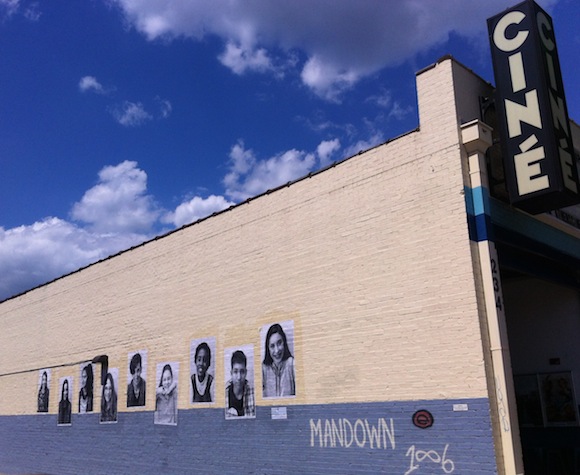
Last Tuesday, June 7, two educators, one preparator and an intern from the Georgia Museum of Art took a break from the galleries to install a new exhibition on an exterior wall of Ciné, the local community-based cinema and arts venue in downtown Athens, Georgia (234 W. Hancock Avenue). This installation is the culmination of the Do Good Fund Teen Photography Workshop, in which a group of local teens learned about the art of photography through the Do Good Fund's exhibition of photographs by Southern artists. In response, the young artists created work to influence community engagement. In conjunction with Inside Out, a worldwide outdoor photography project, the display of eleven teen portraits honors the contributions of young adults to our community’s well-being.
Time-lapse video of the installation by Larry Forte
At the museum, we pride ourselves in preserving works of art to ensure their long existence for the public. For this outdoor installation, we faced a number of challenges that rarely threaten an exhibition indoors. The final large-scale photographs were printed on paper and adhered to the public wall space with a homemade wheat paste made from a mixture of flour and water. Although we always understood this installation was ephemeral and to last for one month, torrential rain and wind quickly disintegrated many of the photographs in just one week, with only two photos managing to stay intact.
But not to fret. The damaged work will be replaced in time to celebrate teen artists at the Athens Farmers Market on Wednesday, June 22, across from Ciné at Creature Comforts from 4 to 7 p.m. The public is invited to create their own self-portrait and continue the young artists’ message that, together, we add life to the Athens community in all of our beautifully individual ways.
Brittany Ranew
Education Program Specialist
* * *
We are the next wave of thinkers, inventors, and astronauts; the ones who will make Athens proud. We are curious, brave, active, smart, shy, busy, loving, daring and different in many ways. We are the quiet ones with books under desks, the bold ones who stand up for what's right, and some of us aren't quite sure who we in are yet.
In these photos you can see our origins our eyes.
Together, we add life to the Athens community.
Artists on view (from left to right): Piper, Crystal, Savannah, Eva, Stacy, Jessa, Kamron, Annesly, Tina, Umberto and Angelina
Contributing artists: Don, Madison, Michael and Sofy
Labels:
Do Good Fund,
education,
public art,
Teen Photography Workshop
Thursday, June 09, 2016
The Georgia Museum of Art and Museums for All
On April 14, 2016, the Georgia Museum of Art at the University of Georgia became the first museum in the state to commit officially to serving low-income families through the Museums for All program. Organized by the Association of Children’s Museums and the Institute of Museum and Library Services (IMLS), Museums for All encourages families of all backgrounds to visit museums regularly and build lifelong museum habits. A study featured in the New York Times concluded that “visiting an art museum exposes students to a diversity of ideas that challenge them with different perspectives on the human condition.” The study showed that students who visited Crystal Bridges Museum of American Art on school tours “demonstrated stronger critical thinking skills, displayed higher levels of social tolerance, exhibited greater historical empathy and developed a taste for art museums and cultural institutions.” In addition, “most of the benefits … observed are significantly larger for minority students, low-income students and students from rural schools.”
With Museums for All, museums with an admission charge offer reduced or free admission to visitors who present an Electronic Benefits Transfer (EBT) card. The Georgia Museum of Art is pleased to join this group of institutions. As part of the state’s flagship land-grant university, the museum has a strong commitment to service and outreach and already offers free admission to all visitors, thereby removing the need to present a card or an ID. About 15 percent of families living in Athens-Clarke County have incomes below the poverty line. By participating in Museums for All, the museum hopes to make low-income visitors aware of this fact and further broaden and diversify its audience.
“I’m pleased to welcome the Georgia Museum of Art into the family of Museums for All participants,” said IMLS director Dr. Kathryn K. Matthew. “As the first museum in Georgia to sign on to the program, the Georgia Museum of Art is leading by example. Through its community outreach and Museums for All participation, the museum will establish its credentials as a true community cornerstone that is accessible to all.”
A full list of participating institutions is available at http://childrensmuseums.org/participating-museums.
For museum hours, location and directions, visit our website.
Hillary Brown
Director of Communications
![]() |
| Young visitors examine a rare Japanese three-paneled screen at the Georgia Museum of Art. |
“I’m pleased to welcome the Georgia Museum of Art into the family of Museums for All participants,” said IMLS director Dr. Kathryn K. Matthew. “As the first museum in Georgia to sign on to the program, the Georgia Museum of Art is leading by example. Through its community outreach and Museums for All participation, the museum will establish its credentials as a true community cornerstone that is accessible to all.”
A full list of participating institutions is available at http://childrensmuseums.org/participating-museums.
For museum hours, location and directions, visit our website.
Hillary Brown
Director of Communications
Labels:
free admission,
Museums for All,
outreach
Thursday, June 02, 2016
"Turned and Sculpted": Wood Art Photography by Michael McKelvey
Hot off the press is the catalogue for the museum's spring exhibition "Turned and Sculpted: Wood Art from the Collection of Arthur and Jane Mason," on display from May 14 to August 7. The exhibition features 30 objects, all made entirely of sculpted wood, by some of the most renowned contemporary artists in the form. The word “turned” in the title of the exhibition reflects the fact that many of the artists used a lathe to sculpt the wood, rotating the material on its axis to create a symmetrical, rounded form.
For the catalogue photography, capturing the intricate textures of wood and the three-dimensionality of wood art poses a unique set of challenges, and photographer Michael McKelvey has done an exceptional job in conveying the tactile nature of the wood sculptures as well as their beauty. Assistant registrar Sarina Rousso, who was present at the photography shoot, said, "I've been working with Michael for about ten years and during all this time it's still an honor to assist someone with such a keen eye for detail and a great appreciation for all art mediums. Some of the bowls were 'tricky,' as he put it, to honor the true piece and deal with the high gloss, but I think he was quite successful!"
Watch the video below for a look at the photographs featured inside the publication.
For the catalogue photography, capturing the intricate textures of wood and the three-dimensionality of wood art poses a unique set of challenges, and photographer Michael McKelvey has done an exceptional job in conveying the tactile nature of the wood sculptures as well as their beauty. Assistant registrar Sarina Rousso, who was present at the photography shoot, said, "I've been working with Michael for about ten years and during all this time it's still an honor to assist someone with such a keen eye for detail and a great appreciation for all art mediums. Some of the bowls were 'tricky,' as he put it, to honor the true piece and deal with the high gloss, but I think he was quite successful!"
Watch the video below for a look at the photographs featured inside the publication.
Thursday, May 26, 2016
Schedule Your Group's Art Adventure Today!
This June and July, Art Adventures will examine contemporary art created at the Mixografia Workshop, a collaborative studio established in 1968 in Mexico City and now based in Los Angeles. In the Mixografia studio, invited artists create three-dimensional prints and use experimental techniques to create handmade paper in relief. Our 90-minute Art Adventure program includes a tour of the exhibition “Paper in Profile: Mixografia and Taller de Gráfica Mexicana” with trained museum guides. Children will investigate the galleries through games that promote close looking and inquiry with museum educators and UGA students who volunteer as education interns. Each participant will also have the opportunity to create a work of art inspired by the exhibition to take home.
Reservations for Art Adventures 2016 are now being accepted. Morning (10–11:30 a.m.) and afternoon (1–2:30 p.m.) time slots are available every Wednesday and Thursday from June 8 to July 28. Each 90-minute session can accommodate up to 30 children, with one chaperone for every 10 children. To schedule your group’s Art Adventure, contact Brittany Ranew at branew@uga.edu or 706.542.0448.
Labels:
Art Adventures,
art education,
programs
Thursday, May 19, 2016
On View: "Refining Realities" by VolvoxLabs
VolvoxLabs is a new media design studio run by Kamil Nawratil, Pa Her and Javier Cruz. “Refining Realities” was created in conjunction with VVOX collaborators, Ryan Kilpatrick, Zyia Zhang and Mariusz Navratil, Kamil’s father. Today’s post is written from the perspective of Benjamin, our Department of Publications intern, about the installation currently on display through June 19 on the Patsy Dudley Pate Balcony.
As an art student at the University of Georgia, I particularly enjoy delving into the complexities of obscure and intellectually challenging works of art such as “Refining Realities.” In this case, I find it fitting to address the installation through the lens of an individual’s evolving experience. Through this personal journey to find meaning in the work, I hope to explicate paths of understanding to emotionally connect with an installation with a life as complex as our own.
The jarring complexity of “Refining Realities” overwhelmed me, and I was so absorbed by theory that I lost sight of the underlying themes. With Kinect sensors placed above each screen, it was easy enough to understand that my interaction with the installation was significant, but the odd patterns only seemed to quiver in response to my sporadic, and sometimes embarrassing, movements. I felt powerless to really manipulate the images even though I knew they were dependent on my actions, but I slowly realized my movements were being dwarfed by a greater influence. Real-time data drawn from undisclosed locations (randomized every 15 minutes) supplies changes in temperature, wind values and cloud coverage; in reaction to these observations, the installation undergoes multiple shifts that add up to a grand, emotional metamorphosis. For instance, when wind speed increases, the LEDs become more energetic. When the temperature rises, the LEDs turn pink. Similarly, when the warm sun begins to shine through the clouds, the ambient music sounds more optimistic and all the panels seem to resonate with a renewed sense of vitality and energy. Upon this enlightenment, I realized it wasn’t just me that was subtly influencing the installation, it was also the fleeting characteristics of the environment that were subtly influencing me through the installation. Additionally, not knowing where the real-time weather data came from universalized that sensation, as though I was being affected by the entire world as a grand idea.
As hinted at by the title, the installation is designed to reduce and repurpose what its sensors describe to it, and this is where “Refined Realities” became increasingly perplexing to me. The way the screens react is simple enough, but the complex, formal mathematical algorithms used to fabricate the initial pattern, followed by the synthesis of the pattern with live data, are something on the forefront of technology. In fact, the computational demands were so extraordinary that the Kinect sensor above the central panel is no longer in place due to limited processing capacity. Several of the monitors were assigned a Voronoi system. Most simply, Voronoi systems are shapes created by the space closest to a particular point on a plane. For clarity, each line in the image below marks locations that are equidistance between a black dot and its closest neighbors, and the space within those lines represent the locations which are closest to the black dots.
Voronoi systems are important because the approximation is useful in understanding complex distributions in real life, such as your very skin’s cells. And that is part of the point of “Refining Realities”: to manifest the forms and patterns underlying life. When I move along the installation, I am reduced to become part of the image, and because of the way it “refines reality,” I am assimilated into the environment. With this came a humble feeling of oneness with nature and art, a wondrous insight into my connection with the surroundings.
After gaining more understanding of the content within the screens, I sought an understanding of how the digital realities presented by the screens related to the intricate frame surrounding them. Most noticeably, the hexagonal patterning created by the Voronoi diagrams and the wave pattern in the central screen is echoed in the frames. I originally perceived it as design for the sake of cohesion, but I later considered it a comment on the difference between the digital and the physical. I began to think about our digital age and how our realities have become increasingly distanced from the physical world. Even as I write this, I consider the intangibility of my words and their loose representation of something real. Here, the environment being monitored is only a digital suggestion of reality, while the frame establishes a connection to the physical environment of the museum. There is also a contrast between the depth created by the frame and the illusion of depth established by the line drawings of Mariusz Navratil. I later learned that the line drawings were spontaneous responses to the forms of the frame, including the shadows the frame casts on the wall. Whether geometric versus organic, digital versus physical or real versus illusion, “Refining Realities” addresses many characteristics of what constitutes our surroundings.
Still, the prevailing influence remains the transitory emotions created by the dynamic environment, and as I tried to dissect my role as viewer in the work, I abandoned my thoughts and surrendered to the influence of how it made me feel. I can get caught up in the idea that art is meant to cater to the viewer, but “Refining Realities” was independent; it became a meditative experience to consciously allow myself to be influenced. Much as the undisclosed source locations were reduced to data points for this installation, I felt reduced by the Kinect sensors until the landscape and I merged into an engulfing singularity on the screens. Some abstract and baffling forms, at once stupefying and unwelcoming, began to take shape as the most poetic reduction of life itself. Sometimes, I irrationally convince myself that I’m some sort of entity outside the system, but my inevitable influence on the environment and the environment’s influence on me inundated my self-centeredness until I felt a sort of engrossing oneness that simultaneously diminished my concerns and assimilated my being into a greater entity of existence.
Benjamin Thrash
Publications Intern
![]() |
| VolvoxLabs, Refining Realities, 2016 |
The jarring complexity of “Refining Realities” overwhelmed me, and I was so absorbed by theory that I lost sight of the underlying themes. With Kinect sensors placed above each screen, it was easy enough to understand that my interaction with the installation was significant, but the odd patterns only seemed to quiver in response to my sporadic, and sometimes embarrassing, movements. I felt powerless to really manipulate the images even though I knew they were dependent on my actions, but I slowly realized my movements were being dwarfed by a greater influence. Real-time data drawn from undisclosed locations (randomized every 15 minutes) supplies changes in temperature, wind values and cloud coverage; in reaction to these observations, the installation undergoes multiple shifts that add up to a grand, emotional metamorphosis. For instance, when wind speed increases, the LEDs become more energetic. When the temperature rises, the LEDs turn pink. Similarly, when the warm sun begins to shine through the clouds, the ambient music sounds more optimistic and all the panels seem to resonate with a renewed sense of vitality and energy. Upon this enlightenment, I realized it wasn’t just me that was subtly influencing the installation, it was also the fleeting characteristics of the environment that were subtly influencing me through the installation. Additionally, not knowing where the real-time weather data came from universalized that sensation, as though I was being affected by the entire world as a grand idea.
As hinted at by the title, the installation is designed to reduce and repurpose what its sensors describe to it, and this is where “Refined Realities” became increasingly perplexing to me. The way the screens react is simple enough, but the complex, formal mathematical algorithms used to fabricate the initial pattern, followed by the synthesis of the pattern with live data, are something on the forefront of technology. In fact, the computational demands were so extraordinary that the Kinect sensor above the central panel is no longer in place due to limited processing capacity. Several of the monitors were assigned a Voronoi system. Most simply, Voronoi systems are shapes created by the space closest to a particular point on a plane. For clarity, each line in the image below marks locations that are equidistance between a black dot and its closest neighbors, and the space within those lines represent the locations which are closest to the black dots.
Voronoi systems are important because the approximation is useful in understanding complex distributions in real life, such as your very skin’s cells. And that is part of the point of “Refining Realities”: to manifest the forms and patterns underlying life. When I move along the installation, I am reduced to become part of the image, and because of the way it “refines reality,” I am assimilated into the environment. With this came a humble feeling of oneness with nature and art, a wondrous insight into my connection with the surroundings.
After gaining more understanding of the content within the screens, I sought an understanding of how the digital realities presented by the screens related to the intricate frame surrounding them. Most noticeably, the hexagonal patterning created by the Voronoi diagrams and the wave pattern in the central screen is echoed in the frames. I originally perceived it as design for the sake of cohesion, but I later considered it a comment on the difference between the digital and the physical. I began to think about our digital age and how our realities have become increasingly distanced from the physical world. Even as I write this, I consider the intangibility of my words and their loose representation of something real. Here, the environment being monitored is only a digital suggestion of reality, while the frame establishes a connection to the physical environment of the museum. There is also a contrast between the depth created by the frame and the illusion of depth established by the line drawings of Mariusz Navratil. I later learned that the line drawings were spontaneous responses to the forms of the frame, including the shadows the frame casts on the wall. Whether geometric versus organic, digital versus physical or real versus illusion, “Refining Realities” addresses many characteristics of what constitutes our surroundings.
Still, the prevailing influence remains the transitory emotions created by the dynamic environment, and as I tried to dissect my role as viewer in the work, I abandoned my thoughts and surrendered to the influence of how it made me feel. I can get caught up in the idea that art is meant to cater to the viewer, but “Refining Realities” was independent; it became a meditative experience to consciously allow myself to be influenced. Much as the undisclosed source locations were reduced to data points for this installation, I felt reduced by the Kinect sensors until the landscape and I merged into an engulfing singularity on the screens. Some abstract and baffling forms, at once stupefying and unwelcoming, began to take shape as the most poetic reduction of life itself. Sometimes, I irrationally convince myself that I’m some sort of entity outside the system, but my inevitable influence on the environment and the environment’s influence on me inundated my self-centeredness until I felt a sort of engrossing oneness that simultaneously diminished my concerns and assimilated my being into a greater entity of existence.
Benjamin Thrash
Publications Intern
Thursday, May 12, 2016
Morning Mindfulness: Monastics Event
For the final spring session of Morning Mindfulness, the meditation practice program held at the Georgia Museum of Art, the museum hosted the Magnolia Grove Monastics from the Order of Thich Nhat Hanh. More than 70 attendees came for the event, which opened with songs, a brief seated meditation and a lecture on mindfulness. Guests were then lead through a guided walking meditation by the Monastics, activating the outdoor spaces of the museum and the Jane and Harry Willson Sculpture Garden.
Thank you to Brother Radiant, Brother Sang To, Brother Capacity, Brother Clarity, Sister Communication, Sister Joy, Sister Xu Nghiem and Sister Beauty for coming to the museum and promoting mindful meditation.
"Morning Mindfulness: Monastics Event" was made possible by Dr. Jerry Gale, professor in the department of human development and family science at the University of Georgia and sponsored by the Faculty Learning Community of Mindfulness, Center for Teaching and Learning and the Marriage and Family Therapy Certificate Program.
Morning Mindfulness is free and open to the public. We invite everyone to participate in guided mindfulness meditation in spaces throughout the museum. The sessions include instructor-led meditation and a period of reflection and discussion. Check our calendar for specific dates when Morning Mindfulness returns this August.
Thank you to Brother Radiant, Brother Sang To, Brother Capacity, Brother Clarity, Sister Communication, Sister Joy, Sister Xu Nghiem and Sister Beauty for coming to the museum and promoting mindful meditation.
![]() |
| Photo: Mic McCoy |
![]() |
| Photo: Mic McCoy |
![]() |
| Photo: Mic McCoy |
"Morning Mindfulness: Monastics Event" was made possible by Dr. Jerry Gale, professor in the department of human development and family science at the University of Georgia and sponsored by the Faculty Learning Community of Mindfulness, Center for Teaching and Learning and the Marriage and Family Therapy Certificate Program.
Morning Mindfulness is free and open to the public. We invite everyone to participate in guided mindfulness meditation in spaces throughout the museum. The sessions include instructor-led meditation and a period of reflection and discussion. Check our calendar for specific dates when Morning Mindfulness returns this August.
Labels:
event recap,
events,
meditation,
Morning Mindfulness
Thursday, May 05, 2016
Spotlight on Studio Workshops: Q&A with Instructor Hope Hilton
This spring, Athens-based artist and educator Hope Hilton will be leading "Studio Workshop: Realism and Representational Art,” a four-part studio-based course that introduces participants to effective techniques for achieving realistic and representational outcomes in works of art. In advance of the course, Hope answered a few of our questions related to the workshop, art and artistic inspiration.
1. What are some of your favorite works at the Georgia Museum of Art?
I absolutely love the Radcliffe Bailey piece! I graduated from Atlanta College of Art and so did he, so beyond the medium and the narrative I'm also really proud. My favorite pieces, though, are in the handcrafted area — the wooden chair made by hand and the quilts, among others. I like to see how people make things with no formal or academic training. It often is more interesting for me to view a work that's intention was to not be shown in a museum. It has something to do with the necessity of a chair or a quilt and then the maker really making it their own that strikes me. That natural impulse to create and adding individuality is something I admire deeply.
2. How does a visit to the museum inspire you as an artist?
It reminds me that there is always the human impulse to create, and it inspires me to try new ways of working and new mediums.
3. What are some of the pieces from the museum's collection that you have selected to use in "Studio Workshop: Realism and Representational Art", and why did you choose these?
I selected a Chuck Close piece because the guy could really, really draw. I mean, holy cow! I especially like how representational he makes his portraits knowing that he does not have natural recognition of people's faces. Peggy Bacon is another artist I chose because her mark is confident and strong. Art museums can also be very heavy in their collected work created by men so I made selections to promote the diversity within the collection. I couldn't resist including an Art Rosenbaum because he's local and has done so much work documenting Southern culture. I also love that he creates environments within his drawings and tells a story with loose marks.
4. Is there something you are currently working on or are excited about starting that you can tell us about?
I've been completely invested the past several years in learning about the plants that enslaved Africans and their descendants used in this area. Because I'm not a horticulturalist I've had a lot of fun learning about medicinal plants and their uses, especially the plants that I always learned were weeds. The history of this area is so rich and complicated. Drawing and painting these plants has been a way for me to recognize this past and tell a story, while also enriching my own learning.
5. What do you read, listen to, or look at to fuel your work?
Oh, wow. Anything and everything. I read a lot of slave narratives as well as interviews from the past. I'm currently listening to Rihanna's new album on repeat in my studio. It's really powerful and motivating, but also vulnerable. I appreciate that mix, because it's human. I also read a ton of poetry for this reason. When I need to tune out I watch British detective shows. I also teach kids of all ages and their work inspires me so much. They're really brave when encountering new ideas. I just watch them go and their fearlessness reminds me to persevere.
6. What advice or words of wisdom have influenced you as an artist?
My high school counselor told me pursuing art was a waste of time. It was probably the best thing that ever happened to me, though it was painful. I really wanted to prove her wrong. Over twenty years later I certainly have, haha. Also, the poet Rilke said this and it has been with me since college:
“Be patient toward all that is unsolved in your heart and try to love the questions themselves, like locked rooms and like books that are now written in a very foreign tongue. Do not now seek the answers, which cannot be given you because you would not be able to live them. And the point is, to live everything. Live the questions now. Perhaps you will then gradually, without noticing it, live along some distant day into the answer.”
And gosh do I ever love that.
I've heard this, love it and shared it over the years — don't stop. It's that simple.
"Studio Workshop: Realism and Representational Art" runs Thursdays, May 5 through 26, from 6:30 to 8:30 p.m. Artists from all backgrounds are encouraged to attend, as these museum sessions are designed to be equally engaging for enthusiastic beginners and seasoned practitioners alike. The sessions draws inspiration from the museum’s collection, including works from the archives not currently on display. The cost of the course is a $15 materials fee, which covers all necessary supplies for the four sessions. Call 706.542.8863 or email callan@uga.edu to register.
![]() |
| Photo: Sarah Baugh, EarlyGirl Photography |
1. What are some of your favorite works at the Georgia Museum of Art?
I absolutely love the Radcliffe Bailey piece! I graduated from Atlanta College of Art and so did he, so beyond the medium and the narrative I'm also really proud. My favorite pieces, though, are in the handcrafted area — the wooden chair made by hand and the quilts, among others. I like to see how people make things with no formal or academic training. It often is more interesting for me to view a work that's intention was to not be shown in a museum. It has something to do with the necessity of a chair or a quilt and then the maker really making it their own that strikes me. That natural impulse to create and adding individuality is something I admire deeply.
2. How does a visit to the museum inspire you as an artist?
It reminds me that there is always the human impulse to create, and it inspires me to try new ways of working and new mediums.
3. What are some of the pieces from the museum's collection that you have selected to use in "Studio Workshop: Realism and Representational Art", and why did you choose these?
I selected a Chuck Close piece because the guy could really, really draw. I mean, holy cow! I especially like how representational he makes his portraits knowing that he does not have natural recognition of people's faces. Peggy Bacon is another artist I chose because her mark is confident and strong. Art museums can also be very heavy in their collected work created by men so I made selections to promote the diversity within the collection. I couldn't resist including an Art Rosenbaum because he's local and has done so much work documenting Southern culture. I also love that he creates environments within his drawings and tells a story with loose marks.
4. Is there something you are currently working on or are excited about starting that you can tell us about?
I've been completely invested the past several years in learning about the plants that enslaved Africans and their descendants used in this area. Because I'm not a horticulturalist I've had a lot of fun learning about medicinal plants and their uses, especially the plants that I always learned were weeds. The history of this area is so rich and complicated. Drawing and painting these plants has been a way for me to recognize this past and tell a story, while also enriching my own learning.
5. What do you read, listen to, or look at to fuel your work?
Oh, wow. Anything and everything. I read a lot of slave narratives as well as interviews from the past. I'm currently listening to Rihanna's new album on repeat in my studio. It's really powerful and motivating, but also vulnerable. I appreciate that mix, because it's human. I also read a ton of poetry for this reason. When I need to tune out I watch British detective shows. I also teach kids of all ages and their work inspires me so much. They're really brave when encountering new ideas. I just watch them go and their fearlessness reminds me to persevere.
6. What advice or words of wisdom have influenced you as an artist?
My high school counselor told me pursuing art was a waste of time. It was probably the best thing that ever happened to me, though it was painful. I really wanted to prove her wrong. Over twenty years later I certainly have, haha. Also, the poet Rilke said this and it has been with me since college:
“Be patient toward all that is unsolved in your heart and try to love the questions themselves, like locked rooms and like books that are now written in a very foreign tongue. Do not now seek the answers, which cannot be given you because you would not be able to live them. And the point is, to live everything. Live the questions now. Perhaps you will then gradually, without noticing it, live along some distant day into the answer.”
And gosh do I ever love that.
I've heard this, love it and shared it over the years — don't stop. It's that simple.
"Studio Workshop: Realism and Representational Art" runs Thursdays, May 5 through 26, from 6:30 to 8:30 p.m. Artists from all backgrounds are encouraged to attend, as these museum sessions are designed to be equally engaging for enthusiastic beginners and seasoned practitioners alike. The sessions draws inspiration from the museum’s collection, including works from the archives not currently on display. The cost of the course is a $15 materials fee, which covers all necessary supplies for the four sessions. Call 706.542.8863 or email callan@uga.edu to register.
Labels:
Hope Hilton,
local artists,
studio workshops
Thursday, April 28, 2016
Master of Fine Arts Degree Candidates Exhibition
On display at the museum is
the spring Master of Fine Arts Degree Candidates Exhibition, showing now through
May 1. This annual exit show highlights the work by students in the MFA program
at Lamar Dodd by giving them space in the museum’s galleries to share their
projects. This year, 15 students have work displayed in a variety of different
mediums, including photography, painting, drawing, sculpture, videography,
metalwork, printmaking and interior design.
This exhibition is a special
opportunity for students; for many of them, it will be the first time their
artwork has been displayed in a museum. The students produced many interesting
pieces, which vary greatly in style and intent to form an eclectic assemblage
of talent. Erin Mazzei’s
work, "Vantage Point," features a
geometrically shaped, three-dimensional photo series that depicts a blue sky.
In an oil painting by Michael Ross
called "Crossing," historical soldiers
stumble through a blurry, rainbow forest. A video by Miranda Maynard
humorously portrays the actions of a woman who applauds cheerily, then
uncomfortably looks around the room in "Clapping for the Amount of Time that Hillary Applauded her
Husband at the Start of his 1999 State of the Union Address."
Other students featured in the MFA exhibition include Michael Benedetti, Ryan McCullough, Saegan Moran, Heather Foster, Drema Montgomery, Spence Townsend, Yongxi Wang, Janelle Young, Courtney McCracken, Aaron Obenza, Vivienne Varay and Lu Yang.
Thursday, April 21, 2016
New Illumination at the Georgia Museum of Art
![]() |
| MFA 2016 opening reception |
![]() |
| LEDs illuminating Vantage Point (Sky Swap) by Erin Mazzei '16 |
To find out about upcoming events at the museum, click here.
Labels:
earth day,
lighting,
sustainability
Thursday, April 14, 2016
David Ligare and the Meaning of Xenia
Upon first
sight of David Ligare’s work, it’s easy to feel transported to Homeric Greece.[1] In a time
when contemporary art is often abstract and non-representational, Ligare pulls
from the traditional subject of still lifes, landscapes and nude figures. He
fuses modernity and antiquity,
synthesizing a new ideal that celebrates both tradition and contemporary
society. Like the Renaissance artists of the 16th and 17th centuries, Ligare
realizes society’s “need
of a renewed desire for knowledge,” and he seeks to elevate the viewer’s
intellectual growth by means of the “literate picture[2].” The Renaissance
marked a period of humanism and it was highlighted by the works of Michelangelo,
which synthesized contemporary religion with a renewal of classical themes.[3]
Ligare’s paintings function similarly; he synthesizes classicism with objects
indicative of modern society. Despite his unmistakable affiliation with
unfashionable subjects and dated means of representation, David Ligare has
thrived in the modern art world because he finds equilibrium between relevance
and irrelevance. His paintings depict his native California landscape to
substitute that of Greece or Rome, and he paints from living models rather than
ancient Greek sculptures. Also, inspired by the writings of John Steinbeck and
Robinson Jeffers, he very deliberately fabricates narrative paintings that
speak greater truths about the subjects and the environment surrounding them, though
narration is frequently omitted in modern
art. In keeping with works that recede under the dominance of more nuanced
paintings, Ligare’s still lifes maintain an unassuming presence, but also
typical of his work, the still lifes showcase the greatest reinvention of an
old practice. In “Still Life with Grape Juice and Sandwiches (Xenia),” Ligare
utilizes the simplest of objects to create the deepest of meanings.
Although
his still lifes lack an immediate narrative resonance, Ligare very thoughtfully
chooses his objects and their lighting to provide his subjects with new life
and to expand the potential of this long-forgotten practice. Be that as it may,
he manages to create a semblance of allegory in the way his objects burst with
meaning specific to Greek myths, like mementos of heroic journeys. Alluding
Homer’s great epic, The Odyssey,
“Still Life with Grapes and Sandwiches (Xenia)” directly references the Greek
custom of xenia. Literally translated as “guest-friendship,” xenia refers to
the tradition of hospitality when hosts would treat weary travelers with the
utmost generosity, and guests would return the favor with the utmost courtesy.
Integral to this practice is the offering of wine and bread, and many times
throughout Odysseus’ journey, he is provided the very substances.
Characteristic of Ligare, he pulls from this deeply rooted ritual and
re-contextualizes it with contemporary objects. Instead of rich wine and
authentic loaves, he presents a pitcher of cheap grape juice and a heap of
bologna sandwiches on highly artificial bread. The grape juice is presumably of
poor quality because Ligare was inspired by his time serving in a soup kitchen
for the homeless in Salinas, California. There is something distinctly resonant
in the difference between homeless people today, with whom most people avoid
eye-contact, and the temporarily homeless travelers of ancient Greece who were
treated just short of gods. Granted, the hosts feared the retribution of
failing to accommodate gods in disguise, but the Greeks had a well-developed
humanity that became influential to Ligare and Renaissance artists alike.
Though the xenia of today functions in a dramatically different context, the
heartfelt connection he felt with the homeless he served is evident. The
unsettling divergence between xenia and its modern equivalent is how it has
been transformed into the most menial offering of food, the minimum sustenance for
life in an increasingly arduous world.
Much
as the grape juice and sandwiches act as the essential substance of life for
the homeless, Ligare’s still lifes resound their own essence of life. Still
lifes have historically been divided into two categories: memento mori, which
emphasize the remembrance of death, and vanitas, which deal with the transience
(or even futility) of life. The way morning light strikes the objects and the
way food connotes the preservation of life suggests the latter, entertaining a
feeling of hope with a subconscious understanding of the food’s inevitable
spoilage. The ephemerality of food parallels that of humanity, but Ligare
typically uses fruit that suggest the abundance and prosperity of life — like
plums, apples, and olives. Food has a particularly poetic quality in the way it
functions both as a core component of life and as an object of love and
comradery between people. In “Still Life with Grape Juice and Sandwiches
(Xenia),” Ligare also capitalizes on the sacramental quality of wine and bread
in the Christian religion, framing it in an altar of sorts. The Greeks
frequently made offerings to gods in celebration of their prosperity, so the
stage functions as an altar in which ordinary objects gain religious
significance. Originally a pragmatic solution to a compositional problem, the
box fulfills several artistic purposes. Primarily, he seeks a controlled space
in which to conduct rigorous investigations of the objects, but it also fosters
a “harmony of wholeness,” as the artist puts it, which resembles the work of
old masters. The marble box is also conducive to Ligare’s heavily-controlled
style, providing a space of measured precision matched only by the sculpture
and architecture of Hellenism. The enigmatic, sterile background creates a
sense of isolation akin to surrealism, but it merely acts as a medium through
which to emphasize the allegorical potential of the grape juice and sandwiches.
By granting inanimate objects the attention provided by painting and exhibition,
Ligare forces ordinary commodities into the forefront of a viewer’s thoughts,
fostering a greater appreciation for an object’s narrative history.
“Still Life with Grape Juice and Sandwiches (Xenia)” marks a culmination of Ligare’s most significant accomplishments in still life painting. It connotes a Greek tradition which speaks to both his humanitarian goals and his affinity for classicism. Whether it be a reference to the continuation of xenia, the practice of the Christian Eucharist, or the simple act of giving food to the homeless, Ligare capitalizes on the potential plurality of meaning within objects and expands the boundaries of still life painting by dramatizing the transience of meaning throughout the course of history.
Benjamin Thrash
Publications Intern
[1]
Homer is the author of the epic poems The
Iliad and The Odyssey, two defining
works of the Greek people and two of the oldest pieces of literature ever known.
[2] Words
from the artist in David Ligare:
California Classicist by Scott A. Shields.
[3]
Humanism was a concept that reemerged during the Renaissance and emphasized the
intellectual and creative potential of man.
Thursday, April 07, 2016
Collectors Auction Preview: "All About Art"
![]() |
| For the auction: John L. Cleaveland Jr., View from Montefaucon, the Argonne France (n.d.). Oil on panel, 13 x 15 inches, framed. |
Every other year, the museum’s Collectors group (an upper-level membership group within the Friends of the Georgia Museum of Art) organizes a fabulous evening of food, fun and fundraising, the proceeds from which go toward enriching the museum’s collection. This April 23 brings “All About Art,” the latest version of the event. Chaired by Greg Barnard, the new head of the Collectors, the event gets started at 6:30 p.m. with cocktails and a silent auction at the museum, followed by dinner catered by Epting Events.
| For the auction: Robert Clements, Summer Meadow (2012). Acrylic, 24 x 30 inches, framed. |
Barnard says the theme reflects the evening’s purpose: “It’s all about acquiring art for the museum and, by extension, for the state of Georgia and its residents — us, in other words.” Previous auctions have led to the purchase of works on prominent display in the museum’s permanent collection galleries, from the early Georgia portrait of William Harris Crawford to the Dorothy Dehner sculpture that joined the collection in 2014.
Barnard says, “In addition to notable works of art — paintings, drawings, photography, prints and sculpture — by both area and non-area artists, the auction will feature fashion accessories, contemporary and antique furnishings and decor, entertainment opportunities such as catered dinners and restaurant meals and personal ‘get-away’ experiences such as spa treatments.”
![]() |
| For the auction: Carol John, Turquoise Chrysanthemum (2015). Oil on canvas, 60 x 48 inches. |
Heirloom Café and artist Susie Burch have donated a farmers’ market tour and four-course lunch or supper for eight people, including wine pairings, to be held in Susie’s studio, which houses portraits of local farmers. Epting Events has contributed a period dinner for a group of people at The Hill, Lee Epting’s beautiful hideaway event space in Athens. Last Resort Grill has donated a $100 gift certificate, and many more donations are still coming in.
This year, sponsors at the $1,000 level are entitled not only to four tickets to the event, but also to priority auction check-out at the end of the evening and an exclusive cocktail-hour preview starting at 5:30 p.m., with a “buy-it-now” option for auction items.
![]() |
| For the auction: Margie Spalding, French Bottle and Lady Apples (n.d.). Oil, 9 x 12 inches, framed. |
Ticket information:
Members of Friends of the Georgia Museum of Art: $100/person, nonmembers: $125/person.
To purchase tickets or to sponsor the event, visit http://bit.ly/collectors-auction16.
It’s not too late to become a member! For more information, visit http://georgiamuseum.org/join, or call 706.542.0830 or email jointhemuseum@uga.edu.
Labels:
Collectors,
Collectors Auction,
development,
events
Thursday, March 31, 2016
New Acquisitions: "Girl Sewing (The Chinese Robe)" by Frederick Carl Frieseke
![]() |
| Frederick Carl Frieseke, Girl Sewing (The Chinese Robe) (1931) |
Among the latest additions to the Georgia Museum of Art's permanent collection is the American Impressionist painting “Girl Sewing (The Chinese Robe)” by Frederick Carl Frieseke (pronounced FREE-suh-kuh). Peaceful domestic settings were a common theme in American Impressionism. This purchase was made possible with funds given by The Chu Family Foundation. Dr. David Chu is a distinguished research professor emeritus in UGA’s College of Pharmacy. He and his wife, Jane, made this financial gift through their family foundation with the specific goal of having the museum purchase a significant American painting. The museum held a formal unveiling to commemorate the acquisition of this painting.
![]() |
| Gift unveiling with Jane Chu of The Chu Family Foundation |
Sarah Kate Gillespie, our curator of American art, said, “Frieseke was an important force in American Impressionism, particularly among those Americans working in the colony of Giverny, France, adjacent to Claude Monet’s gardens. He enjoyed great popularity on both sides of the Atlantic. This particular work not only fills what had been a major gap in the genre within our collection, but also very much complements our current holdings in American Impressionism.”
“Girl Sewing (The Chinese Robe)” is now on view in the Marilyn Overstreet Nalley Gallery at the museum, alongside other American Impressionist paintings from the collection by Mary Cassatt, Frank Weston Benson, Childe Hassam and William Merritt Chase.
Thursday, March 24, 2016
Highlights from Black History Month Dinner 2016
At the end of February, the Georgia Museum of Art held its
annual Black History Month dinner and awards ceremony. The title of this year’s
event was “Hallowed Ground: Sites of African American Memory,” in coordination
with the overarching theme of Black History Month in the U.S. Guests from
around the nation congregated at the museum to reflect on and celebrate the
contributions of African Americans to Georgia’s culture.
At the event, museum curators Sarah Kate Gillespie and
Shawnya Harris led gallery talks about pieces in the permanent collection by
African American artists, including paintings by Emma Amos, winner of this
year’s Thompson award. Guests were also treated to a concert by the UGA African
American Choral Ensemble, followed by dinner and dessert in the M. Smith
Griffith Grand Hall. At the ceremony, Michael L. Thurmond and Emma Amos’s
awards were presented; both Thurmond and India Amos, daughter of Emma Amos,
gave wonderful acceptance speeches. Read more about our winners here.
Curator Sarah Kate Gillespie giving a gallery talk about paintings
by African American artists. Image: Madison Bledsoe
Two women visiting in front of the Emma Amos feature
wall in the museum galleries. Image: Madison Bledsoe
Table of students waiting for the awards ceremony to begin. Image: Madison Bledsoe
The Thompsons and friends. Image: Madison Bledsoe
Dr. Gregory Broughton directing a concert set by the UGA
African American Choral Ensemble. Image: Madison Bledsoe
Michael L. Thurmond accepting the 2016 Lillian C. Lynch
Citation from Peggy Galis. Image: Madison Bledsoe
India Amos accepting the 2016 Larry D. and Brenda A. Thompson
Award from Shawnya Harris. Image: Madison Bledsoe
Past honoree, Harold Rittenberry, congratulates
Michael L. Thurmond. Image: Madison Bledsoe
Subscribe to:
Posts (Atom)