This past December, The New York Times put together an interesting article that took a closer look at the book Rescuing Da Vinci, which focused on some of the art recovery efforts following World War II. As the world currently grapples with how best to handle the issues involving the removal of art and other artifacts resulting from the invasions of Afghanistan and Iraq, it's worthwhile to take a look at some examinations of what happened in the 1940s. The following are some suggested reads that deal with this topic.
Rescuing Da Vinci - During and following WWII, a special multinational group of more than 350 men and women served behind enemy lines and joined frontline military units to ensure the preservation, protection, liberation and restitution of the world's greatest artistic and cultural treasures. This "band of unsung heroes," formally referred to as the Monuments, Fine Arts and Archives (MFAA) section, or commonly referred to as the "Monuments Men," worked tirelessly to track down, identify and catalogue millions of priceless works of art and irreplaceable cultural artifacts, including masterpieces by Da Vinci, Michelangelo, Rembrandt and Vermeer, that had been stolen by Hitler and the Nazis.
The Rape of Europa: The Fate of Europe's Treasures in the Third Reich and the Second World War - Every few months you'll read a newspaper story of the discovery of some long-lost art treasure hidden away in a German basement or a Russian attic: a Cranach, a Holbein, even, not long ago, a da Vinci. Such treasures ended up far from the museums and churches in which they once hung, taken as war loot by Allied and Axis soldiers alike. Thousands of important pieces have never been recovered. Lynn Nicholas offers an astonishingly good account of the wholesale ravaging of European art during World War II, of how teams of international experts have worked to recover lost masterpieces in the war's aftermath and of how governments "are still negotiating the restitution of objects held by their respective nations."
The Lost Museum - Pillage is one of the traditional perks of warfare. But it took Adolf Hitler to systematize the decimation and despoiling of cultures, and it took Hector Feliciano seven years to track five famous art collections stolen by the Nazis. He uncovered not only Nazi schemes but also a well-oiled machine of collaborators, informants, moving companies, and neighbors, all with their fingers in the pie. The Lost Museum reads like a good detective story. Inspired by a fascination with the theft of five prominent Parisian Jewish families' art collections, it focuses on the beneficiaries of the thefts and justice for its victims. Filled with family photos of the art, some never before seen by the public, The Lost Museum tracks the pieces as they passed through the hands of German officials, unscrupulous art dealers, and unsuspecting auction houses. That the network was so deviously intricate illustrates the enormous challenge of restitution.

Monday, February 12, 2007


Got a date?
Who knew we were such a desirable romantic destination?
The museum is free, so there's that. Plus, art is terribly romantic.
The museum is free, so there's that. Plus, art is terribly romantic.
Cheap date tip
 According to Emily Gomez in the University of Georgia student newspaper, The Red & Black, the Georgia Museum of Art is good for a cheap date. Apparently, according to Ms. Gomez, "date night has dwindled in college. ...
The next time you want to go on a real date, but you are hurting for cash, try these cheap date tips, and don't let dates become extinct. ...
Indulge in the arts. Go to the Georgia Museum of Art, or check out concerts at the School of Music."
Can't really get much "cheaper" than the GMOA...always free.
Friday, February 09, 2007
Love is in the air, and on fabric
Right now, we've got Modern Threads: Fashion and Art by Mariska Karasz up at the museum, which is a beautiful exhibition chronicling the work of Hungarian designer Mariska Karasz. Karasz was an accomplished fashion designer, who crafted numerous outfits for her daughters, Solveig and Rosamond.
One of the works done for her daughters on display at the museum is a scarf that is decorated with hearts and cherubs, which is perfect with Valentine's Day right around the corner.

One of the works done for her daughters on display at the museum is a scarf that is decorated with hearts and cherubs, which is perfect with Valentine's Day right around the corner.

Wednesday, February 07, 2007
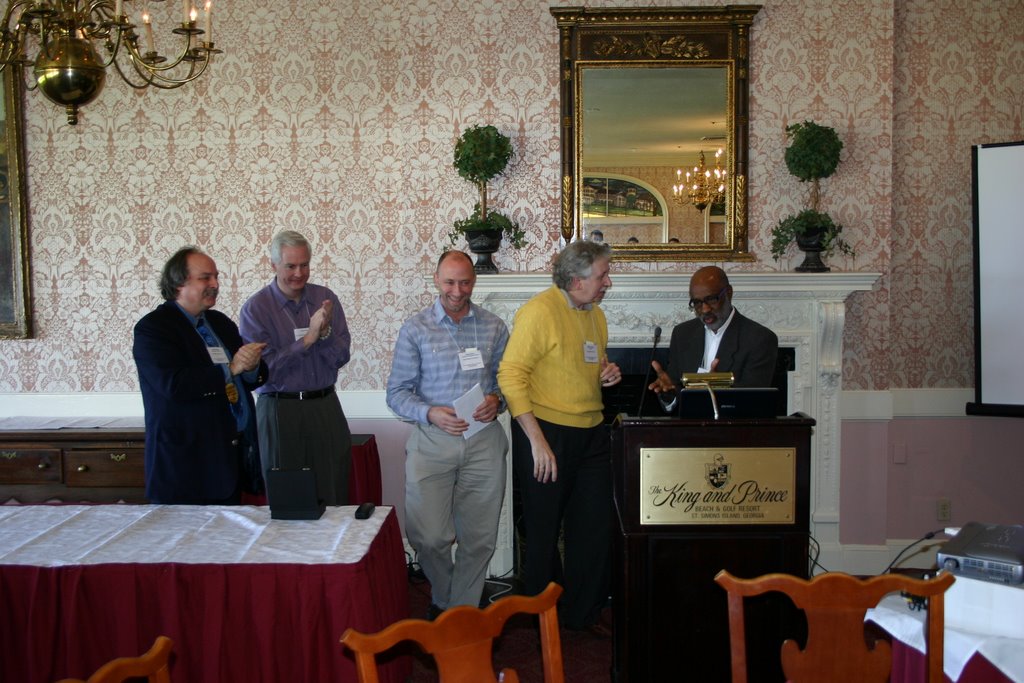
Bigtime honors
William Eiland, the director of the Georgia Museum of Art, recently received the Lifetime Achievement Award from the Georgia Association of Museums and Galleries. Eiland has been the museum's director for the past 14 years and has overseen the expansion of the museum's permanent collection, its move from North Campus to its current location in the Performing and Visual Arts Complex and the current fundraising process to build the necessary Phase II expansion for the museum.

Monday, February 05, 2007
On Children at Play
There's a good bit of permanent collection up at the museum right now, and one of the featured works is Jacob Lawrence's Children at Play.
Lawrence, born in Atlantic City, N.J., grew up as the eldest child of three in a series of foster homes and settlement houses in Pennsylvania; his mother had left the children and gone to New York City in search of work. When Lawrence was about 13, his mother re-settled the family in Harlem and enrolled the children in Utopia House, a settlement house whose after-school arts program was run by Charles Alston, the cousin of Romare Bearden. Lawrence studied with Alston during the early 1930s, and Alston’s studio became a center in the Harlem Renaissance – a group of writers, mural and easel painters, poets, composers, and choreographers flourishing during the 1920s then assisted by the federal programs of the Works Progress Administration.
With the help of a Rosenwald Foundation Fellowship, Lawrence created his most well-known paintings – 60 gesso panels titled The Migration of the Negro (1940-41). He arranged for Romare Bearden to have a studio directly above his. Lawrence was drafted into the U.S. Coast Guard in 1943. Following his discharge at the end of World War II, Lawrence taught at Black Mountain College in North Carolina, the Pratt Institute, and the University of Washington, among many other places. Lawrence, in Children at Play, painted in Harlem following World War II, utilizes primary colors and flattened forms to show an everyday urban scene.
In 1970, looking back on his career as an artist, Lawrence stated: “If I have achieved a degree of success as a creative artist, it is mainly due to the black experience which is our heritage – an experience which gives inspiration, motivation, and stimulation. I was inspired by the black aesthetics by which we are surrounded, motivated to manipulate form, color, space, line, and texture to depict our life, and stimulated by the beauty and poignancy of our environment.”
One busy weekend
It was a jam-packed weekend at the museum with three different events on three consecutive days, all geared at different audiences.
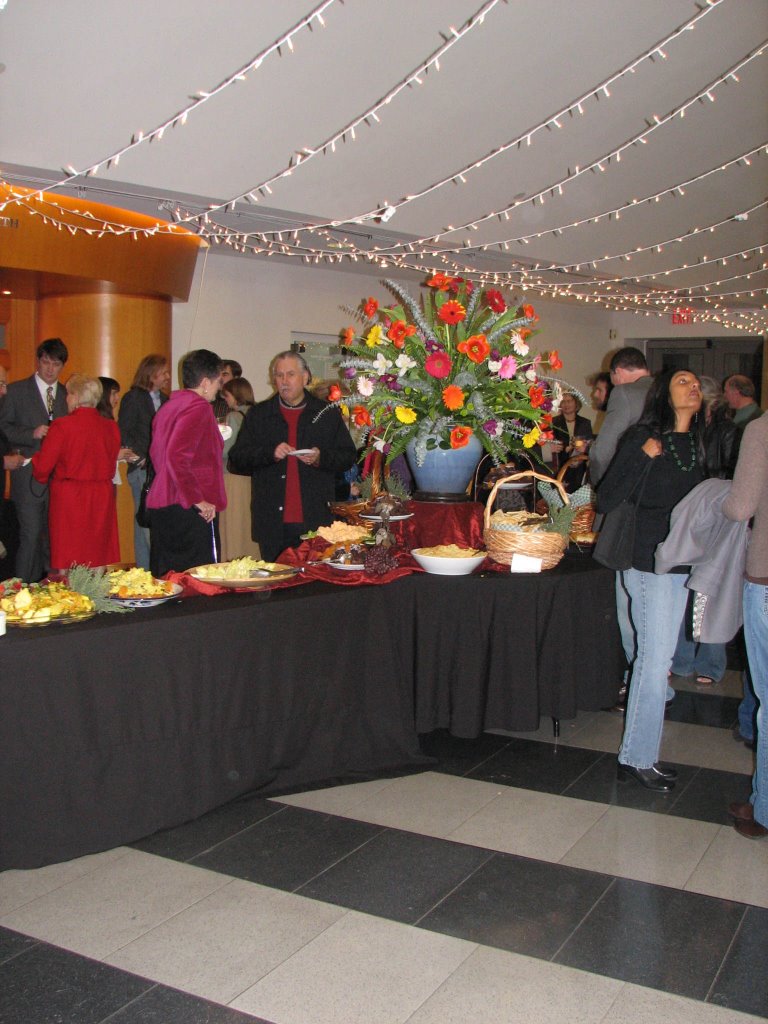
On Friday, we hosted AfterHours@GMOA, which was the opening reception for the exhibitions Modern Threads: Fashion and Art by Mariska Karasz and Wild Ride: Artistic Lessons of Nature by Eric Strauss.

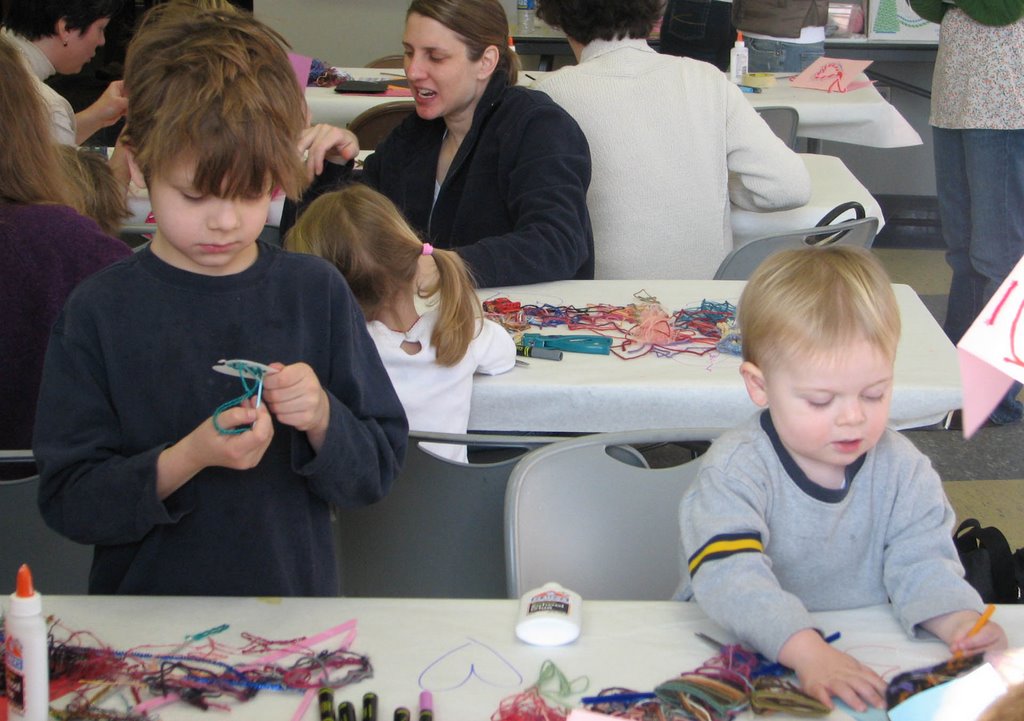
On Saturday, the monthly Family Day program offered by our education department was dedicated to the work of Mariska Karasz, and children packed the museum to take a look in our galleries and then came down to the classroom to work on their own Valentine's Day cards.
Finally, on Sunday afternoon, Solveig Cox and Rosamond Berg Brassett, the daughters of Mariska Karasz, joined Ashley Callahan to give a gallery talk on their mother's work. More than 40 people came to the museum to hear about Karasz's work, as well as some personal stories from the daughters' childhood.

To view photos from all three events, please visit the museum's web site.
On Friday, we hosted AfterHours@GMOA, which was the opening reception for the exhibitions Modern Threads: Fashion and Art by Mariska Karasz and Wild Ride: Artistic Lessons of Nature by Eric Strauss.
On Saturday, the monthly Family Day program offered by our education department was dedicated to the work of Mariska Karasz, and children packed the museum to take a look in our galleries and then came down to the classroom to work on their own Valentine's Day cards.
Finally, on Sunday afternoon, Solveig Cox and Rosamond Berg Brassett, the daughters of Mariska Karasz, joined Ashley Callahan to give a gallery talk on their mother's work. More than 40 people came to the museum to hear about Karasz's work, as well as some personal stories from the daughters' childhood.
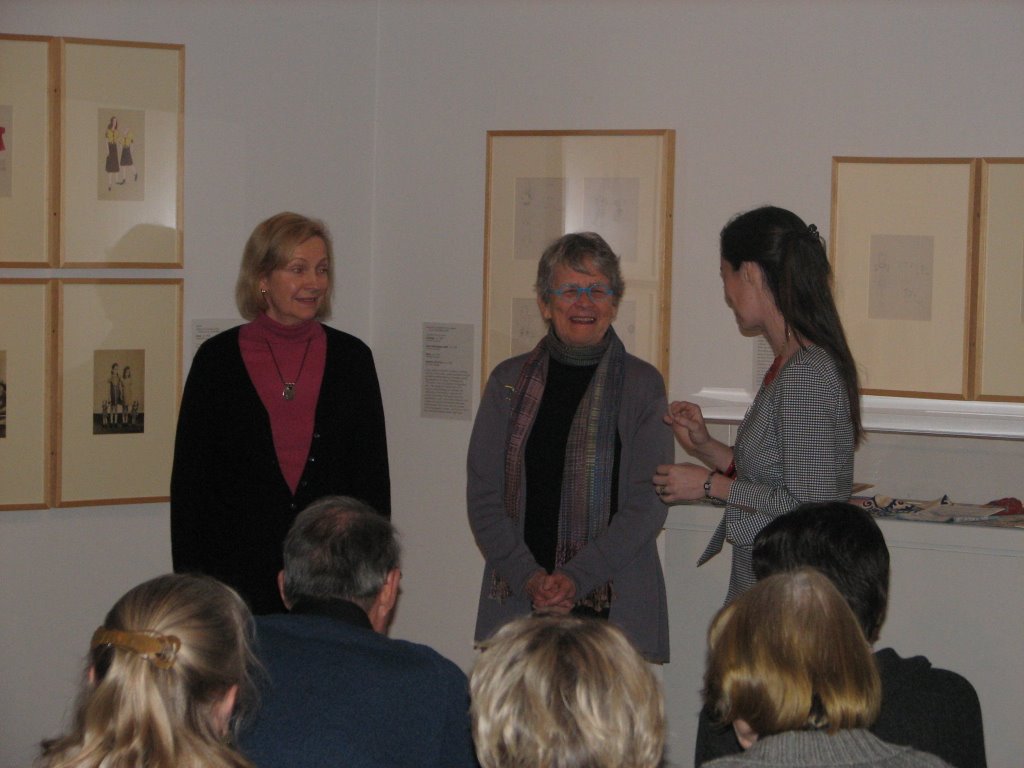
To view photos from all three events, please visit the museum's web site.
Tuesday, January 23, 2007
Figgie's@Five schedule lined up
We've set up our lineup for the next few editions of Figgie's@Five at the Georgia Museum of Art.
On Jan. 31, Kyshona Armstrong will be our featured performer. Kyshona's style has been heavily influenced by blues, folk and neo-soul, and she's been compared to Tracy Chapman and Dionne Ferris.
Check Kyshona out at her MySpace page.
On Feb. 28, acoustic artist Allison Weiss will perform in Figgie's Cafe. Allison is a student at the University of Georgia whose style, according to Gordan Lamb of Flagpole "sits stylistically somewhere between Dashboard Confessional and Emmylou Harris."
Check Allison out at her MySpace page.
Thursday, January 18, 2007
Behind the scenes
 |  |
 |  |
 Giancarlo Fiorenza, curator of European art/The Pierre Daura Center, working on one of his many future projects. |
Tuesday, December 19, 2006
Georgia Museum of Art inches toward fundraising goal for $20M expansion
Rebecca K. Quigley's article from the Athens Banner-Herald:
Georgia Museum of Art inches toward fundraising goal for $20M expansion
Collection stored away for rainy day
 Museum visitors take in Art Rosenbaum's India Triptych, 1998, oil on linen, at the Georgia Museum of Art during a guided tour through the museum last week.
David Walter Banks/Staff
The edgy temperaments of the inner-city teenagers in painter Paul Cadmus' "The Playground" are lost on most Georgia Museum of Art patrons.
The extra special piece, which usually hangs hidden from the public in a floor-to-ceiling storage rack, along with many other famous works of art, is one that should never be stowed, said GMOA Director William Eiland.
"Under normal circumstances, any museum would want to have that out always," he said.
Museum patrons rarely will find Georgia O'Keefe's "Red Barn, Lake George, New York," Gregory Gillespie's "Wheel of Life" or works by Joan Mitchell, Frederick [sic] Church and Charles Burchfield in the small corner of the museum set aside for displaying GMOA's permanent collection.
The permanent collection includes about 11,000 works - 2,000 of which were acquired in the past 10 years - yet the museum doesn't have the space to display even 3 percent of it.
Many more of the museum's paintings, 97 percent of which are kept in crowded storage rooms, could be on view, said GMOA Head Registrar Tricia Miller.
The museum doesn't keep anything on view year-round - "with paintings, it's because we're not able to," Miller said.
The packing room and the student assistants' room are two of a handful of rooms being used for the storage of three-dimensional art, drawing sighs of exasperation from staff who never have been able to put it on display.
Museum staff said they ought to take down the "student assistants" room sign, at least for a few years, until they have 10 new galleries designed especially for Asian, American, African, European, graphic and decorative art as part of a $20 million museum expansion.
The current building on Carlton Street opened in 1996, but the museum has been around since 1948 in what now is the Administration Building housing the president's office.
The expansion will include 10 additional galleries to showcase more of the permanent collection, increase storage and classroom space, expand the library and add a print study room and an outdoor sculpture garden.
The additional galleries will allow museum curators to dedicate the current galleries to traveling and temporary exhibits.
About 7,000 drawings, watercolors and other works on paper - which make up the majority of the collection - are in storage most of the time because they are too fragile to sit under lights.
But many museum patrons do see the works - just not at the museum.
The museum lends out the works more often than it displays them here as part of 12 sets of paperworks of up to 60 pieces, put together especially for traveling exhibits, said associate registrar Christy Sinksen.
"We can say that other people see our works more than we do," Sinksen said.
Although they are not on display very often, students and faculty can come in for private study, she said.
But they can't do it in the soft-lit, teak-paneled room intended as a print study - it, too, is being used for storage.
With some free time to spare, Cristina and Brian Jarrel of Lawrenceville found a sitter and drove to Athens on Thursday to see what the museum had on display this season.
The couple said they were most keen on seeing sculpture, impressionism and other traditional works that they hope the museum will show more of with the expansion.
"I'd like to see more photography on the walls," said Brian Jarrel, a some-time visitor to the museum. "(Also) I would like to be able to take pictures in the galleries. ... I like to be able to go back home and relive it."
Art museums, on average, display about 5 percent of their collections at any given time, said Jason Hall, director of government and media relations for the American Association of Museums.
But many factors can make it as low as less than 2 percent and as high as 10 percent. If a small museum has a small collection, it may put more works on display, but a large museum that has been collecting for a long time may have less in public view, Hall said.
Museums primarily expand for more exhibition space as their collections grow, but they also expand to support education, conservation and other missions that museums have come to focus on more than in the past, he said.
To date, Georgia Museum of Art staff and friends have raised about $13.1 million toward the museum's $20 million expansion.
The museum will receive a $5 million challenge grant from the Atlanta-based Robert Woodruff Foundation once the campaign reaches the $15 million mark, but the final fundraising stretch always is the most difficult, Eiland said.
"I'm surprised that this size community is so supportive of this kind of museum," he said. "(But) the last million dollars is always the hardest."
Workers have begun construction of a new $39 million Lamar Dodd School of Art just to the west of the museum as part of the university's master plan to expand the visual and performing arts area of East Campus.
Georgia Museum of Art inches toward fundraising goal for $20M expansion
Collection stored away for rainy day
Museum visitors take in Art Rosenbaum's India Triptych, 1998, oil on linen, at the Georgia Museum of Art during a guided tour through the museum last week.David Walter Banks/Staff
The edgy temperaments of the inner-city teenagers in painter Paul Cadmus' "The Playground" are lost on most Georgia Museum of Art patrons.
The extra special piece, which usually hangs hidden from the public in a floor-to-ceiling storage rack, along with many other famous works of art, is one that should never be stowed, said GMOA Director William Eiland.
"Under normal circumstances, any museum would want to have that out always," he said.
Museum patrons rarely will find Georgia O'Keefe's "Red Barn, Lake George, New York," Gregory Gillespie's "Wheel of Life" or works by Joan Mitchell, Frederick [sic] Church and Charles Burchfield in the small corner of the museum set aside for displaying GMOA's permanent collection.
The permanent collection includes about 11,000 works - 2,000 of which were acquired in the past 10 years - yet the museum doesn't have the space to display even 3 percent of it.
Many more of the museum's paintings, 97 percent of which are kept in crowded storage rooms, could be on view, said GMOA Head Registrar Tricia Miller.
The museum doesn't keep anything on view year-round - "with paintings, it's because we're not able to," Miller said.
The packing room and the student assistants' room are two of a handful of rooms being used for the storage of three-dimensional art, drawing sighs of exasperation from staff who never have been able to put it on display.
Museum staff said they ought to take down the "student assistants" room sign, at least for a few years, until they have 10 new galleries designed especially for Asian, American, African, European, graphic and decorative art as part of a $20 million museum expansion.
The current building on Carlton Street opened in 1996, but the museum has been around since 1948 in what now is the Administration Building housing the president's office.
The expansion will include 10 additional galleries to showcase more of the permanent collection, increase storage and classroom space, expand the library and add a print study room and an outdoor sculpture garden.
The additional galleries will allow museum curators to dedicate the current galleries to traveling and temporary exhibits.
About 7,000 drawings, watercolors and other works on paper - which make up the majority of the collection - are in storage most of the time because they are too fragile to sit under lights.
But many museum patrons do see the works - just not at the museum.
The museum lends out the works more often than it displays them here as part of 12 sets of paperworks of up to 60 pieces, put together especially for traveling exhibits, said associate registrar Christy Sinksen.
"We can say that other people see our works more than we do," Sinksen said.
Although they are not on display very often, students and faculty can come in for private study, she said.
But they can't do it in the soft-lit, teak-paneled room intended as a print study - it, too, is being used for storage.
With some free time to spare, Cristina and Brian Jarrel of Lawrenceville found a sitter and drove to Athens on Thursday to see what the museum had on display this season.
The couple said they were most keen on seeing sculpture, impressionism and other traditional works that they hope the museum will show more of with the expansion.
"I'd like to see more photography on the walls," said Brian Jarrel, a some-time visitor to the museum. "(Also) I would like to be able to take pictures in the galleries. ... I like to be able to go back home and relive it."
Art museums, on average, display about 5 percent of their collections at any given time, said Jason Hall, director of government and media relations for the American Association of Museums.
But many factors can make it as low as less than 2 percent and as high as 10 percent. If a small museum has a small collection, it may put more works on display, but a large museum that has been collecting for a long time may have less in public view, Hall said.
Museums primarily expand for more exhibition space as their collections grow, but they also expand to support education, conservation and other missions that museums have come to focus on more than in the past, he said.
To date, Georgia Museum of Art staff and friends have raised about $13.1 million toward the museum's $20 million expansion.
The museum will receive a $5 million challenge grant from the Atlanta-based Robert Woodruff Foundation once the campaign reaches the $15 million mark, but the final fundraising stretch always is the most difficult, Eiland said.
"I'm surprised that this size community is so supportive of this kind of museum," he said. "(But) the last million dollars is always the hardest."
Workers have begun construction of a new $39 million Lamar Dodd School of Art just to the west of the museum as part of the university's master plan to expand the visual and performing arts area of East Campus.
Wednesday, December 06, 2006
Art Rosenbaum podcast
 Art Rosenbaum, Hurricane Season (triptych), 1999. Oil on linen, 72 x 210 in.
Collection of the artist.
The Georgia Museum of Art has an excerpt from this past Sunday's "Afternoon of Art and Music" featuring Art Rosenbaum. In the podcast, Rosenbaum plays the banjo and sings, discusses how music can serve as an inspiration for abstract art, and -- in typical Rosenbaum fashion -- offers paraphrased quotations from W.B. Yeats and Philip Guston.
Weaving His Art on Golden Looms: Paintings and Drawings by Art Rosenbaum remains open at GMOA through the holiday season.[Click here to link to the GMOA's podcast.]
mp3 file
Monday, November 06, 2006
Rosenbaum DVD segment
 The exhibition catalogue for Weaving His Art on Golden Looms: Paintings and Drawings by Art Rosenbaum includes a 45-minute documentary on DVD titled "It's Not What You Think It Is," directed by Neil Rosenbaum.
The Communications Department at the Georgia Museum of Art has made a clip of the documentary available:
Tuesday, October 31, 2006
The Daura Center opening
As cooler weather creeps in, and the colors of the leaves slowly begin to turn hues of orange, yellow and red, it becomes more and more apparent that fall is settling in on Northeast Georgia.


And those stunning images of autumn conjure up memories of Pierre Daura, the Catalan-American artist who was a member of the influential artistic group Cercle et Carré. Daura spent many of his years in Virginia, where he produced several beautiful landscape paintings.
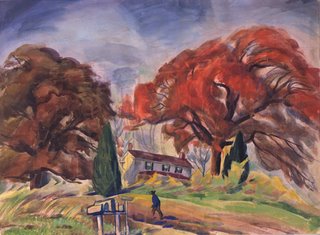 Autumn Trees
 Return to the Village
The Pierre Daura Center at the Georgia Museum of Art initiates and promotes the exhibition and study of the works of Pierre Daura and the contextualization of his oeuvre and career into the history of his time and place. Recently the museum named Gioncarlo Fiorenza as the new Pierre Daura Curator of European art and the director of the Pierre Daura Center.
On Dec. 8 at 5:30 p.m. at the Georgia Museum of Art, we will officially open the Pierre Daura Center with a reception honoring this new beginning. Fiorenza will give a brief lecture on Daura's life and his works. This event is free and open to the public, and we hope you'll come join us for this celebration.
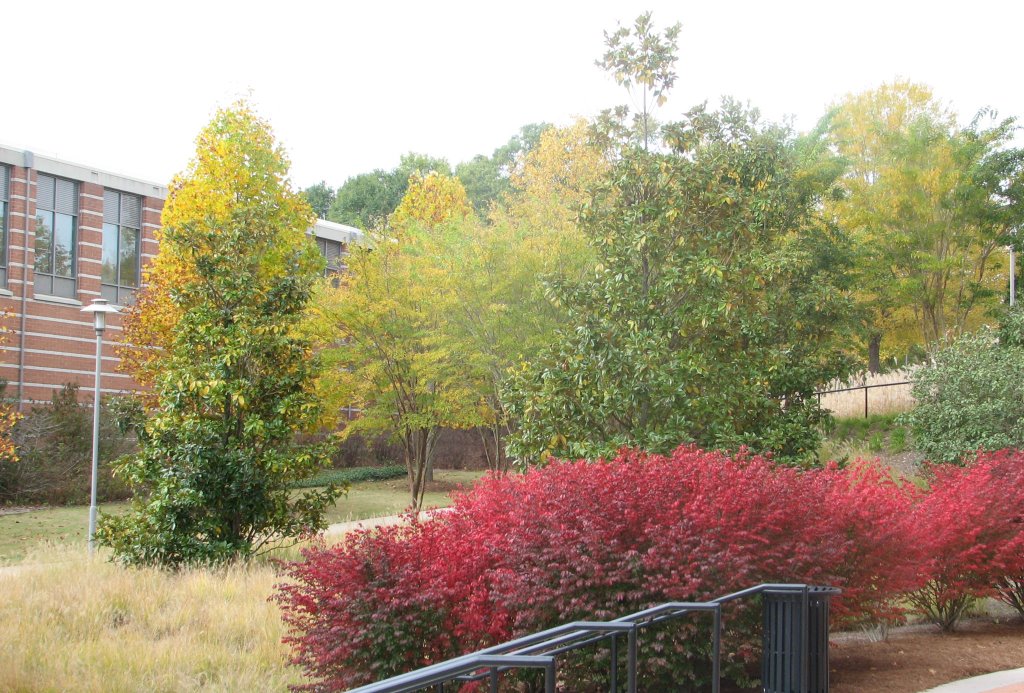
And those stunning images of autumn conjure up memories of Pierre Daura, the Catalan-American artist who was a member of the influential artistic group Cercle et Carré. Daura spent many of his years in Virginia, where he produced several beautiful landscape paintings.
 Autumn Trees
 Return to the Village
The Pierre Daura Center at the Georgia Museum of Art initiates and promotes the exhibition and study of the works of Pierre Daura and the contextualization of his oeuvre and career into the history of his time and place. Recently the museum named Gioncarlo Fiorenza as the new Pierre Daura Curator of European art and the director of the Pierre Daura Center.
On Dec. 8 at 5:30 p.m. at the Georgia Museum of Art, we will officially open the Pierre Daura Center with a reception honoring this new beginning. Fiorenza will give a brief lecture on Daura's life and his works. This event is free and open to the public, and we hope you'll come join us for this celebration.
Tuesday, October 17, 2006
American Impressionism podcast
The podguide tour of our Rachel Cosby Conway (permanent collection) Gallery is also now available for download. The Conway Gallery currently features some of our best paintings from the era of American Impressionism. In order for you to enjoy the podguide without visiting the Georgia Museum of Art, I have included several images here.
You can download the podcast, in mp3 format, [here].


Images:
(1) Gallery view showing the paintings by George Inness, Ralph Albert Blakelock, and Thomas Moran.
(2) Detailed close-up of the Blakelock painting.
(3) The William Louis Sonntag painting of the Blue Ridge Mountains.
(4) James A. McNeill Whistler (American, 1834-1903), Rose and Red: The Barber’s Shop, Lyme Regis, 1895, Oil on panel, 4 7/8 x 8 1/4 inches, Georgia Museum of Art, University of Georgia; Eva Underhill Holbrook Memorial Collection of American Art, gift of Alfred H. Holbrook GMOA 1945.96
(5) Mary Cassatt (American, 1845-1926), Study for “The Sun Bath,” n.d., Oil on canvas, 15 x 23 inches, Georgia Museum of Art, University of Georgia; extended loan from the Joan M. MacGillivray 1957 Trust GMOA 2002.115E
(6) Gallery view showing the paintings by William M. Chase, Childe Hassam, and Theodore Robinson.
(7) John H. Twachtman (American, 1853-1902), The Little Bridge, ca. 1896, Oil on canvas, 25 x 25 inches, Georgia Museum of Art, University of Georgia; Eva Underhill Holbrook Memorial Collection of American Art, gift of Alfred H. Holbrook GMOA 1945.90
(8) Childe Hassam (American, 1859-1935), Bridge at Old Lyme, 1908, Oil on canvas, 24 x 27 inches, Georgia Museum of Art, University of Georgia; Eva Underhill Holbrook Memorial Collection of American Art, gift of Alfred H. Holbrook GMOA 1945.47
You can download the podcast, in mp3 format, [here].


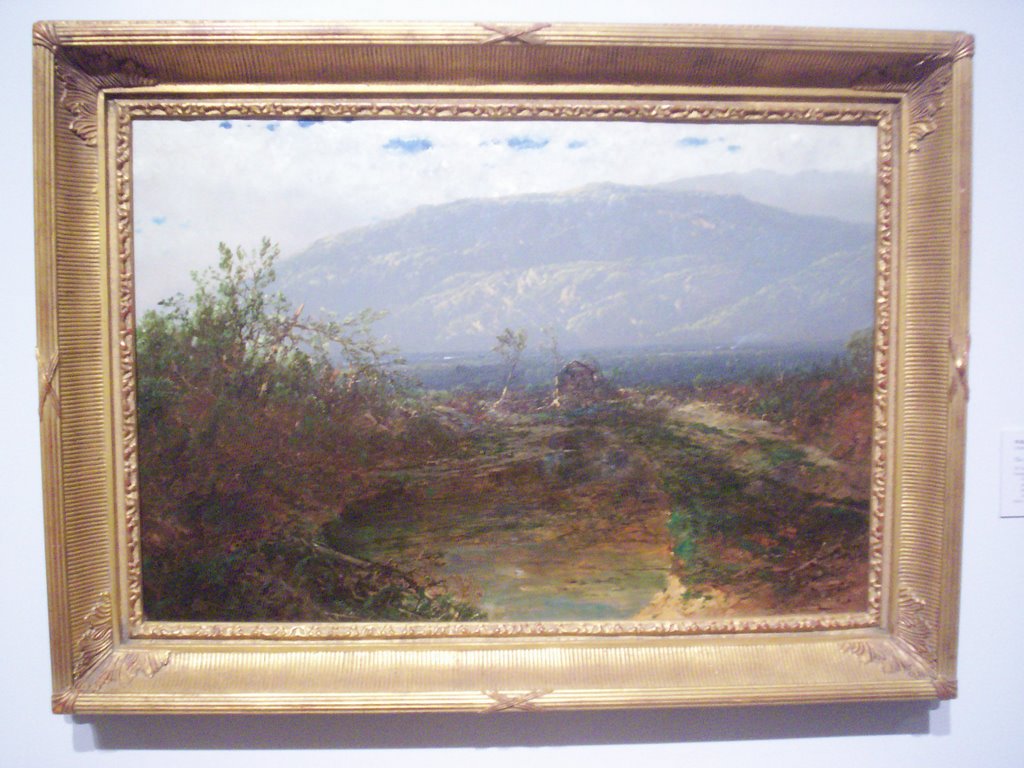

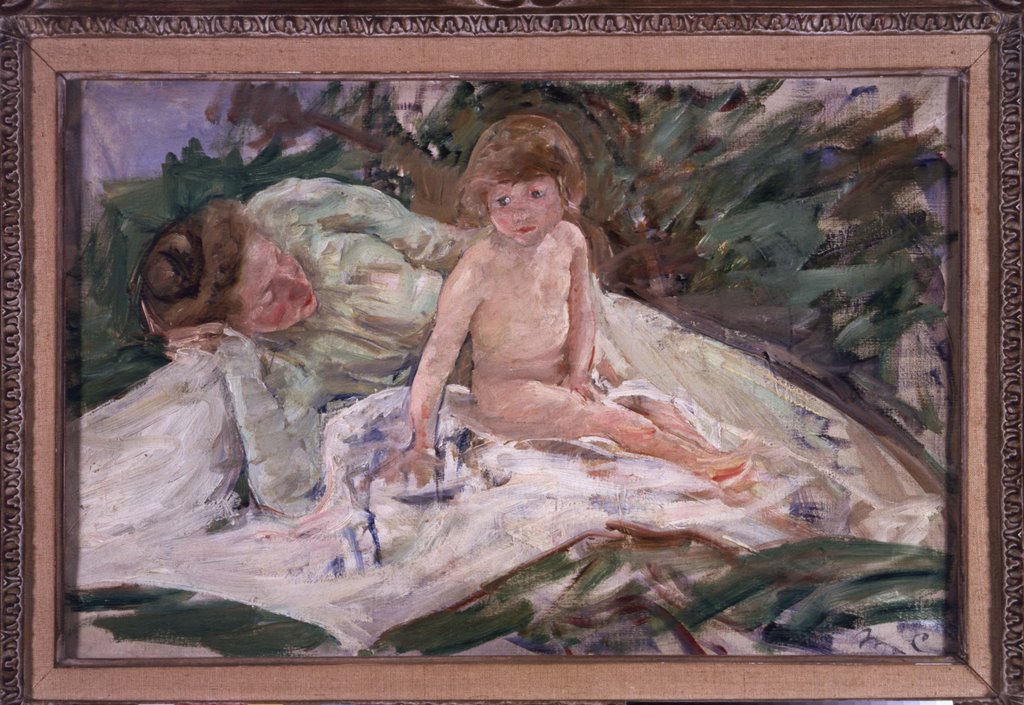
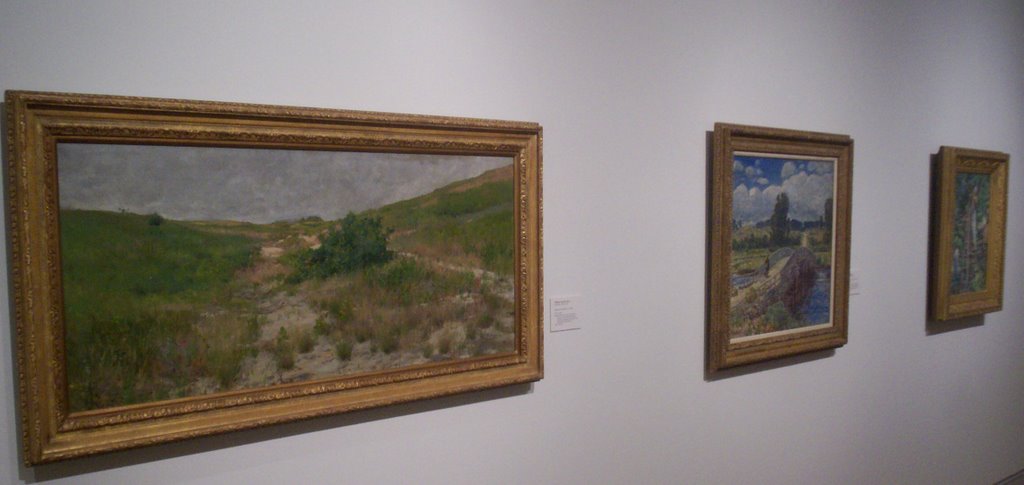
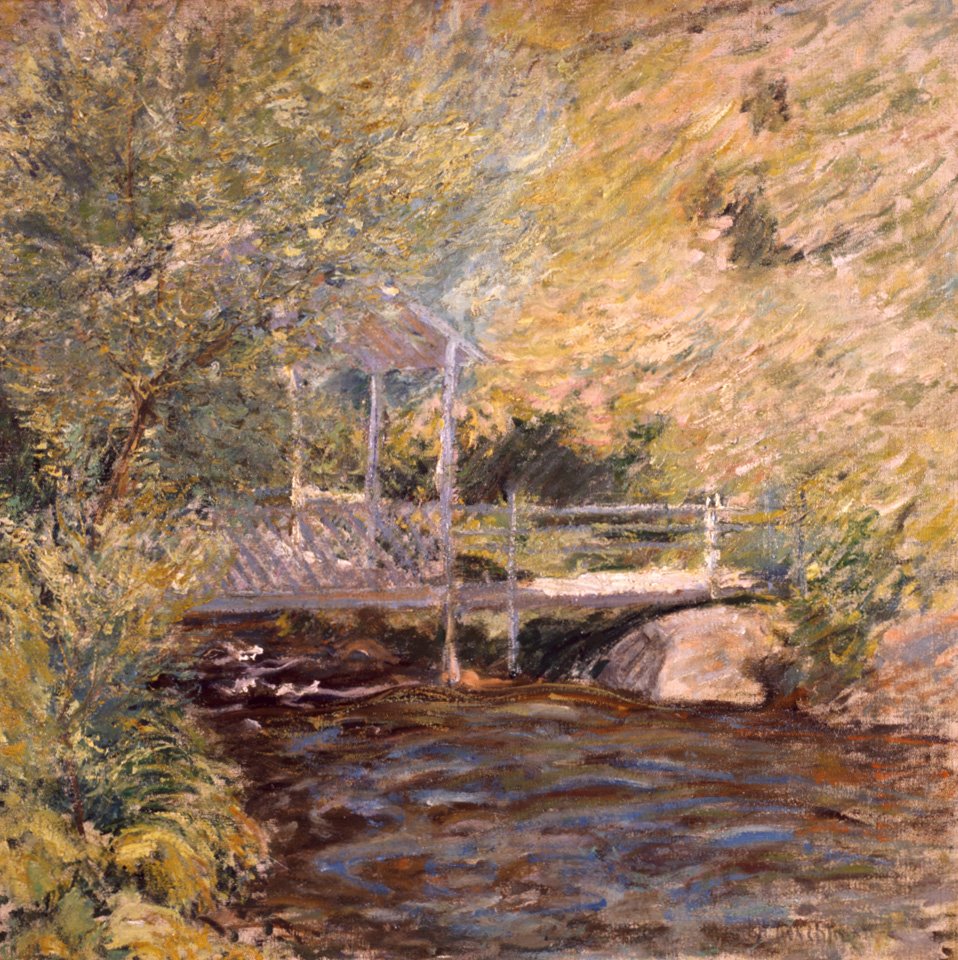

Images:
(1) Gallery view showing the paintings by George Inness, Ralph Albert Blakelock, and Thomas Moran.
(2) Detailed close-up of the Blakelock painting.
(3) The William Louis Sonntag painting of the Blue Ridge Mountains.
(4) James A. McNeill Whistler (American, 1834-1903), Rose and Red: The Barber’s Shop, Lyme Regis, 1895, Oil on panel, 4 7/8 x 8 1/4 inches, Georgia Museum of Art, University of Georgia; Eva Underhill Holbrook Memorial Collection of American Art, gift of Alfred H. Holbrook GMOA 1945.96
(5) Mary Cassatt (American, 1845-1926), Study for “The Sun Bath,” n.d., Oil on canvas, 15 x 23 inches, Georgia Museum of Art, University of Georgia; extended loan from the Joan M. MacGillivray 1957 Trust GMOA 2002.115E
(6) Gallery view showing the paintings by William M. Chase, Childe Hassam, and Theodore Robinson.
(7) John H. Twachtman (American, 1853-1902), The Little Bridge, ca. 1896, Oil on canvas, 25 x 25 inches, Georgia Museum of Art, University of Georgia; Eva Underhill Holbrook Memorial Collection of American Art, gift of Alfred H. Holbrook GMOA 1945.90
(8) Childe Hassam (American, 1859-1935), Bridge at Old Lyme, 1908, Oil on canvas, 24 x 27 inches, Georgia Museum of Art, University of Georgia; Eva Underhill Holbrook Memorial Collection of American Art, gift of Alfred H. Holbrook GMOA 1945.47
Jay Robinson podcast
The podguide tour of the small Jay Robinson exhibition at the Georgia Museum of Art is now available...several days before the show officially opens to the public.
I already posted about the exhibition [here]. That post included three images from the exhibition. Here are two more...these are both drawings...in lo-res format:


Both works are by Jay Robinson (American, born 1915), and are on extended loan from the collection of Jason Schoen, Miami, Florida. (left) Quality Music Shop, Washington, D.C., 1943, Graphite on paper, 12 ½ x 15 ½ inches, GMOA 2005.93E; (right) Three Dimensional Forms in Space, 1946, Ink on yellow paper, 22 ½ x 27 ½ inches, GMOA 2005.101E.
Unfortunately, this podguide was not recorded, like the George Bellows one this summer, in the cushy and elite confines of a sound studio at UGA's New Media Institute. So, if it sounds like some guy just sitting at his desk, that might be because I was. In an ideal world, you would download the file to your mp3 player, bring the player into the museum, and take a tour of the exhibition while listening.
The podcast, in an mp3 format, can be downloaded from [here].
Monday, October 16, 2006
Art (Rosenbaum) exclusive
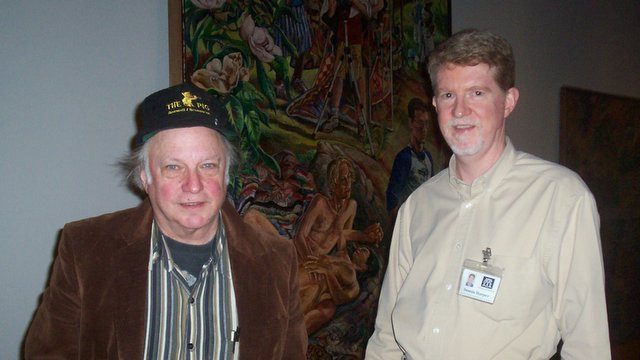
From just a few minutes ago...Art Rosenbaum (left) and GMOA curator of exhibitions, Dennis Harper, strolling through the ongoing set-up of the retrospective Weaving His Art on Golden Looms: Paintings and Drawings by Art Rosenbaum...opening to the public this Saturday. The exhibition is also featured in this week's Columns, the UGA faculty/staff newspaper.
The big "party" for the autumn exhibitions at GMOA is Wed., Oct. 25th.
Tuesday, August 29, 2006
Museum news wire
The Georgia Museum of Art has appeared and re-appeared all across the World Wide Web in recent days. Here are a few links to some of those appearances:
 * In the UGA independent student newspaper, found at redandblack.com, there is an article "Museum displays fabric of daily life" on Ashley Callahan's American quilt exhibition. The quilt display also appears in the "Resource Library" at Traditional Fine Arts Organization's web site. Some nice images there.
* The Modern Indian Works on Paper exhibition has been mentioned at Artdaily.com and redandblack.com.
* All of our new exhibitions found mention in Beth Sale's "Art Notes" in the Athens Flagpole.
* A review of the John Grabach: Century Man traveling exhibition, now at the Morris Museum in NJ and coming to Athens in July 2007, at NorthJersey.com.
* Another future exhibition, this one curated by Dennis Harper here at the museum and coming up in October, gets a blurb. Titled Weaving His Art on Golden Looms: Paintings and Drawings by Art Rosenbaum, the show earns a place at "Art Knowledge News."
* In the UGA independent student newspaper, found at redandblack.com, there is an article "Museum displays fabric of daily life" on Ashley Callahan's American quilt exhibition. The quilt display also appears in the "Resource Library" at Traditional Fine Arts Organization's web site. Some nice images there.* The Modern Indian Works on Paper exhibition has been mentioned at Artdaily.com and redandblack.com.
* All of our new exhibitions found mention in Beth Sale's "Art Notes" in the Athens Flagpole.
* A review of the John Grabach: Century Man traveling exhibition, now at the Morris Museum in NJ and coming to Athens in July 2007, at NorthJersey.com.
* Another future exhibition, this one curated by Dennis Harper here at the museum and coming up in October, gets a blurb. Titled Weaving His Art on Golden Looms: Paintings and Drawings by Art Rosenbaum, the show earns a place at "Art Knowledge News."
"It's a Controversy on canvas"
Julie Phillips and the Athens Banner-Herald staff took an interesting approach to presenting our current exhibition The Eternal Masquerade: Prints and Paintings by Gerald Leslie Brockhurst (1890-1978) from the Jacob Burns Foundation. They asked if we would drape the portrait of the Duchess of Windsor, which is not allowed to be photographed for any purpose, by Brockhurst so that they could use the draped version as an image for their article. The results:
 This painting on display at the Georgia Museum of Art cannot be photographed or reproduced in any way until after the death of the queen of England.
Photograph by John Curry/ABH Staff
It's a Controversy on canvas
Why can't we show you this painting?
By Julie Phillips
Oh, the scandalous lives the rich and famous lead.
Mind you, in her portrait, the Duchess of Windsor could be your stuffy, even boring, wealthy Aunt Bessie, smiling politely, not a hair out of place. But her likeness, painted by famous portrait artist Gerald Leslie Brockhurst and currently on display at the Georgia Museum of Art, can't be reproduced in any way until after the death of the current queen.
It seems the Duchess - née Bessie Wallis Warfield and a divorcée twice over - earned the love of King Edward VIII while she was still Mrs. Ernest Aldrich Simpson. When Edward announced his plans to wed her upon her divorce, he was forced to abdicate the throne and went into exile after marrying her in 1937.
Exile for nobility is hardly the poor house, however, and the former Mrs. Simpson earned the title of Duchess in the arrangement as her husband became the Duke of Windsor. In her portrait, her exquisite brooch offers evidence that the woman who'd spent much of her childhood in poverty did extremely well for herself.
The Duchess is just one of many faces with colorful stories to tell in "The Eternal Masquerade: Prints and Paintings by Gerald Leslie Brockhurst (1890-1978) from the Jacob Burns Foundation," on view through Oct. 8. Curator Romita Ray notes that, while it's an impressive showing of the artist's work in terms of content and scale, it's nonetheless a small collection in the career of the prolific British artist. Brockhurst was the country's most famous portraitist during the first half of the 20th century, and painted some of the world's wealthiest elite.
Brockhurst wasn't without his own scandals, either, though.
While married to his wife, Anaîs, who posed for numerous works by the artist, Brockhurst fell for a teenage model, "Dorette," more than 20 years younger than he. An early etching of Dorette, a nude titled "Adolescence," was published just after Brockhurst had become romantically involved with the then 18-year-old, and the London media reported on the relationship just after the etching was published.
Perhaps for the scandal surrounding it, it remains among Brockhurst's most famous works. But it also reveals the skill of a true master, notes Ray.
"It's a fantastic exercise in light and different surfaces - the hard, cold glass of the mirror and the softness of the skin," Ray says.
A number of works featuring both Anaîs and Dorette are represented in the show; Ray notes it would be nearly impossible to offer a collection of the artist without these, as both women were favorite (at different times) and frequent subjects for Brockhurst.
The exhibit features a variety of portraits of other subjects as well, from pouting children to astute, be-suited businessmen, among them the famous J. Paul Getty, painted, notes Ray in the exhibit catalog, "with a hint of modernism" by an artist who drew much of his influence from the Italian masters, "filtered through the Pre-Raphaelite preference for early Renaissance painting," notes Ray in the catalog.
In fact, Brockhurst, master that he was, was much at the mercy of pleasing his subjects and those who commissioned his work. While his attention to detail and obvious affinity for giving depth and texture to his sitters' faces shines in every work, Brockhurst was obliged to soften edges, hide flaws and romanticize his subjects at their request.
"These are works of fiction created out of real bodies," Ray says, adding these commissioned works were kept in private collections, for the most part.
Today, they are part of the collection of the Jacob Burns Foundation, named for Brockhurst's longtime friend and lawyer, who himself dabbled in portraiture later in life, painting a portrait of Brockhurst himself in 1964. In December 2001, the Jacob Burns Foundation designated the GMOA as the temporary repository for the archives, paintings, prints and drawings, and Ray, who has a strong interest in British art, says she made it her goal to bring the exhibit to the museum. Although Ray recently left her post as curator and prints and drawings for a position at Syracuse University, she says she'll return in late September to see the show.
Ray admits to a fascination for the genre of portraiture in addition to being interested in Brockhurst's work.
"It's one of the oldest genres, you see it in sculpture and photography as well ... and it's more accessible as a genre. There's a more intimate awareness of the human body when we look at a portrait. And we want to know who are these people and what are their stories."
This painting on display at the Georgia Museum of Art cannot be photographed or reproduced in any way until after the death of the queen of England.Photograph by John Curry/ABH Staff
It's a Controversy on canvas
Why can't we show you this painting?
By Julie Phillips
Oh, the scandalous lives the rich and famous lead.
Mind you, in her portrait, the Duchess of Windsor could be your stuffy, even boring, wealthy Aunt Bessie, smiling politely, not a hair out of place. But her likeness, painted by famous portrait artist Gerald Leslie Brockhurst and currently on display at the Georgia Museum of Art, can't be reproduced in any way until after the death of the current queen.
It seems the Duchess - née Bessie Wallis Warfield and a divorcée twice over - earned the love of King Edward VIII while she was still Mrs. Ernest Aldrich Simpson. When Edward announced his plans to wed her upon her divorce, he was forced to abdicate the throne and went into exile after marrying her in 1937.
Exile for nobility is hardly the poor house, however, and the former Mrs. Simpson earned the title of Duchess in the arrangement as her husband became the Duke of Windsor. In her portrait, her exquisite brooch offers evidence that the woman who'd spent much of her childhood in poverty did extremely well for herself.
The Duchess is just one of many faces with colorful stories to tell in "The Eternal Masquerade: Prints and Paintings by Gerald Leslie Brockhurst (1890-1978) from the Jacob Burns Foundation," on view through Oct. 8. Curator Romita Ray notes that, while it's an impressive showing of the artist's work in terms of content and scale, it's nonetheless a small collection in the career of the prolific British artist. Brockhurst was the country's most famous portraitist during the first half of the 20th century, and painted some of the world's wealthiest elite.
Brockhurst wasn't without his own scandals, either, though.
While married to his wife, Anaîs, who posed for numerous works by the artist, Brockhurst fell for a teenage model, "Dorette," more than 20 years younger than he. An early etching of Dorette, a nude titled "Adolescence," was published just after Brockhurst had become romantically involved with the then 18-year-old, and the London media reported on the relationship just after the etching was published.
Perhaps for the scandal surrounding it, it remains among Brockhurst's most famous works. But it also reveals the skill of a true master, notes Ray.
"It's a fantastic exercise in light and different surfaces - the hard, cold glass of the mirror and the softness of the skin," Ray says.
A number of works featuring both Anaîs and Dorette are represented in the show; Ray notes it would be nearly impossible to offer a collection of the artist without these, as both women were favorite (at different times) and frequent subjects for Brockhurst.
The exhibit features a variety of portraits of other subjects as well, from pouting children to astute, be-suited businessmen, among them the famous J. Paul Getty, painted, notes Ray in the exhibit catalog, "with a hint of modernism" by an artist who drew much of his influence from the Italian masters, "filtered through the Pre-Raphaelite preference for early Renaissance painting," notes Ray in the catalog.
In fact, Brockhurst, master that he was, was much at the mercy of pleasing his subjects and those who commissioned his work. While his attention to detail and obvious affinity for giving depth and texture to his sitters' faces shines in every work, Brockhurst was obliged to soften edges, hide flaws and romanticize his subjects at their request.
"These are works of fiction created out of real bodies," Ray says, adding these commissioned works were kept in private collections, for the most part.
Today, they are part of the collection of the Jacob Burns Foundation, named for Brockhurst's longtime friend and lawyer, who himself dabbled in portraiture later in life, painting a portrait of Brockhurst himself in 1964. In December 2001, the Jacob Burns Foundation designated the GMOA as the temporary repository for the archives, paintings, prints and drawings, and Ray, who has a strong interest in British art, says she made it her goal to bring the exhibit to the museum. Although Ray recently left her post as curator and prints and drawings for a position at Syracuse University, she says she'll return in late September to see the show.
Ray admits to a fascination for the genre of portraiture in addition to being interested in Brockhurst's work.
"It's one of the oldest genres, you see it in sculpture and photography as well ... and it's more accessible as a genre. There's a more intimate awareness of the human body when we look at a portrait. And we want to know who are these people and what are their stories."
Books: Museum Studies, part I
On rare occasions, I get asked about what books are good and interesting reads in "museum studies." Authors dealing with the museum in American culture often extol inclusiveness, plurality, and constant re-evaluation as key if museums, especially art museums, wish to help construct a new idea of ourselves as a nation. Here are quick reviews of two fairly recent publications that critique "the museum":
 Peter Vergo, ed., The New Museology (London: Reaktion, 1989).
In 1989, Peter Vergo edited a series of essays on the museum and its functions. The essayists in The New Museology note that objects have multiple meanings, museums are products of cultural and ideological discourse, and museum visiting is itself a cultural phenomenon. The many authors note that the act of collecting always has had a political, ideological, and/or aesthetic dimension. Every acquisition and deaccession in a museum, every juxtaposition of objects, every arrangement of a work of art "means placing a certain construction upon history, be it the history of the distant or more recent past, of our own culture or someone else's, of mankind in general or a particular aspect of human endeavor." Museums (if they ever truly were) are certainly no longer, the essayists argue, bastions of "true" knowledge and temples of objective truth. Every museum exhibition, whatever its subject, inevitably draws upon the cultural assumptions and resources of the people who create the exhibition.
 Amy Henderson and Adrienne L. Kaeppler, eds., Exhibiting Dilemmas: Issues of Representation at the Smithsonian (Washington and London: Smithsonian Institution Press, 1997).
Published to commemorate the 150th anniversary of the Smithsonian Institution, Exhibiting Dilemmas utilizes twelve essays by Smithsonian staff members to address issues of ideology, cultural assumptions, and curatorial practices. Steven Lubar, in the book's opening essay, calls for museum curators to make use of audience "memory" within exhibitions and to explain the complexities of exhibitions to visitors. But the most intriguing essays in Exhibiting Dilemmas are the ones that focus on historicizing and deconstructing the myths around individual objects:

As time permits, I will post on some more museum studies books that I have enjoyed reading.
Peter Vergo, ed., The New Museology (London: Reaktion, 1989).In 1989, Peter Vergo edited a series of essays on the museum and its functions. The essayists in The New Museology note that objects have multiple meanings, museums are products of cultural and ideological discourse, and museum visiting is itself a cultural phenomenon. The many authors note that the act of collecting always has had a political, ideological, and/or aesthetic dimension. Every acquisition and deaccession in a museum, every juxtaposition of objects, every arrangement of a work of art "means placing a certain construction upon history, be it the history of the distant or more recent past, of our own culture or someone else's, of mankind in general or a particular aspect of human endeavor." Museums (if they ever truly were) are certainly no longer, the essayists argue, bastions of "true" knowledge and temples of objective truth. Every museum exhibition, whatever its subject, inevitably draws upon the cultural assumptions and resources of the people who create the exhibition.
Amy Henderson and Adrienne L. Kaeppler, eds., Exhibiting Dilemmas: Issues of Representation at the Smithsonian (Washington and London: Smithsonian Institution Press, 1997).Published to commemorate the 150th anniversary of the Smithsonian Institution, Exhibiting Dilemmas utilizes twelve essays by Smithsonian staff members to address issues of ideology, cultural assumptions, and curatorial practices. Steven Lubar, in the book's opening essay, calls for museum curators to make use of audience "memory" within exhibitions and to explain the complexities of exhibitions to visitors. But the most intriguing essays in Exhibiting Dilemmas are the ones that focus on historicizing and deconstructing the myths around individual objects:
- William Truettner's "pro-revisionist" discussion of hypothetical labels for Emmanuel Leutze's The Founding of Maryland;
- Mary Jo Arnoldi's reading of Herbert Ward's sculptures of Africans;
- Jane Maclaren Walsh's dialogue regarding the problematic history and authenticity of an Aztec crystal skull.
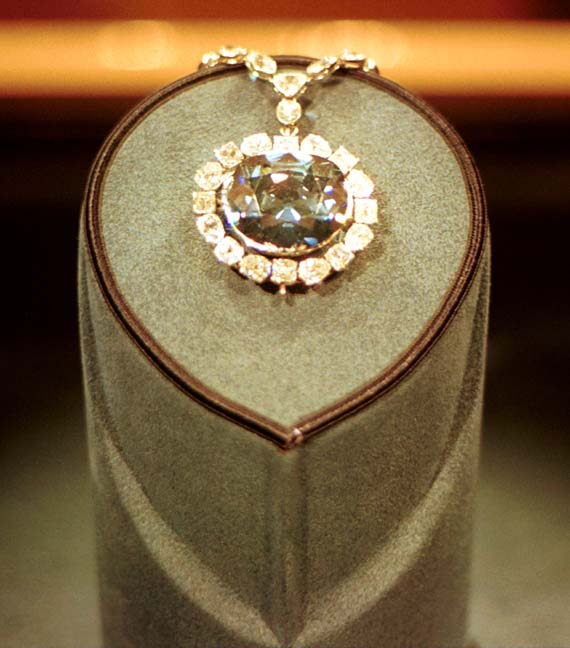
- and Richard Kurin's look at the Hope Diamond (stating his belief that it is on display in the wrong museum on the Mall);
As time permits, I will post on some more museum studies books that I have enjoyed reading.
Tuesday, August 01, 2006
Museum news wire
 A great art topic: 19th-century American landscape painting. The Wadsworth Atheneum in Hartford has its great collection of Hudson River School paintings on display in a special "homecoming" exhibition: American Splendor: Hudson River School Masterworks From the Wadsworth Atheneum. More than 60 of the museum's best images, including Thomas Cole, Frederic Church, Albert Bierstadt, Sanford Gifford, and John Kensett. New York Times review [here].
London's Tate Modern announced plans for a very postmodern addition. Designed by the Swiss firm Jacques Herzog and Pierre de Meuron, the architecture of the new wing seems to play with the idea of the gallery as white cube, and ancient Mesopotamian ziggurats. The price tag: $397 million. The Tate Modern plans to have it ready by the 2012 London Olympics.
The National Archives in DC has an exhibition -- Eyewitness -- that features "[t]reasures in the form of letters, diaries, photographs, and audio and film recordings, culled from the billions of documents in the holdings of the National Archives and its Presidential libraries, open new and unique windows onto well-known events." If you can't get to DC before it closes in January, the Archives has an on-line version [here].
 One of the most important treasures looted in the ransacking of Iraq’s national museum three years ago has been recovered in a clandestine operation involving the United States government and was turned over to Iraqi officials in Washington recently. The artifact, a headless stone statue of the Sumerian king Entemena of Lagash, was stolen from Iraq, taken into Syria, and came on the market. The backstory of the recovery remains a secret in order to protect future recovery efforts.
Images: Wadsworth Atheneum: Thomas Cole, View in the White Mountains, 1827. Oil on canvas. Bequest of Daniel Wadsworth, 1848.17; Angel Franco/The New York Times. A headless stone statue of the Sumerian king Entemena of Lagash, looted in the ransacking of Iraq’s National Museum three years ago, has been recovered.
Subscribe to:
Posts (Atom)