Friday, March 01, 2013

Artist’s designs transform community

Conestee Mill: A Revitalization Project Combining Historic Preservation and Interior Design

Kaitlin McShea wants to improve the community of Greenville County, S.C., her hometown, by redesigning the historic Conestee Mill there.

McShea’s interior design project in the “Master of Fine Arts Degree Candidates Exhibition” transforms the aging textile mill into a mixed-use development that includes luxury loft apartments, retail spaces, a conference center, a community fitness center, a textile history museum and a South Carolina-themed restaurant.

“My goal is to not only design a beautiful, livable, walk-able space, but also to revive the Conestee community through preservation of the mill, interior design and programming in order to create a sustainable complex that future generations will continue to enjoy,” said McShea. She based her design concept on the textiles once produced at the mill. The interior spaces have elements playing with the textures, forms and physical qualities of fabric and historic textile equipment.

McShea has worked in community design through her fellowship with the University of Georgia’s Fanning Institute and Carl Vinson Institute of Government. In her work, she combines historic preservation with modern and sustainable designs.

McShea is combining her two MFA degrees (master of historic preservation and master of fine arts with a focus in interior design) with this project. She began with historical documentation, studying historic floor plans and interviewing people in the community about the mill. Her research also included case studies of two other similar mills in the Southeast.

McShea said she wanted to choose a community that would benefit economically from the redevelopment. She chose the specific businesses in her design based on what the community was currently missing. She created both hand and 3-D computer renderings of the spaces as well as choosing materials, finishes and furniture for each space in the new facility. Last, she created a brand identity for the site with logos and color schemes for each space and combined everything in a visual package for the exhibition.

The final design reflects McShea’s goals of creating a space that is attractive in its living, work and play spaces. Her design also reflects the unique history of textile mills in Greenville and in the Southeast.

The “Master of Fine Arts Degree Candidates Exhibition” is on view at the Georgia Museum of Art March 16 to April 22, 2013, with an opening reception in conjunction with 90 Carlton: Spring on March 22. MFA Speaks is scheduled for March 21 at 5:30 p.m. and will feature the artists discussing their work.

Thursday, February 28, 2013

Artist blends ideas of “beginning” and “end” in works of art

Still from "Inhumation" by Adam Forrester

Adam Forrester isn’t bothered by failure. In fact, he’s inspired by it.

Forrester’s works of art in the “Master of Fine Arts Degree Candidate Exhibition” are about the merging of polar opposites, like failure and success. To illustrate these ideas, he engages in character-driven performance acts. His exit show work will feature short videos of his performances, accompanied by objects from these acts.

“The acts themselves closely resemble absurd cycles of meaningless or futile acts,” said Forrester. He incorporates performance with sculptural elements and uses his photography and filmmaking background to reiterate this idea of making and unmaking, creating and destroying.

The theme for these works arose when Forrester grew frustrated with making and creating art and decided to act in the moment to counter his frustration. Grabbing the nearest object, a shovel, he began digging holes, only to fill them back up again. This labor, while giving him no tangible or “meaningful” results, inspired him.

Forrester’s work has been featured in the Oxford American, Appendix Magazine and F-Stop Magazine. In 2011, he was awarded the Willson Center for Humanities and Arts Research and Performance Grant for his documentary featurette “Eat White Dirt.” His work has been screened and exhibited both nationally and internationally.

Forrester plans to continue making similar video works and exhibiting them. He recently self-published a book of images and texts, “SUPERMOON,” that will be the first of a large volume of books about celestial bodies. He hopes to release the next volume, “YELLOWKNIFE,” a book about Mars, with a publishing company.

The “Master of Fine Arts Degree Candidates Exhibition” is on view at the Georgia Museum of Art March 16 to April 22, 2013, with an opening reception in conjunction with 90 Carlton: Spring on March 22. MFA Speaks is scheduled for March 21 at 5:30 p.m. and will feature the artists discussing their work.

Wednesday, February 27, 2013

Artist uses architecture to describe the world

"Dystopia 1" by Clara Hoag

Clara Hoag had hit a wall.

Uninspired by her ceramic sculptures, Hoag needed a new visual language for her works of art. After sketching and drawing, she realized that, in order to move forward, she needed to remove the human form from her sculptures.

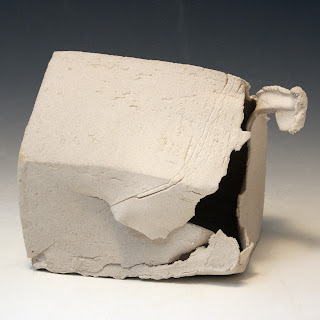
For her work in the “Master of Fine Arts Degree Candidates Exhibition” Hoag created works of art inspired by architecture, which she uses to describe the construction of people and the world. The show will feature a large installation of houses and buildings scattered around the floor, a collection of small and broken porcelain houses, a towering ceramic sculpture with a secret window and a grouping of prints and drawings made with graphite, coffee and spackling paste, among other materials.

“My process involves a lot of experimentation: over-firing clay, under-firing glazes, wedging raw materials into my clay, building with multiple clay bodies and gluing fragments of my work together post-firing,” said Hoag. She said the art in her exit show developed from the trial and error that came from “breaking the rules.”

Hoag has received two BFA degrees from the University of Illinois at Urbana-Champaign and is an MFA candidate at the University of Georgia. She has participated in both group and solo shows in Illinois, Georgia and Florida. She is represented by two galleries in Illinois, her home state.

Hoag uses her sculptures to describe her interest in human psychology. Her works of art deal with the nature of human life and how people can be “destructive, subversive, deceptive or profoundly good,” according to Hoag.

“My soaring skyscrapers, complex scaffolding, and accumulations of slum housing describe the complexity of 21st-century life—from the dynamic social structures that keep our world running to the systemic problems that oppress us every day,” said Hoag.

For Hoag, single buildings highlight both individuality and the mundane. Stability and fragility act as opposing forces seeking balance. Her works of art can be small or large, delicate or aggressive.

Hoag is currently applying to residency programs across the country. She hopes to travel in order to see new places and meet new people to help her learn about the “beauty, ugliness and mystery of the world.”

The “Master of Fine Arts Degree Candidates Exhibition” is on view at the Georgia Museum of Art March 16 to April 22, 2013, with an opening reception in conjunction with 90 Carlton: Spring on March 22. MFA Speaks is scheduled for March 21 at 5:30 p.m. and will feature the artists discussing their work.

Tuesday, February 26, 2013

Artist paints up scares with female monsters

"Boogiewoman" by Jaime Bull

Thirteen-foot-tall paintings are enough to intimidate any viewer. That’s just how Jaime Bull hopes museum visitors will react to her depictions of female beasts that represent strength, sexuality and aggression, among other characteristics.

The larger-than-life oil paintings in Bull’s work in the “Master of Fine Arts Degree Candidates Exhibition” are additionally adorned with hair, rhinestones and soft fabric sculpture. Her paintings serve as a commentary on political statements about women’s health and reproductive rights as well as the “feminine experience,” said Bull.

Bull created these works of art after being inspired by the monsters and beasts depicted in wall frescoes and on Renaissance globes in Cortona, Italy. The ancients used these depictions of female monsters to explain the inexplicable, like natural disasters or heaven and hell, and were meant to keep people in line, according to Bull.

“In response to these ideas, I invented a cast of female monsters who would frighten the pants off anyone who crossed them with their sheer size and blatant sexuality,” said Bull. She was inspired by the grotesque forms of these invented creatures and the scare tactics they employed.

Bull is a 2013 candidate in painting in UGA’s MFA program. Her brightly colored abstractions explore nature, culture, fantasy and sexuality with touches of humor and play. In 2012, she was awarded support to study and work in Cortona and at the Penland School of Crafts in North Carolina. She is a recipient of the 2012–2013 Willson Center for Humanities and Arts Research Grant.

Bull views the paintings in her exit show as a “celebration of materials,” as she used both painting and sculpture to create them. She enjoys making bright, bedazzled surfaces, which she hopes engage viewers’ imaginations. Her paintings, though playful, tend to have a menacing element, according to Bull.

The paintings are on un-stretched linen and can be wrapped around the body and worn as a costume. In addition to her paintings, Bull is making short films documenting her paintings in motion when worn.

Bull is currently applying for grants and residencies and hopes to travel and teach in the future.

The “Master of Fine Arts Degree Candidates Exhibition” is on view at the Georgia Museum of Art March 16 to April 22, 2013, with an opening reception in conjunction with 90 Carlton: Spring on March 22. MFA Speaks is scheduled for March 21 at 5:30 p.m. and will feature the artists discussing their work.

Tuesday, February 19, 2013

Inventorying an American artist


Francis Bryant Godwin

Boxes full of photographs and drawings are taking over Joan Tkacs’ desk at The Georgia Museum of Art. She’s sifting through artifacts representing the life and art of American artist Frances Bryant Godwin (1892–1975).

Tkacs, an assistant to museum director William U. Eiland, is inventorying watercolors, woodblock prints and written postcards by Godwin, along with her photographs and drawings. Items range from a folder of surreal and abstract “dream drawings” to photographs of Godwin’s dogs.

“It’s a lot of strange odds and ends,” said Tkacs. GMOA is deciding whether or not to acquire Godwin’s works of art. Tkacs is in charge of going through these archives to help the museum learn more about the artist.

Godwin was trained as a sculptor by Daniel Chester French and dedicated her life to sculpting and drawing. She was part of an important and wealthy family of artists, art historians, art collectors and writers. As a result, she had important ties to social, cultural and economic American histories.

Tkacs has been working off and on the past two months on an itemized inventory, describing subjects of the items, detailing their conditions and estimating their quality. She’s gone through almost 400 objects in Godwin’s archives and still has two more boxes waiting to be reviewed.

Tkacs conducts research and helps Eiland whenever he needs assistance with a project or presentation. She began working at GMOA as an intern and has been Eiland’s assistant for six months. Her job consists mostly of research.

“I’ll be sad to see this project end,” said Tkacs, adding, “It’s a lot of stuff, but it’s all interesting.”

Monday, February 18, 2013

Christiane Citron on Her Grandmother


When we think of grandmothers, those of the cookie-baking, sweater-knitting variety typically come to mind. 
           
            Not for Christiane Citron, who was sometimes embarrassed by her bohemian grandmother.
            Christiane is the granddaughter of Minna Citron, the social realist and abstract artist featured in the exhibition “Minna Citron: The Uncharted Course from Realism to Abstraction,” on view at the Georgia Museum of Art until March 3. Christiane was in town at GMOA recently to attend 90 Carlton: Winter, the open house that highlighted the exhibition, and to work with students at the University of Georgia. We were lucky enough to sit down with her and get her thoughts on the exhibition she helped organize.

Christiane Citron at the Georgia Museum of Art exhibition
Photo courtesy of 
Christiane Citron
           “She made a big point of saying that she was an artist who happened to be a grandmother,” says Citron. “I mean, she didn’t want to be ‘Grandmother Artist,’ so she really had to make a big point about that. So I would never have called her Grandma or anything. She was always Minna. I don’t think anybody didn’t call her Minna.”
            Bold, bohemian, feminist and full of creative energy, Minna Citron produced art into her 90s. She constantly explored new methods of creating and transitioned from realism to abstraction, serving as one of the first-generation pioneers of abstract expressionism. “She was an artist,” says Christiane. “She didn’t really try not to be.”
            Christiane grew up saturated in Minna’s art. She remembers exploring her grandmother’s art studio as a child, poking through cabinets and drawers filled with bits of collage supplies.
            “Our whole house was probably filled with Minna’s pictures. So they were just part of my childhood, you know, living with these pictures here. They represent my whole sort of personal memories of family and childhood.”
            One of Christiane’s favorite paintings by Minna, which she received as a gift towards the end of law school, was originally a fixture of her childhood home.
            “I particularly liked the colors. It’s an abstract design and I never knew until quite a bit after that that the title of that picture—her title of it—is Memories of Childhood. So it’s kind of ironic because it’s my memories of childhood too,” she says, smiling. The painting now hangs over the mantelpiece in her living room.
            Christiane lights up when talking about her grandmother’s artwork, and her passion—and pride—for Minna’s career is apparent.
            “I admire her integrity in pursuing what she believed in and not becoming stuck in doing the same thing over and over again,” she says. “And that I’m proud of her, well I’m very proud of her, but you know I’m proud of the fact of her personal integrity and that she really was not bending to what some commercial pressures might be.”
            As the oldest grandchild, Christiane became close to and often spent time with her grandmother. When she grew older, she became more involved in Minna’s career and worked on promoting her work.
            “I’ve always felt some responsibility to help promote her because I just thought that what she did was really neat,” she says.
            In 1996, five years after Minna passed away, at age 95, Christiane created an exhibition in Denver to celebrate the centennial of her grandmother’s birth. The show was a success, and Christiane hoped eventually to create a traveling exhibition.
             Later, she began working with Jennifer Streb, an art historian at Juniata College who wrote her dissertation on Minna Citron. The two women expanded on the 1996 compilation of Minna’s work and, over the course of about three or four years, created the traveling exhibition currently at GMOA.
            “It’s a labor of love, and it’s just so gratifying to see people enjoying it and really interacting with the pictures,” Christiane says.
            The collection of paintings chronicles Minna Citron’s 60-year art career, dating from 1929 to 1988, presenting social-commentary sketches, abstract collages and sculptures. When selecting works for the exhibition, Christiane focused on those she thought would exemplify her grandmother’s work and show the evolution of her style.
             “Even in very late years she was still very creative and productive and experimenting and so I wanted to be able to share that with people, to make it be a retrospective. And what I think I’m so happy about it being here in this wonderful museum because I think she in so many ways represents the century,” she said. “I hoped that it would show how she fits into these different developments in American art history. So I think it really has a lot of educational value to show people how in one person you can see all those aspects.”
            Considering Minna’s radical, experimental shift in style, “Minna Citron: The Uncharted Course from Realism to Abstraction” is appropriately titled.
            “She always said to summarize her whole career as the uncharted course. That it wasn’t like there’s a path that shows you where you’re going to go and where to go next or turn here and do that. It was experiment. She didn’t know what the end result would be. And so that’s very brave I think,” said Christiane.
            “There’s something in the stars or synergistic about the way it all worked out that it’s here,” she says. “Seeing it come together and seeing people interact with it, that to me is the payoff. I like that. And it’s just really gratifying thinking how much Minna would enjoy that, to see people interacting with her art.”


Black History Month Dinner


            The Harlem Renaissance will be coming to the museum this Thursday, Feb. 21, as we honor Harold Rittenberry and the late Rudolph Byrd at this year’s Black History Month Dinner. The theme of the annual event is “Harlem Renaissance: A Sampler.” Vintage décor from Agora, a vintage and antiques store in downtown Athens, will contribute to the feel.
            The evening will start off with a gallery talk led by Paul Manoguerra, the museum’s chief curator and curator of American art, on the exhibition, “William H. Johnson: An American Modern.” Following that will be a seated dinner catered by Epting Events, as well as cocktails and desserts. Entertainment, including a performance by singer Monica Kaufman-Pearson, a retired WSB-TV anchor in Atlanta and a current graduate student in the University of Georgia Grady College of Journalism and Mass Communication, will add to overall theme and feel of the evening.
Harold Rittenberry
            Both men, Rittenberry and Byrd, have greatly contributed to the arts and culture in their communities. Rittenberry will receive the Larry D. and Brenda A. Thompson Award and Byrd the Lillian C. Lynch Citation. Rittenberry, born and raised in Athens and a self-taught artist, has metalwork sculptures throughout the state. Byrd, a long-time professor at Emory University, founded the James Weldon Johnson Institute at Emory in 2007, which studies the modern civil rights movement, and served as director of the department of African American Studies for a decade. Both men’s work and contributions express the efforts of both the Thompsons and Lynch.
            This will be an evening that you will not want to miss. Tickets are $45 per person and reservations are requested. We still have tickets left, so call 706.542.0830 to reserve your spot. 

Thursday, November 29, 2012

Minna Citron at GMOA


It’s the week after Thanksgiving and I’m sure we’re all either still full of turkey and sweet potato soufflé or getting geared up for the big winter break. But before we kick back and relax on the couch with movie marathons, the Georgia Museum of Art has one more exhibition starting before the holidays. “Minna Citron: The Uncharted Course from Realism to Abstraction” will open on Dec. 8 and run until March 3, 2013.
      The exhibition will showcase roughly 50 of Citron’s award-winning social realist and abstract paintings and sculptures, picked from her 60 years as an artist. The art is on loan from her granddaughter, Christiane H. Citron, and has traveled from museums in Texas, Pennsylvania and Minnesota.
      Minna Citron attended the Art Students League of New York in 1928, and it was during her time there that she created her iconic genre scenes of Union Square and became a member of the 14th Street School. Citron associated with artists such as Isabel Bishop, a renowned graphic artist, and Reginald Marsh, most notable for his paintings of New York City, Coney Island and vaudeville in the 1920s and 1930s.
     Citron’s work initially started out as realist, depicting fine details in the clothes and faces of her subjects. These early works focused more on the roles of women in her satirical style, and during World War II she traveled across the country for the Works Progress Administration’s Federal Art Program, producing some of her iconic prints based on the women who joined the U.S. Navy. After the war, she moved onto the abstract, strongly emphasizing dynamic shapes that stood out from their backgrounds. During this time she traveled to France to learn new techniques in color printing, which she brought back to the United States. From the 1950s to the 1970s, Citron experimented with collages and other aspects of three-dimensional art, even developing methods for 3D printmaking and assembly. 

Minna Citron
Cold Comfort
Minna Citron
Untitled
      Many of Citron's works hang in prestigious museums, including the Teller Gallery in New York, and GMOA owns a small abstract oil by her that hangs in its permanent collection galleries. The exhibition was organized by Juniata College in Huntingdon, Pa., along with Christiane Citron, and is sponsored locally by the W. Newton Morris Charitable Foundation and the Friends of the Georgia Museum of Art. Paul Manoguerra, our chief curator and curator of American art, will serve as the in-house curator for the exhibition and will lead a tour of it Wednesday, Dec. 12, at 2 p.m. We would be thrilled to see you before and during the holidays when the exhibition opens.

Thursday, November 15, 2012

Happy Birthday, Georgia O'Keeffe!

Georgia O'Keeffe, hands 1918
Photo by Alfred Stieglitz

Today we celebrate the birth of one of the most influential and well-known female artists of the 20th century. Born in 1887 in Sun Prairie, Wisc., O’Keeffe was the second of seven children born to a pair of dairy farmers. Her maternal grandfather and namesake, George Victor Totto, was a Hungarian count who immigrated to the United States in 1848.  Known today for her intense and vibrant paintings, O’Keeffe made the decision to become an artist at the wise age of 10, and, along with her sister, received her first instruction from watercolorist Sara Mann.
When the O’Keeffe family moved to Williamsburg, Va., in 1902, Georgia remained in Wisconsin with her aunt to attend school before making the move to join her family in 1903. After graduating from high school in 1905, O’Keeffe went to study at the School of the Art Institute in Chicago until 1906. From there she enrolled in the Art Students League in New York City, where she happened to study under William Merritt Chase. In 1908 she won a still-life prize named for Chase at the League for one of her oil paintings.
That same year, after attending an exhibition of Auguste Rodin’s watercolors at Alfred Stieglitz’s 291 gallery, O’Keeffe gave up the idea of being a professional artist, believing that she could never distinguish herself from the painters from whom she had learned. She did not paint again for four years.
In 1912, O’Keeffe attended a class at the University of Virginia Summer School, where she was introduced to the innovative ideas and techniques of Arthur Wesley Dow, who was best known for teaching that instead of copying nature, art should focus on the elements of the composition, such as line, mass and color. These ideas inspired O’Keeffe to pick up her brush once more and she ended up teaching art in public schools in Amarillo, Tex., from 1912 to 1914. She still took classes from Dow, who helped shape her thought-process as she painted. After teaching at Columbia University in South Carolina until 1916, O’Keeffe took the job as head of the art department at still young West Texas A&M University in Canyon, Tex., where she stayed until 1918. During that time she made multiple expeditions into the Palo Duro Canyon, using the rock formations as subjects in many of her works.
It was in 1916 that O’Keeffe’s work made an impact on the New York art community. Anita Pollitzer, a photographer and friend of O’Keeffe’s from Columbia University, mailed a few of O’Keeffe’s charcoal drawings to Stieglitz, not only a gallery owner but a photographer (and O’Keeffe’s future husband). Stieglitz told Pollitzer that the drawings were the “purest, finest, sincerest things that had entered 291 in a long while.” In April of that year, he exhibited 10 of her drawings, surprising O’Keeffe. When she confronted him, she agreed to let them remain on display. This catalyst began their partnership. Stieglitz went on to organize nearly all of O’Keeffe’s exhibitions, starting with her first solo show, in 1917, at 291, which included her paintings and watercolors from her time in Texas.
Stieglitz and O’Keeffe kept in constant contact over the years, and in 1918, O’Keeffe agreed to move to New York to devote her time to her art. The two began to fall in love and moved in together, even though Stieglitz was already married and 23 years older. In 1924, his divorce was approved and he married O’Keeffe within four months. It was with Stieglitz’s aid that O’Keeffe’s work gained further fame and commanded higher and higher prices.
O’Keeffe’s notable New Mexico phase did not begin until the late 1920s. Before then she had been working in the New York area, but she had felt the increasing need for a new source of inspiration, and traveled to Santa Fe. She took multiple trips into the desert, painting her iconic scenes with vivid colors. In late 1932, she suffered a nervous breakdown partly because she was falling behind schedule on a mural project. O’Keeffe did not paint again until 1934, after recuperating in Bermuda. She returned to New Mexico, leaving Stieglitz to work (he also had an affair with the photographer Dorothy Norman) in New York.
O’Keeffe continued to work exclusively from New Mexico, buying homes there, including an abandoned hacienda in Abiquiu, until 1946, when Stieglitz died. She spent three years settling his affairs in New York before moving permanently to New Mexico. She worked primarily from her Abiquiu house, making its architectural elements subjects of her work.
In 1962, O’Keeffe became a member of the American Academy of Arts and Letters, and four years later she was elected a Fellow of the American Academy of Arts and Sciences. She continued to have exhibitions, and her work remained a prominent force in the public eye. In 1977, President Gerald Ford presented her with the Presidential Medal of Freedom, the highest honor awarded to American citizens, and in 1985, she was awarded the National Medal of Arts.
O’Keeffe became increasingly frail in her late 90s, and her eyesight began to deteriorate. She moved to Santa Fe in 1984, and in 1986, on March 6, she died at the age of 98. O’Keeffe was cremated in accordance with her will, and her ashes were scattered on the winds atop Pedernal Mountain, over what she called her “beloved faraway.”

Georgia O'Keeffe
Red Barn, Lake George, New York, 1921
O'Keeffe's legacy lives on today, her work being her most influential impact on the arts. The museum in Santa Fe devoted to her paintings, drawings and pottery, coincidentally designed by the same architects as the Georgia Museum of Art's renovation and expansion project, celebrates its 15th anniversary this year. In the sciences, a fossilized species of archosaur (an ancient relative of today's crocodiles) was named after her as Effigia okeeffeae (meaning "O'Keeffe's ghost"). Collections of her paintings hang in the Museum of Modern Art in New York, the Whitney Museum of American Art and in the Georgia Museum of Art. If you'd like to have a look at some of O'Keeffe's influential work, especially on her birthday, we would love to see you in the museum!

Tuesday, November 06, 2012

A Separate Vision

Video by Kathryn Kao
            Vision can be many things. It can be a gift, a science, an image or a distant dream.
            But for Jonathan Jacquet, a professional artist, a security supervisor at the Georgia Museum of Art and a soon-to-be-nurse, vision is an obsession. His paintings and sculptures cling to a fading age of Romanticism that often borders on the grotesque. As an artist, he is heavily influenced by a childhood accident that left him blind in one eye, and on many levels, viewing his works is like reading an intimate autobiography. He is enthralled by how the brain and eye function together to read depth and proportion. In fact, most of his works of art examine the science of neurobiology to explain the physiological processes that occur while a person is drawing. For some people, this may be a dense and complicated subject matter, but for Jacquet, it is his life.
            He is a great admirer of scientists like Margaret Livingstone and Nobel Prize winner Ruth Hubbard for their investigations of how the eye functions. Jacquet humbly explains that Livingston’s article on Dutch painter and etcher Rembrandt might explain why he has a natural ability to replicate visual objects from life onto a two-dimensional plane. “There has been a lot of science and biology that’s fed into the understanding of vision and how the mind processes vision,” says Jacquet. “Just how you hold a pencil, that tactile feel, how the touch is and the amount of brain space dedicated to the hand is miniscule compared to the amount of brain space dedicated to the retina.”
             His stereo blindness, or inability to see depth, is a visual experience that is often represented as a ring or halo in his paintings. In a nut shell, his art depicts what an eye sees. If a person shuts one eye, he or she sees a round, oval shape that defines the perimeter of his or her vision. This ring, representing Jacquet’s unique field of vision, is often depicted in sketches with his nose at the bottom left corner and his eyebrow peeking over the top. Additionally, the anatomy of the retina is built in concentric rings that he believes students can use as a tool to perceive angles, horizons and values. Although this takes a bit of awareness on the artist’s part, the ring in the center of Jacquet’s vision makes reading proportions a great deal easier. “The amount of brain space dedicated to perceiving vision is phenomenal,” says Jacquet. “A student that could train themselves to become more aware of the retina as a tool would greatly aid them in drawing.” 
            To Jacquet, the retina is just as important as the hand, if not more. “Sight is a wonderful gift that is easily lost,” he says, gazing out the window at a clear sky. “Just being able to see currently, I greatly appreciate it.”
*          *          *
            Born on February 13, 1975, Jacquet was only 5-years-old when he stabbed his left eye. “I was carving a piece of wood with scissors my mom took away,” says Jacquet sheepishly. “But I kept sneaking the scissors and carving to make a little knife.” To cut the tape, Jacquet put the end of the roll in his mouth and started poking it with scissors, when he lost his grip and accidentally stabbed his eye. “I don’t remember it hurting. I do remember walking into the living room and being like, ‘Mom, am I going to be blind?’ and she said, ‘Yes, Jon, I think you probably will be.’”
            He was flown to Minneapolis, Minn., where doctors removed the lens over his left eye. But less than a year later, he suffered a retinal detachment that required doctors to wrap a sclera band around his eye. “I actually found out just recently that they should have removed it at around age 12, so my eye could have grown some,” he says. “But my eye is the same size as it was when I was 5-years-old because of the restriction by the sclera band. So there’s actually a rubber band around my eye, but it’s a piece of silicone.” Jacquet is frank about wanting a fake eye one day. “If I saved enough money, but it’s $3,000.”
           Jacquet’s earliest memory is of his first house in Marion County, Fla. He remembers the cows in his backyard, two geese, a fig tree and his dog named Blue. His parents, Leon and Melanie, met at a Bible college and moved the family, which included Jacquet’s brother Emmanuel and sister Star, across the country. The family traveled from Florida to North Dakota, South Dakota, Wyoming, back to Florida and then to Idaho, where they lived on a dairy farm for two years. When his family moved back to Florida from Wyoming, they lived on his grandfather’s front porch for six months.  Jacquet slept under a desk. “I think those were some of my favorite memories,” says Jacquet. “When I think about it, I’m like ‘Wow, we must have been really poor.’”
            While he was attending elementary school, his father moved the family to Cambridge, Idaho to find work. Two years later, Jacquet moved back to Florida, living in a tent for two to three months as the family traveled from Idaho. Along the way, Jacquet helped his father move water lines in fields and load up trucks with hay for money. “It was fun. We got to see birds and be outside all the time doing stuff,” he says. “We were just like migrant labor.”
*          *          *
            A romantic appreciation of sculpture and wood carving runs through Jacquet’s bloodline. His grandfather was a Swedish wood carver and cabinet maker, and his paternal relatives were glassblowers. Jacquet believes this hierarchical perception of art perpetuates within him, often hampering his professional goals. Nevertheless, the classically trained artist couldn’t care less about using an outmoded medium. “It’s what I like to do,” he says simply. “There are people that do what I want to do better, but I’m where I’m at.”
            He holds an intense affinity with major European artists and sculptors of the 16th and 17th centuries. Much of this appreciation stems from the depth of vision he experiences while standing in front of older paintings. Italian artist Caravaggio and Flemish Renaissance painter and printmaker Pieter Bruegel are some of Jacquet’s favorite artists. Their technique of layering transparent paint over opaque colors allows him to see a degree of depth despite his stereo blindness. His romantic fascination with wood sculptures—a medium he’s struggled to make time for in the past decade—is inspired by German sculptor and woodcarver Tilman Riemenschneider. “His work method was primarily facilitating a team of carvers to make a cohesive work of art and not carving solely as one individual,” says Jacquet. “It’s beautiful to me because it goes against the narrative of the isolated artist.”
            Jacquet is a history junkie, naming the English Reformation as one of the most fundamental turning points in art. It was during this time that his favorite painters started shifting away from the church toward the bourgeoisie as their primary supporters. Jacquet mimics the quiet drama of the early Baroque period by applying the painting techniques of Spanish painters Francisco de Zurbarán and Diego Velázquez. “I think Jonathan’s work is notably outside the trends in contemporary art,” says Katya Tepper, a contemporary painter and performance artist based in Athens, Ga. “They feel reactionary. I define them not by what they are, but by what they are not, how outside of the zeitgeist they feel. Although he and I appear to be working on opposite ends of the spectrum with our paintings, I think we are both mesmerized by paint as a material, and we are both expected to refer to its intense history when we make art in the age of technology.”
            Jacquet enjoys modeling sculptures after bog bodies, or preserved human corpses found in Northern Europe. When he lived in New York during the 1990s, he made several life-size figures from wood, hand-stitching leather over them with kite string to create a mummy effect. “Those who are looking for pictures to match their sofa don’t quite ‘get it,’” says Shawn Vinson, a professional art advisor and Jacquet’s representative in Atlanta. “Jonathan’s work stopped and made me look further. I was struck by his unique style and his painting talent was obvious.” These leather bodies were often suspended from the ceiling or hung from the wall for balance and dramatic effect. “I think I’m kind of attracted towards the grotesque because of my eye,” says Jacquet. “The facial deformity that’s caused by the eye being smaller than the other one is always there.”
            In 1997, Jacquet graduated from the Ringling School of Art and Design in Sarasota, Fla., with a bachelor’s degree in sculpture. He later earned his master’s in sculpture from the University of North Carolina at Chapel Hill in 2001.  Jacquet was a scenic sculptor for the Ringling Bros. Circus for two years, carving massive floats from polyurethane foam. He sculpted a 40-foot-tall mountain for “Hercules on Ice” and cast 40 to 50 skulls for Rasputin’s lair in “Anastasia on Ice.” As the lead scenic sculptor for Sightline Studios in Stark, Fla., Jacquet helped construct a 30-foot-long dragon that now sits in a theme park called Terra Mítica in Spain. Additionally, he carved rocks for Universal Studios, sanded the seat backs of river rafting ride Popeye & Bluto’s Bilge-Rat Barges at Universal’s Islands of Adventure and carved a Mickey Mouse statue for a rest stop off Interstate 4 in Florida.
*          *          *
            Jacquet currently works at the Georgia Museum of Art as a security supervisor and at Athens Regional Medical Center as a patient sitter. He is finishing his last year of nursing school at Athens Technical College and will graduate next spring. Balancing his time making art with work and family is a stressful challenge for the father of two. For the past decade, he has not created many sculptures—his preferred medium—because of time constraints.
            He adores his two children, Daisy, 8, and Victor, 6, but admits that taking care of them limits time for his art. On weekdays, he wakes up at 7:15 a.m. to feed his kids and drop them off at school, so he can get to class by 8:30 a.m. After his two four-hour-long lectures are over, he picks his children up from school and tries to devote the rest of his time to them. Every Tuesday, he takes them to the library so they can check-out books and do homework. “Victor’s starting to read, and Daisy’s reading chapter books,” says Jacquet. “She’s in this kind of network for kids and what books they read.” He can name several of her favorite series off the top of his head: “A Series of Unfortunate Events,” “Judy Moody” and “Diary of a Wimpy Kid.”
             When he arrives home, he cooks dinner (his entire family is vegetarian), gives his children baths and then reads to them for an hour before they fall asleep. He has about 90 minutes to himself after this to read and prepare for the next day. 
*          *          *
            After spending most of his childhood in and out of hospitals, Jacquet knew he wanted to be either a doctor or an artist. The course curriculum at Athens Tech coincides with Jacquet’s interest in medicine and, he hopes, will provide him with a stable income in the future.  Despite his interest in both areas, Jacquet still feels torn between his art and nursing school. “I hope my pursuit of art doesn’t damage my career as a nurse,” he says. “I don’t know how corruptive the two will be.”
            He believes that sacrifices in his artwork are necessary to pursue a career in nursing. “People’s lives are important,” he says. “If they need me to be at a level of skill that might be impeded by my career in art, then I might have to sacrifice something.” Despite his confusion, he finds nursing fulfilling. He both fears and respects the amount of dedication the profession requires. In clinicals, students are expected to mimic a nurse’s typical work day, often forcing Jacquet to put art on the back burner. After spending eight hours a week in class and 36 hours a week prepping and doing paper work, he doesn’t have much time to paint.
            Instead, he turns to his children for inspiration. Lately, Victor has been drawing more. He likes to decorate pages, stapling them together to make a book or magazine. “They believe they’ll be able to draw like I can,” he says. “To help them, I put pirate patches on them, so they can draw with one eye.” He wants his children to follow their interests and isn’t too concerned about them learning how to draw accurately from life. “I have a vision of what I’m trying to work towards,” he says. “Sometimes it gets clouded, but I have faith that I know what I want to do. I always know I’ll be making art.”

Thursday, November 01, 2012

Happy Birthday, William Merritt Chase!

William Merritt Chase in 1900
Born in 1849 in Nineveh, Ind., Chase was an exponent of Impressionism and is best known for establishing the Chase School, today Parsons The New School for Design. In 1861, Chase’s father moved the family to Indianapolis and employed William as a salesman in his local business. Chase exhibited an interest in art early and studied under such local, self-taught artists as Jacob Cox, a landscape and portrait painter who is known for his paintings of several Indiana governors.
Chase joined the navy for a brief period before his teachers encouraged him to travel to New York to further his artistic training in 1869. He enrolled in the National Academy of Design and studied under Lemuel Wilmarth, who was a student of French artist Jean-Léon Gérôme, considered one of the most important painters in the Academic style. Chase was forced to leave a year later for St. Louis, Mo., to rejoin his family due to financial trouble. While he worked to help support them, he ingrained himself in the St. Louis art community, winning prizes for paintings at local exhibitions. In 1871, Chase exhibited his first painting at the National Academy, which elicited the interest of wealthy St. Louis collectors who ultimately acted as his benefactors, arranging for him to visit Europe for two years in exchange for his paintings and help securing European art for their own collections.
Chase traveled around Europe, first settling in Munich at the Academy of Fine Arts in Germany, then made his way to Venice. He returned to the United States in the summer of 1878, where he subsequently exhibited his new paintings with the newly created Society of American Artists. He also opened a studio in New York and became a member of the Tilers, a group of artists and authors including Winslow Homer and John Twachtman.
In 1886, Chase, now a cosmopolitan and esteemed art teacher, married Alice Gerson, one of his favorite models, and she continued to be his primary model throughout the 30 years of their marriage. They raised eight children, and their eldest daughters, Alice and Dorothy, often modeled for their father as well. During this period, Chase cultivated the lifestyle of a devoted family man, but he became known for his extravagant spending as well, filling his studio with lavish furniture and oriental carpets. By 1895, the cost of maintaining the studio as well as his other residences forced Chase to close it and auction its contents.
In addition to his on-and-off teaching jobs, Chase, on the advice of a patron, opened the Shinnecock Hills Summer School on eastern Long Island, N.Y., in 1891 and taught there until 1902, during which time he adopted the plein-air method of painting and held the majority of his classes outside. In 1896 Chase created his educational magnum opus, the Chase School of Art, which became the New York School of Art two years later. Chase stayed on as a teacher until 1907. Along with Robert Henri, Chase became the most important teacher of 20th century artists, including Georgia O’Keeffe, Marsden Hartley and George Pearse Ennis. 

Chase’s creativity declined in his later years during the onset of modern art, but he kept painting and teaching into the 1910s. He died on Oct. 25, 1916, in New York, and his works carry on his legacy as an esteemed elder of the American art world. His paintings hang in most major U.S. museums, and the Georgia Museum of Art happens to have in its permanent collection one of his paintings of Shinnecock Hills, the location of his home and primary studio, which were added to the National Register of Historic Places. If you would like to have a look at the place that inspired a true visionary, feel free to come on in! 

William Merritt Chase
Shinnecock Hills, ca. 1892