Thursday, January 26, 2017

“Expanding Tradition: Selections from the Larry D. and Brenda A. Thompson Collection”

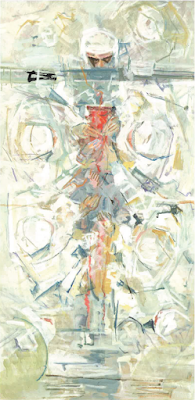
Mildred Thompson, Open Window Series V, 1977
Opening this Saturday, “Expanding Tradition: Selections from the Larry D. and Brenda A. Thompson Collection” is the highly anticipated showcase of over 50 works by artists in the Larry D. and Brenda A. Thompson Collection of African American Art and celebrates the inception of the Thompsons’ endowed curatorship, currently held by Dr. Shawnya L. Harris. “Expanding Tradition” builds upon the 2009 exhibition “Tradition Redefined: The Larry and Brenda Thompson Collection of African American Art,” organized by the David C. Driskell Center for the Study of the Visual Arts and Culture of African Americans and the African Diaspora at the University of Maryland, College Park.

In 2011, the Thompsons donated 100 works of art to the Georgia Museum of Art, and this exhibition provides an overview of certain aspects of the Thompsons’ commitment to art collecting over the last several decades, in tandem with discussions about the shifting artistic and political landscape for African American artists found in their collection. Artists include contemporary artists such as Willie Cole, Whitfield Lovell, Kevin Cole and Kara Walker as well as historical artists such as Elizabeth Catlett, Charles Sebree, Beauford Delaney and Benny Andrews. Rare Great Depression–era works by Norman Lewis, Charles White, Dox Thrash and Rose Piper will also be exhibited.

Left to right: Larry D. Thompson, Shawnya L. Harris and Brenda A. Thompson

“Expanding Tradition: Selections from the Larry D. and Brenda A. Thompson Collection” is on view from January 28 to May 7, 2017. The accompanying catalogue, published by the museum, features a statement of the history and meaning of their many years of collecting as well as a lead essay by Harris, which provides a detailed survey of the artists in the exhibition.

Related events include:

90 Carlton: Winter, the museum’s quarterly reception (free for members of the Friends of the Georgia Museum of Art, $5 non-members)
Friday, February 10 at 5:30 p.m.

Tour at Two with curator Shawnya Harris
Wednesday, February 15 at 2 p.m.

“Conversation on Collecting,” a discussion with the Thompsons and Curlee Raven Holton, executive director of the David C. Driskell Center
Thursday, February 23 at 5:30 p.m.

Black History Month Dinner ($55 members, $75 nonmembers)
Friday, February 24 at 6 p.m.

“Artful Conversation,” hosted in the galleries by assistant curator of education Sage Kincaid
Wednesday, March 22 at 2 p.m.

Artists’ Panel Discussion
Thursday, March 23, time TBA

Family Day
Saturday, April 15, 10 a.m. to noon

All events are free and open to the public unless otherwise indicated.

Thursday, January 19, 2017

“To Spin a Yarn: Distaffs, Folk Art and Material Culture” — Explaining Distaffs

“To Spin a Yarn: Distaffs, Folk Art and Material Culture” opens this Saturday, January 21, and runs through April 16. Sponsored by the Friends of the Georgia Museum of Art and organized by the Stephen F. Austin State University Galleries, this exhibition consists of about 40 decorated wooden distaffs from the collection of Michael T. Ricker.

Detail of a short-form distaff, 1845 (Sweden, probably Vätö, Uppland)

The biggest question we get when discussing the exhibition is: What’s a distaff? 

A distaff is a tool used in spinning, which is the process of converting raw fibers — like wool just sheared off the sheep — into thread or yarn. Until the rise of manufacturing in the late 1700s and early 1800s, spinning was an important art as it was the only way to produce thread or yarn for weaving into cloth and textiles. Distaffs were used to hold raw wool or fiber (for example, linen or cotton) in position during spinning and could also be used in conjunction with a spinning wheel.

Dating from the 19th and 20th centuries, the distaffs featured in “To Spin a Yarn” come from regions across Europe (in Russia, Lithuania, Finland, Sweden, France, Germany, Albania, Greece, Serbia and Bosnia), each of which has its own style. Visitors will see three different types of distaffs. Distaffs from Russia often featured a large base for the spinner to sit and use her weight to hold up the distaff. Short ones with no base sometimes attached to a spinning wheel. Long distaffs without a base could be held under the arm, tucked in the belt or, as seen in the video, tucked between the knees. Here a woman in Breb, Romania, uses a distaff in the traditional manner, working with raw wool by hand.

The museum will also show a “walking wheel,” or large spinning wheel, in the exhibition from its own collection, which was donated in 1997 but has never been on view. All three types of distaffs can be used with a spinning wheel or a drop spindle. The wheel creates the momentum needed to wind thread around a spindle or bobbin, while drop spindles are weighted to create the same spinning momentum to collect the thread. In the video demonstration by spinner Pegg Thomas below, she holds a small amount of llama roving (fibers brushed in one direction and ready for spinning) in her hand as she turns the wheel to wind the fiber around the spindle. If she were to use a distaff, the roving would have been wrapped around the distaff.


Distaffs were more than tools. Originally simple sticks, distaffs evolved into highly decorated objects with intense cultural significance, more important for their meanings than for their function. In some ways, they were the equivalent of an engagement ring today: a gift from a young man to his hoped-for spouse. A more expensive and elaborately decorated distaff expressed wealth and status. The time and money spent on these objects help to show the important place of cloth in a pre-industrial era. Today, we appreciate these diverse distaff traditions as splendid examples of folk art and material culture.

Distaff, early 20th century (Russia, Archangel province, Puchuga village)
Events related to the exhibition include:


All events are free and open to the public unless otherwise indicated.

Stella Tran
Department of Communications

Thursday, January 12, 2017

Abstract Expressionism Exhibitions Opening This Weekend

"The Irascibles," 1950. Photo by Nina Leen.
Time Life Pictures/Getty Images
"Advanced and Irascible: Abstract Expressionism from the Collection of Jeanne and Carroll Berry" and companion exhibition "Artists of the New York School" open this Saturday, January 14, and run together through March 19.

"Advanced and Irascible", which closes on April 30, showcases the efforts of collectors Jeanne and Carroll Berry to gather one work by each of the so-called “Irascible” painters of abstract expressionism. The Irascibles earned their nickname after sending a signed, open letter to the Metropolitan Museum of Art to protest the lack of what they called “advanced” art in its exhibition of contemporary artists in 1950. Artists such as Jackson Pollock, Mark Rothko, Adolph Gottlieb, Willem de Kooning, Hedda Sterne and Ad Reinhardt are represented. In their letter, the artists wrote, “for roughly a hundred years, only advanced art has made any consequential contribution to civilization.”

Characterized by large, gestural paintings, the Irascibles defined the abstract expressionist movement and influenced the trajectory of modern art. A photograph of them, published by Life Magazine in 1951, became the defining image of the abstract expressionists for the remainder of the 20th century.

Almost ready: waiting for the accompanying wall labels to be mounted.
"Artists of the New York School" features works from the museum's permanent collection and several private collections. Containing paintings, sculptures and works on paper, the show highlights artistic trends of the “New York School,” or artists who were active in New York City in the 1950s and 1960s and primarily worked in abstraction. Works by female artists such as Louise Nevelson, Michael (Corrine) West, Helen Frankenthaler and Anne Ryan are included, along with works by artists Robert Goodnough, James Brooks, Frank Stella, Philip Guston and Gerome Kamroski.

An untitled metal sculpture by Robert Goodnough was a gift to the museum in 2016 and will be on view for the first time in the exhibition. An eight-foot-high mixed-media work by Fritz Bultman that uses gouache and collage is a highlight, as is an untitled tall wood sculpture by Nevelson.

Although diverse in medium and technique, the artists of the New York School were key in establishing the United States as a place that welcomed avant-garde art. While visibly influenced by art movements that originated in Europe, such as surrealism and abstraction, the New York School artists innovated in terms of content and material.

Events related to the exhibitions include:

• Irascibles Film Series: “Painters Painting”
Thursday, January 26, 7 p.m.

• Irascibles Film Series: “Pollock”
Thursday, February 2, 7 p.m.

• Artful Conversation: in-depth gallery discussion with Callan Steinmann, associate curator of education 
Wednesday, February 8, 2 p.m.

• Irascibles Film Series: “Robert Motherwell and the New York School: Storming the Citadel”
Thursday, February 9, 7 p.m.

• 90 Carlton: Winter, the museum’s quarterly reception ($5, free for members of the Friends of the Georgia Museum of Art)
Friday, February 10, 5:30–8:30 p.m.

• Family Day: Abstract Valentines
Saturday, February 11, 10 a.m. to 1 p.m. 

• Tour at Two: public tour with Sarah Kate Gillespie, curator of American art 
Wednesday, February 22, 2 p.m.

All events are free and open to the public unless otherwise noted.

Thursday, January 05, 2017

The Art of Giving – Commit to Georgia

The University of Georgia launched its billion-dollar capital campaign, Commit to Georgia, on November 10, and as part of the campaign, the museum is tasked with raising more than $20 million over the next few years. The campaign has three priorities that shape its focus: increasing access for students from Georgia and beyond, enhancing the student experience and solving world problems through research and service. So how does the Georgia Museum of Art fit into all of that?

Heather Malcom (right), with Cyndy Harbold, president of the Friends of the Georgia Museum of Art
First and foremost, the museum is committed to its role within the University of Georgia. Our mission includes the same three pillars as that of the university: teaching, research and service. Our public service is the easiest aspect to see. We serve tens of thousands of visitors a year and bring free visual arts education across the state to communities that need it.

We educate at the same time. We lead gallery tours. We provide a hands-on teaching venue for university students in all disciplines. We supply K–12 teachers with materials that meet state standards at no cost. And we produce the next generation of museum professionals through experiential learning. Finally, we are committed to research. Our curators are faculty members, and every exhibition we organize begins with hours in the library. We’re rewriting art history every day, documenting Georgia’s history and making connections among disciplines.

Though we rely on private gifts for all our programming, numbers aren’t the whole story. When Larry and Brenda Thompson gave us 100 works by African American artists and endowed a curatorial position to focus on that understudied area of art history, their gift served the same three priorities as the campaign. Increasing access isn’t just about scholarships. It’s about making students from a wide variety of backgrounds feel like they belong and providing them with an unparalleled experience while they’re here. The Thompsons’ gift, now reflected in our reinstalled galleries, pushed us toward greater inclusiveness.

That spirit of inclusiveness has also enhanced the student experience, providing models for students of diverse backgrounds to see themselves represented in art. And by validating the importance of all creators, the Thompsons’ gift brings us together as humans, uniting us instead of dividing us. That kind of commitment to the differences that art can make in the lives of individuals is exactly what we’ll be asking of you in the coming years. Together, we can change lives through art.

Heather Malcom
Director of Development

Thursday, December 29, 2016

Lamar Dodd's Odyssey, 1909–1996

On this 20th anniversary of Lamar Dodd's passing, we wish to honor his legacy by sharing with our readers a memoir by William U. Eiland, director of the Georgia Museum of Art. Originally published December 1996 in University of Georgia Magazine.

Lamar Dodd's Odyssey, 1909–1996: A Southern Artist Who Sought Majesty and Truth in the Extraordinary and the Commonplace

Lamar Dodd, Self Portrait, 1936
One of Lamar Dodd's finest paintings is based on a scene he saw not long after his arrival in Athens to join the faculty of the University. Never one to analyze his works in theoretical terms, Dodd always said that any social or political content to his art was in the eyes of the beholder rather than in the mind of the creator. And, thus, when he saw a group of women and children scavenging in the city dump, he decided to describe, to remember, what he had seen in pictorial terms. A cloud of mist or smoke hangs over the scene, the circular forms mirroring the activity below, where women bend and scrabble for life's necessities amongst other people's refuse. As Dodd later appreciated, the picture calls to mind T. S. Eliot's lines, "The worlds revolve like ancient women gathering fuel in vacant lots."

As much as Carr's Hill and the historic North Campus of the University, Dodd's world was equally the city dump, the North Georgia mountains, or his own backyard, where the loveliness of a late-blooming rose sent him scrambling for his watercolors. Elbert Hubbard remarked in the Roycroft Dictionary and Book of Epigrams of 1923, that "Little minds are interested in the extraordinary; great minds in the commonplace." In his career, Lamar Dodd sought the majesty, the truth, in both.

Influenced by LaGrange and New York


Lamar Dodd, 1995
Born on Sept. 22, 1909, in Fairburn, Dodd's first world was the small town of LaGrange, where he studied art at the women's college and where he painted and drew over and over again a lone oak tree and a boat, an image that remained with him for his entire life. Eventually, he went to the Art Students League in New York, where he studied with men and women who were defining American modernism. As early as 1933, with an acclaimed one-man exhibition in Manhattan, he added his voice to those who were seeking meaning through art. His response was in concert with the Agrarians at Vanderbilt University, who argued loudly that Southern artists must look to the rural traditions of the South for suitable subject matter; with the Ashcan artists who argued that the 19th-century academic traditions were obsolete in the 20th century; and the American scene painters, who stridently demanded an American art, one that looked not toward Europe but toward home for inspiration. When he and his wife moved to Birmingham, and as his national stature grew, Dodd became an apostle of this regionalist gospel. His world had now become, once again, the one he loved best: the South, whether the rolling hills of Alabama, the red dirt of Georgia, the tenement houses and cotton pickers and midnight carnivals he sketched and painted and proselytized for, because of the "nearness of their beauty," as he explained to James Saxon Childers. He found in the very air he breathed a challenge to translate it, and he admitted that his inspiration in painting the steel mills of Birmingham was an attempt to capture in paint the "smog that hung like a veil" over the city.

City Dump, 1939
A reviewer of his one-man exhibition in New York characterized Dodd's preoccupation with the everyday sights of the South by noting that the show contained "Not one scene of the Scottish moors with their purple heather. But a glorious painting of the washwoman hanging out the clothes. Not one scene of the fountains of Rome! But a magnificent thing showing the cabins of the tenant farmer. Nothing of Paris or London or Athens or Pompeii. But Georgia, Georgia, Georgia."

Dodd: South no cultural wasteland

And Georgia would be his next destination. By 1937, Dodd, Conrad Albrizio, Anne Goldthwaite, and a very few others, had served notice that the South was no cultural wasteland, that a growing community of Southern artists were fully engaged in the world of New Deal American artistic inquiry. Dodd received a letter from Hugh Hodgson of the School of Fine Arts at the University of Georgia, who invited the young painter, then 28 and without a formal degree, to join the faculty as artist-in-residence. The letter also held the astonishing news that, should he accept the offer, the annual budget for the visual arts program would be raised from $50 to $5,000. The invitation caused consternation in Birmingham, where Childers published in the paper a tongue-in-cheek refusal to give Hodgson a good recommendation of Dodd for the post, because Georgia's gain would be Alabama's irreparable loss.

LaGrange Hillside, 1927
The University joined a group of progressive colleges and universities in hiring leading American painters to act as artists-in-residence, without regard to higher degrees. Dodd was to give example and instruction to students as a practicing, professional artist of note, who was expected to "interest all students with the value of understanding the arts and developing taste so that this institution might serve more faithfully in influencing culturally the people of our state."

The University found itself in 1937 with just such men in the persons of Hodgson and Dodd, who set about consolidating the three teachers, scattered in various departments across campus, into a recognizable department of art, with its own budget — the promised $5,000 — its own building and, most important, students. Nine enrolled as art majors after only one year, and a graduate program was established within the next three years. Dodd's world now became an academic one, but not one confined by walls of ivory.

Student artists popped up everywhere 
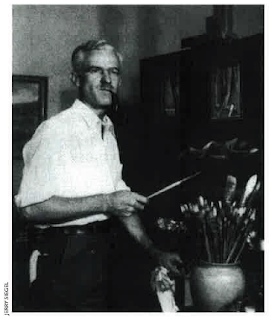
Dodd at work, 1945
Dodd became a force in the community as well. Athenians saw students sketching on Carr's Hill, designing products for local businesses, cajoling patrons to buy their works at auctions. Other artists of note arrived, lured to Athens by Dodd: Elaine de Kooning, John Held, Yasuo Kuniyoshi, Howard Thomas, Ferdinand Warren, and Carl Holty among them. Dodd had inherited an untenable situation, one he moved to rectify through a rational administrative structure. With the force of his singular personality, combined with an obstinate and almost ruthless commitment to his vision, Dodd cut through red tape and created a real department of art. Chances of success were slim: a studio in a dirt-floor basement, few slides available for teaching, and an insufficient budget. From these modest beginnings, Dodd forged one of the largest art schools in the Southeast, one that boasted at his retirement more than 700 majors, a faculty of 53, a "real" slide library, and a complex of buildings.

Lamar Dodd, Alfred Heber Holbrook, ca. 1948–49
Support craftsmen are artists, too

 Dodd was dedicated to the idea that a school of art must include the arts that until recently were defined as "support crafts, minor, or decorative." Thus, he recruited ceramicists, metalsmiths, fabric artists, and interior designers to join the more traditional painters, sculptors, printmakers, and draftsmen. The department grew and prospered through his tenure such that his contributions were recognized in 1996 when the School of Art was named after him. Of all the honors he received, the Lamar Dodd School of Art was the most personal, the most cherished, for it signified that his devotion to students would be forever remembered.

Lamar Dodd, Old Botanical Gardens, Athens, 1938
Cultural ambassador for the U.S.

Lamar Dodd, Open Heart 
Surgery, 1979–81
During his years at the helm of the department, Dodd helped to found the Georgia Museum of Art. In the 1950s, his world once again expanded with his first trips to Europe to study the Old Masters he revered and later in the 1960s as a cultural ambassador for the nation on state department-sponsored trips to Russia, Turkey, India, Korea, China, and Japan. For a time, Dodd's national stature as an administrator eclipsed his reputation as an artist. He was the first artist — and one without an earned degree — to serve as president of the country's largest and most influential professional organization for those working and teaching in the visual arts: the College Art Association. He traveled and lectured extensively on behalf of Phi Beta Kappa. And no matter how far away from Athens, he kept in his breast pocket his long-range plan for the department of art. People in far-flung corners of the world who had never heard of Georgia knew the goals of the university's department of art. Lamar Dodd wore all these hats, those of administrator, advocate, ambassador, and teacher, with equal commitment, but the one he favored most was that of artist. No matter how busy or preoccupied, he found time to sketch, to draw, to paint. His art underwent stylistic, even technical changes, as he reacted to the new vocabularies of the cubists, the abstract expressionists, the neorealists, or any of the host of voices who clamored to be heard in the polyglot 20th-century aesthetic din. Yet even at his most abstract or decorative, he never stepped over into complete nonrepresentation, because, as he remarked over and over, his art was dependent on the natural world. Pure formalism, which he found sterile and cold, a neo-academicism as it were, was the one voice to which he refused to listen.

Lamar Dodd, Turkish Bazaar, No. 2, 1995

New vistas: NASA and heart surgery 

Dodd had to find new means of expression to depict the cosmos when he joined NASA's coterie of artists asked to document America's early adventures in space. His response was to fashion an art of elemental symbols, one where silver and gold emphasized the otherworldly preoccupations of scientists and artists alike. A decade later, in the 1970s, he used similar means to define another, more intimate universe: the surgical amphitheater, one that necessitated an equally novel language of sign and symbol to articulate deeply spiritual concerns about life and rebirth. In the last decade of his life, ever curious, ever impatient with infirmity, he found his subjects on the television screen or in newspapers. Restricted by illness to the community he loved, he searched his own backyard for inspiration, and found it in sunflowers, blades of grass, fossils, and, perhaps most important, in memories of the golden hillsides of Umbria, the glistening masts of sailing ships on the Bosporus, and the multicolored fantasy that is Jaipur. His drawings of this last period retain the vigor, the excitement, the surety of his first sketches of that lone oak tree and boat back in LaGrange. In the last year of his life, Dodd saw both the school of art and a new chair of art in the Athens-Clarke County School System named in his honor, a new museum building with a Lamar Dodd gallery, a major retrospective of his works from 1922 to 1996, and two books about his life and career. One day short of his birthday, he died, but the entire year had been his fellow Georgians' gift to him. The final world, therefore, for Lamar Dodd, teacher and artist, was the most important one: home.

Thursday, December 22, 2016

Celebrating the Holidays with Ornaments Inspired by the Exhibition "Gifts and Prayers: The Romanovs and Their Subjects"


Season's greetings! For the holidays, the museum's education department (Carissa DiCindio, curator of education, Callan Steinmann, associate curator of education, and Sage Kincaid, assistant curator of education) hosted an ornament-decorating party for the staff. We used craft store supplies that reminded us of the sparkle of gems and jewels in the exhibition "Gifts and Prayers: The Romanovs and Their Subjects." The show, which runs through the end of the year, was featured recently by the University of Georgia in the video below.


For holiday shoppers headed to the Museum Shop, Romanov-themed and gift-ready items like crystal eggs and porcelain ornaments are available for sale, in addition to the catalogue of the exhibition.


Thursday, December 15, 2016

Spotlight on Studio Workshops: Q&A with Instructor Erin McIntosh

Open to artists of all levels of experience, including beginners, "Studio Workshop: Biomorphic Acrylics" starts January 5. Led by Athens-based artist and educator Erin McIntosh, the workshop is held on four Thursdays throughout the month and focuses on biomorphic abstraction as expressed through various techniques and acrylic mediums, including applications for both abstract and representational works. The sessions will draw inspiration from the museum's collection, including works from the archives and many not currently on display. 

In anticipation of the program, Erin answered some of our questions related to the workshop, art and her sources of inspiration.


Erin at Vermont Studio Center. Image: Howard Romero

What are some of your favorite works at the Georgia Museum of Art?

I absolutely love the Joan Mitchell painting ["Close," 1973] and visit it every time I visit the museum.  Also, the Radcliffe Bailey painting ["7 Steps," 1994] is a favorite, I had the opportunity to study with him in both undergrad and graduate school and find his work to be alluring because of its tactile nature and its relationship to improvisational process yet, his work is highly researched and is executed with great precision.

How does a visit to the museum inspire you as an artist?
Seeing works of art in person is one of the most informative activities to learn about ways of making paintings and making art in general. To experience the physicality of an object is to fully experience it and as someone who works with a physical medium, the tactile qualities of the surface of a painting are so important to the overall experience of it. This aspect gets completely lost in digital form when viewed on a screen  viewing in person is so much better!

Erin McIntosh, Color Chord 1, 2016
Is there something you are currently working on or are excited about starting that you can tell us about?
I am currently working on a series of biomorphic abstract paintings for a solo exhibition at the University of West Georgia which will take place in the spring. I am using the techniques and processes which we will be exploring in the studio workshop to make these paintings, so it is all fresh on my brain.

What do you read, listen to, or look at to fuel your work?
I tend to read more nonfiction than fiction and gravitate towards books on creativity, teaching, and entrepreneurship. I've also picked up books more recently on science and art.  I spend a fair amount of time in the car commuting so I have been listening to podcasts; one recent favorite is The Art of Authenticity by Laura Coe. In addition, I enjoy learning about science and Neil deGrasse Tyson's StarTalk Radio is another show I enjoy because he makes science digestible to the non-scientist. I listen to a wide variety of music but always enjoying Olafur Arnalds, Yann Tiersen and Hauschka while working in the studio. But other days, you will find me listening to singer-songwriter folk, soul, or rock.

What advice or words of wisdom have influenced you as an artist? 
Radcliffe Bailey once told me to "work as three versions of yourself" and this has greatly influenced the ways in which I work. I tend to have multiple bodies of work going simultaneously and move through these, shifting from one to the other every month or two. Working with different entry points and process helps me to keep what I am working on fresh, for example, one process relies heavily on spontaneity and improvisation while another is highly calculated and methodical. Everything ends up informing everything else and I often find myself circling back to earlier ideas.


"Studio Workshop: Biomorphic Acrylics" runs Thursdays, January 5, 12, 19 and 26, from 6:30 to 8:30 p.m. The cost of the course is a $15 materials fee, which will cover all necessary supplies for the four sessions. Space is limited; please call 706.542.8863 or email callan@uga.edu to reserve a spot.


Thursday, December 08, 2016

Featured Publication: "Icon of Modernism: Representing the Brooklyn Bridge, 1883–1950"

This catalogue accompanies the exhibition of the same name, on view at the Georgia Museum of Art Sept. 17 – Dec. 11, 2016. It includes essays by curator of American art Sarah Kate Gillespie on the history of the Brooklyn Bridge as a symbol of modernity and on photography of the bridge, by Janice Simon on images of the bridge in the popular press, by Meredith Ward on John Marin's renderings of the bridge and by Kimberly Orcutt on Joseph Stella's paintings of the structure. All images in the exhibition are reproduced full page in full-color and many supplementary images flesh out the discussions.
Watch the video below for a 3-minute reading from the catalogue and to preview the interior pages of the publication.


Full-color images; slipcase; two ribbon markers. Hardcover; 126 pp.; $55.00. ISBN 978-0-915977-95-6. Order through the Museum Shop at 706.542.0450 or online at (Museum Shop via UGA Marketplace) and Amazon.com.


Copyright disclaimer under Section 107 of the Copyright Act 1976: Allowance is made for "fair use" for purposes such as criticism, comment, news reporting, teaching, scholarship, and research. Fair use is a use permitted by copyright statute that might otherwise be infringing.

Thursday, December 01, 2016

The Instagram Beat and Upcoming December Events

This past August, we reopened our permanent collection to the public, and visitors have extended their museum experience to the digital realm on Instagram in delightful ways. Their posts demonstrate how social media can continue to engage us with the museum's collection outside of our walls as well as how art can continually feel new and playful. We are grateful to our visitors who enliven the museum experience and exemplify our motto here at the Georgia Museum of Art: Art for everyone.


Soup-er women!

A photo posted by Erin Ernst (@ernst.agram) on

You never see this untitled work by Fred Eversley the same way twice.

A photo posted by GeorgiaMuseumofArtStudentAssoc (@gmoasnaps) on

Sister, sister

A photo posted by andrew mcdermott (@stealyourdog) on

Making art work for you!


Life imitates art with "La Confidence."


The museum also has its own Instagram account and we invite you to follow us at @georgiamuseum. For those who are making the physical trip to the museum as well, here is a list of some upcoming events this December:

Thursday, December 1:
Friends and Family Day in the Museum Shop, 10:00 a.m. – 8:45 p.m.

Friday, December 2:
Morning Mindfulness, 9:30 a.m. – 10:30 a.m.
Gallery Talk: Nicholas Kilmer, 2 – 3 pm

Wednesday, December 7:
Tour at Two: “Gifts and Prayers: The Romanovs and Their Subjects” with curator Asen Kirin, 2 – 3 pm

Wednesday, December 14:
Tour at Two: Decorative Arts with curator Dale Couch, 2 – 3 pm

Wednesday, December 21:
"Artful Conversation: DeScott Evans" with Carissa DiCindio, curator of education, 2 – 3 pm

Visit our calendar for a full list of upcoming events in December and January.

Copyright disclaimer under Section 107 of the Copyright Act 1976: Allowance is made for "fair use" for purposes such as criticism, comment, news reporting, teaching, scholarship, and research. Fair use is a use permitted by copyright statute that might otherwise be infringing.

Thursday, November 24, 2016

Annual Book and Frame Sale and Membership Specials


Happy Thanksgiving! As the holidays approach, we've organized a few events to help you shop for your loved ones or for yourself. We'll be closed today and tomorrow to allow our hard-working front-line staff to spend time with their families, but will be back open regular hours over the weekend, including Saturday, when UGA hosts Georgia Tech for its final football game of the year. The game starts at noon, but we open at 10 a.m., so if there are exhibitions you've wanted to see and haven't made it over for yet, you have time to fit in both.

From Tuesday, November 29, through Friday, December 2, we'll have our annual holiday book and frame sale. The sale features new and used publications in all genres.

(And for anyone who would like to donate books or frames, give us a call on the main line at 706.542.4662. We'll even come pick them up!)


Then, on December 1, the Museum Shop will be offering special deals and discounts from 10 a.m. to 8:45 p.m., including beautifully packaged gift memberships:

- 20% discount on memberships at the Contributing level or above, either for yourself or as a gift

- 20% discount on non-sale items for museum members, including brand-new members*

- Free cookies and coffee to fuel your shopping, from 5:30 to 8:30 p.m.

- Free parking for shoppers in the museum's gated lot under the building.

Contributing-level memberships include reciprocal membership discounts and privileges at more than 1,000 museums throughout the United States and Canada and can be a wonderful gift even for friends and family outside of Athens.

* Don’t forget to bring your membership card.


Thursday, November 17, 2016

Highlights from the Permanent Collection: Blair-Daura Chest


This chest of drawers descended in the Blair family of Virginia and is attributable to the south side of the state or possibly the area of Milton, N.C. The chest was gifted to the Georgia Museum of Art from the Pierre Daura estate. Comprising walnut, poplar and yellow pine, the chest displays numerous aspects of fine craftsmanship and probably dates to around 1825–60. For its time and region, important stylistic features include ring-turned feet, cross-hatched inlay characteristic of furniture from the Roanoke River valley, large inlaid circles and ovals and, especially, carved masks placed in the upper stiles beneath the top. Referred to in the 19th century as “mummies,” the masks reference long-standing classical examples. Georgia Museum of Art's curator of decorative arts, Dale Couch, is exploring a possible attribution to or influences from African American cabinetmaker Thomas Day. Similar masks are found in his architectural woodwork from that region.

According to Couch, “The Blair-Daura chest is exciting for a number of reasons, but especially since aspects of its design, in particular its cross-hatched inlay, migrated with settlers from Georgia in the lower southern piedmont. Such pieces serve not only as remarkable specimens of American decorative art but also as important reference points for evaluating Georgia examples. The chest will provide numerous ongoing research projects for a long time to come. Thomas Mapp and Martha Daura’s names are well known to the museum community, and it is well known that she is the daughter of internationally important Catalan artist Pierre Daura. We forget that she is also a Virginian, and her family heirlooms have now become an important part of our decorative arts holdings.”


Thursday, November 10, 2016

Elegant Salute XV: "A Night of Tropical Splendor"

When they begin the Beguine
It brings back a sound of music so tender
It brings back a night of tropical splendor
It brings back a memory evergreen
— Cole Porter, “Begin the Beguine”

From Elegant Salute XIV of 2015: "An Elegant Salute to Georgia."

The 15th edition of Elegant Salute will soon be upon us, on Saturday, January 28, 2017. Elegant Salute is our black-tie gala held every other year and is the museum’s most important fundraiser. Funds from this event go directly to educational programming and exhibitions. This year’s chair is Maggie Hancock, who crafted the beautiful and inspiring décor for the last Elegant Salute and has made herself an indispensible member of the Friends of the Georgia Museum of Art. Hancock will work with her co-chair, Sarah Peterson, and her network of committee chairs to create an unforgettable evening, inspired by Cole Porter’s song “Begin the Beguine.”

Written in 1935 while Porter was on a cruise in the South Pacific, the song evokes the elegance of the time period. As Hancock puts it, “Porter transports one to a place where the Beguine (a Latin dance) is happening, and the tropical setting heightens the sensorial moment. Expect to be transported into an evening of lush paradise filled with elements from shore to sea.” Flower arrangements are always a highlight of the event, and this year’s theme provides an abundance of inspiration for flower committee chair Beverly Sligh.

Dancing at Elegant Salute XIV, 2015
The evening will begin with a reception in the Jane and Harry Willson Sculpture Garden. Cocktails and hors d’oeuvres will be followed by dinner catered by Epting Events in the M. Smith Griffith Grand Hall. Following dinner, guests will return to the sculpture garden for dessert and dancing at the Copacabana-themed after-party.

The museum relies on private donations to fund programming and exhibitions, making this event vital to our success in the coming year. The Friends hope to raise $180,000 in support, and we have no doubt that David Matheny, fundraising chair, can achieve that goal. There’s no one better at nicely twisting arms. 

The rest of the committee chairs bring talent, experience, energy and creativity to their jobs, and we look forward to seeing what they come up with. Ligia Alexander is spearheading décor, Devereux Burch and Amburn Power are in charge of social, Evelyn Dukes is handling logistics, Airee Hong Edwards will manage publicity for the after-party, Mike Landers is planning the entertainment, and Mike Montesani will work with Epting Events on the evening’s menu.

Advance reservations are required by January 13. $300 per person for members and $350 per person for nonmembers. Tickets for the after-party only are $50 for members and $65 for nonmembers and allow entry for the dessert and dancing in the sculpture garden at 9:30 p.m. Tropical attire encouraged. Call 706.542.0830 or visit http://bit.ly/gmoa-es2017 for more information, to sponsor or to purchase tickets.

Thursday, November 03, 2016

"Storytelling: The Georgia Review’s 70th Anniversary Art Retrospective"

"Storytelling: The Georgia Review’s 70th Anniversary Art Retrospective" opens this Saturday, November 5, during the University of Georgia's Spotlight on the Arts festival. In this exhibition, the Georgia Review — the university's highly regarded journal of arts and letters — celebrates the wide-ranging roster of visual artists whose work it has reproduced with a selected retrospective of paintings, works on paper, photographs and 3-D compositions by contributors from across the United States and beyond: Kael Alford, Benny Andrews, Nina Barnes, Carl Bower, Tamas Dezso, Vanessa German, Margaret Morrison, Celeste Rapone, Bianca Stone, Kara Walker, Patti Warashina, and Masao Yamamoto.

Masao Yamamoto, KAWA = FLOW #1637, 2013–15

Focusing on the many ways in which stories can be told, the exhibition drives the point home on a local and global scale. Of the 25 works in the show, some come from the state of Georgia while some, like the photographs, document conditions in Iraq, Romania and Colombia — many of the works address issues of gender, race and politics. "Storytelling: The Georgia Review’s 70th Anniversary Art Retrospective" emphasizes art-making as visual testimony.

Jenny Gropp, managing editor at the Review and co-curator of this exhibition, said she is “thrilled to be presenting this particular gathering of artists.” Annette Hatton, former managing editor of the Review, is Gropp’s co-curator, and Sarah Kate Gillespie, the museum’s curator of American art, served as in-house curator.

Events related to the exhibition include:

Tour at Two: Jenny Gropp, managing editor of the Georgia Review and co-curator of the exhibition, will give a special tour.
Wednesday, November 9, 2 p.m.

Opening reception: Award-winning poet Rachel Eliza Griffiths will read work at this event as part of her Georgia Poetry Circuit tour. Light refreshments will be served.
Thursday, November 17, 7 p.m.

Closing reception: Light refreshments will be served and the exhibition will be open.
Thursday, January 19, 7 p.m.

All events are free and open to the public unless otherwise noted.

Thursday, October 27, 2016

"Gifts and Prayers" and Music from the Golden Age of Russia

This past Tuesday, the Hugh Hodgson School of Music held an ensemble concert inspired by our current exhibition on 19th century objects from Russia titled “Gifts and Prayers: The Romanovs and Their Subjects.” The concert program, “Music from the Golden Age of Russian Culture,” focuses on Russian music from that same period and examines another side of art from the era of Romanov rule. Some highlights of the concert include:

Scherzo in A flat Major by Alexander Borodin


Just as some of the gifts given and received during the House of Romanov included enameled miniatures, it turns out music can have miniatures too. Clocking in at three minutes when played at the correct tempo, this vivacious and lively piece belies Alexander Borodin's own interesting background. Borodin, who was a bright youth with a passion for both the sciences and the arts, was denied access to higher education because he was born out of wedlock to a Georgian prince and a commoner. Eventually, through the help of his mother and stepfather, Borodin enrolled at the academy of medicine in Saint Petersburg.

Sonata for Violin I: Allegro by Mikhail Glinka


Glinka is known for his particularly Russian brand of classical music, and his works were performed often during the Romanov Tercentenary in 1913, which celebrated the rule of the Romanov dynasty. Under the rule of Nicholas I, Glinka's “The Life of a Tsar” became the national opera of Russia.

The last highlight is “Ya li v pole da ne travushka bila (Were I a blade of grass)” from Seven Romances Op. 47 by Pyotr Ilyich Tchaikovsky, sung here by Polish soprano Teresa Zylis-Gara. This sorrowful and graceful piece takes its words from a poem published in 1870 by Ivan Surikov, titled “Little-Russian Melody.”


Thursday, October 20, 2016

Highlights from the Permanent Collection: "Saint George and the Dragon"

This Tiffany stained-glass window depicting St. George and the Dragon has made a circuitous journey over seven decades to its current home. Installed in the second-floor overlook of the Georgia Museum of Art, in windows facing east, this beautifully crafted work of art is finally on view to the public.

The subject of the window is the story of St. George. In the tale, a dragon lives in a spring or lake, preventing local townspeople from gathering water. To pacify and distract the creature, the villagers offer up sheep as a sacrifice. If no sheep are available, a maiden is offered. The king’s daughter is one such maiden, but while she awaits her fate, St. George appears on horseback, makes the sign of the cross and slays the dragon. The citizens then convert to Christianity.

 The window shows St. George after his triumph, with his foot on the head of the monster, a final gasp of flame issuing from its mouth. The saint’s delicately painted face shows
his gaze heavenward. The tips of his sword and standard have a faint blood-red tinge. Layered, rippled blue glass creates the effect of undulating water in the lake behind him, and pinkish drapery glass captures the folds of his cape. St. George’s scale-like armor is made up of numerous small sections of green leaded glass. The brilliant colors and various textures of the glass help accentuate the moment of his victory. 

Much of the window’s history was lost over time and changes of stewardship. Until recently, it was listed in the museum’s files as by an unknown artist, possibly German, but dedicated investigation has uncovered some of its full story. Before his death in 1938, George Foster Peabody, famed philanthropist and friend to the University of Georgia, wrote to UGA president Harmon Caldwell to donate the window to the university. The window was eventually installed on campus in Strahan House, a faculty residence. It stayed there until the mid-1960s, when the building was razed for the new Law Library. At this time, the window was transferred to the museum’s permanent collection.

For more than 30 years, the window was installed in the stairwell of the original Georgia Museum of Art on North Campus, now the university’s administration building. When the museum relocated in 1996, the window was removed and remained crated and in storage for 15 years. As part of the museum’s subsequent renovation and expansion, completed in 2011, it was finally ready to go back on display.

Unfortunately, the window was damaged during preparations for that opening and required considerable conservation. Botti Studios in Chicago, Illinois, worked on the window for approximately two years, documenting it in detail and removing, cleaning, conserving and reinstalling much of the stained glass. Once the window returned to Athens, work began in earnest to design and construct a mount so that the work of art could be illuminated with natural light during the day and backlit during the evening with LEDs. Local craftsman Hunt Leathers led a team to create an elegant steel frame to house the several-hundred-pound window within the mullions of the overlook window.

The window’s damage resulted in unforeseen benefits. During the restoration, with the help of archivists Steven Brown and Gilbert Head at UGA and local stained-glass artist Marianne Parr, I was able to rediscover the window’s history and, most important, its maker. In addition, its placement was upgraded to a more prominent location than had been planned in 2011. The window, in a sense, was reborn.

Annelies Mondi
Deputy Director

This article originally appeared in the Autumn 2016 issue of Facet.

Thursday, October 13, 2016

"It Happened in Brooklyn" and Tin Pan Alley: 20th Century Music from New York

Our current exhibitions "Icon of Modernism: Representing the Brooklyn Bridge 1883–1950" and "Man's Canyons: New York City on Paper" show visual representations of the bridge and New York during a period of changing social attitudes and perceptions; music was another creative discipline that reflected those times.

Of course, you wouldn't think times had changed all that much based on this studio take of "The Brooklyn Bridge" from 1947. Performed by Frank Sinatra, this song was featured in the film "It Happened in Brooklyn," which is screening for free tonight as part of our Brooklyn Bridge film series at 7 p.m. in the M. Smith Griffith Auditorium.


The writers and producers of this light-hearted musical comedy were aware of the growing generational gap between those who remembered how things were and those who saw only modern life, and they used music to contrast the old and the new. Check out two versions of the same song, also featured in "It Happened in Brooklyn."


Outside the film, New York City's contributions to musical history in America has been incredibly rich and diverse. The city is the birthplace of hip hop, doo woo, new wave and salsa, and two of America's most celebrated composers, George Gershwin and Aaron Copland, were born in Brooklyn. For those interested in hearing more of the music created contemporaneously with the paintings featured in "Icon of Modernism," here are a few select playlists of music from Tin Pan Alley, which was the name given to the row of music publishing houses in New York on West 28th Street between Fifth and Sixth Avenue, where popular music flourished from about 1885 through the 1950s.

This first playlist features 80 tracks, some of them the same songs with different arrangements, for a broader view of songwriting during this period.


Gershwin got his musical career started in Tin Pan Alley, eventually moving on to writing Broadway theatre tunes, classical music, and Hollywood movie scores. Some of his most recognizable works include "An American in Paris," "Rhapsody in Blue" and "Porgy and Bess." This particular playlist features his early songs from Broadway and Tin Pan Alley.


Have a favorite song from the early 20th century? Be sure to share with us in the comments!

Thursday, October 06, 2016

"Driving Forces: Sculpture by Lin Emery"

“Driving Forces: Sculpture by Lin Emery” is on view now through April 2, 2017. Four of Emery’s large kinetic sculptures, including "Octet," "Splay," "Lyric" and "Umbrella Tree," will be outside in the Jane and Harry Willson Sculpture Garden, and five smaller sculptures will be inside in the Alonzo and Vallye Dudley Gallery. Included indoors is a maquette of "Tree Flowers 2" (also in the exhibition) to show visitors how Emery's works evolve from paper model to sculpture. Check out the video below to see the sculptures in motion.


An internationally recognized artist, Emery takes inspiration from the kinetic appeal of music, dance and natural forms, especially flowers and trees, to design works that move gently in response to the wind. Her main materials, polished and brushed aluminum, are the same as those used in boat building in New Orleans, where her work can be found throughout the city. Annelies Mondi, the museum’s deputy director of the museum and curator of the exhibition, came upon Emery’s work while in New Orleans. Mondi said, “It was incredible. She really is a big part of the city, and that intrigued me.” Emery was born in New York City in 1928 and studied under Russian sculptor Ossip Zadkine before settling in New Orleans.

Playwright Edward Albee, who knew Emery from when they were children, compared her sculpture to that of Alexander Calder and George Rickey, both of whom also make use of movement in their work. Albee writes, however, that Emery’s “work can be confused with no one else’s; the world of kinetic art is healthy in her mind and hands.” Emery's sculptures are the latest to be featured in the Jane and Harry Willson Sculpture Garden. Opened in 2011, the sculpture garden is devoted to the works of women sculptors. Previous exhibitions there have focused on sculpture by Alice Aycock, Patricia Leighton, Chakaia Booker and Steinunn Thorarinsdottir.