Thursday, November 30, 2017

Competing with Netflix: The Georgia Museum of Art's Student Night


UGA students Gabby Victorio and Kylie Anderson at Student Night
How do you catch the attention of college students on a Thursday evening when there’s Netflix to be watched, essays to be written and concerts to go to? A combination of free pizza, amusing crafts, a WUOG DJ, a Polaroid photo booth and an innovative exhibition by an African American artist will not only capture their attention but attract them in hordes. The Georgia Museum of Art StudentAssociation put on its second student night of the academic year on Thursday, November 9, highlighting the exhibition “Muse: Mickalene Thomas Photographs andtête-à-tête.”

Students making collages at Student Night   
The student nights are put on three nights a year by the Student Association as a way to draw students in and showcase the current exhibitions and permanent collection of the museum. Each student night includes a craft that is related to the exhibition, free food catered by a local restaurant, a DJ from the student-run college radio station (WUOG), an activity involving the exhibition and a Polaroid photo booth. The craft for this Student Night involved students making collages with Polaroids and magazine clippings as homage to Thomas’ work and the activity had students using Snapchat to complete a scavenger hunt of images from the exhibition.

Student Association president Rebecca Gross said, of choosing the Thomas exhibition for the student night, “Our whole team really felt drawn to this show. We always go and take a walk through the galleries to choose an exhibit before we start planning student night, and this one was an immediate yes. Not only were all the works visually striking, but the themes addressed really stuck out to us. The show deals with things that may be uncomfortable for some people to talk about, but I think they are exactly the things we need to talk about, especially as college students. Our hope in featuring this exhibit was that the vibrancy and visual opulence would draw students in, and from that they would be prompted to think about some of these important social issues.”

Members of the student association in front of the photo booth    

The Student Association has been active for many years now and continues to grow with each passing year. Students enjoy the opportunity to be an active member in promoting the museum and its wonderful exhibitions. 

The Student Association is planning its next student night for February 8, 2018. Join them for a night of art, music and fun. 

Stephanie Motter
Intern, Department of Communications

Thursday, November 16, 2017

Former Intern Daniel Chamberlin Is Making a Career in Museums

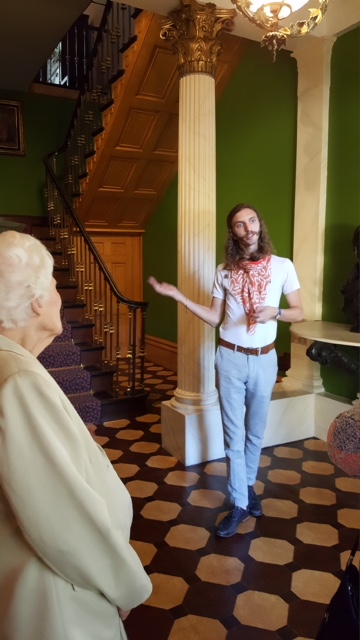
Daniel Chamberlin giving a tour at the Owens-Thomas House, Savannah.

Daniel Chamberlin was a volunteer intern at the Georgia Museum of Art from 2012 to 2014. He worked on numerous projects while here, including with Dale Couch, curator of decorative arts, and with the preparators, helping to mount exhibitions including "Rugs of the Caucasus." For that exhibition, he also wrote materials for its catalogue. We've followed his museum travels since he left here and been proud to see him working first at Hay House, Georgia Trust for Historic Preservation, in Macon, where he was a museum interpreter, and now in a similar role at the Owens-Thomas House and Telfair Academy, part of the Telfair Museums in Savannah. We asked if he would write something for us on his experience here, and he was kind enough to oblige.

During my time as an intern at the Georgia Museum of Art I was exposed to so many great things I have taken with me into other jobs since that time. Working with Dale Couch as a curatorial intern was one of the most rewarding experiences I have ever had, and he continues to be a mentor to me today. His wealth of knowledge combined with the resources available at the Georgia Museum of Art were invaluable. I not only learned a great deal about object analysis, best museum practices and research methods; but was exposed to both public and private collections giving me innumerable learning opportunities. He introduced me to many other museum professionals within the field, and I continue to maintain those connections today. Through those I have been able to further my own education and career path.
Unlike many student interns, I completed two consecutive internships, and stayed for a second year to work within the preparators' department. The skills I gained during my time working with Todd Rivers and Larry Forte have also proven to be of great worth — from exhibit design to ​various construction methods. Given the chance to design and execute a temporary exhibition, I was able to work directly with curatorial and preparation staff members simultaneously, which gave me such an in-depth and holistic experience. 
All of this has carried me through much of the work I have done since that time. Currently employed by the Telfair Museums in Savannah, Georgia, I am still using those skill sets and knowledge I gleaned within the collections and galleries of the Georgia Museum of Art. I would highly recommend these intern programs to anyone who is interested in pursuing a career in museum work on any level. 
To learn more about internship opportunities at the museum, which are rich in experiential learning, visit our website here. 

Thursday, November 09, 2017

Mickalene Thomas highlights her muses

Mickalene Thomas, “La leçon d’amour,” 2008. © Mickalene Thomas. Courtesy the artist; Lehmann Maupin, New York and Hong Kong; and Artists Rights Society (ARS), New York.

The word “muse” conjures an image of an ethereal ancient Greek figure, but artist Mickalene Thomas has a different, more grounded set of muses, comprising strong African American women, including her mother, friends and former lovers. Thomas is best known for her large-scale paintings of women, which complicate the art historical representation of female beauty and reconsider tropes around femininity, identity and desire.

Currently based in Brooklyn, Thomas earned her bachelor of fine arts in painting at Pratt Institute in 2000 and a master of fine arts at the Yale University School of Art. She experimented with photography by taking photographs of herself and her mother. For each image, Thomas creates a tableau with furniture and fabrics that the models pose within. She uses stylistic influences from the 1970s, the civil rights movement and second-wave feminism as she puts forward a complex depiction of what it means to be a woman and an expansive definition of beauty.

The Georgia Museum of Art at the University of Georgia is presenting the exhibition “Muse: Mickalene Thomas Photographs and tête-à-tête” through January 7, 2018. More than 40 works by Thomas and artists whose work she has selected are on view.

Thomas’ work both deconstructs and reappropriates art history while it reflects a personal community of inspiration. Her photograph “Le Déjeuner sur l’Herbe: Les Trois Femmes Noires,” for example, reimagines Edouard Manet’s famed painting of a bohemian picnic with three women who are close friends of the artist.

“We are excited about the opportunity to exhibit the work of this cutting-edge contemporary artist,” said Shawnya Harris, the museum’s Larry D. and Brenda A. Thompson Curator of African American and African Diasporic Art. “Our audiences will be engaged and fascinated with works that are both accessible and thought provoking.”

Carrie Mae Weems, "Project Row Houses," 2006 – present. © Carrie Mae Weems,
courtesy the artist and Jack Shaman Gallery, New York.
Thomas served as curator of the other artists’ works on display in the exhibition, an installation of work by fellow photographers that includes specific works of art that have inspired her. Artists include Derrick Adams, LaToya Ruby Frazier, Lyle Ashton Harris, Deana Lawson, Zanele Muholi, Malick Sidibé, Xaviera Simmons, Hank Willis Thomas and Carrie Mae Weems.

This exhibition is organized by Aperture Foundation in New York, a not-for-profit foundation that aims to connect the photo community and its audiences with the most inspiring work. This exhibition is sponsored by the Robert Mapplethorpe Foundation, Inc., and locally by UGA’s Willson Center for Humanities and Arts, the W. Newton Morris Charitable Foundation and the Friends of the Georgia Museum of Art.

Remaining programs related to the exhibition include a Teen Studio program tonight (November 9 from 5:30 to 8:30 p.m.), which is free and includes a pizza dinner (email sagekincaid@uga.edu or call 706.542.0448 to reserve a spot); Student Night, organized by the Georgia Museum of Art Student Association, also tonight, from 6:30 to 8:30 p.m.; and an Artful Conversation on December 13 at 2 p.m. Several of these programs are in conjunction with UGA’s 2017 Spotlight on the Arts festival.

Thursday, November 02, 2017

Spotlight on the Arts Enters Its 6th Year


When UGA started its Spotlight on the Arts festival, it was a much smaller affair, but last year about 23,000 people attended its events. The festival runs November 1 – 12, with events in the literary, performing and visual arts happening all over the UGA campus. Today (November 2) brings the Student Spotlight, on the Tate Student Center Plaza, with theatrical and musical groups performing every 15 minutes until after 4 p.m. It's a great chance to see all the things students in the arts are doing on campus.

Of course, the museum has many events scheduled as part of Spotlight, including the first film in our Americans in Paris film series, "An American in Paris," tonight at 7 p.m. in the M. Smith Griffith Auditorium. Come experience Vincente Minnelli's lavish musical on the big screen, as Gene Kelly and Leslie Caron sing and dance their way around Paris.

Friday, November 3, brings one of our Morning Mindfulness sessions at 9:30 a.m. These free guided mindfulness meditation sessions, held every other Friday during the school year, include a variety of instructor-led meditation, movement and mindfulness techniques. No experience or special clothing is necessary, and we provide meditation pillows or yoga mats. (Reservations are encouraged; please contact 706.542.0448 or sagekincaid@uga.edu. Funded in part by the Hemera Foundation.)

We have no special events planned for this Saturday, November 4, when UGA plays South Carolina at home at 3:30 p.m., but we will be open, as we are every home game Saturday, from 10 a.m. to 5 p.m. And Sunday, November 5, at 3 p.m., we'll have a docent-led tour of highlights from the permanent collection. We'll have another tour Wednesday, November 8, at 2 p.m.

On Tuesday, November 7, at 10 a.m., we'll have the latest in our series of Toddler Tuesdays, with a special tour, story time in the galleries and art activities just for little ones. This free, 40-minute program is designed for families with children ages 18 months to 3 years. Space is limited, and registration is full for this session, but you can email sagekincaid@uga.edu or call 706-542-0448 to be placed on the waiting list. 

Toddler Tuesday in action
From November 1 – 7, we're hosting the poster competition part of the 4 minutes, 33 seconds: Spotlight on Scholarship event, in our education resource center, just off the lobby. Stop by to see student research in the arts, then attend the in-person competition in our auditorium on Tuesday, November 7, at 7 p.m., where students have 4 minutes and 33 seconds to present their research and win cash prizes.

Teen Studio attendees will make photography collages
The evening of Thursday, November 9, will be one of our busiest times, with both Teen Studio and Student Night. This edition of the Teen Studio program focuses on the Mickalene Thomas exhibition and runs from 5:30 to 8:30 p.m. Teens ages 13 – 18 are invited to this studio-based workshop led by local artist and educator Kristen Bach. The group will spend time in the galleries exploring the work of contemporary artist Mickalene Thomas in the exhibition "Muse: Mickalene Thomas Photographs and tête-à-tête" before creating their own mixed-media works of art using photography and collage. This program is free and includes a pizza dinner, but space is limited. Email sagekincaid@uga.edu or call 706-542-0448 to reserve a spot. 

Student Night is open to all UGA students, from 6:30 to 8:30 p.m. Titled "Exposure: Race, Gender & Sexuality," it also focuses on the Mickalene Thomas exhibition. Thomas’ work focuses on the experience of African American women and the resulting work is vibrant and larger than life— definitely a must see. Come to see the exhibition, then stay for the Polaroid photo booth, collaging, button making, WUOG dj and local eats. Student Night is generously sponsored by the UGA Parents Leadership Council and the Friends of the Georgia Museum of Art. 

Finally, Saturday, November 11, is an away game, which means it's time for the Spotlight on the Arts Family Day. In addition to the museum's monthly Family Day, which runs from 10 a.m. to noon and focuses on color as a theme, and creative writing activities taking place in the museum's education resource center in the afternoon, you can also bring your little ones to the Saturday Morning Club at Hodgson Concert Hall in the Performing Arts Center, an instrument petting zoo at the Community Music School in the Hugh Hodgson School of Music (plus performances by Community Music School attendees), dance performances (inside the music school) and an art carnival all over the Lamar Dodd School of Art. The Taqueria 1785 food truck will be on hand from 11:30 a.m. to 1:30 p.m.

For details on all of these events and the dozens of others all over campus, visit http://arts.uga.edu/spotlightuga2017/. 

Thursday, October 26, 2017

The Museum Café Is Open

A salad at the Museum Café
 After a few months without a full-time coffee option, the Georgia Museum of Art has opened a new café for all of our caffeine-loving visitors. Operated by the UGA Hotel and Conference Center, the café offers not only coffee, tea and soda, but also a selection of sandwiches, salads, snack boxes, baked goods, snacks and even soup. There are plenty of options for vegetarians or those who are eating gluten-free as well as healthy, fresh choices.
Pastries at the Museum Café
Located on the first floor beside our study area, we find the café allows students and visitors like to find sanctuary in the museum for their studies and projects. The museum café is open from 10 a.m. to 3 p.m. Tuesday through Saturday (except for UGA home football games, when it is closed but the museum remains open).

The Georgia Museum of Art recognizes that our visitors need a tranquil place to work and study. We strive to make sure that everyone who visits the museum is given a great environment. We aim to make sure each visit is just as good, if not better, than the last. 

Be sure to make a quick stop at the museum café! Feel free to have a coffee and explore the sculpture garden or take a seat at a table and finish that book you’ve been meaning to read. Then, when you’re done, make your way to the second floor and take a look at the art on display.


Marq Norris
Intern, Department of Communications

Thursday, October 19, 2017

A Look into the Life of Louise Blair Daura

Louise Blair Daura's passport from 1927

Imagine leaving your home, family and country right after graduating college and moving to a bustling city halfway across the world. It’s daunting to think about, yet for Louise Blair Daura, the idea of a fresh start was thrilling, so she moved to Paris with her cousin and soon decided to pursue a dream of becoming an artist. She would achieve success during her career, but over time was overlooked and eventually forgotten about, until now. The Georgia Museum of Art is proud to present the exhibition “Louise Blair Daura: A Virginian in Paris.”

Daura was an accomplished artist during her life, exhibiting at the Salon d’Automne in Paris, and frequently received praise from her friends and fellow artists for her work. Why, then, is she so understudied today? The most likely reason is that, after about 1930, she did not exhibit any of her works. It’s unclear why she gave up her career as an artist, but she may have felt out of place in the Parisian art scene. Her husband, Pierre Daura, whom she met and married in Paris, was also an artist, a co-founder of the artists’ group Cercle et Carré. He was supportive of her career and her art (he actually submitted her painting to the Salon), but her figurative work was very different from what he and his friends were producing.

An untitled portrait of Louise Blair Daura's daughter, Martha, from 1930.

Louise did continue to paint after 1930, but she mainly produced art for herself or her friends, including portraits of her daughter. Although she was not painting much at this time, her works were still of high quality and precisely painted. An untitled painting of her infant daughter shows the baby sleeping, wrapped in a floral bed sheet, with her hands clutching the fabric and her face contorted, as if she is deep in a dream. This skill in portrait painting is evident throughout her career, as in “Self portrait with Mantilla.” The mantilla, a traditional Spanish lace shawl worn over the head, is painted with precision, and Louise depicts herself in a stoic manner. She wrote about refusing to idealize her acquaintances, or herself, for their own pride. Both of these works can be seen in the exhibition.

Louise Blair Daura, "Self-portrait with Mantilla," ca. 1929. Oil on canvas, 24 x 15 inches.
Musée d’art Hyacinthe Rigaud, Perpignan, 
95.2.50

The exhibition is not only noteworthy because it examines a lesser-known artist, but also because its exhibition catalogue publishes the letters Louise Blair Daura wrote to her family in the United States, from the time she arrived in Europe until the end of 1930. These letters give an intimate look into her life: from her soirees with prominent artists to her travels around France and Spain and the joyous birth of her daughter, her letters leave the reader feeling as if they were a close friend of hers. The letters also illustrate what life was like for an American in Paris at this time.

The exhibition is up through December 10 at the museum, after which it will travel to the Daura Gallery at Lynchburg College, Virginia. Remaining programs include a Family Day this Saturday from 10 a.m. to noon, Museum Mix (tonight from 8 to 11 p.m.), and a Film Series on Americans in Paris, beginning November 2.

Stephanie Motter
Intern, Department of Communications

Friday, October 13, 2017

Extreme Makeover: Database Edition


Remember the last time you went to the Georgia Museum of Art?

The refreshingly cool foyer? Being greeted by the front desk security guard? You then made your way upstairs and into the galleries to admire the art. How many works of art do you remember seeing? Fifty? One hundred? Two hundred? The museum has about 500 works on display at any given time—only 5 percent of its total collection. The museum is proud that its permanent collection now consists of more than 12,000 works of art from a wide range of cultures and artists, and it does its best to rotate what is on display regularly, but limited gallery space means it can only display a small fraction of what it owns. That’s where the museum’s registrars have been hard at work.

Over the past few years, the registrars have been implementing a new collections database. This new database replaces the old DOS-based database, which was built in the 1980s and only accessible to some museum staff. The new database, called The Museum System (TMS), is online, and information on more than 2,400 works of art is now accessible to the public, with more being added every day. TMS will not only allow the public to explore the full collection, but will also greatly aid scholars and faculty in their research.

Head registrar Tricia Miller is particularly enthusiastic about the public’s access to the new database, saying, “Better access to information about the museum’s collection is one of the Georgia Museum of Art’s primary goals, and we are so pleased to reach this milestone in the process. I look forward to continuing to make more information about the collection available for students, faculty, scholars and the public to enjoy.”

The process of transferring the information from both the old database and from paper files to the new database is intricate. Basic data transferred from the previous system—such as title, date, artist, medium and dimensions—must be reviewed and corrected for each record before it can be made available to the public. In addition, relevant metadata, such as subject, country of origin or style of art will be added to the records in order to enhance the system’s search capabilities. The process may take several more years before all 12,000 records are made public, but the registrars work every day to make more records available. Additionally, all newly acquired objects will be added to the system on an ongoing basis.

Not everything in the system has a photograph attached to it. The registrars have been taking snapshots of new objects when they enter the collection for some years, but many works that were acquired earlier have not been imaged. It is the registrars’ hope to find funding to document the entire collection photographically at some point.

The public can access TMS through the collections page on the museum’s website (georgiamuseum.org), which presents several options. You may view collections of highlighted works (African, American, European, Asian and decorative arts for now). You may view the works by category (print, painting, drawing, photograph, etc.). You may view all works alphabetically, by date or by object number, if you just want to browse. You can also search a word—for example, “bird,” which will return works relating to birds. These specifications are what make this new database so efficient, cutting out the need to spend hours going through files to find exactly what you may be looking for.

Another revolutionary function of TMS is that it allows visitors to sign in and create a folder of their favorite images, called “My Collection.” This feature allows people to play curator, creating their own online “exhibition” and forging a personal connection to the collection. These collections can be kept private or made public to share with other users on the site.

So the next time you find yourself mindlessly surfing the Internet, take a minute to examine the new database. You may find a work that inspires you, examine the career of a local artist or bask in the glory of a master of American impressionism. You never know what you’ll find.

Stephanie Motter
Intern, Department of Communications
Thursday, October 05, 2017

The Art of Giving: Beard Scholars at the Georgia Museum of Art

(left to right) Joseph Litts, Linda Beard, Victoria Ramsay and Larry Beard

The stereotype of southerners is that they move, think and speak slowly, but people who think that haven’t met Dale Couch. Come to the offices of the Georgia Museum of Art any day and you will see Couch, the museum’s curator of decorative arts, practically running around the museum, talking a mile a minute. Recently, Couch has been accompanied by two people just as lively as he is: the museum’s new Beard Scholars, Joseph Litts and Victoria Ramsay.

Earlier this year, Drs. Linda and Larry Beard—major supporters of the Georgia Museum of Art and its decorative arts initiative—made a commitment to establish this scholarship as a paid position for undergraduate interns in the museum’s Henry D. Green Center for the Study of the Decorative Arts. Linda Beard is a member of the museum’s Decorative Arts Advisory Committee and the Executive Committee of its Board of Advisors. She is also a distinguished collector and connoisseur of Belleek porcelain, and works from her collection are on long-term loan to the museum, where they constitute a popular display. Professor Larry Beard is also a scholar of the arts and is an able associate in the Beards’ quest to improve the learning experience in the decorative arts.

Beard Scholar Joseph Litts discusses a chair
Litts and Ramsay are the first students to receive the scholarship, which runs through the 2017–18 academic year. Both of them have demonstrated a strong commitment to the study of the decorative arts. The field focuses on useful objects (furniture, silver, ceramics, textiles et al.) that transcend their function through design, craft, ornament or inherent beauty.

The Beards said, “It is an honor and privilege for us to encourage the work and research of outstanding students in the decorative arts. These scholars represent the absolute best of those students who are passionate about the arts. Their work and aspirations bode well for the future of the decorative arts.”

Litts previously studied history as an undergraduate student at Clemson University. He interned at the museum in the summer of 2015. In the summer of 2016, he attended the summer institute at the Museum of Early Southern Decorative Arts, in Winston-Salem, North Carolina, an in-depth, practice-based program that focuses on the decorative arts and material culture of the early American South. Ramsay is an undergraduate UGA student majoring in English and history, with an emphasis on British and Irish studies. She attended the University of Georgia at Oxford program, at Trinity College, for 6 weeks this summer studying English literature. 

Beard Scholar Victoria Ramsay shows
Linda and Larry Beard some of her work

As Beard Scholars, Litts and Ramsay are tasked with a variety of responsibilities, from visiting donors to digging through antiques shops to writing research articles. The program fosters a more intensely educational, hands-on experience than they would get in a classroom alone. 

When asked what he hopes they will gain from this position, Couch says, “I hope they realize that following a passionate interest gives fulfillment to life. This program exists first to educate and enrich lives of students, not solely to train future curators. I would be delighted to have my interns go on to be lawyers, professors, stay-at-home mothers and fathers, businesspeople. Good design gives rise to conscious living.”

Litts and Ramsay believe that the scholarship will benefit them by providing an enriching educational experience that allows them to be fully invested in their work. Ramsay said, “This internship has made me realize things about myself that I wouldn’t have
known before. I have found what I am truly passionate about and what I want
to work toward in the future.” Both Beard Scholars have decided to attend graduate school. Litts will be studying art history and Ramsay will study English with the intent of becoming either a professor or an archivist. They advise anyone who has interest in the program and the decorative arts to apply for the Beard Scholarship.

The importance of the Beard Scholarship cannot be emphasized enough. Director of development Heather Malcom said, “The Beard Scholarship establishes the first paid internship position for undergraduates at the museum and serves as a model for programs of its kind that help remove barriers and open doors for talented students. It provides opportunities for students to do original research on material culture that helps tell stories about our shared history and environment. And it will go a long way toward creating and diversifying the next generation of scholars in the decorative arts.”

Information about how to apply for this scholarship and other experiential-learning-focused internships at the museum is available at georgiamuseum.org/learn/internships.

Stephanie Motter
Intern, Department of Communications