Thursday, March 17, 2016

From the Pierre Daura Archive: Shedding Light on the Cinq Refusés

Guest post by Madeline Bates, curatorial intern at the Georgia Museum of Art:

Cinq Peintres Refusés par le Jury du Salon
Paris, Galerie Marck, November 3–15, 1928

Before my first semester as an intern of the Georgia Museum of Art’s Pierre Daura Center for European Art, I had never heard of Pierre Daura, an artist about whom very little has been published despite his lifelong artistic career and interactions with some of the major figures of European modernism, like Wassily Kandinsky and Piet Mondrian. To learn more about the artist, I turned to the Pierre Daura Archive located in the museum’s Study Center for the Humanities.

While perusing the archive, filled with letters, newspapers, photos and similar ephemera, my interest was piqued by a Parisian exhibition in which Dau
ra took part called the Cinq Peintres Refusés par le Jury du Salon, which ran concurrently with the November 1928 Salon d’Automne. This annual exhibition, established in 1903, was an important Parisian showcase for the work of modern avant-garde artists. A group of artists, including Henri Matisse, founded the exhibition in an act of creative opposition to the exclusivity of the Salon of the French Royal Academy of Painting and Sculpture; the traditionally conservative institution was not accepting of the innovations of modernism. In October of 1928, Daura and four artists with whom he worked in Paris submitted works of art that were subsequently rejected by the jury of the Salon d’Automne. The Cinq Refusés exhibition was quickly conceived and shown at the Galerie Marck in Paris. My interest in the Cinq Refusés largely sprung from the fact that the formation of the exhibition, much like the Salon d’Automne, was a response to the subjective hierarchy of fine art established via the Salons, the major artistic exhibition spaces of the period.


[Five painters rejected by the jury of the Salon d’Automne exhibit their “condemned” paintings and a few others. When a violent retrograde movement manifests itself, it is interesting—perhaps prudent—to know what trends contradict it. Here, so many among others, are five Parisian painters singled out by the flattering rejection of the jury: Torres-Garcia, Uruguayan; Aberdam, Polish; Engel-Rozier, Belgian; Daura, Catalan; Jean Hélion, French.][1]


Photo of the artists printed in Blanco y Negro, Madrid, December 9, 1928. 
From left to right: Engel-Rozier, Helion, Torres-García, Daura, and Aberdam.

This international group of Cinq Refusés artists included Daura, from the Catalan region of northern Spain; Joaquín Torres-García of Uruguay, who organized the exhibition; Ernest Engel-Rozier, also known as Engel-Pak, of Belgium; Alfred Aberdam, of Poland; and Jean Hélion of France. Each painter worked in idiosyncratic modern modes, representing very different subjects and styles. Unfortunately, because only one or two photos of the exhibition survive, today’s knowledge of the exhibition content largely derives from critical commentary. Along the same lines, it appears that the planning of the exhibition took place in person, as there are no letters from this time between Daura and the other peintres refusés present in the Daura archive.[2] Daura’s personal diary from 1928, however, extensively recounts the days during this period and thus provides unique insight into the exhibition process.

By its twenty-fifth year, the 1928 Salon d’Automne had grown virtually to the scale of the Royal Salon, exhibiting more than 2,500 paintings. Critics reported that the Salon’s jury selection must have been arbitrary, for the work of Daura and his comrades was no worse—and in many cases, more interesting or better executed—than the Salon’s accepted works of art. Perhaps this was the case, as Daura’s paintings had been accepted for the Salon d’Automne in 1922 and 1926. Interestingly, in 1928, Pierre Daura secretly submitted a painting by Louise Daura, his bride-to-be and a fellow visual artist; her work was accepted by the Salon that year, and Pierre describes the occasion that Louise received her acceptance letter with enthusiasm in his diary.

Although the Cinq Refusés have received relatively little attention in art historical studies over the years, there was a great deal of contemporary critical acclaim in France and Spain, even reaching as far as America. Wr
iters described the show with colorful language and varying degrees of compassion for the artists rejected by the Salon; some columnists embraced the show as a cheeky but well-purposed response, while others mocked and belittled the artists as failures.  Many writers suggested, in reference to the formation of the Salon d’Automne, that with the Cinq Refusés, Parisian history was repeating itself.


One contemporary Parisian review, published under the penname Nephtalie, speaks of the juried salon as a “dying institution” and expresses support for the Cinq Refusés creative mission:
 

If it is a battle to fight, I say immediately to these five men that I am by their side, because it really seems to me too that all Salons they force-feed us are really too formal and dying. Let those who have talent get up and move; we will be with them![3]

I found that Spanish publications gave the work of the artists more attention than did French newspapers, which more often provided only exhibition announcements or a critique of the Salon’s selection methods rather than reviews of the show’s artistic content. English translations of most of these articles, particularly those in Catalan, have never been published. Across Spanish and French papers alike, Daura received consistent praise for his still life paintings featured in the exhibition. I was delighted to find that Daura’s diary includes a rough sketch of the very still life Daura would later send to the Salon d’Automne and show in the Cinq Refusés exhibition. 


A sketch of a natura muerta scene from Daura’s diary, located in the Pierre Daura Archive, from August 1928.


Daura’s otherwise untitled Natura Muerta, completed by October 1928, now in a private collection.

La Publicitat de Barcelona, a Catalan newspaper, presented an especially interesting review of the exhibition. The article, entitled “Els cinc refusats de Saló de Tardor de Paris,” gives each artist careful consideration and provides extensive commentary on the role of the show within the scope of the changing nature of exhibition spaces. Concerning Daura’s Naturas Muertas, the author comments: "The great value of the Catalan Daura’s canvases lie particularly in their finesse and subtlety. This artist painted unassuming still-lifes and landscapes in an agile and nuanced manner.”[4]


The exhibition of the Cinq Refusés, which reached its eighty-seventh anniversary in November 2015, represents a pivotal moment in the history of these artists’ careers. Daura’s close association with Torres-García—a lifelong friendship that began in 1926 when, connected by a mutual friend, Daura organized Torres-García first Parisian art show—would lead to his relatively short-lived experiments with abstract constructionism and his involvement in the international exhibition group Cercle et Carré. This show was particularly formative for Torres-García: the artist received significant recognition in the press for his organizing role, the first in a long course of gathering together international groups of artists, such as Cercle et Carré and its South American counterpart, Círculo y Cuadrado. Furthermore, scholars have long said that Cinq Refusés exhibition was where Torres-García first met the Dutch artist Theo van Doesburg, a founder of De Stijl who would later oppose the ideals of Cercle et Carré with his own group, Art Concret. In my research for this blog post, I came across a letter written by Torres-García that indicates he met van Doesburg at least six months prior to this exhibition; the letter, then, raises important questions for this period in Torres-García’s career. For the artists the exhibition brought together and its juxtaposition to the Salon d’Automne as well as the lingering questions surrounding it, the Cinq Peintres Refusés par le Jury du Salon remains a fascinating moment in history deserving of further scholarly examination.


[1] [Cinq Peintres Refusés par le jury du salon d’automne exposent leurs toiles “condamnées” et quelques autres. Au moment où se manifeste un violent mouvement retrograde, il est intéressant—peut-être prudent—de connaitre quelles tendances le contredisent. Voici parmi tant d’autres, 5 peintres parisiens désignés par le refus flatteur du jury: Torrès-Garcia: Uruguayen; Aberdam: Polonais; Engel-Rozier: Belge; Daura: Catalan; Jean Hélion: Français.”]
[2] The latest letter in 1928 from Torres-García to Daura dates to May 27; the next is not until May 1929. There are no letters in the museum’s archive between Daura and Engel-Rozier or Hélion during this time, or any between Daura and Aberdam at all.
[3] Published in Adam (44 rue de Bruxelles), Paris, November 16 1928: Si c’est une bataille à livrer, je dis tout de suite à ces cinq hommes que je suis à leurs côtes, car il me semble vraiment à moi aussi, que tous les Salons dont on nous gave sont vraiment trop officiels et mourants. Que ceux qui ont du talent se lèvent et bougent, nous serons avec eux!
[4] Published November 23, 1928: Es per la finesa i la subtilesa que valen sobretot les teles del català Daura. Aquest artista ha pintat natures mortes i paisatges infinitament senzills, d’una manera àgil i matisada. I am deeply grateful to Dr. Stephen Ramos and Nuria Jaumot-Pascual for the translation from Catalan.

Thursday, March 10, 2016

Art in the Stacks: "One Hundred American Paintings" Now at Georgia Public Libraries

"One Hundred American Paintings," Georgia
Museum of Art, 2011.
A project in the works for many years, "One Hundred American Paintings" by our former curator of American Art, Paul Manoguerra, is a full-color catalogue of a selection of 100 important works of art from the Georgia Museum of Art’s permanent collection. Published to coincide with the museum’s grand reopening in January 2011 after a 30,000-square-foot expansion, the publication is both a tribute to Alfred Heber Holbrook, the museum’s founder, and a record of his legacy, which began in 1945 when he gave 100 works of American art to the people of Georgia through its flagship university. His gift formed the foundation of the museum’s current collection of more than 10,000 art objects.

As the official state museum of art, outreach programs are an important part of the Georgia Museum of Art. The state of Georgia is made up of 159 counties, some of which are considered to be rural and geographically isolated. Due to our location in North Georgia, some state residents would have to drive more than 250 miles to visit the museum in person. As part of our mission to support and promote teaching, research and service, we developed a program to distribute copies of “One Hundred American Paintings” at no charge to every public library system in Georgia and also surveyed librarians for future planning. So far, this program has helped us reach more residents statewide without requiring them to come to us and we hope that this program will aid public libraries and their patrons in enjoying and learning more about the visual arts. 

“One Hundred American Paintings” was supported by the National Endowment for the Arts and its distribution was funded by the Georgia Council for the Arts and the President’s Venture Fund through the generous gifts of the University of Georgia Partners. Purchase your own copy, with the option of cloth-bound or softcover, by phone at 706.542.0450 or online at http://georgiamuseum.org/learn/publications/one-hundred-american-paintings.

To learn more about our educational and outreach programs or inquire on how you can bring our programs to your local community in Georgia, click here.

Stella Tran
Editor, Department of Communications

Thursday, March 03, 2016

From the Permanent Collection: Winslow Homer's “Taking Sunflower to Teacher”

By the end of his artistic career, Winslow Homer was considered by critics and the public among the greatest American painters. Born in Boston, Massachusetts, Homer was apprenticed to a lithographer at nineteen. In 1859, he began to create illustrations for Harper’s Weekly in New York City, eventually covering the Civil War as a correspondent/artist. His experience as an illustrator led to his first two major series of paintings — images of the war and of fashionable life.

Winslow Homer, Taking Sunflower to Teacher, 1875

In 1875, Homer turned to a subject for which American painters were receiving positive critical reviews: the African American. These northern Reconstruction-era images of African Americans, although tinged with paternalism, provided viewers in New York, Boston, and Philadelphia the opportunity to reflect on the history of slavery in the United States and the debate over the role freed slaves would play in the postwar Republic. Homer had come of age in Boston as the abolitionist movement in the city intensified, and his time spent working for Harper’s and with the Army of the Potomac during the war brought Homer into direct contact with the everyday issues surrounding the position of freed slaves in the country’s civic life.

In this small, intimate format, Homer shows a lone black child, wearing partially torn and patched clothing, sitting on a wood log in a lush green forest. With his arms crossed at the wrists as if bound, the boy holds a large, brilliant sunflower in his right hand. A monarch butterfly, a symbol of freedom and of metamorphosis, rests on the boy’s left shoulder. The boy, shown in slight profile yet with erect posture, looks off into the distance as he awaits the start of school when he can give the flowery present to his instructor.

During the Reconstruction era, basic literacy skills were required in order for black citizens to secure their own rights, and schools dedicated to freed slaves emerged in many parts of the South even before the war ended. Throughout the region, communities of impoverished ex-slaves showed their commitment to education by imposing taxes on themselves to fund it, by donating their labor to construct and furnish schools, and by providing room and board for teachers. The November 9, 1867, edition of Harper’s Weekly included an article stating, “The alphabet is an abolitionist. If you would keep a people enslaved refuse to teach them to read.”

Homer’s figure in this watercolor represents the patronizing belief that the children of the post–slavery era could be instructed to “grow” into moral and civic responsibilities. An 1870 blurb in the New York Evangelist uses the sunflower as a metaphor for the growth of a child in a poem titled “Planting Himself to Grow” in which “little bright-eyed Willie” plants his feet in “the moist and cooling sand” and stands “so grave and dignified” adjacent to “a sunflower tall.” Homer’s boy stands as an allegory for all African Americans, who were seen as children like Willie, not yet “grown up” into the tasks of democracy, yet more than willing to learn. The sunflower in particular symbolized a willingness and steadfast commitment to the cause of literacy and citizenship among southern blacks. In life, literature, poetry, and popular culture, the sunflower always turns toward the sun as it travels across the sky. The sunflower came to symbolize constancy and virtue, and writers spoke of “the pride of the sunflower.”

In this watercolor, the boy clasps the sunflower in front of the luxuriant greens of the watercolor’s dense, forested backdrop, as if it protects him from the swirling miasma of Reconstruction-era politics and debates over the social position of freed slaves. “Taking Sunflower to Teacher” emphatically supports the notion of education to ensure African American participation in civic life. The child’s posture, poverty, sunflower and his look into the distance reflect the constant difficulties of making that education and contribution possible back in 1875.

Adapted from an essay by Paul Manoguerra in "One Hundred American Paintings," Georgia Museum of Art, 2011.

Thursday, February 25, 2016

From the Permanent Collection: "Boys Pilfering Molasses" by George Henry Hall

Last month, we posted about two recently acquired 19th-century American genre scenes from our permanent collection (“Winter Morning” by George Washington Nicholson and “The Kitten” by Thomas Waterman Wood). In contrast to these works, which were painted after the Civil War and provide some insight into images of race during the era, the politically charged “Boys Pilfering Molasses” by George Henry Hall was painted and exhibited shortly before the onset of the Civil War.

In 1854, the year that Hall was inducted as an associate member of the National Academy of Design in New York, he presented this transfiguration of the “naughty child” genre as a commentary on the divisive politics of abolitionism. One pernicious effect of the abolitionist debates of the 1850s was the revival of the slave trade under the guise of legitimate commerce. As the son of a ship-timber merchant, Hall knew of the legal and illicit trade happening at New York City’s harbor. The port became infamous for clearing 15,000 slavers a year. Ingeniously, “Licking Lasses” serves as Hall’s commentary on a perpetual slave trade cloaked in the innocence of capitalist commerce. The artist uses the conventions of genre painting, including the popular subject of children pilfering food, to make them speak to the most pressing concerns of New York and the nation.


George Henry Hall, Boys Pilfering Molasses (or Licking Lasses), 1853 

Hall’s African American boy displays the stereotyped depictions of the antebellum “Happy Sambo,” though not egregiously so. The boy heaps brown molasses on the white bread as if painting a canvas with a palette knife or running a bow over a fiddle. His eyes, nostrils and open lips wait in excitement. He alone has yet to taste what his companions already consume. The white youths turn their backs on him, and, as they victoriously sit and lean on the barrel, they dreamily yet unequivocally indulge in their looted booty. The composition suggests that their aggressive mischief has consequences for the black boy’s fate, as the bread he so attentively butters with the spoils of their pillaging forms the symbolic center of the composition.

“Licking Lasses” also alludes to allegories of the five senses. Taste in particular is a vice fully enacted by the white companions, who slobber over the molasses. Hall’s fair-haired boy, seated victoriously on the molasses barrel, takes on the blushed complexion and mindless gaze of a drunken stupor. His clothes are the most tattered, his shirt shredded as if from whiplashes, and it barely covers his sensuous flesh. Brown molasses oozes from the barrel, soiling all three lads, but none more so than the uppermost boy. He turns his back on the harbor and his African American companion; an upturned cap by his foot suggests begging. The scene symbolizes the greedy appetites that have split the nation, just as the two white boys oppose each other in dress and position: open shirt versus suit coat; one boy faces out, the other in; one rises to the top, the other stays below, occupying the north and south of the picture. Hall makes his condemnation even more explicit by including sails with the letters S, T and E — that is, “Slave Trade Empire.”

The carefully chosen title reinforces the visual and verbal puns of this condemnatory painting. As a mid–nineteenth-century edition of Webster’s Dictionary reminds us, “lick” means to lap, to devour, to consume entirely. But it also means to strike, to whip, to flog, to chastise. By exhibiting his painting under the title “Licking Lasses,” Hall alluded not only to the lapping up of molasses but also to the punishing “licks” and “lashes” inflicted on enslaved African Americans and, by its complicity, on the American Empire, due to its greedy appetite.

Adapted from an essay by Janice Simon in "One Hundred American Paintings," Georgia Museum of Art, 2011.


Thursday, February 18, 2016

The Eighth Henry D. Green Symposium of the Decorative Arts

Earlier this month, the Georgia Museum of Art at the University of Georgia held its eighth Henry D. Green Symposium of the Decorative Arts. Scholars from across the state, region and nation attended to deliver original research papers devoted to this year's theme: “Folk and Folks: Variations on the Vernacular.” Some of the topics included Georgia stoneware flower vessels; Catawba pottery; English pottery influences in North Georgia; South Carolina fraktur; Moravian influence in Georgia; the story of a southern needlework object whose maker had South African and Virginia associations; a group of Georgia sisters who pursued a 19th-century style of living into modern times; early Athens portraiture; and the depiction of early southern folk craft in the photography of Doris Ulmann. Robert M. Hicklin Jr., proprietor of Charleston Renaissance Gallery, delivered the keynote speech, “The Story of Southern, in Pictures,” in which he described the excitement and headiness of the marketplace in the 1980s and 1990s, when he participated in the discovery of many icons of southern art and craft. 


Keynote speech, held at the Georgia Center at UGA.

Katherine Gross Farnham receiving the Henry D. Green Lifetime
Achievement Award for the Decorative Arts.
Linda N. Beard discussing Belleek porcelain with speaker Joseph Litts.

UGA President Jere Morehead with museum director William U. Eiland at 90 Carlton: Winter,
 the reception following the keynote speech.

To see more photos from the symposium, visit our album on Flickr.

Thursday, February 11, 2016

Honoring Emma Amos and Michael L. Thurmond for their Contributions to Art and Culture in Georgia

On February 26, we are proud to be honoring Emma Amos and Michael L. Thurmond during our annual Black History Month awards dinner. Amos will be receiving the Larry D. and Brenda A. Thompson Award for her contribution to the visual arts in Georgia, and Thurmond, a native of Athens, Georgia, is the recipient of our 2016 Lillian C. Lynch Citation for his tireless dedication to public service and cultural education in Georgia. Here at the museum, we stand in awe of their esteemed careers.

Emma Amos

Emma Amos. Photograph by Becket Logan.
Emma Amos’ rich career in the visual arts spans over 50 years, and encompasses textile work, illustration, painting, prints and art education. Amos has been recognized for her ability to integrate race and gender politics into her pieces and her work has played a vital role in the historic representation of black subjects in art. Amos was also involved in several feminist collectives, including the magazines Heresies and M/E/A/N/I/N/G. Her style, characterized by a complex use of color, composition, and abstract representations, is praised for its unique versatility.

Emma Amos, Hope, 2012. Acrylic on linen and African 
fabric borders. 78.5 x 61 inches. Photographed by Becket Logan.
Born in Atlanta, her first solo exhibition was in 1960, where she exhibited her own artwork and prints. Soon after her debut, she moved to New York City. In 1961, she was hired by designer Dorothy Liebes to create a series of original designs, weavings and rugs for textile manufacturing. In the late 1960s, Amos worked for Sesame Street magazine as an illustrator. From 1977–79, she developed and hosted an educational television program in Boston called Show of Hands, which featured different crafting lessons. Amos was the only female member of the artist group Spiral, a group of influential black artists featuring Romare Bearden, Norman Lewis and Charles Alston.

Amos also has had a successful career in art education. After discovering a passion for teaching while working as a teaching assistant, she decided to pursue a master’s degree in art education at New York University in 1964. By 1980, she was an assistant professor at the Mason Gross School of Art and went on to earn tenure and serve as department chair from 2005 to 2008, when she retired. Amos, still living in New York, continues to create and exhibit her art nationally. In addition to honoring Amos with the Thompson award, the Georgia Museum of Art is also organizing a major retrospective of her work.

Michael L. Thurmond

Michael L. Thurmond. Image: Rome News-Tribune
Throughout his prosperous and impressive career as attorney, public servant, lecturer and author, Thurmond has been a role model to residents of Athens–Clarke County, Georgia, and his exceptional service as a politician has aided thousands of Georgians across the state.

Thurmond is currently an attorney with Butler Wooten Cheeley & Peak LLP. Thurmond holds a bachelor’s degree in religion and philosophy from Paine College and a doctor of law from the University of South Carolina School of Law. He currently lives in Atlanta with his wife, Zola. They are both proud members of The Ebenezer Baptist Church West of Athens. A dedicated history buff, Thurmond also presides over the Board of Curators of the Georgia Historical Society, whose mission is to promote and preserve the history of Georgia. His recent book, Freedom: Georgia’s Antislavery Heritage 1733–1865, has received multiple awards and honors.

Born the son of a sharecropper, Thurmond began his career in government. In 1986, he became the first African American man from Clarke County since the Reconstruction era to be elected to the Georgia General Assembly. His work in Athens–Clarke County continued when he was hired in 1997 to teach at the University of Georgia’s Carl Vinson Institute of Government. Though he left shortly after being elected as Georgia Labor Commissioner, Thurmond will always be considered an honorary bulldog.

Some of Thurmond’s greatest accomplishments for the state of Georgia took place during his time as commissioner. In that role, Thurmond created the nationally celebrated Georgia Works program, which has been used as a model for the American Jobs Act. Thurmond also spearheaded the construction of two buildings in Georgia: a $20 million school for young people with disabilities at the historic Roosevelt Warm Springs Institute for Rehabilitation and a new Cave Spring Rehabilitation Center on the campus of the Georgia School for the Deaf. As if these accomplishments weren’t enough, between 2013 and 2015, Thurmond served as Dekalb County School System Superintendent, where he raised graduation rates and turned the budget deficit into an $80 million surplus. We look forward to celebrating Michael L. Thurmond’s accomplishments here at the museum. 

Click here if you would like to become a dinner sponsor. Individual tickets to the Black History Month awards dinner are sold out, but please email gmoarsvp@uga.edu or call 706.542.4199 if you would like to be placed on a wait list while we assess additional seating availability.

Madison Bledsoe
Public Relations Intern

Thursday, February 04, 2016

Tradition Redefined: Larry D. and Brenda A. Thompson

Last month, we introduced Shawnya Harris, our new Larry D. and Brenda A. Thompson Curator of African American and African Diasporic Art. Harris’s position on our curatorial staff was funded by an endowment by Larry D. and Brenda A. Thompson, generous donors who have created a lasting legacy here at the museum. This week, we celebrate the Thompsons for their contributions to the education and cultural enrichment of the museum and its community.

Tradition Redefined: Brenda A. and Larry D. Thompson

In 2011, the Thompsons donated 100 works to the Georgia Museum of Art from their private collection of pieces by African American artists. This initial donation echoes the donation by the museum's founder, Alfred Heber Holbrook, who donated 100 American paintings to the people of Georgia in 1945. The Larry D. and Brenda A. Thompson Collection of African American Art includes paintings, prints and sculpture from the 1890s to present, some of which are on view now in the permanent collection wing at the museum. An upcoming exhibition in early 2017 will feature selections from the Larry D. and Brenda A. Thompson Collection and highlight additional works by important, yet underrecognized African American artists. In addition, this exhibition will celebrate the inception of the Thompsons’ endowed curatorship. According to museum director William U. Eiland, the Thompsons "have quite simply changed the course of this museum. In effect, the Thompson endowment and the gift of their collection guarantees the ongoing study and exposure of African American artists in Georgia for posterity."

Radcliffe Bailey, 7 Steps (1994). From the Larry D. and
Brenda A. Thompson Collection of African American Art.
On view at the Georgia Museum of Art.
On February 26, the museum will present the Larry D. and Brenda A. Thompson Award, named in their honor, at its annual Black History Month awards dinner. The award recognizes a living African American visual artist with a significant Georgia connection. This year's winner is artist Emma Amos. To purchase tickets for the dinner or to become a sponsor, click here.


About Larry D. and Brenda A. Thompson: Both Larry and Brenda Thompson have significant ties to the University of Georgia and the museum. Larry joined Georgia Law in 2011 as the John A. Sibley Professor in Corporate and Business Law. Having served as former deputy attorney general for the United States and former senior vice president of government affairs, general counsel and secretary for PepsiCo., he now teaches about corporate law and white-collar crime. Previously, he was a partner in the Atlanta office of King & Spalding and served as the U.S. Attorney for the Northern District of Georgia, where he directed the Southern Organized Crime Drug Enforcement Task Force and was a member of the Attorney General’s Economic Crime Council. Brenda, a member of the museum’s board of advisors, received her Ph.D. in clinical psychology from Saint Louis University in 1980. She was an assistant professor at Morehouse College in the department of psychology before focusing on child and adolescent mental health, first as a clinical psychologist and then as a school psychologist. A longtime patron and leader in the arts, she also serves on the board of trustees for the Barnes Foundation in Philadelphia and for the Bruce Museum in Greenwich, Connecticut.

Samantha Meyer and Madison Bledsoe contributed to this post.


Tuesday, January 26, 2016

"Portrait of Archbishop William Laud" Attracts Controversy


A couple of weeks ago, the museum issued a press release highlighting its acquisitions in calendar year 2015, including a large portrait of Archbishop William Laud by Anthony van Dyck and studio (pictured above in a low-resolution version). The credit line on the image that ended up going out to the press through UGA's News Service deleted the "and studio" part, for space and because they are not art historians (we don't expect them to be!). When read without that caption, the release suggested that the museum believed the painting was by Van Dyck alone, and a high-profile art history blog quickly picked up on that fact.

From that point, other news sites and newspapers wrote their own versions of the story. Some of them contacted us for information. Others did not.

We have created a FAQ that appears below in the interest of accuracy. If you have questions, please leave them in the comments and we will do our best to address them and add both questions and answers to this post.

FAQ

Q. Who painted this portrait of Archbishop Laud?

A. The painting is attributed to Anthony van Dyck and studio. The credit line for the image of our painting that appeared on the news.uga.edu website was edited to remove “and studio.” Our version of the press release, sent through MailChimp, only included an image of the Frederick Frieseke painting the release also promoted. It is unambiguously listed as “Anthony van Dyck and his studio” in the deed of gift in the museum’s files.

Q. Didn’t you edit your press release after the fact?

A. We did, to make the authorship of the painting clearer, but we included a note saying the release had been edited and why, to be as transparent as possible. We assumed, with the original release, that the credit line appearing with the image would make it clear who painted it, but the image and the release have not always appeared together. Lesson learned.

Q. Did the museum know the painting is one of several versions of the same image?

A. Yes. Contrary to the news stories that have appeared, we were fully aware that this painting exists in several versions, including in the collections of the Fitzwilliam Museum in Cambridge, the National Portrait Gallery and the Hermitage in St. Petersburg.

Q. Which is the original?

A. Scholarship tends to agree that the version in the Fitzwilliam is directly by the hand of Van Dyck, but it was not recognized as such until 1982, after cleaning and restoration, when Michael Jaffé made the case that it was by Van Dyck himself. Before that, the Fitzwilliam had catalogued it as “Studio of Van Dyck,” even though the collectors who donated it to the museum (Charles Ricketts and C.H. Shannon) believed it was by Van Dyck alone.

Q. Is the Georgia Museum of Art’s painting a “fake,” as Blouin/ArtInfo says?

A. Absolutely not! There is a big difference between a deliberate forgery and a painting created either as a collaboration between the artist and his studio or by the studio under the supervision of the artist. For example, Gilbert Stuart painted numerous versions of his Athenaeum portrait of George Washington, some with the assistance of his daughters (see, for example, the version at the Philadelphia Museum of Art).

Q. Who gets to say whether or not it’s a Van Dyck?

A. This kind of work is what art historians do: research, comparison, careful argument. Our curator of European art believes strongly that the face and hands are by Van Dyck, with the clothing and drapery having been rendered by his studio, but it is rare that a definitive answer can be found, especially with a 17th-century work. The provenance (or ownership history) for the Georgia Museum of Art’s painting dates back to the mid-17th century.

Bendor Grosvenor, an English art historian, contends on his blog that our painting is only “studio of Van Dyck” at best but admits he has not seen it in person. Making judgments from photographs is difficult.

Erik Larsen’s 1988 catalogue raisonné lists the Hermitage and Fitzwilliam versions of the portrait (cat. nos. 896-97, pages 350-51) but writes that both were created with the artist’s studio. He mentions Jaffé’s article but writes, “Considering that Jaffé is the director of the Museum which owns the painting, his panegyric must be taken with a grain of salt.” Larsen then lists five studio replicas on pages 493-94 and writes that “There exist also a number of copies, both contemporary and later,” i.e., the National Portrait Gallery’s painting. Grosvenor, in the same blog entry, refers to Larsen’s work as “perhaps the most inept catalogue raisonné ever.”

Sammy J. Hardman, in his “Sir Anthony Van Dyck: The English Portraits” (1999, privately printed, cat. no. 103, pages 43-44) believes this version of the portrait may be the original or a prototype for it. He writes, “As compared with the other known portraits of Laud, the work is of excellent quality. X-ray studies of this work show emphatic pentimenti in the head as well as in the hands.” Hardman documents this version as having been sold at Christie’s on March 4, 1927 (no. 58), as a Van Dyck (although previously attributed, in 1876 and 1910, to Henry Stone, a contemporary and known copyist of Van Dyck’s; Hardman calls this an “old family attribution” and “without foundation”).

The 2004 catalogue raisonné of Van Dyck, published by the Paul Mellon Centre for Studies in British Art at Yale University, lists the version in the Fitzwilliam as the original (IV.153, pages 549-550). It then lists some of the “more important” copies but does not include the painting now at the Georgia Museum of Art.

[Edit 1/26/16 11:35 a.m.] Mary Louisa Boyle's "Biographical notices of the portraits at Hinchingbrook" (1876, Victoria press) lists it as "A Copy of Vandyck in Lambeth Palace. / By stone" on pages 61-62.

Q. Did the Georgia Museum of Art buy this painting?

A. We did not. The painting was a gift from Mr. and Mrs. M. Daniel Byrd, of Atlanta. The museum has a very limited budget for acquisitions, especially high-dollar ones. Any news sources that refer to our buying the painting are incorrect.

Q. How do objects come into the museum’s collection?

A. The Georgia Museum of Art has a collections committee that meets monthly to discuss potential accessions, whether through gift or purchase. The committee carefully assesses various factors, including quality, size (storage space is unfortunately limited), condition and whether a given work fits with the collections plan before agreeing to accept a particular object, even if that object is a gift.

Q. Why would you want this painting if you believed it was by Van Dyck and studio instead of by Van Dyck alone?

A. Our collection of European art, especially 17th-century European art, is very small. Even if the painting should turn out to be only studio of the artist, it would still fill a very large gap in our collection. Considering the fact that the National Portrait Gallery and the Hermitage both own copies of the same painting, we feel we are in very good company. In addition, an important part of our role as a university museum is to participate in and share the results of research. We invite any scholars to come study the painting.

Thursday, January 21, 2016

Meet Shawnya Harris, our new Larry D. and Brenda A. Thompson Curator of African American and African Diasporic Art

Shawnya Harris, Larry D. and Brenda A.
Thompson Curator of African American
and African Diasporic Art
If it hadn’t been for a vacant seat on a shuttle bus and a welcoming smile, the Georgia Museum of Art might never have had Shawnya Harris as its inaugural Larry D. and Brenda A. Thompson Curator of African American and African Diasporic Art. The way Harris tells it, she stepped aboard the bus at the annual College Art Association conference only to be greeted by the grin of Lynn Boland, the museum’s Pierre Daura Curator of European Art, who encouraged her to take the seat next to him. As they chatted, she was intrigued by his ability to pursue academic research, organize exhibitions and work with the public, all at the same time. They spent the rest of the drive talking about the Thompsons’ collection, which she knew from the David C. Driskell Center at the University of Maryland.

Harris holds both master’s and doctoral degrees in art history from the University of North Carolina (UNC) at Chapel Hill, and she received her bachelor’s degree in African American Studies from Yale University. It was during Harris's undergraduate years that she decided she wanted to work in museums. The way the university integrated its gallery into the curriculum, combined with the enthusiasm of certain crucial professors for visual arts, hooked her. One of those teachers was Robert Farris Thompson, a specialist in Black Atlantic art, and Harris was inspired by his eclectic way of approaching material, fusing fine with vernacular art in an effort to tell a sweeping, inclusive story.

Robert, one of our preparators, and
Shawnya exchanging a laugh.
Harris comes to the museum from Elizabeth City State University, Elizabeth City, North Carolina, where she taught courses in African American art, 20th-century art and art appreciation, as well as survey courses on the history of Western art. In addition to teaching at UNC Chapel Hill and Middle Tennessee State University, Harris served as director of the University Galleries at North Carolina A&T State University, in Greensboro, North Carolina, and worked as an art consultant at North Carolina Central University’s art museum and as a research assistant at UNC Chapel Hill’s Ackland Art Museum.

Her eyes light up when she talks about what she wants to accomplish in her position at the Georgia Museum of Art. The upcoming reinstallation of the permanent collection, for example, is a way to juxtapose artists of color with their peers, helping them become part of the narrative of art history rather than confining them to their own section in the galleries. 

Harris will start teaching at the Lamar Dodd School of Art next academic year, with Introduction to African American Art, a survey course that will allow her to use the museum’s permanent collection. Here, as elsewhere, she plans on conveying what she learned from her own teachers: an enthusiasm for the subject and for the work. To Harris, that is the most important thing she can pass on.

Adapted from an article in Facet, the museum's quarterly publication. The official press release can be read here.

Thursday, January 14, 2016

New Acquisitions: "The Kitten" by Thomas Waterman Wood

Thomas Waterman Wood, The Kitten, also known as Pompey and the Kitten, 1873

Genre painting in America from the 19th century can appear deceptively ordinary. One such example is the Georgia Museum of Art's recent acquisition, “The Kitten,” by Thomas Waterman Wood, which we mentioned in our last post on new acquisitions. Our curator of American art, Sarah Kate Gillespie, explains why there is more than meets the eye:

While on its surface it seems to smack of overt sentimentality, one can infer deeper political messages based on Wood’s other works. His most well-known series of paintings, “A Bit of War History” (1865–66), features an African American man as contraband, soldier and veteran and was apparently inspired by the sight of a Kentucky veteran on homemade wooden crutches. 
Many of Wood’s subsequent paintings treat politicized subjects, both white and African Americans. When examined in light of Wood’s larger oeuvre and his obvious interest in the politics and shifting social norms of a post–Civil War era, his seemingly innocuous images of African Americans can be read as deliberately reassuring depictions of a newly emancipated population for a white, northern audience. The black man is shown as docile, humane, kind to animals and children—in short, not a threat. When paired with existing works in our collection from the same era that also treat African American subjects (such as George Henry Hall’s “Boys Pilfering Molasses” and Winslow Homer’s “Taking Sunflower to Teacher”), this image helps us begin to tell a more complete story about visualizations of race in the Civil War period.

Check back in the upcoming weeks to learn more about George Henry Hall’s “Boys Pilfering Molasses” and Winslow Homer’s “Taking Sunflower to Teacher.”

Thursday, January 07, 2016

"Samurai: The Way of the Warrior"


Helmet, first half of 17th century

Earlier this month, our autumn exhibition, "Samurai: The Way of the Warrior," came to a close. During its run, people responded to the show with great excitement and we were thrilled to see many new faces at the museum as well as repeat visitors. There were also many special events that accompanied the exhibition, including a demonstration of Japanese archery by Georgia Kyudo Renmei at our samurai-themed Family Day; an introduction to kendo, the modern Japanese martial art, presented by student organization Kendo at UGA; and a sake tasting hosted by the Consulate General of Japan in Atlanta as a thank you to the donors who helped fund the exhibition.

"Samurai: The Way of the Warrior," organized by Contemporanea Progetti in collaboration with the Stibbert Museum in Florence, Italy, was the most comprehensive presentation of Japanese art of the samurai era in Georgia in nearly 30 years and showcased approximately 100 objects, including full suits of armor, helmets, swords, sword-hilts, saddles, lacquered calligraphy boxes, quivers and bows, incense trays, and foldable chairs. We thank our many corporate, foundation, and individual sponsors for their generous support, and a special thank you goes to Professors Hyangsoon Yi and Masaki Mori at UGA for their help in developing programming for this memorable exhibition highlighting the legendary warrior class of traditional Japan and the artistry and highly skilled craftsmanship of Japanese artisans.


"Samurai: The Way of the Warrior." Tag your photos on Instagram with #georgiamuseumofart. 

Click here for a list of exhibitions now on view at the Georgia Museum of Art.

Tuesday, January 05, 2016

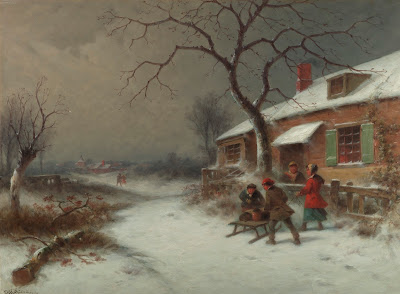
New Acquisitions: "Winter Morning" by George Washington Nicholson


George Washington Nicholson, Winter Morning, ca. 1880
Happy new year! On this cold winter morning, it seems only right to share this painting recently purchased by the Georgia Museum of Art. This genre scene, "Winter Morning" by George Washington Nicholson, was acquired using funds donated in memory of Board of Advisors member Harry Gilham. 

Born in New Jersey, Nicholson trained in Philadelphia, where he learned academic realism at the Pennsylvania Academy of the Fine Arts. In 1866, he traveled to England and France for further training. Nicholson settled in Philadelphia upon his return to the United States, and his reputation was at its height from the mid-1880s through the 1890s. He painted a mural titled “The Old Homestead” that was on display at Wanamaker’s department store in Philadelphia and another, “Washington Crossing the Delaware,” for the Pennsylvania State House in Harrisburg (most likely lost when the building burned in 1897).


Nicholson produced works commissioned by patrons who preferred seascapes, exoticized landscapes of Europe and Northern Africa and scenes of daily life in the American countryside. This snowy country scene is an example of the latter. He painted several variations on the scene, usually featuring a house and human figures in bright clothing to draw the eye, but most of them are smaller than this one. Along with the recent purchase of Thomas Waterman Wood’s “The Kitten,” this painting helps us better tell the story of 19th-century American art by enriching our small collection of genre painting from the era.