Thursday, July 05, 2007

Stairway: Frances de La Rosa

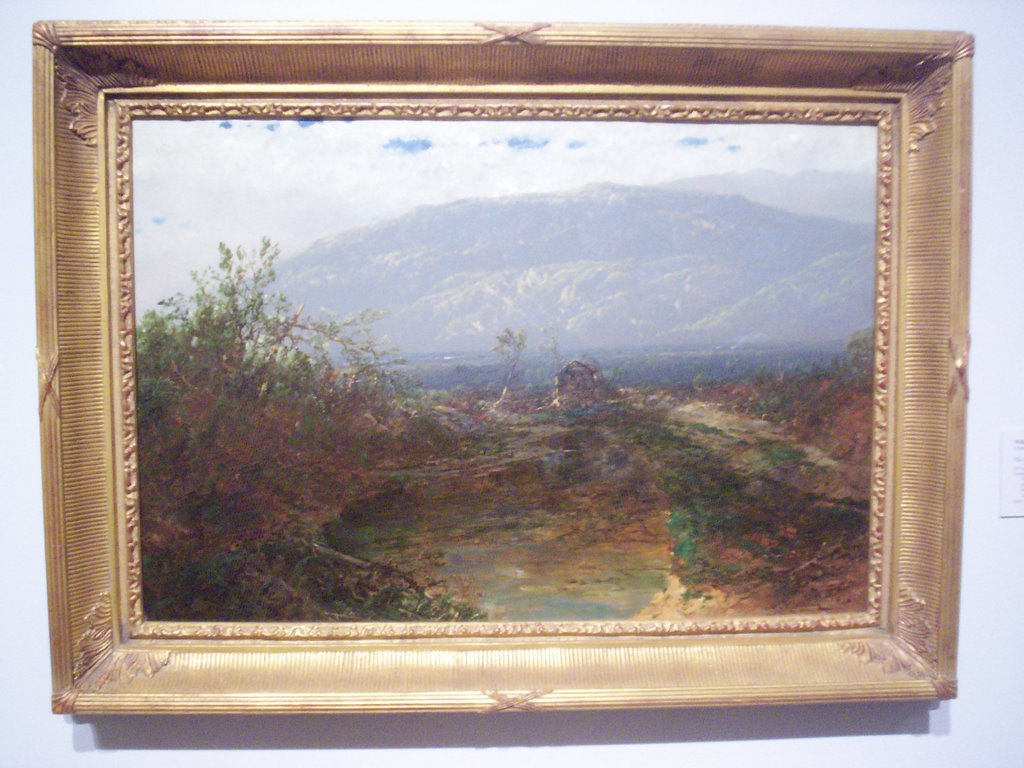
Installed this week in the main stairway at the Georgia Museum of Art...Frances de La Rosa's Landscape Series #1-12, 2006-07, oil on canvas, each 48" x 48".

More on her [here].

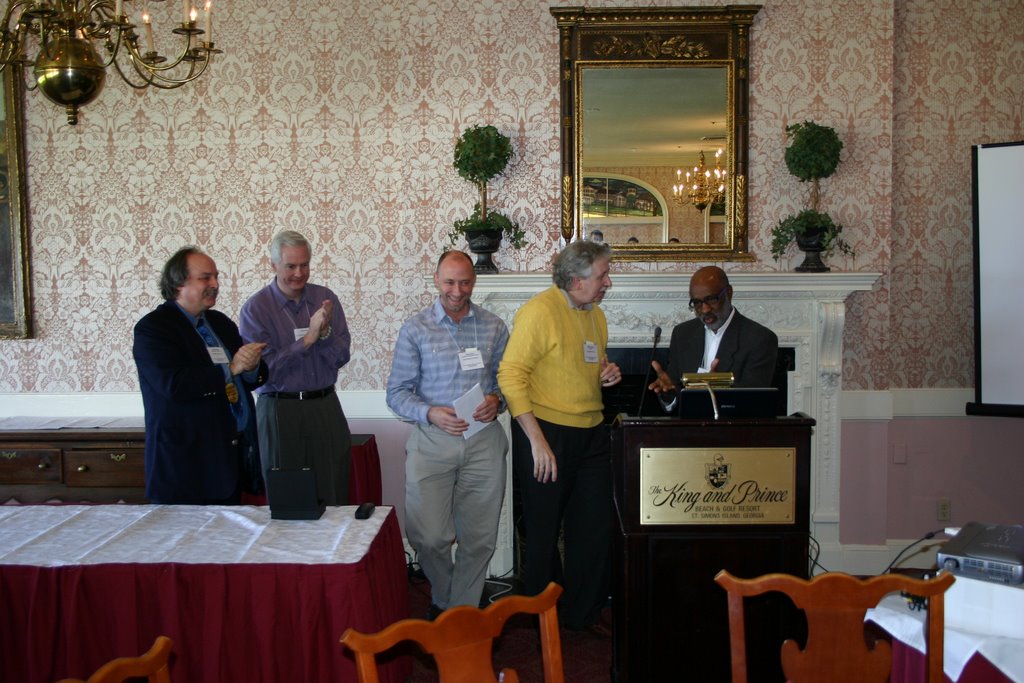
Some installation shots, including Dennis Harper (our curator of exhibitions), Larry Forte (Daura art handler), Lanora Pierce (preparator), Frances, and Frances's husband, photographer Fernando La Rosa:


Monday, June 11, 2007

Molasses Skye coming to GMOA

One of the museum's favorite guests is Kyshona Armstrong, who performed for February Figgie's@Five event.

Kyshone has joined with Rachel Cole to form Molasses Skye, and their new project will perform at the museum for Figgie's@Five on June 27 at 5 p.m.

Check out this video of them performing their song 'Hold On Me' ...

New podcasts

Feel free to check out our newest podcasts.

In this one, Paul Manoguerra leads a tour of Suitcase Paintings, while here Dennis Harper gives a brief overview of Cut Along the Grain.

Wednesday, June 06, 2007

More Suitcase Paintings

Beth Sale, in the Athens Flagpole, gives a nice summary of the Suitcase Paintings: Small Scale Work by Abstract Expressionists exhibition and our corresponding permanent collection display. Full text of the Flagpole's "Art Notes" [here]. Museum relevant section follows:

Living is Easy: “Suitcase Paintings: Small Scale Work by Abstract Expressionists, on view at the Georgia Museum of Art (GMOA), has the perfect concept for summer travel. Thomas McCormick of Chicago titled the exhibit after a story told by New York art dealer Gertrude Stein about collector Larry Aldrich’s habit of traveling with paintings he could fit into his suitcase. Abstract Expressionists are known for creating large-scale works (such as Jackson Pollack’s canvases of dripped paint), but as a quote by Robert Motherwell, included in the exhibition’s text, mentions, “It’s possible to paint a monumental picture that’s only 10 inches wide, if one has a sense of scale, which is very different from a sense of size.” This exhibit highlights works which contain the energy and vibrancy of Abstract Expressionism in a small scale. The exhibit is populated by thick paint; broad, generous brushstrokes, such as in Alfonso Ossorio’s painting; and the bold shapes of Robert Richenburg (to whom the exhibit is dedicated), who died while the exhibit was being assembled in October of 2006. Collages in muted colors by Ronald Ahlstrom, Fred Berman and Robert Nickle exude a heavy, aged authority, while Frank Lodbell and Robert Natkin’s light and airy paintings have a more summery palette. Well-known artists of the Abstract Expressionists are also included in the exhibit: Elaine de Kooning, Perle Fine, Phillip Guston, Franz Kline, Conrad Marca-Relli, Joan Mitchell, Robert Motherwell and Jack Tworkov.

One viewer suggested that a blue painting by William Baziotes resembled a woman playing piano until she read the title “Moon Dream.” Herman Cherry’s “No Title (Black Slash)” vaguely resembles a car going downhill, with a black line of asphalt on a red hill with an olive-green car and yellow sky. See what you can find. The exhibit will be on view through July 22, after which it will travel to other museum venues. A series of documentary films complements the exhibit on Wednesday nights during the month of June. “Stroke of Genius: De Kooning on de Kooning” begins the series on June 6. Check Movie Dope for more information.

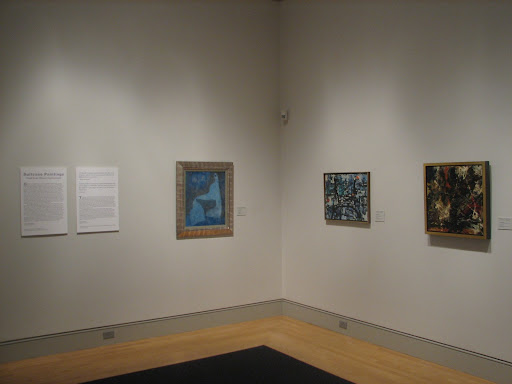
Sense of Permanence: Paintings from the Permanent Collection currently on display include large-scale works by Howard Thomas and Carl Holty, who use squares and rectangles to build their compositions. Lamar Dodd and Jack Kehoe, both essential UGA instructors, have work in the exhibit. Joan Mitchell’s “Close” steals the show with an amazing amount of light pouring both on the painting and coming from it. Her large rectangles of light orange ochre drip down the surface like a cat’s tail on a sunny windowsill. If you missed the recent exhibit of Mariska Karasz’s work, you can get a taste of it now; one of her pieces is included in this exhibit.

Images: Two views of the Dodd Gallery, Georgia Museum of Art, showing the Kehoe, Mitchell, and Dodd mentioned in the "Art Notes" text.

Thursday, May 31, 2007

Donald Keyes (1940-2007)

Donald D. Keyes
(December 24, 1940 – May 19, 2007)
former curator of paintings, Georgia Museum of Art

Original Athens Banner-Herald article about Dr. Keyes's death [here].
Arizona Daily Star article [here].
Flagpole article [here].
Athens Banner-Herald brief article on the museum's memorial effort [here].
Link to Dr. Keyes's ABH obituary [here].

“We are all distraught around here at the museum. It’s a piece of our history that’s gone with Donald’s death. He was very important to the museum and to the Athens art scene.” – William U. Eiland, director, Georgia Museum of Art.

“He was a very creative curator. He came up with wonderful ideas and had connections with curators throughout the country to allow us to secure excellent shows. He was also great at keeping in touch with artists in Georgia.” – Bonnie Ramsey, director of communications, Georgia Museum of Art.

The Georgia Museum of Art and the arts community of Athens mourn the loss of Dr. Donald Keyes, curator of paintings at the museum from 1984 to 2001. Dr. Keyes died Saturday, May 19, after suffering a heart attack while hiking in the Grand Canyon in Arizona.

Born on Christmas Eve in 1940 in New York City, Keyes graduated from Yale University, and earned his doctorate in art history from New York University. Besides his time at the museum, he taught at Ohio State University and Smith College and was director of the Marietta Cobb Museum. Keyes was very active in the cultural life of the state as one of the founding members of Atlanta Photography Gallery and Five Art in Athens which houses Athens Institute for Contemporary Art (ATHICA) and artists’ studios. He also coordinated the artists’ market for AthFest, the annual music and art extravaganza, and was the auctioneer for the annual Mental Health Benefit Auction. As curator at the Georgia Museum of Art, Keyes organized numerous exhibitions and published articles, books, and exhibition catalogues. These included studies about American Impressionism, art and artists in the White Mountains of New Hampshire, Stuart Davis, the nineteenth-century Southern itinerant painter George Cooke, the Woodstock painter AndrĂ©e Ruellan, Impressionism in California, and European and American photography.

One of Dr. Keyes’s many personal and professional interests was photography. He collected contemporary photography for more than three decades, and was responsible for numerous acquisitions and gifts to the museum’s collection of photographs. In memory of Dr. Keyes, the museum is presenting a temporary display of three photographs that entered the American collections here through his dedication, diligence, and knowledge. Also, through funds from M. Smith Griffith, the staff of the museum, and the museum’s American art department, the Georgia Museum of Art has purchased a photograph, Church, Havana, Alabama (1964) by renowned American photographer, William Christenberry (b. 1936), to be added to the collection in memory of Dr. Keyes.
In an essay he wrote for the exhibition To See a World in 1997, Donald Keyes described the power of photography: “Photography, more than any other medium, reminds the viewer of its subject while simultaneously removing him/her from that subject. …Most modern photography utilizes this tension between what is represented and what the viewer knows or believes to have been the original subject. Thus, most art photography exists as a nexus between reality and fantasy.”

Images: Tom Zetterstrom (American, born 1945), Coast Oak, n.d. From the Portrait of Trees series. Gelatin silver print. Georgia Museum of Art, University of Georgia; museum purchase through funds provided by the Friends of the Museum GMOA 1996.18


William Christenberry (American, born 1936), Church, Havana, Alabama, 1964. Vintage color Brownie print mounted to board. Georgia Museum of Art, University of Georgia; museum purchase, in memory of Donald D. Keyes, through funds provided by M. Smith Griffith, the staff of the Georgia Museum of Art, and the American art department at the Georgia Museum of Art, Accession pending 2007

Friday, May 18, 2007

Suitcase Paintings

This week...post-war/contemporary art set auction records: $72.8 million for Mark Rothko’s White Center (Yellow, Pink and Lavender on Rose) [from a Rockefeller , via Sotheby's, to a mysterious bearded collector!]; $52.6 million for a Francis Bacon; even $5.8 million for a Tom Wesselman.

This week here in Athens...post-war/contemporary art is on display. Blog posts already exist about the Jay Bolotin exhibition [here] and [here]. Tonight, we open to the public Suitcase Paintings: Small Scale Work by Abstract Expressionists. The show will remain open until July 22, and then will travel to five other museum venues.

From the Georgia Museum of Art's website:

"Big. That is how most of us think about Abstract Expressionism of the mid-20th century. The artists worked with big ideas, big emotions, big action and on big scale. This group of ground-breaking artists, sometimes referred to as the New York School, pushed the limits of scale, using the canvas as a field to act upon. However, most also created small-scale works of intense beauty and intimate size, while losing none of the bravura and energy.

Suitcase Paintings, organized by Art Enterprises, Ltd., Chicago, is designed to show this other side of the movement. The exhibition will also introduce to many viewers some artists who, while important at the height of Abstract Expressionism, may be less known today. Suitcase Paintings include[s] work by Franz Kline and Elaine de Kooning, among several others."

The primacy of the paint itself, and the role of Surrealism and the the free expression of the unconscious mind are themes throughout. Emphasis is on New York in the show, but Chicago and San Francisco Abstract Expressionists get a gallery. The exhibition is intense, made more concentrated by the small size of the objects.


“It’s possible to paint a monumental picture that’s only 10 inches wide, if one has a sense of scale, which is very different from a sense of size.” -- Robert Motherwell

“I don’t feel that it’s necessary to get a painting that large to have impact. I think that, with the control of whatever the medium is, you can get it, I always say, in a postage stamp size.” -- Perle Fine

Images: (l) View of the opening section of the exhibition, including paintings by William Baziotes, Buffie Johnson, and Alfonso Ossorio. (c) Franz Kline (1910-1962), Untitled, 1958, oil and collage on paper laid down on canvas, 17 3/8 x 14 7/8 inches, Collection of Art Enterprises, Ltd., Chicago. (r) View of the "Tenth Street Style" section of the show.

Wednesday, May 09, 2007

More Jackleg

This week's Athens Flagpole has lots of coverage of the Georgia Museum of Art's Jay Bolotin exhibition The Jackleg Testament. One of Bolotin's woodcuts became the cover:


The relevant section of Beth Sale's article which includes a mention of our permanent collection woodcuts:

Every now and then, someone comes along and changes the way things are done. Dreaming and then making that dream a reality are what makes an artist. Sometimes the dream takes years to come to fruition. Sometimes it requires inventing new ways of creating. Sometimes it requires new ways of displaying.

The Woodcut Bible: Jay Bolotin’s woodcut film titled The Jackleg Testament, Part One: Jack and Eve is currently on view at the Georgia Museum of Art (GMOA). The film is Bolotin’s variation of the Book of Genesis, reinterpreted as an imaginative, dark tale of theatre and adventure, involving Eve, Jack (a Jack-in-the-box freed from his box), and a godlike figure called Nobodaddy (a reference to the poetry of William Blake). Bolotin created the film by making woodcuts of the characters, landscape elements and props, and scanning them into a computer for manipulation. The woodcuts used in the production of the film are displayed in the exhibit as a supplement, offering “behind-the-scenes” access, which works on two levels. Images used to make the film are on view, as well as the plates used to create the woodcuts. Examples of large circular woodcut plates help the viewer identify the process required to make the finished product. These plates, along with the large wooden sculpture of Daniel Boone, were not originally part of the traveling exhibit; they were selected by Curator of Exhibitions Dennis Harper for inclusion in the GMOA show. The sculpture of Daniel Boone is included in the film, although the inclusion is in reference only, and serves as an example of the solidity of the world Bolotin has created. Bolotin created a woodcut of the sculpture and included it in the plot of the film. “A portfolio of prints that outlines the narrative” is also included in the exhibit. While “claymation” (stop motion animation using clay as the image-making medium) has been used for decades, this is likely the first film created using woodcuts. Bolotin, who first used the term “Woodcut Motion Picture,” is credited as having forged a new path. He wrote the script and the musical score, and performed music and the voice of Nobodaddy. The film also features the vocal talents of Karin Bergquist, and opera singers Monte Jaffe and Nigel Robson. Layers upon layers of literary and biblical references are woven into the script and imagery.

References were taken from William Blake, Shakespeare and the Bible; and literary puns and allusions are scattered throughout the film. Bolotin quotes Nietzsche in the prologue: “We were fashioned to live in paradise and paradise was destined to serve us. Our destiny has been altered; this has also happened with the destiny of paradise not stated.” Watching the film is “like reading James Joyce,” says Harper.

For example, Bolotin titles one section of the film where Eve catches the apple “the Beginnings of Irony,” alluding to both the irony of the biblical story and the first example of irony used in the film. (See this week's cover.) The imagery is dark and morose. The sound track is operatic. The characters’ movements are peculiarly like paper dolls, with only the heads and upper limbs moving. The film alternates between color and black and white, adding to the unique quality. The Georgia Museum became involved in the preparation for this traveling exhibit when the film was still in its early stages, through the introduction of a mutual friend. The hour-long film will run continuously throughout the duration of the exhibit, starting on the hour. Just in time for the summer, sit and watch the film in the cool, dark, air-conditioned museum. The exhibit will be on display through July 8. There will be an opening reception for the summer exhibitions on Friday, May 18, from 6:30 p.m. to 8:30 p.m. Keep your eyes open for a local musical performance by Jay Bolotin. See www.uga.edu/gamuseum or call 706-542-GMOA.

Carved in Wood: Also on view in the Georgia Museum of Art is an exhibit of woodcuts dating from the late-15th century to the 20th century, from the museum’s permanent collection. These prints were chosen by Dennis Harper to illustrate the history and process of the woodcut. Included in the exhibit are Japanese Ukiyo-e prints, such as Hokusai’s “The Great Wave off Kanagawa” from the “36 Views of Mt. Fuji.” The iconic look of woodcuts is seen in Emile Bernard’s “Christ, or Crucifixion” from 1894. A page from Wassily Kandinsky’s collection of poems and woodcuts called “KlĂ¥nge” (translates as “sounds”) is in the exhibit. Leonard Baskin’s “Florentine” from 1952 shows a dark angel with wings. The variety of woodcut images in the exhibit provides an overview of the technique. Visit www.uga.edu/gamuseum to see more.

Tuesday, May 01, 2007

The Jackleg Testament, Part One

Georgia Museum of Art's exhibition page [here]. Official (pdf) press release [here]. More, including multimedia, from semantikon.com [here]. Direct link to .mov [here] and [here].


The Athens Banner-Herald has video and music links for the exhibition. Sections from Julie Phillips's article -- "Storyteller has new twist on Genesis" -- in the ABH:

It took Jay Bolotin five years to rewrite Genesis. ...But really, in the ancient tradition of storytelling, that's not a terribly long time - especially given Bolotin's version went from sketches to woodcuts to music to an animated musical film that tells his version of the story. ...

Eve is lured from the Garden of Eden, in Bolotin's version, by a jack-in-the-box named, appropriately, Jack, and takes up with a Vaudeville-style review that's run by a god figure named Nobodaddy. Every few epochs, Nobodaddy produces a play called "The Theater of the Western Regions."...

Bolotin, who lives on a farm outside of Cincinnati, created the film from extensive digital photographs of his woodcuts and prints, manipulating them into a fascinating moving world by way of motion picture software.

A gifted musician and songwriter who's worked with Dan Fogelberg and whose praises have been sung by the likes of Kris Kristofferson and famed opera director Jonathan Eaton, Bolotin also created the musical score for the film and enlisted the vocal talents of opera singers Nigel Robson and Monte Jaffe, along with vocalist Karin Bergquist (of the band Over the Rhine).

The film, titled "The Jackleg Testament, Part One" along with an exhibition featuring all of the source work that went into the process of making the film, is on display at the Georgia Museum of Art. The exhibit has been on an extensive tour across the country, making its debut in May 2005 at the Contemporary Arts Center in Cincinnati.

It follows Bolotin's previous theatrical works, which have included an opera featuring large mechanical sculptures based on his woodcut-inspired creations. That project in particular took about 10 years. ...

Images: (left) Jay Bolotin, A Prehistory to that which is, by mistake, called The Fall of Man: Jack and Eve (The Beginning of Irony), 1999. Printed by Michelle Red Elk. 12 color woodcut prints, Edition of 20. Courtesy of the artist. (right) Jay Bolotin, Elements of a Woodcut Motion Picture Titled "The Jackleg Testament: part one - Jack & Eve" (Serpent Print), 2004-2005. Printed by Krista Gregory. Portfolio of 37 black and white woodcut prints with notations, Edition of 35. Courtesy of the artist.

Thursday, April 12, 2007

MFA 2007

Details from the Georgia Museum of Art's exhibition page [here].
Official press release for this year's MFA exhibition (pdf file) [here].

Beth Sale's discussion from the April 11th edition of the Athens Flagpole [here].

What is it? Upon his appointment at the University of Georgia in 1939, Lamar Dodd set about organizing exhibitions, auctions, and lectures that increased the awareness of art both on campus and in the Athens community. Collaborating with Georgia Museum of Art founder Alfred H. Holbrook, Dodd also viewed the museum as a laboratory of ideas and aesthetics related to art. The 2007 Master of Fine Arts Candidates Exhibition continues the traditions instituted by Dodd at the university. By its very makeup, the annual exhibition operates as a vibrant, eclectic example of the depth and quality of the Lamar Dodd School of Art. The annual show serves as one of the most intriguing, challenging, and enjoyable spectacles during the museum’s active schedule of exhibitions. Each year, the audience of the Georgia Museum of Art gets the opportunity to respond to and to enjoy what the University of Georgia’s students are doing in the world of contemporary art.

If/when you visit the exhibition, open until May 6th, here are some general themes and/or recurring motifs to look for among the work of the 23 -- likely the most ever at the university -- graduating MFA students:
  • Nostalgia, and the playing/building upon our longing and understanding of persons, situations, traditions.
  • Time (and the function of time)
  • Contradictions, and the assertion and creation of opposing ideas, situations, feelings, materials.
  • Monochromatic work.
  • Hanging/dangling objects.
  • Overt and conscious lack of (clear) narrative.
  • Process (especially instead of meaning and narrative).
  • Personal identity and memory (as opposed to group identity).
  • Interiority vs. exteriority.
Last night the museum hosted "MFA Speaks," and the students spent 2-3 minutes each on the microphone giving the general public some "talking points" about the art.

The museum created a slideshow of images to accompany the talk. The slideshow follows as a youtube video.

The artists, in slideshow order, are: Jim Norton (jewelry/metals), Kathlene Moyer (interior design), Deborah Ford (interior design), Audrey Molinare (printmaking), Rylan Steele (photography), Shawn Eisenach (printmaking), Nick Gagliardi (painting), Teddy Johnson (painting), Nara Kim (fabric design), Meghan Moser (fabric design), Brook Reynolds (photography), Susannah Zucker (ceramics), Kate Windley (painting), Andy Anzardo (sculpture), Amanda Burk (printmaking), Erin Burke (sculpture), Danielle Benson (printmaking), Chris Merz (painting), Natasha Seedorf (jewelry/metals), Zamila Karimi (interior design), Susan Gunter (fabric design), Jenn Manzella (printmaking), and Krista Coleman-Silvers (jewelry/metals).


The "opening" reception for the 2007 show is at the Georgia Museum of Art on Friday the 13th, 7 - 9pm.

Friday, March 23, 2007

New banner

Curator's Corner, the web blog for the Georgia Museum of Art, now has a header with images.

So...what is on the header?


Starting at the top left and moving down the first column:

1. George Cooke's Tallulah Falls, 1841. Oil on canvas, 35 3/4 x 28 3/4 inches. Georgia Museum of Art, University of Georgia; gift of Will Moss. GMOA 1959.646. Cooke's painting was the subject of a presentation and essay at the museum's Second Henry D. Green Symposium of the Decorative Arts. You can read that essay [here].

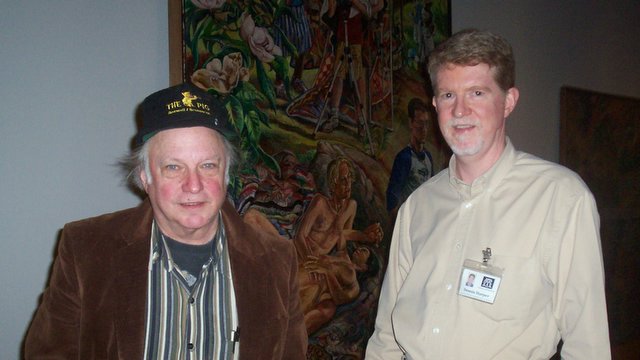
2. Art Rosenbaum, and curator of exhibitions at GMOA, Dennis Harper. Rosenbaum's art was recently the subject of an exhibition, curated by Harper.

3. Pierre Daura (American, b. Spain, 1896-1976), Martha at Thirteen, 1943-44. Oil on canvas. Georgia Museum of Art, University of Georgia; gift of Martha R. Daura. Established at GMOA with a gift from Ms. Daura in honor of her father, the Pierre Daura Center contains a collection of paintings, prints, drawings and sculptures by the Catalan-American artist Pierre Daura, who co-founded the artists' group Cercle et Carré.

4. A student enjoying one of GMOA's podguides.

5. Richard Weisman in front of the portrait Andy Warhol painted of Mr. Wesiman...at GMOA last April.

6. Lamar Dodd (American, 1909-1996), Copperhill, 1938. Oil and egg tempera on linen canvas. Georgia Museum of Art, University of Georgia; extended loan from the University of Georgia Foundation, gift of Mary and Lamar Dodd. GMOA 1974.3F. The School of Art at UGA is named for Dodd.

7. Cheever Meaders (American, 1887-1967), face jug, ca. 1920s. Stoneware and quartz. Georgia Museum of Art, University of Georgia; gift of Roy Ward. GMOA 2006.131.

Moving to the right-hand column...

8. Detail of J. Alden Weir (American, 1852-1919), Farm in Winter, 1895. Oil on canvas. Georgia Museum of Art, University of Georgia; extended loan from the collection of Jason Schoen, Miami, Florida. GMOA 1998.13E.

9. Curator of decorative arts, Ashley Callahan, working on the exhibition Modern Threads: Fashion and Art by Mariska Karasz.

10. Curator of European art, Giancarlo Fiorenza, working in his office.

11. Robert Henri (American, 1865-1929), Sissy, 1924. Oil on canvas. Georgia Museum of Art, University of Georgia; Eva Underhill Holbrook Memorial Collection of American Art, gift of Alfred H. Holbrook. GMOA 1947.103. One of the more popular paintings at GMOA.

12. Curator of American art, Paul Manoguerra, in the Dodd Gallery.

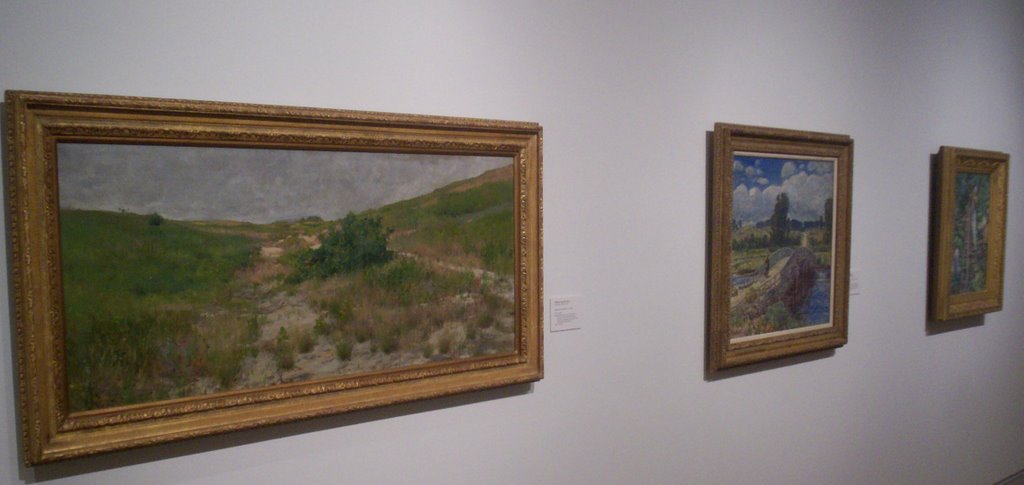
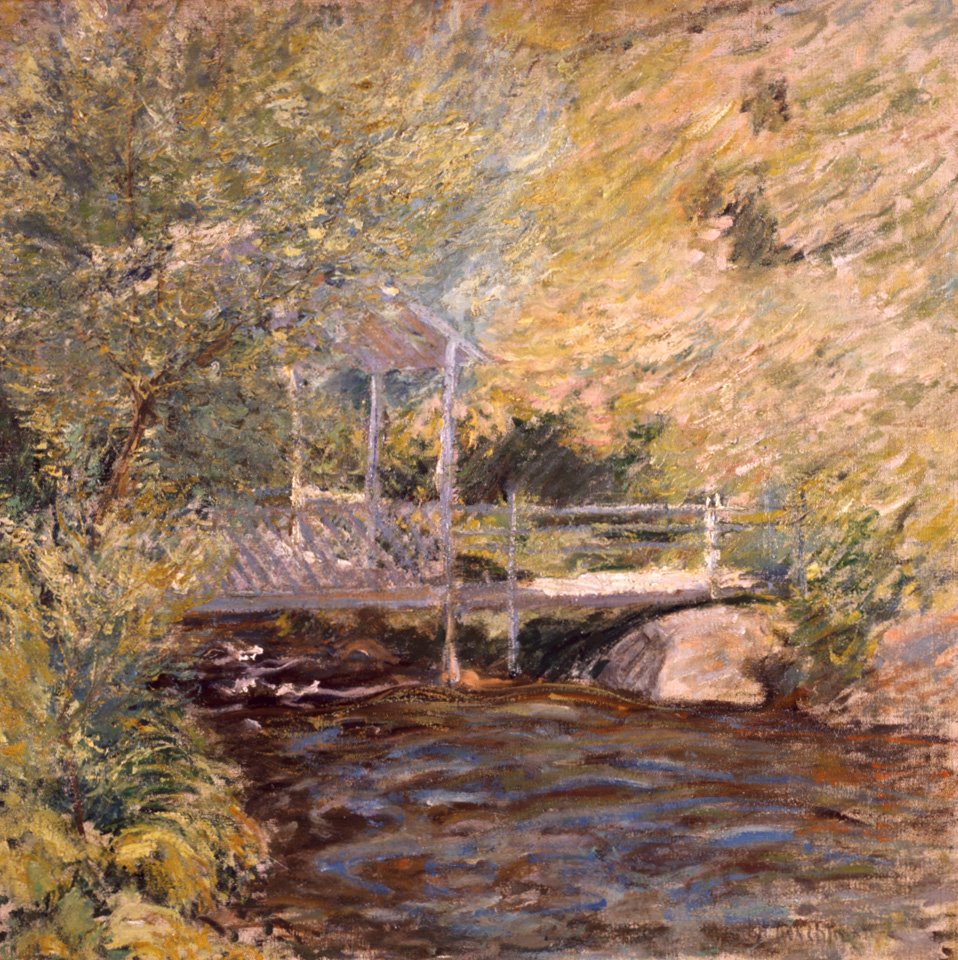
13. John H. Twachtman (American, 1853-1902), The Little Bridge, c.1896. Oil on canvas. Georgia Museum of Art, University of Georgia; Eva Underhill Holbrook Memorial Collection of American Art, gift of Alfred H. Holbrook. GMOA 1945.90.

Tuesday, February 27, 2007

Spring, a bit early, is in the air

Maybe it's global warming, maybe it isn't ... but the weather has definitely taken a spring-like turn as of late. And there's signs of life among the trees, bushes and other plantlife that line the campus of the University of Georgia.


Such beautiful scenes, particularly after the cold weather that's gripped the area the past few months, bring to mind other bright images, such as John Twachtman's The Little Bridge, which is a part of the museum's permanent collection.


A native of Cincinnati, Twachtman first began dabbling in art by painting floral window shades for his father's business. These initial efforts spurred his interest, and he would study at the Academie Julian in Paris. It was there that he was heavily influced by the work of James Abbott McNeill Whistler and the French Impressionists. Working with fellow artists and friends Childe Hassam and J. Alden Weir, he helped to found "The Ten" - an American Impressionist group in the late 1890s.

For an interesting biography of Twachtman, click here.

Friday, February 23, 2007

Comprehensive crafting?

One of the Georgia Museum of Art’s most publicized exhibited works of art last year was Theresa Sporer’s knitted motorcycle in the 2006 MFA Degree Candidates’ exhibition. Craft blogs, websites and magazines picked up on its bright colors and interestingly subversive use of traditional and feminized handwork.

Now, the Museum of Arts and Design in New York is presenting an exhibition titled Radical Lace and Subversive Knitting, which is up through June. The New York Times review of the exhibition is interesting in that the author, Martha Schwendener, thinks that its failing is in not being comprehensive or contemporary enough. Still, the pictures on both MAD’s site and alongside the NYT article present new ways of looking at crafts.


Theresa has also posted photographs of some of her recent work online, including a knit jackhammer.

Thursday, February 22, 2007

Figgie's@Five update

We've had a change in programming for next week's Figgie's@Five here at the museum. Gabriel Kelley will be performing for us. He's a local folk musician who regularly plays around town. Check out his web site, and be sure to come listen to him on Wednesday, Feb. 28 at 5 p.m.

Monday, February 19, 2007

New podcast

Giancarlo Fiorenza, the museum's Pierre Daura Curator of European Art, has just recorded a podcast where he leads a tour of the exhibition he organized - Spanish Works on Paper.

Leo Twiggs

A few years back, the museum was proud to help organize an exhibition chronicling the life and works of Leo Twiggs, an African American artist who strives to take the influences of the current social landscape and not only interpret them, but sometimes give them a new meaning.

Twiggs, who was educated as an artist at Clafin University in Orangeburg, S.C., began his work in the mid-1950s and would go on to teach for 25 years at his alma mater. In 1970, he became the first African American to earn a Doctorate of Arts from the University of Georgia.

This was never more clear in his vast body of work than with his depictions of the Confederate flag, as noted by William Eiland, the director of the Georgia Museum of Art, in the museum's catalogue for his exhibition Myth and Metaphors: The Are of Leo Twiggs.

Leo Twiggs, with gentle but unswerving irony, takes the flag and claims it as part of his Southern heritage. Tattered, disappearing almost on its support, the standard about which there is so much controversy becomes in Twiggs's hands an ambiguous metaphor of unresolved conflict, yes, but also of a shared history. In addition to the Civil War, it calls to mind equally for Twiggs the suffering of slaves, the turmoil of Reconstruction, the indignity of Jim Crow, and even the promise of the Civil Rights era, and, of course, the aftermath, when this piece of cloth, venerated by some, reviled by others, continues to inspire argument and dissension. Twiggs transforms the image through shaping a new iconography for it, one in which he finds the possibility, albeit remote, of accord.

Twiggs also has used much of his career to recreate scenes and events from South Carolina, including the destruction from Hurricane Hugo in 1989.

Leo Twiggs; Blues at the Beach, 1999; batik and painton cotton mounted on board; 33 1/2 x 30 inches (frame); Collection of the artist.

South Carolina African American History Online has an interesting biography of Twiggs for those who wish to learn more about this artist.

Wisdom on President's Day

A father came home from the office and noticed that his son was spending too much time playing video games. In an attempt to motivate the young lad, the father said "You know, when Abraham Lincoln was your age, he was studying books by the light of the fireplace."

The son replied, "Well, when Lincoln was your age, he was the president of the United States."

Happy President's Day all.

Friday, February 16, 2007

Revisiting the Carter Collection

Among the Bulletins published by the Georgia Museum of Art to further scholarship in the art historical field is one that particularly deserves rediscovery at the moment. The 1976-77 Bulletin covered the original exhibition of Open to New Ideas: A Collection of New Art for Jimmy Carter, some of which is once again on the walls of the museum in The Carter Collection Revisited, a 30th-anniversary return to the art of the late 1970s.

Each artist included in Open to New Ideas is briefly profiled and his or her work of art illustrated and discussed by then-acting director of the museum Richard S. Schneiderman. The Bulletin also includes a transcript of a day-long panel discussion held on January 7, 1977, at the Georgia Center for Continuing Education on public support of art that was attended and contributed to by 15 of the artists.

Artists included are: Mac Adams, William Anastasi, Laurie Anderson, Robert Barry, Bill Beckley, James Collins, Douglas Davis, Joel Fisher, Hermine Freed, Helen Mayer Harrison, Newton Harrison, Lynn Hershman, Douglas Huebler, Peter Hutchinson, Patrick Ireland, Joan Jonas, Jerry Jones, Sharon Kulik, Les Levine, Gordon Matta-Clark, Duane Michals, Larry Miller, Dennis Oppenheim, Charlemagne Palestine, Alan Daniel Saret, Paul Sharits, Bernar Venet, William Wegman and Roger Welch.

The Bulletin is an important record of issues in art, especially avant-garde or challenging art, 30 years ago. As Schneiderman writes in his introduction, “For many of these artists, art must not be simply art; they consider art serving a significant role in the intellectual life of society, and thus, they ask that we look beyond the work of art and perceive or be cognizant of the meaning that the artist presents. Perhaps the works in this collection can best be understood as objects for contemplation since the message presented by the artist is often above and beyond the physical nature of the work itself ... In fact, several of these pieces are incomplete without specific interaction between artist and viewer through the work of art. This attitude marks a return to the spirit of the art of the medieval period ... Using their art as a vehicle for communication, these artists create a new art that permits modern society to enter into the creative process.”

The 1976-77 Bulletin is available for purchase in the museum shop. It runs 166 pages and is extensively illustrated both in black and white and in color.

Wednesday, February 14, 2007

One looks like another

Gallery Guide is a pretty popular publication that comes out each month that focuses on exhibitions at different art museums and galleries across the country. And if you look at this month's cover, you might think that it looks a bit familiar.


The painting featured on the cover is Daphnis and Chloe by Elizabeth Jane Gardner. If it looks familiar, that's because it is.


La Confidence, also by Gardner, is a part of the Georgia Museum of Art's permanent collection and is one of the most recognizable works we possess. It's been featured on posters, notecards, magnets and the like. We even have a large cutout of the painting that sits in our classroom.

Not only is it a beautiful work, but it's a testament to the career of Gardner, who was one of the first American woman artists who studied and trained in the art academies of France which, at the time, were dominated by men. She was a groundbreaking artists who shattered gender boundaries and help women gain more acceptance in the art community. Gardner would go on to become the first American woman to exhibit at the Paris Salon.

A native of New Hampshire, Gardner worried that her abilities were lacking, which is what prompted her to travel to Paris and study under William Adolphe Bouguereau. She quickly adopted the style of her mentor, who would also become her husband, and was quoted as saying "I would rather be known as the best imitator of Bouguereau than be nobody."

Monday, February 12, 2007

Reads on art recovery

This past December, The New York Times put together an interesting article that took a closer look at the book Rescuing Da Vinci, which focused on some of the art recovery efforts following World War II. As the world currently grapples with how best to handle the issues involving the removal of art and other artifacts resulting from the invasions of Afghanistan and Iraq, it's worthwhile to take a look at some examinations of what happened in the 1940s. The following are some suggested reads that deal with this topic.

Rescuing Da Vinci - During and following WWII, a special multinational group of more than 350 men and women served behind enemy lines and joined frontline military units to ensure the preservation, protection, liberation and restitution of the world's greatest artistic and cultural treasures. This "band of unsung heroes," formally referred to as the Monuments, Fine Arts and Archives (MFAA) section, or commonly referred to as the "Monuments Men," worked tirelessly to track down, identify and catalogue millions of priceless works of art and irreplaceable cultural artifacts, including masterpieces by Da Vinci, Michelangelo, Rembrandt and Vermeer, that had been stolen by Hitler and the Nazis.

The Rape of Europa: The Fate of Europe's Treasures in the Third Reich and the Second World War - Every few months you'll read a newspaper story of the discovery of some long-lost art treasure hidden away in a German basement or a Russian attic: a Cranach, a Holbein, even, not long ago, a da Vinci. Such treasures ended up far from the museums and churches in which they once hung, taken as war loot by Allied and Axis soldiers alike. Thousands of important pieces have never been recovered. Lynn Nicholas offers an astonishingly good account of the wholesale ravaging of European art during World War II, of how teams of international experts have worked to recover lost masterpieces in the war's aftermath and of how governments "are still negotiating the restitution of objects held by their respective nations."

The Lost Museum - Pillage is one of the traditional perks of warfare. But it took Adolf Hitler to systematize the decimation and despoiling of cultures, and it took Hector Feliciano seven years to track five famous art collections stolen by the Nazis. He uncovered not only Nazi schemes but also a well-oiled machine of collaborators, informants, moving companies, and neighbors, all with their fingers in the pie. The Lost Museum reads like a good detective story. Inspired by a fascination with the theft of five prominent Parisian Jewish families' art collections, it focuses on the beneficiaries of the thefts and justice for its victims. Filled with family photos of the art, some never before seen by the public, The Lost Museum tracks the pieces as they passed through the hands of German officials, unscrupulous art dealers, and unsuspecting auction houses. That the network was so deviously intricate illustrates the enormous challenge of restitution.

Got a date?

Who knew we were such a desirable romantic destination?

The museum is free, so there's that. Plus, art is terribly romantic.

Cheap date tip

According to Emily Gomez in the University of Georgia student newspaper, The Red & Black, the Georgia Museum of Art is good for a cheap date. Apparently, according to Ms. Gomez, "date night has dwindled in college. ...
The next time you want to go on a real date, but you are hurting for cash, try these cheap date tips, and don't let dates become extinct. ...

Indulge in the arts. Go to the Georgia Museum of Art, or check out concerts at the School of Music."

Can't really get much "cheaper" than the GMOA...always free.

Friday, February 09, 2007

Love is in the air, and on fabric

Right now, we've got Modern Threads: Fashion and Art by Mariska Karasz up at the museum, which is a beautiful exhibition chronicling the work of Hungarian designer Mariska Karasz. Karasz was an accomplished fashion designer, who crafted numerous outfits for her daughters, Solveig and Rosamond.

One of the works done for her daughters on display at the museum is a scarf that is decorated with hearts and cherubs, which is perfect with Valentine's Day right around the corner.

Wednesday, February 07, 2007

Bigtime honors

William Eiland, the director of the Georgia Museum of Art, recently received the Lifetime Achievement Award from the Georgia Association of Museums and Galleries. Eiland has been the museum's director for the past 14 years and has overseen the expansion of the museum's permanent collection, its move from North Campus to its current location in the Performing and Visual Arts Complex and the current fundraising process to build the necessary Phase II expansion for the museum.

Monday, February 05, 2007

On Children at Play

There's a good bit of permanent collection up at the museum right now, and one of the featured works is Jacob Lawrence's Children at Play.

Lawrence, born in Atlantic City, N.J., grew up as the eldest child of three in a series of foster homes and settlement houses in Pennsylvania; his mother had left the children and gone to New York City in search of work. When Lawrence was about 13, his mother re-settled the family in Harlem and enrolled the children in Utopia House, a settlement house whose after-school arts program was run by Charles Alston, the cousin of Romare Bearden. Lawrence studied with Alston during the early 1930s, and Alston’s studio became a center in the Harlem Renaissance – a group of writers, mural and easel painters, poets, composers, and choreographers flourishing during the 1920s then assisted by the federal programs of the Works Progress Administration.

With the help of a Rosenwald Foundation Fellowship, Lawrence created his most well-known paintings – 60 gesso panels titled The Migration of the Negro (1940-41). He arranged for Romare Bearden to have a studio directly above his. Lawrence was drafted into the U.S. Coast Guard in 1943. Following his discharge at the end of World War II, Lawrence taught at Black Mountain College in North Carolina, the Pratt Institute, and the University of Washington, among many other places. Lawrence, in Children at Play, painted in Harlem following World War II, utilizes primary colors and flattened forms to show an everyday urban scene.

In 1970, looking back on his career as an artist, Lawrence stated: “If I have achieved a degree of success as a creative artist, it is mainly due to the black experience which is our heritage – an experience which gives inspiration, motivation, and stimulation. I was inspired by the black aesthetics by which we are surrounded, motivated to manipulate form, color, space, line, and texture to depict our life, and stimulated by the beauty and poignancy of our environment.”

One busy weekend

It was a jam-packed weekend at the museum with three different events on three consecutive days, all geared at different audiences.

On Friday, we hosted AfterHours@GMOA, which was the opening reception for the exhibitions Modern Threads: Fashion and Art by Mariska Karasz and Wild Ride: Artistic Lessons of Nature by Eric Strauss.


On Saturday, the monthly Family Day program offered by our education department was dedicated to the work of Mariska Karasz, and children packed the museum to take a look in our galleries and then came down to the classroom to work on their own Valentine's Day cards.


Finally, on Sunday afternoon, Solveig Cox and Rosamond Berg Brassett, the daughters of Mariska Karasz, joined Ashley Callahan to give a gallery talk on their mother's work. More than 40 people came to the museum to hear about Karasz's work, as well as some personal stories from the daughters' childhood.


To view photos from all three events, please visit the museum's web site.

Tuesday, January 23, 2007

Figgie's@Five schedule lined up

We've set up our lineup for the next few editions of Figgie's@Five at the Georgia Museum of Art.

On Jan. 31, Kyshona Armstrong will be our featured performer. Kyshona's style has been heavily influenced by blues, folk and neo-soul, and she's been compared to Tracy Chapman and Dionne Ferris.

Check Kyshona out at her MySpace page.

On Feb. 28, acoustic artist Allison Weiss will perform in Figgie's Cafe. Allison is a student at the University of Georgia whose style, according to Gordan Lamb of Flagpole "sits stylistically somewhere between Dashboard Confessional and Emmylou Harris."

Check Allison out at her MySpace page.

Thursday, January 18, 2007

Behind the scenes


One view of some of the outdoor sculpture in Wild Ride: Artistic Lessons of Nature by Eric Strauss, organized by the Booth Western Art Museum.
A closer view of Strauss's stainless steel sculpture in Wild Ride on this cold, drizzly morning in Athens.


Ashley Callahan, curator of decorative arts,
working on the installation of Modern Threads: Fashion and Art by Mariska Karasz.
An interesting juxtaposition in The Carter Collection Revisited.


Giancarlo Fiorenza, curator of European art/The Pierre Daura Center,
working on one of his many future projects.

Tuesday, December 19, 2006

Georgia Museum of Art inches toward fundraising goal for $20M expansion

Rebecca K. Quigley's article from the Athens Banner-Herald:

Georgia Museum of Art inches toward fundraising goal for $20M expansion
Collection stored away for rainy day

Museum visitors take in Art Rosenbaum's India Triptych, 1998, oil on linen, at the Georgia Museum of Art during a guided tour through the museum last week.
David Walter Banks/Staff

The edgy temperaments of the inner-city teenagers in painter Paul Cadmus' "The Playground" are lost on most Georgia Museum of Art patrons.

The extra special piece, which usually hangs hidden from the public in a floor-to-ceiling storage rack, along with many other famous works of art, is one that should never be stowed, said GMOA Director William Eiland.

"Under normal circumstances, any museum would want to have that out always," he said.
Museum patrons rarely will find Georgia O'Keefe's "Red Barn, Lake George, New York," Gregory Gillespie's "Wheel of Life" or works by Joan Mitchell, Frederick [sic] Church and Charles Burchfield in the small corner of the museum set aside for displaying GMOA's permanent collection.


The permanent collection includes about 11,000 works - 2,000 of which were acquired in the past 10 years - yet the museum doesn't have the space to display even 3 percent of it.

Many more of the museum's paintings, 97 percent of which are kept in crowded storage rooms, could be on view, said GMOA Head Registrar Tricia Miller.

The museum doesn't keep anything on view year-round - "with paintings, it's because we're not able to," Miller said.

The packing room and the student assistants' room are two of a handful of rooms being used for the storage of three-dimensional art, drawing sighs of exasperation from staff who never have been able to put it on display.

Museum staff said they ought to take down the "student assistants" room sign, at least for a few years, until they have 10 new galleries designed especially for Asian, American, African, European, graphic and decorative art as part of a $20 million museum expansion.

The current building on Carlton Street opened in 1996, but the museum has been around since 1948 in what now is the Administration Building housing the president's office.

The expansion will include 10 additional galleries to showcase more of the permanent collection, increase storage and classroom space, expand the library and add a print study room and an outdoor sculpture garden.

The additional galleries will allow museum curators to dedicate the current galleries to traveling and temporary exhibits.

About 7,000 drawings, watercolors and other works on paper - which make up the majority of the collection - are in storage most of the time because they are too fragile to sit under lights.
But many museum patrons do see the works - just not at the museum.

The museum lends out the works more often than it displays them here as part of 12 sets of paperworks of up to 60 pieces, put together especially for traveling exhibits, said associate registrar Christy Sinksen.

"We can say that other people see our works more than we do," Sinksen said.

Although they are not on display very often, students and faculty can come in for private study, she said.

But they can't do it in the soft-lit, teak-paneled room intended as a print study - it, too, is being used for storage.

With some free time to spare, Cristina and Brian Jarrel of Lawrenceville found a sitter and drove to Athens on Thursday to see what the museum had on display this season.

The couple said they were most keen on seeing sculpture, impressionism and other traditional works that they hope the museum will show more of with the expansion.

"I'd like to see more photography on the walls," said Brian Jarrel, a some-time visitor to the museum. "(Also) I would like to be able to take pictures in the galleries. ... I like to be able to go back home and relive it."

Art museums, on average, display about 5 percent of their collections at any given time, said Jason Hall, director of government and media relations for the American Association of Museums.

But many factors can make it as low as less than 2 percent and as high as 10 percent. If a small museum has a small collection, it may put more works on display, but a large museum that has been collecting for a long time may have less in public view, Hall said.

Museums primarily expand for more exhibition space as their collections grow, but they also expand to support education, conservation and other missions that museums have come to focus on more than in the past, he said.

To date, Georgia Museum of Art staff and friends have raised about $13.1 million toward the museum's $20 million expansion.

The museum will receive a $5 million challenge grant from the Atlanta-based Robert Woodruff Foundation once the campaign reaches the $15 million mark, but the final fundraising stretch always is the most difficult, Eiland said.

"I'm surprised that this size community is so supportive of this kind of museum," he said. "(But) the last million dollars is always the hardest."

Workers have begun construction of a new $39 million Lamar Dodd School of Art just to the west of the museum as part of the university's master plan to expand the visual and performing arts area of East Campus.

Wednesday, December 06, 2006

Art Rosenbaum podcast

Art Rosenbaum, Hurricane Season (triptych), 1999. Oil on linen, 72 x 210 in.
Collection of the artist.

The Georgia Museum of Art has an excerpt from this past Sunday's "Afternoon of Art and Music" featuring Art Rosenbaum. In the podcast, Rosenbaum plays the banjo and sings, discusses how music can serve as an inspiration for abstract art, and -- in typical Rosenbaum fashion -- offers paraphrased quotations from W.B. Yeats and Philip Guston.

Weaving His Art on Golden Looms: Paintings and Drawings by Art Rosenbaum remains open at GMOA through the holiday season.

[Click here to link to the GMOA's podcast.]

mp3 file

Monday, November 06, 2006

Rosenbaum DVD segment

The exhibition catalogue for Weaving His Art on Golden Looms: Paintings and Drawings by Art Rosenbaum includes a 45-minute documentary on DVD titled "It's Not What You Think It Is," directed by Neil Rosenbaum.
The Communications Department at the Georgia Museum of Art has made a clip of the documentary available:

Tuesday, October 31, 2006

The Daura Center opening

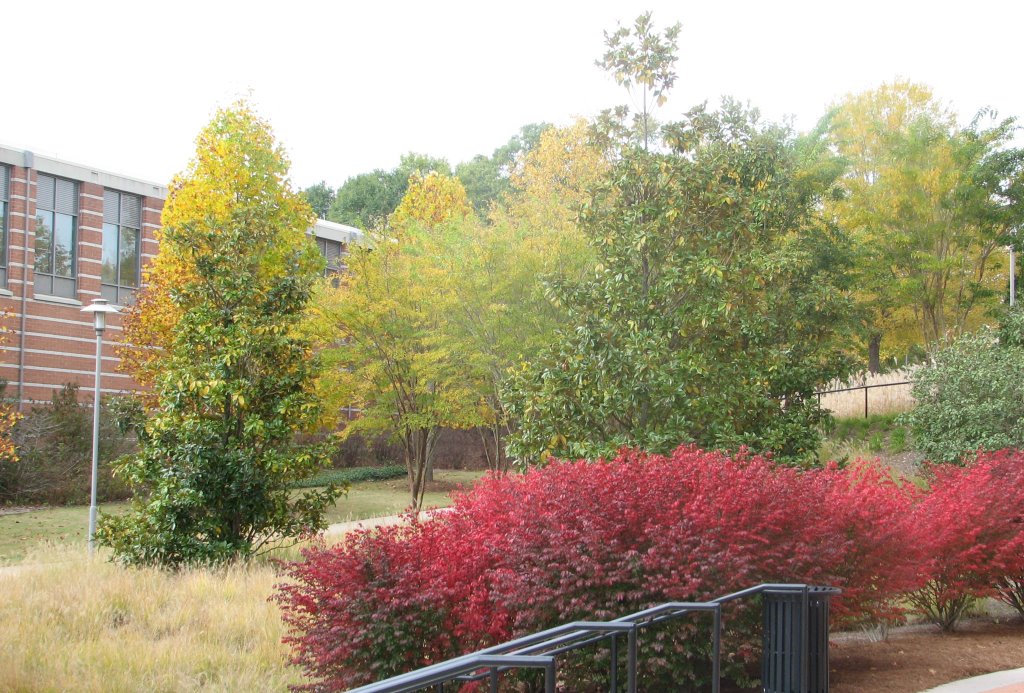
As cooler weather creeps in, and the colors of the leaves slowly begin to turn hues of orange, yellow and red, it becomes more and more apparent that fall is settling in on Northeast Georgia.


And those stunning images of autumn conjure up memories of Pierre Daura, the Catalan-American artist who was a member of the influential artistic group Cercle et Carré. Daura spent many of his years in Virginia, where he produced several beautiful landscape paintings.

Autumn Trees

Return to the Village

The Pierre Daura Center at the Georgia Museum of Art initiates and promotes the exhibition and study of the works of Pierre Daura and the contextualization of his oeuvre and career into the history of his time and place. Recently the museum named Gioncarlo Fiorenza as the new Pierre Daura Curator of European art and the director of the Pierre Daura Center.

On Dec. 8 at 5:30 p.m. at the Georgia Museum of Art, we will officially open the Pierre Daura Center with a reception honoring this new beginning. Fiorenza will give a brief lecture on Daura's life and his works. This event is free and open to the public, and we hope you'll come join us for this celebration.

Tuesday, October 17, 2006

American Impressionism podcast

The podguide tour of our Rachel Cosby Conway (permanent collection) Gallery is also now available for download. The Conway Gallery currently features some of our best paintings from the era of American Impressionism. In order for you to enjoy the podguide without visiting the Georgia Museum of Art, I have included several images here.
You can download the podcast, in mp3 format, [here].


Images:
(1) Gallery view showing the paintings by George Inness, Ralph Albert Blakelock, and Thomas Moran.
(2) Detailed close-up of the Blakelock painting.
(3) The William Louis Sonntag painting of the Blue Ridge Mountains.
(4) James A. McNeill Whistler (American, 1834-1903), Rose and Red: The Barber’s Shop, Lyme Regis, 1895, Oil on panel, 4 7/8 x 8 1/4 inches, Georgia Museum of Art, University of Georgia; Eva Underhill Holbrook Memorial Collection of American Art, gift of Alfred H. Holbrook GMOA 1945.96
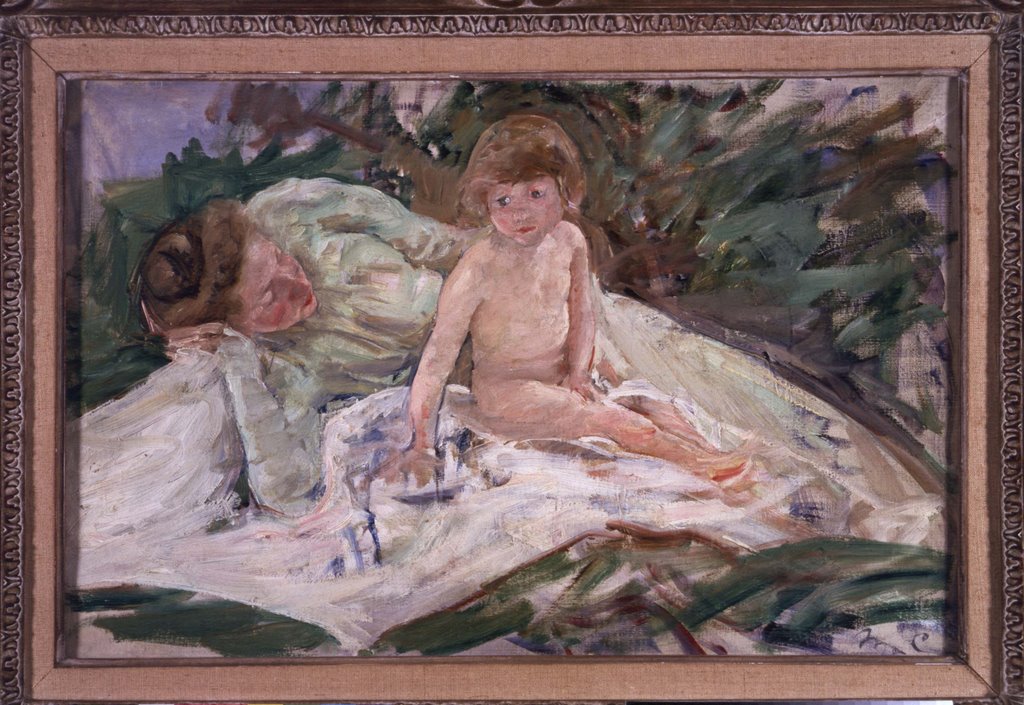
(5) Mary Cassatt (American, 1845-1926), Study for “The Sun Bath,” n.d., Oil on canvas, 15 x 23 inches, Georgia Museum of Art, University of Georgia; extended loan from the Joan M. MacGillivray 1957 Trust GMOA 2002.115E

(6) Gallery view showing the paintings by William M. Chase, Childe Hassam, and Theodore Robinson.
(7) John H. Twachtman (American, 1853-1902), The Little Bridge, ca. 1896, Oil on canvas, 25 x 25 inches, Georgia Museum of Art, University of Georgia; Eva Underhill Holbrook Memorial Collection of American Art, gift of Alfred H. Holbrook GMOA 1945.90

(8)
Childe Hassam (American, 1859-1935), Bridge at Old Lyme, 1908, Oil on canvas, 24 x 27 inches, Georgia Museum of Art, University of Georgia; Eva Underhill Holbrook Memorial Collection of American Art, gift of Alfred H. Holbrook GMOA 1945.47

Jay Robinson podcast

The podguide tour of the small Jay Robinson exhibition at the Georgia Museum of Art is now available...several days before the show officially opens to the public.

I already posted about the exhibition [here]. That post included three images from the exhibition. Here are two more...these are both drawings...in lo-res format:


Both works are by Jay Robinson (American, born 1915), and are on extended loan from the collection of Jason Schoen, Miami, Florida. (left) Quality Music Shop, Washington, D.C., 1943, Graphite on paper, 12 ½ x 15 ½ inches, GMOA 2005.93E; (right) Three Dimensional Forms in Space, 1946, Ink on yellow paper, 22 ½ x 27 ½ inches, GMOA 2005.101E.

Unfortunately, this podguide was not recorded, like the George Bellows one this summer, in the cushy and elite confines of a sound studio at UGA's New Media Institute. So, if it sounds like some guy just sitting at his desk, that might be because I was. In an ideal world, you would download the file to your mp3 player, bring the player into the museum, and take a tour of the exhibition while listening.

The podcast, in an mp3 format, can be downloaded from [here].

Monday, October 16, 2006

Art (Rosenbaum) exclusive


From just a few minutes ago...Art Rosenbaum (left) and GMOA curator of exhibitions, Dennis Harper, strolling through the ongoing set-up of the retrospective Weaving His Art on Golden Looms: Paintings and Drawings by Art Rosenbaum...opening to the public this Saturday. The exhibition is also featured in this week's Columns, the UGA faculty/staff newspaper.

The big "party" for the autumn exhibitions at GMOA is Wed., Oct. 25th.