Showing posts with label 19th-Century. Show all posts

Thursday, February 25, 2016

From the Permanent Collection: "Boys Pilfering Molasses" by George Henry Hall

Last month, we posted about two recently acquired 19th-century American genre scenes from our permanent collection (“Winter Morning” by George Washington Nicholson and “The Kitten” by Thomas Waterman Wood). In contrast to these works, which were painted after the Civil War and provide some insight into images of race during the era, the politically charged “Boys Pilfering Molasses” by George Henry Hall was painted and exhibited shortly before the onset of the Civil War.

In 1854, the year that Hall was inducted as an associate member of the National Academy of Design in New York, he presented this transfiguration of the “naughty child” genre as a commentary on the divisive politics of abolitionism. One pernicious effect of the abolitionist debates of the 1850s was the revival of the slave trade under the guise of legitimate commerce. As the son of a ship-timber merchant, Hall knew of the legal and illicit trade happening at New York City’s harbor. The port became infamous for clearing 15,000 slavers a year. Ingeniously, “Licking Lasses” serves as Hall’s commentary on a perpetual slave trade cloaked in the innocence of capitalist commerce. The artist uses the conventions of genre painting, including the popular subject of children pilfering food, to make them speak to the most pressing concerns of New York and the nation.


George Henry Hall, Boys Pilfering Molasses (or Licking Lasses), 1853 

Hall’s African American boy displays the stereotyped depictions of the antebellum “Happy Sambo,” though not egregiously so. The boy heaps brown molasses on the white bread as if painting a canvas with a palette knife or running a bow over a fiddle. His eyes, nostrils and open lips wait in excitement. He alone has yet to taste what his companions already consume. The white youths turn their backs on him, and, as they victoriously sit and lean on the barrel, they dreamily yet unequivocally indulge in their looted booty. The composition suggests that their aggressive mischief has consequences for the black boy’s fate, as the bread he so attentively butters with the spoils of their pillaging forms the symbolic center of the composition.

“Licking Lasses” also alludes to allegories of the five senses. Taste in particular is a vice fully enacted by the white companions, who slobber over the molasses. Hall’s fair-haired boy, seated victoriously on the molasses barrel, takes on the blushed complexion and mindless gaze of a drunken stupor. His clothes are the most tattered, his shirt shredded as if from whiplashes, and it barely covers his sensuous flesh. Brown molasses oozes from the barrel, soiling all three lads, but none more so than the uppermost boy. He turns his back on the harbor and his African American companion; an upturned cap by his foot suggests begging. The scene symbolizes the greedy appetites that have split the nation, just as the two white boys oppose each other in dress and position: open shirt versus suit coat; one boy faces out, the other in; one rises to the top, the other stays below, occupying the north and south of the picture. Hall makes his condemnation even more explicit by including sails with the letters S, T and E — that is, “Slave Trade Empire.”

The carefully chosen title reinforces the visual and verbal puns of this condemnatory painting. As a mid–nineteenth-century edition of Webster’s Dictionary reminds us, “lick” means to lap, to devour, to consume entirely. But it also means to strike, to whip, to flog, to chastise. By exhibiting his painting under the title “Licking Lasses,” Hall alluded not only to the lapping up of molasses but also to the punishing “licks” and “lashes” inflicted on enslaved African Americans and, by its complicity, on the American Empire, due to its greedy appetite.

Adapted from an essay by Janice Simon in "One Hundred American Paintings," Georgia Museum of Art, 2011.


Thursday, January 14, 2016

New Acquisitions: "The Kitten" by Thomas Waterman Wood

Thomas Waterman Wood, The Kitten, also known as Pompey and the Kitten, 1873

Genre painting in America from the 19th century can appear deceptively ordinary. One such example is the Georgia Museum of Art's recent acquisition, “The Kitten,” by Thomas Waterman Wood, which we mentioned in our last post on new acquisitions. Our curator of American art, Sarah Kate Gillespie, explains why there is more than meets the eye:

While on its surface it seems to smack of overt sentimentality, one can infer deeper political messages based on Wood’s other works. His most well-known series of paintings, “A Bit of War History” (1865–66), features an African American man as contraband, soldier and veteran and was apparently inspired by the sight of a Kentucky veteran on homemade wooden crutches. 
Many of Wood’s subsequent paintings treat politicized subjects, both white and African Americans. When examined in light of Wood’s larger oeuvre and his obvious interest in the politics and shifting social norms of a post–Civil War era, his seemingly innocuous images of African Americans can be read as deliberately reassuring depictions of a newly emancipated population for a white, northern audience. The black man is shown as docile, humane, kind to animals and childrenin short, not a threat. When paired with existing works in our collection from the same era that also treat African American subjects (such as George Henry Hall’s “Boys Pilfering Molasses” and Winslow Homer’s “Taking Sunflower to Teacher”), this image helps us begin to tell a more complete story about visualizations of race in the Civil War period.

Check back in the upcoming weeks to learn more about George Henry Hall’s “Boys Pilfering Molasses” and Winslow Homer’s “Taking Sunflower to Teacher.”

Tuesday, January 05, 2016

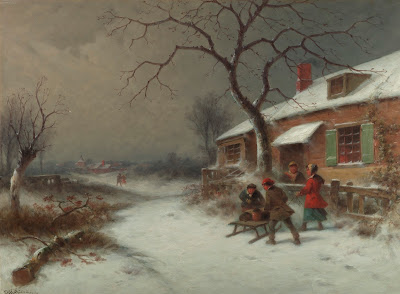
New Acquisitions: "Winter Morning" by George Washington Nicholson


George Washington Nicholson, Winter Morning, ca. 1880
Happy new year! On this cold winter morning, it seems only right to share this painting recently purchased by the Georgia Museum of Art. This genre scene, "Winter Morning" by George Washington Nicholson, was acquired using funds donated in memory of Board of Advisors member Harry Gilham. 

Born in New Jersey, Nicholson trained in Philadelphia, where he learned academic realism at the Pennsylvania Academy of the Fine Arts. In 1866, he traveled to England and France for further training. Nicholson settled in Philadelphia upon his return to the United States, and his reputation was at its height from the mid-1880s through the 1890s. He painted a mural titled “The Old Homestead” that was on display at Wanamaker’s department store in Philadelphia and another, “Washington Crossing the Delaware,” for the Pennsylvania State House in Harrisburg (most likely lost when the building burned in 1897).


Nicholson produced works commissioned by patrons who preferred seascapes, exoticized landscapes of Europe and Northern Africa and scenes of daily life in the American countryside. This snowy country scene is an example of the latter. He painted several variations on the scene, usually featuring a house and human figures in bright clothing to draw the eye, but most of them are smaller than this one. Along with the recent purchase of Thomas Waterman Wood’s “The Kitten,” this painting helps us better tell the story of 19th-century American art by enriching our small collection of genre painting from the era.


Wednesday, October 21, 2015

New Exhibition: “Before the March King: 19th-Century American Bands”

"Grandfather of the March King", Patrick Gilmore (1829 - 1892)

The Georgia Museum of Art opened a new exhibition to the public last week, “Before the March King: 19th-Century American Bands.” The exhibition focuses on American bands in the era before the “March King,” John Philip Sousa, and is open until the beginning of the year (Jan. 3, 2016).

The exhibition features many portraits of famous band directors, woodwind and brass instruments, non-military local bands and artifacts such as broadsides advertising performances by local bands and national events. Famous band directors featured in this exhibition range from cornet player Alonzo Ford to the “Grandfather of the March King,” Patrick S. Gilmore, who was an inspiration to Sousa.

Stereoscopic view of a concert hall conducted by Patrick Gilmore in Brooklyn, NY.

Instruments displayed in the exhibition include bugles, cornets, euphoniums and over-the-shoulder horns. The exhibition has a variety of photographic portraits that show the many types of bands that played in the early to late 19th century, such as military, newsboy and all-female bands. Artifacts include souvenirs from the National Peace Jubilee in 1869 and the World Peace Jubilee of 1872 (conducted by Gilmore) and sheet music covers.

An All-Female Band in the 19th-Century

All the objects in the exhibition come from the collection of UGA Performing Arts Center director George C. Foreman, who will give a gallery tour of it this Thursday (October 22). The public is invited to attend this free event, with champagne, coffee and cake at 5 p.m. and the tour at 6 p.m.