Showing posts with label new acquisitions. Show all posts

Thursday, October 11, 2018

Museum Acquires Work by Douglas Finkel

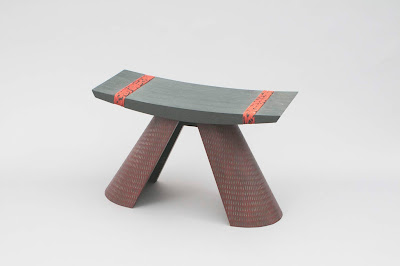
Source Bench by Douglas Finkel

The Georgia Museum of Art has impressive holdings of 20th- and 21st-century wood art thanks to the expansive gift of Jane and Arthur Mason a few years back. Despite its wide variety of craft, the museum did not have an example from prominent artist Douglas Finkel until a recent gift by the Center for Art in Wood.

Finkel is known, in part, for a series of benches, of which he has created 42 since 1997. French designer Pierre-Emile Legrain (1889–1929), who introduced these African forms to Western culture in the 1920s, is a noted influence of Finkel. According to the artist, “[Source bench’s] form and surface detail are inspired by Japanese architecture and, in particular, Samurai helmets.” The example recently added to the collection is an exemplary expression of this series. The recently acquired work has legs that are painted and carved, with a wire-brushed, painted and inlayed seat with kente cloth. Finkel has been both a woodworking artist and teacher for the past 21 years, and his work can be found in a number of collections, including the Renwick Gallery of the Smithsonian
American Art Museum.

We sincerely thank our friends at the Center for Art in Wood as well as the original donors, Bruce and Marina Kaiser, for this gift. It serves as a wonderful addition to our decorative arts holdings, filling an important gap in our collection.

--
Dale Couch
Curator of Decorative Arts,
Henry D. Green Center for the Study of the Decorative Arts

Thursday, August 23, 2018

Museum Acquires Moina Michael Portrait

Portrait of Moina Michael

Many a good idea has been scribbled on the back of an envelope. On November 9, 1918, two days before the armistice that officially ended the First World War, education professor and Athens resident Moina Michael used the back of an envelope to respond to Lt. Col. John McCrae’s poem “In Flanders Field.” McCrae’s last verse bemoaned veterans and casualties of war when abandoned by those they protected:

To you from failing hands we throw the Torch; be yours to hold it high. If ye break faith with us who die, we shall not sleep, though poppies grow in Flanders Field.”

Michael wrote a poem in response, her phrases full of ardent sympathy. Her own last verse reads:

And now the Torch and Poppy Red we wear in honor of our dead. Fear not that ye have died for naught; we'll teach the lesson that ye wrought in Flanders Fields.”

From this moment grew an industry of charity whose worldwide contributions to veterans of WWI would, after adjusting for inflation, sum over $3 billion. Michael began to wear and champion the wearing of red silk poppies in remembrance of fallen and wounded soldiers. After interest within her community grew, she began selling poppies, with the profits benefiting veterans of the Great War. She undertook national letter-writing campaigns, and by 1920 the poppy was designated the official flower of the American Legion. Not only did the proceeds directly assist veterans, but injured veterans considered unfit for labor could be employed crafting these poppies. Michael continued her active role in Athens by teaching classes of disabled servicemen, attending Disabled American Veterans meetings and planting poppies on the campus of the University of Georgia.

Michael’s legacy as “the Poppy Lady” continues, not only in her tradition of remembrance, but in the fabric of Athens itself. The Georgia Museum of Art recently received a donation of a portrait of Michael, painted by Thomas James Delbridge. The work comes to the museum from Michael’s relative Lucia Howard Sizemore, as part of a larger donation to UGA’s Special Collections Libraries. The portrait depicts Michael clothed in white, bearing a solemn expression and a bouquet of red poppies against an austere dark background. Delbridge was born in Atlanta in 1894 and was active in the South and all around the country before his death in Long Island in 1968. His painting “Lower Manhattan” was included in the 2009-10 Smithsonian exhibition “1934: A New Deal for Artists.” His contemplative portrayal of Michael will soon hang near the museum’s exhibition “For Home and Country: World War I Posters from the Blum Collection.”

Organized by Georgia Museum of Art director William U. Eiland with the assistance of head preparatory Todd Rivers, the exhibition highlights propaganda posters from across the world, including the United States, Great Britain, France and Germany. These posters put a unified image to struggle and created a singular effort behind which all citizens could rally. The exhibition invites viewers to investigate the means by which governments on either side of the conflict gathered and maintained support from their citizens. “For Home and Country” can be found in the Boone and George-Ann Knox Gallery II until November 11, 2018. You can read more about the exhibition here.

--
Penske McCormack
Intern, Department of Communications

Thursday, August 09, 2018

New Acquisitions at the Georgia Museum of Art


Recently, the museum graciously accepted the Colquitt family’s donation of two representative portraits by George Cooke, which will bring the museum’s holdings of Cooke’s work to five, and the campus-wide holdings to seven. Amazingly, these two portraits have remained together in the Colquitt family since they were painted in the mid-19th century. They depict Mr. and Mrs. Walter Terry Colquitt, most likely in commemoration of their 1841 wedding. It was also around this time that Colquitt served as both senator and congressman of Georgia, and it is after him that Colquitt County, Georgia, is named.

In addition to their excellent provenance and great condition, these two portraits provide skillful examples of Cooke’s middle-period style, as well as his affinity for creating portraits of couples. Although he became involved in the Hudson River school of landscape painting, Cooke stayed true to his love of portraiture throughout his career. The museum is lucky to have examples of both aspects of Cooke’s work, landscape being represented in his oil painting “Tallulah Falls” (1841) and portraiture in his “Portrait of Mary Hattaway Curry and Her Son, John” (1847), both currently on display in the permanent collection.

The University of Georgia is privileged in its access to one of the most extensive known collections of George Cooke’s paintings in the world. The UGA Chapel is home to a Cooke masterpiece, the 17 x 23–foot oil painting “Interior of St. Peter’s Cathedral,” painted from 1846 to 1847. This work is believed to be one of the largest oil paintings created during the time period and demonstrates an exquisite use of trompe-l’oeil. Another notable work, “View of Athens from Carr’s Hill,” belongs to UGA’s Special Collections Library. It was painted in 1843 when Cooke was visiting Athens, a city to which he would eventually move in order to enjoy “the hospitality of the truly Athenian people.”

Thursday, July 27, 2017

New Acquisitions: Sculpture by Horace Farlowe

Horace Farlowe, "Tennessee Cut."

In 2013, the Georgia Museum of Art acquired “Tennessee Cut,” a pink marble sculpture measuring 28 by 23 by 20 inches carved by artist and former University of Georgia professor Horace Farlowe (1933–2006). Previously tucked into a hidden garden at the UGA Hotel and Conference Center, where Scott Simpson of the Office of University Architects noticed it, the sculpture has found new life at the museum thanks to Robert Jarrell (b. 1963), an artist and former student of Farlowe’s; deputy director Annelies Mondi; preparators Todd Rivers and Elizabeth Howe; and Rebecca Salem, an undergraduate preparatory intern.

Simpson emailed Mondi to suggest that the Conference Center might be willing to transfer ownership of the sculpture to the museum, which it did. Mondi, who also took one course with Farlowe, and remembers him as a “patient and mild-mannered human being,” then consulted with Jarrell to restore and display the sculpture in a way that captured Farlowe’s intention for the piece and celebrated his legacy at the university. Located in a small garden to the right of the side entrance of the museum, the sculpture now faces the Lamar Dodd School of Art, connecting Farlowe’s professional and artistic careers and echoing his conviction that “Life and Art are the same thing.”

“Tennessee Cut” is part of Farlowe’s window series, so it was important that the piece be placed at a height to allow both adult and young visitors to look through to the other side, as well as that it frame a good view from either side. The sculpture now rests on a smooth, square concrete plinth poured carefully by Dave Lawson of the Facilities Management Division. Farlowe worked mostly in stone, and his sculptures, towering up to 17 feet tall, can be seen in Spain, Germany, Italy, Scotland and all over the United States. According to Jack Kehoe, one of his colleagues in the art department, the prominence of the marble-carving program at the university can be attributed to Farlowe’s skill and passion as an artist and teacher.


Horace Farlowe, untitled.

Farlowe’s work appeared in several exhibitions at the museum during his lifetime, including “City on a Hill: 20 Years of Art at Cortona” (1989). The museum also owns a small untitled example of his work, also in marble, that was a gift of Margaret Leary (GMOA 2016.250). Farlowe gave Leary the sculpture after they worked together on a site-memorial entry to commemorate the World Trade Center towers.

Martha Wilde
Intern, Department of Communications

Thursday, May 11, 2017

New Acquisitions: "Minnehaha" by Edmonia Lewis

Edmonia Lewis, Minnehaha, 1868
The museum recently purchased a significant 19th-century neoclassical work with funds from the Collectors of the Georgia Museum of Art. “Minnehaha” is a petite marble sculptural bust carved by artist Mary Edmonia Lewis (1844–1907). Born in Greenbush, New York, Lewis was an artist of mixed African American and Chippewa (Ojibwe) ancestry who was among the few female artists to have worked actively in Rome, Italy. Prior, she studied at Oberlin College in Oberlin, Ohio, and then moved to Boston. She gained a following there creating busts of prominent anti-slavery activists. Lewis also often portrayed American Indian subjects.

In Rome, Lewis produced several commissioned busts of prominent abolitionists and biblical and mythical figures. She was also known for her American Indian subjects drawn from the popular literature. Henry Wadsworth Longfellow’s epic poem “The Song of Hiawatha” (1855) inspired her to produce several figural groups, of which “Minnehaha” is an example. In Longfellow’s fictional poem, Minnehaha, a Dakota, was the lover of Hiawatha, a warrior among the once enemy nation of the Ojibwe.

Unveiling of "Minnehaha" as part of the annual Black History Month dinner.
This Minnehaha bust represented a rare opportunity to acquire a quality sculpture by this 19th-century pioneer. The purchase fills a major gap in the collection for both American and African diasporic artists who worked in the U.S. and abroad.

Shawnya L. Harris
Larry D. and Brenda A. Thompson Curator of
African American and African Diasporic Art

Thursday, April 20, 2017

New Acquisitions: "Shad, Altamaha River, Georgia" by Warren Cushman

Warren Cushman, Shad, Altamaha River,
Georgia
, 1895. Oil on canvas.
As Earth Day approaches, we reflect on this new acquisition, which touches upon the subject of the ecology of Georgia’s rivers. Through the generosity of Greg and Jennifer Holcomb, the Georgia Museum of Art reeled this work in to its permanent collection. The image is of a shad fish. By the time Warren Cushman painted this image in 1895, the fish may have been something of a rarity, for the shad species had disappeared in the upper waterways of the state, though it played a significant role in the human experience of Georgia, from prehistoric times into the late antebellum period.

Shad fish had been a prominent part of the food culture for early American Indians as well as later settlers. Interestingly, Athens was found to be an attractive settlement site in part because the Oconee River had a “shad run,” but by 1807, the Augusta Chronicle reported that the shad had ceased to “run” on the upper Oconee River. By 1812, the Georgia legislature tried to secure open rivers as part of some of the first environmental legislation in this region. Writing in 1877, W.L. Jones observed the radical demise of various species of Georgia fish: “It is lamentable fact that our food fisheries are so rapidly decreasing in numbers, and, unless the State, in a few years, shall take the matter in hand, and resort to artificial propagation to replenish our nearly exhausted streams, our grand children will have to refer to a book on Natural History to ascertain the kinds of fish upon which our fathers fed so bountifully on.”

Books of natural history were created from works of art such as this depiction, a visual description designed to catch the observable physical characteristics of this species. Cushman’s work, however, also betrays a genre of decorative still life. Within the image, he uses decorative wood “graining,” a technique used to simulate either wood on nonwood surfaces or expensive woods on cheaper ones. While Georgia’s children can now have a shad fish image to view, thankfully they are not restricted to it. Ecological restoration to Georgia’s rivers has since resulted in increased runs of shad. Happily, objects like this one point to cross-disciplinary study and collaboration, one of our sustained educational goals. We extend our appreciation to the Holcombs for their generosity in making this gift.

Dale L. Couch
Curator of Decorative Arts

Thursday, September 08, 2016

New Acquisitions: "Die Gänsemagd" (The Goose Girl) by Paula Modersohn-Becker

A pioneer of European modern art, Paula Modersohn-Becker was an influential participant in the artistic community in Worpswede, in northern Germany, at the start of the 20th century. Trained in Berlin, she became acquainted with the formal innovations of post-impressionists like Paul Cézanne and Paul Gauguin during a trip to Paris in 1900. Her paintings are often discussed in the scholarship on the period as important precursors to the German expressionist style.

Paula Modernsohn-Becker, Die Gänsemagd (The Goose Girl), ca. 1900

Artists of the Worpswede community sought escape from the industrialization of German cities, often romanticizing rural life in their images. Modersohn-Becker usually selected local children, old women or farmers’ wives as models for her portraits and figure studies, while emphasizing abstract patterns within the forms. Her subject for "Die Gänsemagd" is based on a German fairy tale of the same name from the Brothers Grimm. The exaggerated limbs and contours of her figures recall storybook illustrations and also point to the expressive distortion of forms found in later expressionistic styles. Modersohn-Becker’s career was cut short when she died of an embolism in 1907 at the age of 31. The poet Ranier Maria Rilke, also in Worpswede at this time, wrote “Requiem for a Friend” in her memory in 1908.

"Die Gänsemagd" is currently on display through October 9 in the exhibition "Recent: Acquisitions."

Lynn Boland
Pierre Daura Curator of European Art

Thursday, August 18, 2016

New Acquisitions: "A Ride Home at Sunset" by Lyell Carr

Lyell Carr, A Ride Home at Sunset (1891)

This scene was painted on Tolburt Plantation in Haralson County, Georgia, by Lyell Carr, a painter to be recognized for his scenes that accurately and charmingly portray life in the South at the close of the 19th century. Born in 1857 in Chicago, Illinois, Carr studied in Paris for one year at the Ecole des Beaux-Arts, where his teachers were Jules Joseph Lefebvre and Gustave Boulanger. These masters emphasized the importance of drawing to good painting. Their training had a lasting effect on Carr’s style, which is characterized by the firm definition of form and a realistic handling of space.

Throughout Georgia’s early history, the predominant demographic group was ordinary white families who farmed for a living. With abundant natural resources and less class-ridden social structures than their European counterparts, these families were often prosperous and enjoyed their American liberty and bounty. Their existence was distinctly different than that of enslaved African Americans who were denied most of the American bounty and founding doctrines of personal freedom, but the families came to share many agrarian values with emancipated enslaved people later. The visual culture of the white “yeomanry” produced few artists, and most representations of these people are fraught with condescension and caricature. The museum has long wished to present a worthy image of ordinary Georgians with our collection of plain-style furniture from yeoman homes; this image by Lyell Carr is a rare and gratifying image that depicts two children of the yeoman class with realism and dignity.

“A Ride Home at Sunset” was purchased in memory of Samuel “Sam” Marvin Griffin Jr.

Dale Couch
Curator of Decorative Arts

Thursday, June 30, 2016

New Acquisitions: "Patchwork/Terry" by Sam Gilliam


Created by abstract painter Sam Gilliam in 1980, “Patchwork/Terry” was commissioned by Rita Curran Morgan, Teresa Friedlander’s mother, as a college graduation gift for her daughter, whom she called “Terry.” Teresa has enjoyed this work for over three decades and, through her generous gift, has extended this opportunity to countless new visitors to the Georgia Museum of Art, in memory of her mother. Morgan was an administrative assistant to Gilliam and his wife, Dorothy, during the late 1970s and early 1980s.

Gilliam is a significant figure in the development of abstract color field painting. A prolific painter currently active in the Washington, D.C., area, Gilliam gained initial recognition in the late 1960s for his large and colorful, unstretched — or “draped” — canvases. In the 1980s, his techniques included putting large pieces of canvas on the floor and pouring or throwing acrylic paint on them to build thick layers. The artist then used a rake, broom or fingers to move the paint to add texture and reveal the various colors. When the canvases dried, Gilliam cut them into geometric shapes and pieced them together into three-dimensional paintings over polygonal wooden stretchers, as with “Patchwork/Terry.” Here, Gilliam exposes its painted edges, suggesting spatial qualities akin to sculpture, with the work itself appearing as colorful, textured fragments reminiscent of quiltmaking.

Shawnya Harris
Larry D. and Brenda A. Thompson Curator
of African American and African Diasporic Art

Thursday, March 31, 2016

New Acquisitions: "Girl Sewing (The Chinese Robe)" by Frederick Carl Frieseke

Frederick Carl Frieseke, Girl Sewing (The Chinese Robe) (1931)

Among the latest additions to the Georgia Museum of Art's permanent collection is the American Impressionist painting “Girl Sewing (The Chinese Robe)” by Frederick Carl Frieseke (pronounced FREE-suh-kuh). Peaceful domestic settings were a common theme in American Impressionism. This purchase was made possible with funds given by The Chu Family Foundation. Dr. David Chu is a distinguished research professor emeritus in UGA’s College of Pharmacy. He and his wife, Jane, made this financial gift through their family foundation with the specific goal of having the museum purchase a significant American painting. The museum held a formal unveiling to commemorate the acquisition of this painting.

Gift unveiling with Jane Chu of The Chu Family Foundation 
Sarah Kate Gillespie, our curator of American art, said, “Frieseke was an important force in American Impressionism, particularly among those Americans working in the colony of Giverny, France, adjacent to Claude Monet’s gardens. He enjoyed great popularity on both sides of the Atlantic. This particular work not only fills what had been a major gap in the genre within our collection, but also very much complements our current holdings in American Impressionism.”

“Girl Sewing (The Chinese Robe)” is now on view in the Marilyn Overstreet Nalley Gallery at the museum, alongside other American Impressionist paintings from the collection by Mary Cassatt, Frank Weston Benson, Childe Hassam and William Merritt Chase.