Showing posts with label art history. Show all posts

Monday, November 22, 2010

Trecento 2010: An Enriching Weekend of Early Italian Art

Paul Manoguerra, chief curator and curator of American art, and Judith Ellis attend the Alfred Heber Holbrook Lecture

Laura Rhicard, who works in our Daura department, wrote up a wonderful account of our recent Trecento Conference, which took place November 11-13:
The weekend before last, the Georgia Museum of Art and the Lamar Dodd School of Art played host to the biennial Trecento Conference in Memory of Andrew Ladis. Scholars and enthusiasts of early Italian Renaissance and late Medieval art from around the world and the United States gathered at the art school to discuss a wide range of topics on the trecento period of Italian art history. Click here to view a full list of the presentations.

Marvin Trachtenberg, of the Institute of Fine Arts at New York University, opened the conference on Thursday evening with the 2010 Alfred Heber Holbrook Memorial Lecture. His topic, “Building-in-Time: Thinking and Making Architecture in the Premodern Era” was based on his newly published, similarly titled book, which explores the role of temporality in architectural theory and practice in 14th-century Italy.

Friday and Saturday were filled with presentations. Intern Joanna Reising especially enjoyed the presentation of a paper by Peter Scholz of the Kunsthistorisches Institut in Florence, “Creating Space and Constructing Identity: the Painted Architectures of Giusto de’ Menabuoi and Altichiero.” Joanna found the topic interesting in light of the research she’s been doing in our curatorial department:
This lecture is important for our own research on our Giusto panels, which are part of a dismembered polyptych. Not only did the lecture give us a better idea of Giusto's style, but it also gave us a lead on reconstructing the polyptych: the altarpiece of the baptistry seen in the third slide of the lecture looks very similar to the reconstruction that I have done on our polyptych. This could give us a better idea of what the polyptych looked like before it was dismembered.
Curator of education Carissa DiCindio found interest in a presentation by Cecilia Frosinini of Opificio delle Pietre Dure e Laboratori di Restauro in Florence, entitled “New results on Giotto's panel paintings and wall paintings restoration at the Opificio delle Pietre Dure: the Ognissanti Crucifix and some preliminary remarks on the Peruzzi Chapel.” Said Carissa, “It was fascinating to see how the works of art are being restored, and the discoveries made through these restorations are very exciting.” She also noted that the highlight this year was knowing that the conference will now be named for Dr. Ladis, “because I cannot think about this event without thinking of his presence there.”

The relatively small size of the conference made it easy for seasoned international scholars and new graduate students alike to converse on their shared passion. To sustain the sense of community, participants were treated to dinner at local homes each night. Several visitors from Italy were complimentary of the food, particularly the Low Country Boil! For lunch, conference participants got a taste of today’s college dining experience at the Harris Commons dining hall, and coffee and tea breaks were delivered by local cafĂ© Big City Bread. Toward the end of one break, a comment was overheard that could have been either “This is the best conference around,” or “the best coffee around….” Either way, we’ll take the compliment!

For Dale Couch, curator of decorative arts, last weekend was his first time attending the Trecento Conference. He provided this assessment that nicely sums up the weekend: “It was an enriching experience both to be around so much trecento art history, so many art historians, and such incredible diversity of languages and culture. The Trecento conference was a case study in a successful academic conference. I believe it brought something special to Athens.”

Tuesday, October 12, 2010

Experience Italian Masterpieces Like Never Before…With a Click of Your Mouse

Photo courtesy of artdaily.org

An Italian company by the name of Haltadefinizione is revolutionizing public access to the works of the great masters. With just a few clicks of your mouse, you can experience works like Caravaggio’s “Bacchus” and Botticelli’s “The Birth of Venus” as though your nose were only millimeters from the centuries-old canvas.


“If you can’t come to them, they’ll come to you,” boasts a banner on Haltadefinizione’s homepage. And the site is true to its word, giving visitors an up-close view of the paintings that even an actual visit to the museum wouldn’t allow.


The site features photographs of six masterpieces of the Uffizi Gallery in Florence, including works by Bronzino, Botticelli, Verrocchio, Leonardo and Caravaggio. But these aren’t your average photographs—the camera used has a resolution up to 3,000 times greater than the average digital camera. Not impressed yet? The resulting images have a resolution of up to 28 billion pixels and can show details up to a hundredth of a millimeter.


So what does this mean for visitors to the site? For one, it means seeing the tiny outline of a self-portrait in the reflection of the wine jug of Caravaggio’s “Bacchus.” It means that a few clicks of the mouse can bring you close enough to Leonardo’s “Annunciation” to see the individual golden brushstrokes of the virgin’s hair, the tiny ships in the distant landscape, the cracks in the 500-year-old paint.


The image is created by taking hundreds of pictures of tiny portions of the painting, then compiling them and reforming them into a complete image of the work. The result is, as Culture Ministry official Mario Resca puts it, like looking at a painting “with a giant magnifying glass.” The technology uses a minimal amount of light and does not utilize infrared in the interest of preservation.


Haltadefinizione plans to digitize more artworks, with the eventual goal of opening a virtual museum. However, for the time being, these six Italian masterpieces remain accessible to the public for free until January 29.


To experience these images for yourself, please click here.

Wednesday, September 29, 2010

Past, Present and Future


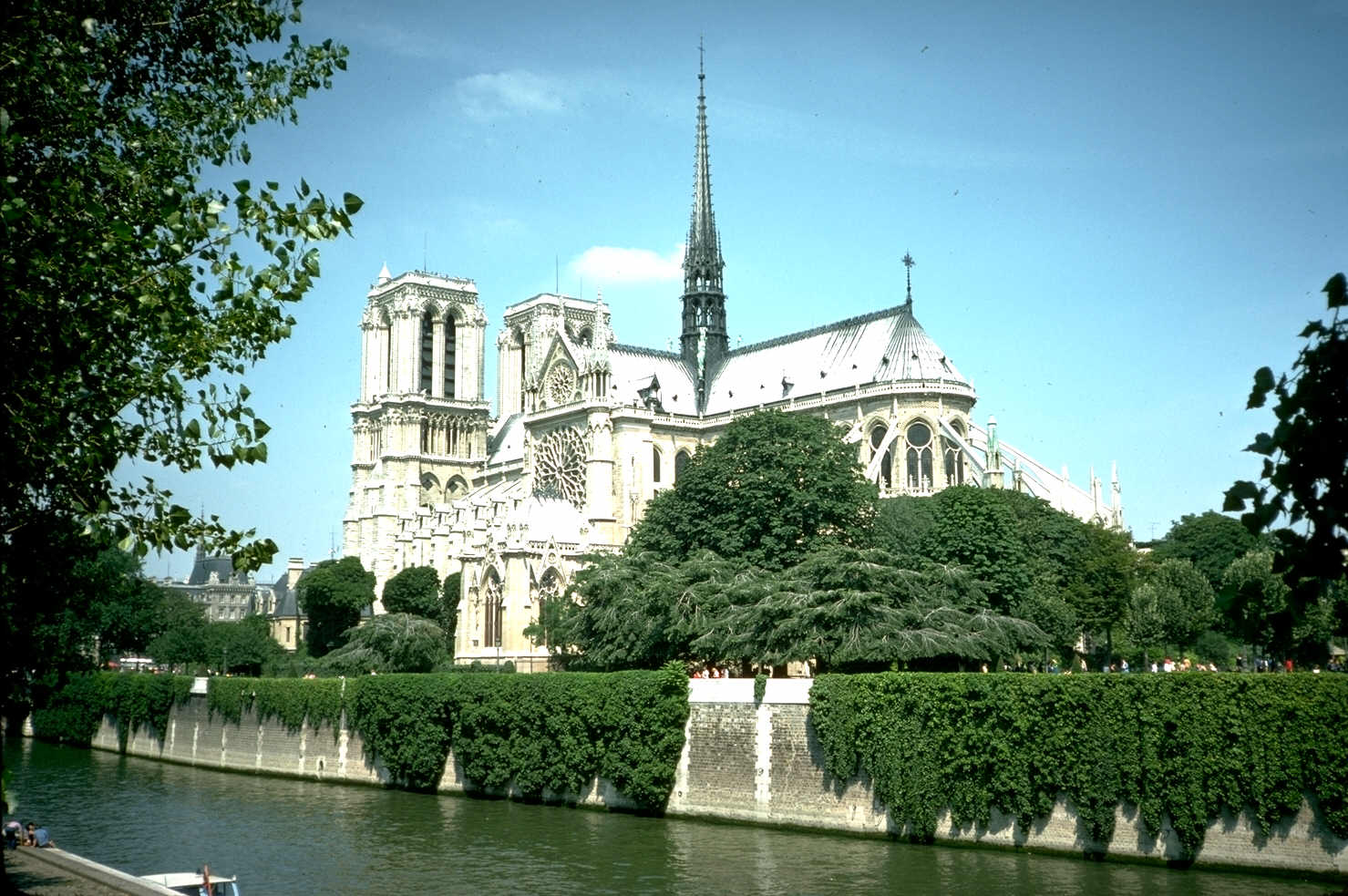
Notre Dame, Paris


When asked what 500-year-old gothic cathedrals and artificial intelligence (A.I.) technology have in common, you would think not much, right? However, the application of this new(er) tool could help explain the architecture of these historic buildings. Providing a new method for studying building design, particularly that of medieval times, A.I. looks at how the pieces work together to create a well-built structure. In addition to studying architectural giants such as Notre Dame Cathedral, the computer can also generate those structures that have since turned to ruins.


The group running the study, which is funded by the National Endowment for the Humanities, is led by Stefaan Van Liefferinge, an assistant professor of medieval art and architecture in the Lamar Dodd School of Art at the University of Georgia, as well as Don Potter and Michael Covington, two professors from the university’s Institute for Artificial Intelligence. Van Liefferinge says, “The aim of our project is to develop an ontology or knowledge representation for architectural history that will make it possible for us to apply methods from artificial intelligence to historic descriptions of architecture,” basically meaning computerizing the structures in order to study them in a modern context and, thus, creating relationships between many different medieval buildings.


The group hopes that the research will help students learn about different architectural styles in addition to creating software that simulates parts of or entire buildings that are now lost. Starting with a simple part of a building, like a window and its surrounding supports, the research will expand to the cathedral as a whole when more information is added to the system. The application of A.I. to architecture is new, and the group recognizes its potential to investigate much simpler building structures too, such as bungalows. According to the article, “the long histories of cathedrals, though, make them perfect as a test case for this intersection of science and art.”


This makes for an exciting future in art and technology. It could lead to the study of older paintings, tapestries and more, all the while closing the daunting time-gap between then and now.


Quotes and facts taken from an article written by Philip Lee Williams.

Tuesday, March 09, 2010

The History of Western Art in Music Video Form

70 Million by Hold Your Horses ! from L'Ogre on Vimeo.

Hat tip to Amy Miller, who suggested this great mix of fine art and indie rock for the blog. It's Spring Break for the students around here, but that doesn't mean we're slowing down a bit. Things have been very busy today, so blogging has been light.

Wednesday, February 03, 2010

Art History Lecture - Lamar Dodd School of Art


For the third installment of the Association of Graduate Art Students’ (AGAS) lecture series, Ronda Kasl will present her lecture tomorrow, February 4, at 5 p.m. in Room S150 of the Lamar Dodd School of Art. Kasl will discuss the devotional practices surrounding lifelike images, or “holy dolls,” of the infant Christ in the 17th century.

Kasl is senior curator of painting and sculpture before 1800 at the Indianapolis Museum of Art and specializes in late medieval Spanish art.

Thursday, October 22, 2009

How Works of Art Get Their Names

Brian Palmer from Slate has written an interesting article about the process of naming old paintings. Until the middle of the 17th century, it was uncommon for an artist to name his or her own painting. Usually, descriptive names like “Profile of a Young Woman” were given for record-keeping purposes, but the names we know today (like “Mona Lisa” or “La Belle Ferronniere”) were given posthumously by art historians. When historians needed to refer to certain pieces about which they were writing, the original vague descriptions became obsolete. The growing conversational and academic focus on pre-17th-century paintings also called for a shorthand way to refer to the paintings—usually a more succinct and specific name, short and to the point. Moreover, some of these paintings, like Botticelli’s “Primavera,” bore different appellations throughout the centuries:
Botticelli's Primavera was described as a "Painting by Botticelli with Nine Figures" in a 16th-century catalog of the Medici family's holdings. During the 17th and 18th centuries, the same painting is described in other collectors' catalogs as The Garden of the Hesperides. Modern scholars adopted the current name in accordance with the interpretation of 16th-century art historian Giorgio Vasari, who described the painting's subject as the arrival of spring (in Italian, primavera).

Some artists, like Jan Vermeer, occasionally christened their paintings with interesting and peculiar names, but most paintings were nameless. Much of how we look at paintings today, or at least how we remember and think of them, has to do with their names. The name of a painting lends itself intensely to that work’s identity. When Mona Lisa’s other name, La Joconde or La Gioconda, is used I feel slightly uncomfortable, as La Joconde carries a much more formal tone—Gioccondo was her husband’s family name. Part of the charm in Mona Lisa, to me, and I’m sure to a great many people, is the informality of her gaze and her pose. It seems like using her first name is more fitting. Palmer also delves into the changes that took place within academy system and how and when artists gained the control to name their own pieces.

La Bella PrincipessaLa Belle Ferronniere

Tuesday, October 20, 2009

Visiting Artist Lecture


This afternoon Michael Fried will speak as a part of the Visiting Artist and Scholar Lecture Series, sponsored by the Lamar Dodd School of Art and the Franklin College of Arts and Sciences. Fried is an art historian, art critic, literary critic and poet whose knowledge and expertise encompass a broad range of topics. For more information about Fried, visit the Lamar Dodd Web site. The lecture will take place at 5:30 at the Lamar Dodd School of Art, room S151.

Thursday, April 09, 2009

Events Around Campus

Curatorial assistant Jenny Gunn just sent along this lecture that some of you might be interested in attending, especially if you're interested in what exactly a curator does.

The Undergraduate Art History Society is honored to welcome guest lecturer Mr. Carter Foster to Lamar Dodd School of Art on Thursday, April 23, 2009 at 5:30 PM in lecture hall S150. Mr. Foster, who completed his undergraduate degree at UGA went on to receive his Masters at Brown University. He has since worked at the National Gallery of Art, the Philadelphia Museum of Art, the New York Public Library, the Cleveland Museum of Art, and the Los Angeles County Museum of Art. Currently he works as a curator (specializing in drawings) at the Whitney Museum of American Art. Mr. Foster will present a lecture entited "Curating the Modern Artist: Edward Hopper and Roni Horn." He has this to say about the lecture: "This talk will discuss modern curatorial practice in the context of two exhibitions with very different sets of parameters. One involves interpreting the work of a historical figure through the collections of the Whitney Museum of American Art, the other working closely with an important living artist to organize a presentation of her work for a major retrospective currently on view at the Tate Modern."