Showing posts with label interns. Show all posts

Thursday, September 20, 2018

Student Spotlight: Neil Hancock


Each semester, the Georgia Museum of Art has student interns from departments and units across campus. Penske McCormack is currently an intern for the department of communications and a student at the Lamar Dodd School of Art. In the essay below, they examine and interpret the work of another Lamar Dodd student, Neil Hancock.

"Large, But Not Biggest"
By his own insistence, Neil Hancock’s paintings are guarded by code. Meaning and narrative embroiled within a foreign alphabet, each visual element is a Gordian knot of misinterpretation, to the point that we, the viewers, are forced to release our compulsion to comprehend. It is only with such release that these paintings are able to be effectively experienced. Hancock’s self-portrait as a raccoon serves as an excellent example, using the question “why?” as a weapon against trespass. We are confronted by symbols and objects that, according to our own logic, must hold translatable meaning: a dead raccoon, surrounded by an aura of vibrating white; a rectangle layered over the animal and painted with wood grain; digital prints of oranges and a table full of beer and cigarettes; and road lines of exaggerated perspective, which disappear with blotched strokes that ground the painting as a painting, not an illusion. Why include these elements? What are their logic and their purpose, if we are not given tools to excavate their significance? This art historian would argue that it is to the end of redemption, even democratization, of autobiography that the artist performs such futile semiotics.

Although we are presented with symbolic elements very consciously chosen and executed on the part of the artist, and the painting therefore reeks of personal significance — the title, “Game Knows Game,” exemplifies such — the fact that the symbols are not explained means that we are free to experience the narrative as an object. Rather than being bound to the artist’s experiences and point of view, we are able to adjust our mental grip to our own comfort. Like the consumption of food versus the preparation of it, we are sensing the self-portrait rather than understanding it.

Hancock’s paintings also perform alchemy in the transformation of sensation and experience into an object. As can only be effectively seen in person, the canvases are thick, the sides painted to encase them fully in the artist’s will. “Camo Object” highlights this prioritization of a painting’s reality rather than its realism. “Ill Dome” performs the same transformation, with the added layer of a perfectly comprehensible and relatable phrase, “Shut Up Brain,” manifesting in reality along with the painting. The frustration of overthinking is made feasible, something we could grip in our hands, turn over and over, even throw against the wall. This potentiality creates a sense of wonder regarding a sensation that would otherwise be somewhat sinister, yet fully castrated by its mundaneness.

“Horrible People,” a collaboration with Athens artist Annemarie DiCamillo, takes this transfiguration and magnifies it through vehemence. The graphic flames amplify the phrase and raze the viewer’s perception in a straightforward sense, but scribbled paint strokes, tone-shifting emotive letters, and drips of paint both precise and messy communicate the sensation even more effectively. We do not know of whom the artist is speaking, or what situation brought about the frustration — for certainly it was a condensed moment, implied by the phrase’s hasty scrawl — but the necessity of such knowledge has been done away with. An explosive sensation is reinterpreted through intentionality and allows us to reconsider with it with impunity--the experience of aggravation without the cause or consequence.

“Large, But Not the Biggest” (above), includes all these factors. It is a painting of tenderness, and of an important story we can feel but not iterate. By withholding information, the narrative becomes almost universalized. Hancock’s painting is a practice in labor and ease, immediacy and distance, as is best described by the statement on the artist’s website:

“He uses abstraction as a means of generalization, reexamining and categorizing experience into painting surface and object. Experience becomes truth. Ambiguity is important. The code cannot be broken. Defend the castle.”

--
Penske McCormack
Intern, Department of Communications


Thursday, May 17, 2018

Former Intern Samantha Meyer Reflects on Her Time at the Museum

Samantha Meyer
One of our former public relations interns, Samantha Meyer, recently took the time to write about how her internship with the Georgia Museum of Art helped her find her ideal career path. Meyer is currently the lead career consultant for the Grady College of Journalism and Mass Communication at the University of Georgia.

During my time as a student at the University of Georgia, I worked as a public relations intern for the Georgia Museum of Art. I was thrilled to land this role and learn more about my chosen major and career path in the context of art in the Athens community. I was excited to learn about the basics of PR—how to write a press release, practicing my writing skills and generally learning how to communicate effectively on behalf of an organization. I had no idea that I would learn so much more about my future career path and myself.
One of my favorite things about working at the museum was that I was trusted to do the work I was assigned. I was responsible for touching base with curators about upcoming exhibitions for the advance exhibition schedule, and I managed the process of tracking press clippings. I was also writing press releases frequently—and about some major initiatives, at that. I mean, I wrote a release about Michelle Obama’s Let’s Move! initiative, y’all!
As intimidating as that all may have sounded to me at the time, I learned that I love autonomy in any role I assume; I will always appreciate the trust that was put into me during my time as a public relations intern.
In addition, I learned how to carry myself in an office setting. As a first generation college student, I didn’t understand the importance of this. The museum was a wonderful learning environment as I processed how to collaborate with peers and superiors, how to take constructive criticism and simply how to work effectively within an organization.
An unexpected outcome of my time at the museum was learning how much I enjoyed working in higher education. Working at the Georgia Museum of Art taught me that there were ways to apply my communications experience in support of causes and organizations that make an impact on their communities and stand for something meaningful. I realized that I couldn’t work for an organization whose mission and impact I didn’t support. As a double major in public relations and women’s studies, coupled with my time at the museum, I realized my values would play a huge role in my careersomething that I was unable to foresee early on in my time at UGA.
Nowadays, it’s my job to help current University of Georgia students figure out what they want to do with their careers. One of the first things we encourage at the UGA Career Center is to get experience (such as internships) to help them learn what they might want to do. I encourage starting out in campus roles (and have even recommended GMOA before!) so students can begin learning what they like, what they don’t like, and what they want more of in future roles. Though I’m no longer working in the art world, there was no better setting for me to gain experience for my future career than the Georgia Museum of Art.

For more information on our internship opportunities, you can read about our various positions here or fill out an application.

Thursday, November 16, 2017

Former Intern Daniel Chamberlin Is Making a Career in Museums

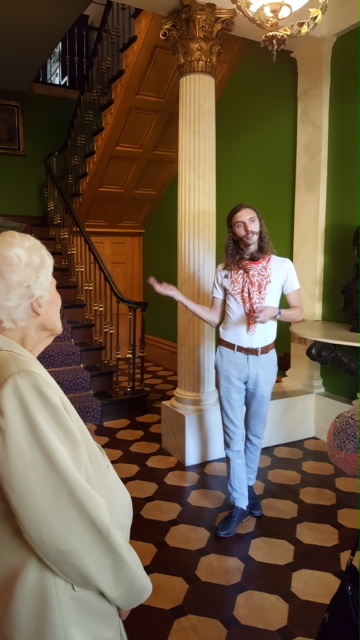
Daniel Chamberlin giving a tour at the Owens-Thomas House, Savannah.

Daniel Chamberlin was a volunteer intern at the Georgia Museum of Art from 2012 to 2014. He worked on numerous projects while here, including with Dale Couch, curator of decorative arts, and with the preparators, helping to mount exhibitions including "Rugs of the Caucasus." For that exhibition, he also wrote materials for its catalogue. We've followed his museum travels since he left here and been proud to see him working first at Hay House, Georgia Trust for Historic Preservation, in Macon, where he was a museum interpreter, and now in a similar role at the Owens-Thomas House and Telfair Academy, part of the Telfair Museums in Savannah. We asked if he would write something for us on his experience here, and he was kind enough to oblige.

During my time as an intern at the Georgia Museum of Art I was exposed to so many great things I have taken with me into other jobs since that time. Working with Dale Couch as a curatorial intern was one of the most rewarding experiences I have ever had, and he continues to be a mentor to me today. His wealth of knowledge combined with the resources available at the Georgia Museum of Art were invaluable. I not only learned a great deal about object analysis, best museum practices and research methods; but was exposed to both public and private collections giving me innumerable learning opportunities. He introduced me to many other museum professionals within the field, and I continue to maintain those connections today. Through those I have been able to further my own education and career path.
Unlike many student interns, I completed two consecutive internships, and stayed for a second year to work within the preparators' department. The skills I gained during my time working with Todd Rivers and Larry Forte have also proven to be of great worth — from exhibit design to ​various construction methods. Given the chance to design and execute a temporary exhibition, I was able to work directly with curatorial and preparation staff members simultaneously, which gave me such an in-depth and holistic experience. 
All of this has carried me through much of the work I have done since that time. Currently employed by the Telfair Museums in Savannah, Georgia, I am still using those skill sets and knowledge I gleaned within the collections and galleries of the Georgia Museum of Art. I would highly recommend these intern programs to anyone who is interested in pursuing a career in museum work on any level. 
To learn more about internship opportunities at the museum, which are rich in experiential learning, visit our website here

Thursday, October 05, 2017

The Art of Giving: Beard Scholars at the Georgia Museum of Art

(left to right) Joseph Litts, Linda Beard, Victoria Ramsay and Larry Beard

The stereotype of southerners is that they move, think and speak slowly, but people who think that haven’t met Dale Couch. Come to the offices of the Georgia Museum of Art any day and you will see Couch, the museum’s curator of decorative arts, practically running around the museum, talking a mile a minute. Recently, Couch has been accompanied by two people just as lively as he is: the museum’s new Beard Scholars, Joseph Litts and Victoria Ramsay.

Earlier this year, Drs. Linda and Larry Beard—major supporters of the Georgia Museum of Art and its decorative arts initiative—made a commitment to establish this scholarship as a paid position for undergraduate interns in the museum’s Henry D. Green Center for the Study of the Decorative Arts. Linda Beard is a member of the museum’s Decorative Arts Advisory Committee and the Executive Committee of its Board of Advisors. She is also a distinguished collector and connoisseur of Belleek porcelain, and works from her collection are on long-term loan to the museum, where they constitute a popular display. Professor Larry Beard is also a scholar of the arts and is an able associate in the Beards’ quest to improve the learning experience in the decorative arts.

Beard Scholar Joseph Litts discusses a chair
Litts and Ramsay are the first students to receive the scholarship, which runs through the 2017–18 academic year. Both of them have demonstrated a strong commitment to the study of the decorative arts. The field focuses on useful objects (furniture, silver, ceramics, textiles et al.) that transcend their function through design, craft, ornament or inherent beauty.

The Beards said, “It is an honor and privilege for us to encourage the work and research of outstanding students in the decorative arts. These scholars represent the absolute best of those students who are passionate about the arts. Their work and aspirations bode well for the future of the decorative arts.”

Litts previously studied history as an undergraduate student at Clemson University. He interned at the museum in the summer of 2015. In the summer of 2016, he attended the summer institute at the Museum of Early Southern Decorative Arts, in Winston-Salem, North Carolina, an in-depth, practice-based program that focuses on the decorative arts and material culture of the early American South. Ramsay is an undergraduate UGA student majoring in English and history, with an emphasis on British and Irish studies. She attended the University of Georgia at Oxford program, at Trinity College, for 6 weeks this summer studying English literature. 

Beard Scholar Victoria Ramsay shows
Linda and Larry Beard some of her work

As Beard Scholars, Litts and Ramsay are tasked with a variety of responsibilities, from visiting donors to digging through antiques shops to writing research articles. The program fosters a more intensely educational, hands-on experience than they would get in a classroom alone. 

When asked what he hopes they will gain from this position, Couch says, “I hope they realize that following a passionate interest gives fulfillment to life. This program exists first to educate and enrich lives of students, not solely to train future curators. I would be delighted to have my interns go on to be lawyers, professors, stay-at-home mothers and fathers, businesspeople. Good design gives rise to conscious living.”

Litts and Ramsay believe that the scholarship will benefit them by providing an enriching educational experience that allows them to be fully invested in their work. Ramsay said, “This internship has made me realize things about myself that I wouldn’t have
known before. I have found what I am truly passionate about and what I want
to work toward in the future.” Both Beard Scholars have decided to attend graduate school. Litts will be studying art history and Ramsay will study English with the intent of becoming either a professor or an archivist. They advise anyone who has interest in the program and the decorative arts to apply for the Beard Scholarship.

The importance of the Beard Scholarship cannot be emphasized enough. Director of development Heather Malcom said, “The Beard Scholarship establishes the first paid internship position for undergraduates at the museum and serves as a model for programs of its kind that help remove barriers and open doors for talented students. It provides opportunities for students to do original research on material culture that helps tell stories about our shared history and environment. And it will go a long way toward creating and diversifying the next generation of scholars in the decorative arts.”

Information about how to apply for this scholarship and other experiential-learning-focused internships at the museum is available at georgiamuseum.org/learn/internships.

Stephanie Motter
Intern, Department of Communications

Thursday, September 28, 2017

Serving UGA Students Through Experiential Learning

Sarah Dotson in the Met galleries

Hi there. My name is Sarah, and I graduated from the University of Georgia last May. During my senior year, I interned at the Georgia Museum of Art in the publications department in order to evaluate whether or not a job in museum publishing would perfect for me – as a lover (and student) of both English and art history, it seemed to be ideal. As it turns out, it was. As the imminent approach of graduation put existential pressure on seniors across the country, I began applying for jobs, internships and other post-grad opportunities that would allow me to move to New York City and begin a career in the arts. 

Much to my excitement and surprise, I landed an internship at the Metropolitan Museum of Art in its publications department as part of the summer MuSe program. To apply, I wrote a few essays, provided both academic and occupational references, and interviewed with the people who would soon become my supervisors. I can say with absolute certainty that I have never felt more prepared or qualified for an interview in my life. It was almost surreal finishing an interview and knowing that I didn’t have to come up with irrelevant anecdotes out of thin air to illustrate relevant skills. I had concrete examples of the projects I had been involved in at the museum, and I knew the work I was doing was actually contributing to the progress of various museum publications. 

I sat with Hillary Brown, the director of communications and my supervisor at the Georgia Museum of Art, before my interview to prepare. It was immediately clear that, by trusting me with image acquisition work, blogging, writing press releases, transcribing interviews and updating the museum’s various calendars, the museum had given me the chance to develop many skills that would appeal to my interviewers. I felt challenged but always supported by Hillary as well as by staff in other departments during my time at the museum. 

My time at the museum taught me a tremendous amount…not just about museum publishing, but also about how a museum functions as a whole, office etiquette and which shoes echo the loudest in quiet galleries (Hint: the shoes you think will echo the loudest absolutely do. Heels, heavy boots and dress shoes.)

It is easy to say I built a strong foundation at the Georgia Museum of Art that will allow me to continue pursuing work in my three different areas of occupational interest: museums, publishing and the arts. I think that is one of the ways in which I feel my internship was most helpful – I left knowing that the skills I developed were transferrable between different fields. While understanding the ins-and-outs of how to acquire image rights to reproduce photographs of an artist’s work may be specific to a job in museum publishing, learning about interdepartmental communication, project management and writing for various audiences are skills that will be helpful throughout my career, wherever it takes me. I am reaping the benefits already as I shift from my summer in publishing at the Met to online art news publishing at a company called Artsy. I’ve approached both endeavors nervously but with tremendous excitement, knowing that my experience at the Georgia Museum of Art prepared me for both. 

It is almost impossible to list all of the many ways in which the year I spent at the Georgia Museum of Art helped me reach my ultimate post-grad goal. Above all, I left my internship there knowing that I had an incredible, supportive, intelligent, artistic community behind me cheering me on as I graduated college, moved across the country and started a new job. I am so thankful for everyone at the museum, for the integral role it plays in the Athens community and for all of the inspiring works it houses. I encourage and recommend students to take advantage of the many opportunities the museum offers during their time at UGA, from internships to Museum Mix and everything in between. 

Sarah Dotson (UGA '17)

Thursday, July 26, 2012

We're Just Getting Started!


It’s been a fulfilling summer here at the Georgia Museum of Art. We’ve had exhibitions come and go, interns who have started and departed and events and parties throughout. As July winds down and August looms around the corner, what can we expect from the GMOA this coming autumn? After all of the amazing art in only a summer, what more can the museum show?
While our permanent collection remains as impressive as ever in its cohesive survey of artists ranging from Americans of the Roaring ‘20s to those of the Italian Renaissance, and Chakaia Booker’s statues remain in our sculpture garden, GMOA has a few more tricks up its sleeves that are bound to wow. We’re going to hit the ground running on the very first day of August, as we’ll be installing George Beattie’s controversial agriculture murals, which will be on display through Jan. 7, 2013. What else do we have, you ask?  On August 18, we’re going to open not one, but three exhibitions to the public. First, we have “Francisco de Goya's 'Disasters of War',” which features all 80 prints from the master's series. Second, we have “The Epic and the Intimate,” a collection of French drawings dating all the way back to the late 1600s, on loan from the Snite Museum of Art at the University of Notre Dame. Third, and this should really knock your socks off, the GMOA has made a recent purchase, and quite an incredible one at that, in “The New York Collection for Stockholm Portfolio,” a collection of prints compiled in the 1970s for a joint project between the artists and engineers of New York and the Moderna Museet in Stockholm, Sweden. The cherry on top that makes this acquisition so special? The edition we purchased was an original publisher’s proof, meaning it was never meant to go into stores with the other 300 copies. All of this is just in August—this summer was just a taste of what we have in store. There’s plenty more coming, so stick around! 

Wednesday, June 27, 2012

On Museums


I have found that art museums are, for the most part, fairly quiet places. They seem to operate on the same dynamics of a library. For example, though museum workers rarely will, the environment has somehow conditioned me to expect someone to raise a finger to their lips and “shh!” me if I breathe too loudly. When I read about the debates on the concepts of art during the 19th century—what is art? is art moral or immoral? is the artist insane for making a splatter-painting and asking $5,000 for it?—I imagine that many of these thinkers had lengthy and animated conversations in front of works of art and museum patrons. It seems like back then art museums used to be more warm and invigorating, their works the subject of thoughtful conversation. Today, museums have evolved into colder spaces for hushed whisperings and silent reflection.

Part of the museum experience is allowing the art to sink in and permeate your mind. I honestly can’t do that by just standing in front of a painting and looking at it in silence. Okay, so I understand that some people like to concentrate quietly on the painting before them, but I feel that many others like to delve actively into the art to make it more alive for them. Furthermore, talking about a painting or sculpture with others allows for different insights into the work. For example, I might only talk about the artist’s use of shadows and how they might reflect a darker personality, whereas one of my friends might point out the quality of light in the work and how it serves to illuminate the combat between good and evil. That interpretation actually widens my horizons on the matter, which is important when discussing the different messages a work of art can impart. And yes, we can talk about the painting outside the museum, but once you’ve seen more than 800 works, how can you bring that single canvas to the forefront of your brain (unless you’ve got a photographic memory, in which case, you’re incredibly lucky) and talk about it in detail?

So what can we do if we want to have those spirited gallery sessions of yesteryear? GMOA has programs for group tours and interactive art sessions. We’ve had a plethora of student groups who have already come through and there are other events such as Family Day for families to gain a greater appreciation for art through activities, discussions and seminars. We’ve even gone a step further to implement the Artful Conversation program, which invites patrons to join Carissa DiCindio, our curator of education, to discuss one of the pieces in the galleries—all of these certainly amount to a step in the right direction, but what about for the rest of the museum community? Should curators install soundproof glass chambers to separate the “talkies” and the “silents”? Should there be loud days and quiet days during the week? Or should each work be put online for viewers to scroll through and discuss/silently regard at their leisure? GMOA has even begun work on a new collections database that will eventually put many of its works online. Ironically, while there is no easy answer when it comes to art, the question still inspires very passionate discussion, which is a good start.


Tuesday, June 12, 2012

"What Is Art?" Continued...


    Last week’s post by Kat, one of my fellow interns, made me think about what art is. For me, each unique piece, no matter if it’s photographic, kinetic, electronic or even made out of dry noodles, conveys the essence of the artist—his or her perception, opinion, state of mind—everything he or she can’t say out loud because there simply aren’t any words that exist to express those emotions or thoughts. But then I thought of the different kinds of art. There’s aesthetically pleasing art, such as sculptures, paintings, and music; there’s functional art, which either serves a tangible purpose (such as a beautifully designed bench) or promotes thought and conversation; there’s even language art, which includes poetry and prose that is artistically written.

    Going over these genres, I then began to trail through my memory and look back on my own experiences with art. I traveled to London in March, and one place I had to go was the Tate Gallery. It was there I saw one of my favorite paintings in person: “The Lady of Shalott,” by John William Waterhouse. That painting is not merely a canvas with pigment on it—the story behind Alfred Tennyson’s poem that inspired the work stretches as far back as the 13th century with the legend of Elaine of Astolat. Just think; the Lady traveled nearly 600 years just to become a visual work of art that, today, another hundred years later, inspires, awes and (perhaps in my own opinion) mystifies. What is she looking at? Is there more to her story than simply wishing to meet Sir Lancelot? What does she yearn for, truly? What were Waterhouse, Tennyson, and the writer of the original legend trying to express through their respective mediums that they couldn’t say outright?

John William Waterhouse,"The Lady of Shalott"

    Thinking all of this, I realized that this is painting that encompasses the genres I mentioned previously. It’s aesthetically pleasing, it’s functional in that the subject promotes some form of thought, and it was initially based on a work that persisted through time. But, more than that, as I stood in front of it, I felt this overwhelming sense of history, myth, and emotion coming together in a magnificent form envisioned by Waterhouse—I could see what he saw, feel what he felt. That, for me, is what art is. It affects you in such a way that you can’t ignore the artist’s hands that held the brush, chisel, clay, or pen. It can be an understanding of a message, such as Damien Hirst’s “The Void” or just a feeling as it was for me and “The Lady of Shalott.” What makes art art is the impact it leaves on the viewer, and I hope very much that you find that impact at GMOA. 

Friday, June 08, 2012

What is art?


At first, the question seems easy to answer, the elegant paintings of Edgar Degas with his ballerina’s who float across the canvas, or maybe the gargantuan statue of David that Michelangelo so meticulously sculpted. Maybe even the bizarre sketches of Salvador Dalí come to mind. However, what really constitutes as art? I found myself wondering this very question as I toured Museum Brandhorst, a modern art museum in Munich, Germany.

There were such strange forms of art and I couldn’t figure out how some of the artists even came up with their ideas.  “I could do that,” I thought to myself. As I continued to walk around and read the descriptions, I tried to decipher what inspired such strange creations and one particular work: Damien Hirst’s stainless steel pill cabinet called “The Void” stuck out.

The display includes 6,000 pills made from resin and plaster, which were then hand painted.  The pills are positioned precisely on rows of shelves. I couldn’t help but stare in confusion. I thought to myself, “How on earth is this considered art?” I read the description under the title “In this terrible moment we are victims clinging helplessly to an environment that refuses to acknowledge the soul.”

Damien Hirst's stainless pill cabinet "'The Void"

 I understood. Well, maybe not the caption, but the idea behind it.

Visual images often say what verbal language cannot. Instead of words, artists use images to communicate their feelings and thoughts, essentially the ineffable. The process of art allows the mind to soar to great heights and create an image that expresses, rather than states, the artist’s product, allowing the artist to describe, explain, or even challenge the world through a different form of language: visual art.


Thursday, June 07, 2012

I Louvre it!


Many students take advantage of the endless study abroad opportunities that UGA has to offer.  In fact, the Open Doors 2011 list released annually by the national Institute of International Education ranks UGA in the top 15 for the number of students studying abroad.

Just last summer I was packing my big red suitcase and stepping off the plane in Paris. I not only expanded my field of cultural reference, but also learned about international affairs, and had the chance to see famous works of art and landmarks that I would not have seen otherwise. 

Spanning eight thematic departments and 35,000 works of art dating from antiquity to the early modern period, the Louvre can be overwhelming to visit! I was in dazed by its size of the Louvre, and the map didn’t do much help with a museum that big. I wished I had done more research of the paintings inside, so I ordered a vanilla skinny latte from Starbucks and sat down to figure out where to go first. I couldn’t make much sense of the map, but the energy of the caffeine was kicking in, so I was ready to roll! I was itching to see every painting, every sculpture, every Egyptian work… basically every detail of the museum. Here are a few helpful hints I wished I had known when trying to conquer the Louvre.
I took this picture from a window inside the Louvre


  •  First, it’s free the first Sunday of every month for students. That being said, get there early and expect a crowd.
  • There is a third entrance through the Louvre mall (on rue de Rivoli), beneath the museum. Lines here tend to be shorter than the others but can occasionally be long as well. 
  • If there is a crowd of people around a work of art, you can bet it’s one you should look at too. Even if you aren’t familiar with the work, it’s probably famous. Test it out- write down the name of the work and the artist and Google it later. I did that a few times and was so glad that I took the time to appreciate it even though I had no idea what I was looking at.

Kat’s top 10 works to see in the Louvre:

  1. The Nike of Samothrace, known as “Winged Victory”
  2. Aphrodite, known as the Venus de Milo
  3. “Liberty Leading the People” Eugène Delacroix
  4. “Oath of Horatii,” Jacques-Louis David
  5. “The Death of Marat,” Jacques-Louis David
  6. “The Raft of the Medusa,” Théodore Géricault
  7. “Mona Lisa,” Leonardo da Vinci
  8. “La Grande Odalisque,” Jean-Auguste-Dominique Ingres
  9. “The Wedding Feast at Cana,” Paolo Veronese
  10.  The Code of Hammurabi
"La Grande Odalisque" Jean- Auguste-Dominique Ingres succeeded in his desire to capture purity, and the essence of her beauty is indescribable up close!

"The Death of Marat" Jacques-Louis David