Showing posts with label decorative arts. Show all posts

Thursday, October 11, 2018

Museum Acquires Work by Douglas Finkel

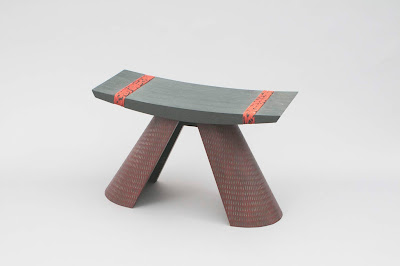
Source Bench by Douglas Finkel

The Georgia Museum of Art has impressive holdings of 20th- and 21st-century wood art thanks to the expansive gift of Jane and Arthur Mason a few years back. Despite its wide variety of craft, the museum did not have an example from prominent artist Douglas Finkel until a recent gift by the Center for Art in Wood.

Finkel is known, in part, for a series of benches, of which he has created 42 since 1997. French designer Pierre-Emile Legrain (1889–1929), who introduced these African forms to Western culture in the 1920s, is a noted influence of Finkel. According to the artist, “[Source bench’s] form and surface detail are inspired by Japanese architecture and, in particular, Samurai helmets.” The example recently added to the collection is an exemplary expression of this series. The recently acquired work has legs that are painted and carved, with a wire-brushed, painted and inlayed seat with kente cloth. Finkel has been both a woodworking artist and teacher for the past 21 years, and his work can be found in a number of collections, including the Renwick Gallery of the Smithsonian
American Art Museum.

We sincerely thank our friends at the Center for Art in Wood as well as the original donors, Bruce and Marina Kaiser, for this gift. It serves as a wonderful addition to our decorative arts holdings, filling an important gap in our collection.

--
Dale Couch
Curator of Decorative Arts,
Henry D. Green Center for the Study of the Decorative Arts

Thursday, February 08, 2018

Ninth Henry D. Green Symposium Illustrates the Value of an Expert

Robert Leath (second from left) receives the Henry D. Green Award for lifetime achievement in the decorative arts

If you need to know the value of an object, then you ask an expert. Janine E. Skerry can tell you the value of silver in the early American South. Alexandra Kirtley knows the price paid for porcelain in Philadelphia during the Revolutionary Era. And Luke Zipp could give you some advice on Savannah River Valley pottery in the Antebellum South. But how does one find out the value of an expert?

Simple, monetary measurements do not result in an accurate appraisal of worn hands and trained eyes. The reward of long nights consumed in research may not be silver and gold, but hard-earned conclusions after years of patient scholarship. Individuals who dedicate their time and energy to knowledge and then choose to share their knowledge are truly priceless.

Many of these such individuals, including Skerry, Kirtley and Zipp, found their way to the ninth Henry D. Green Symposium of the Decorative Arts, hosted by the Georgia Museum of Art this past weekend at the Classic Center. The event kicked off with a keynote lecture from Peter M. Kenny, titled "You Must Not Get Your Furniture Here . . . Get What You Want from N. York in the Spring." Scholars came from universities and museums all over the South to share their expertise, with novices and students welcomed at the event as well.

Ashley Callahan, Annelies Mondi, and Mary Pearse, curators of "Crafting History: Textiles, Metals and Ceramics at the University of Georgia"

This year, the theme of the symposium was “Belonging: Georgia and Region in the National Fabric.” The theme celebrated how research in the decorative arts weaves together scholars from diverse regional fields into one community. From Georgian rifles to Russian treasures, each scholar brings a unique perspective to the table. This interesting mix produced rich and profitable conversations all weekend long. Robert Leath, chief curator of the Museum of Early Southern Decorative Arts, received the Henry D. Green Award for lifetime achievement in the decorative arts on Thursday evening, while 90 Carlton: Winter hosted over 500 individuals from students to field experts back at the museum on the same night.


Joseph Litts, a curatorial intern and Beard scholar at the museum, said about the weekend, “Seeing Georgia so well represented in the talks was particularly meaningful for me, as was noting the various—and frequently surprising—ways in which Georgia and Georgians have been intrinsically involved with decorative arts, as makers, consumers, and scholars.”

We would like to thank the Forward Arts Foundation, Georgia Humanities and all of our sponsors for helping make this hugely successful weekend possible.

-
McKenzie Peterson
Intern, Department of Communications

Thursday, December 07, 2017

"Artful Instruments": Taking a Look at 19th-Century Weaponry Made in Georgia

Henning D. Murden, longrifle, 19th century. Walnut and silver, 52 inches long. Georgia Department of Natural Resources, A.H. Stephens State Park.

With guns dominating the news cycle, it may seem odd for an art museum to present an exhibition focused on them, but the Georgia Museum of Art at the University of Georgia is presenting the exhibition “Artful Instruments: Georgia Gunsmiths and Their Craft” through February 25. Co-organized by the museum’s curator of decorative arts, Dale Couch, and guest curator Sam Thomas, of the T.R.R. Cobb House, in Athens, the exhibition includes 18 19th-century longrifles as well as two pistols, powder horns and a miniature cannon on loan from private and public lenders.

Decorative arts, as opposed to traditional fine arts like painting and sculpture, focus on functional objects. Most often, they include furniture, silver, pottery and the like, which range from the plain versions of these items that would have been found in a yeoman farmer’s home to highly refined and decorated versions from the wealthiest estates. It may seem strange to include weaponry in this category, but early gunsmithing incorporated many crafts, including silversmithing and casting as well as woodworking.

Less prosperous than its neighbor states immediately to the North, Georgia produced decorative arts that have historically been overlooked. Couch points out that these rifles represent “the quintessence of craft in 19th-century Georgia” and says that “the objects in this exhibition are some of the finest artistic achievements in the state at the time.” The museum’s Henry D. Green Center for the Study of the Decorative Arts attempts to shed light on Georgia craft, particularly items that have received less attention.

Henning D. Murden, powder horn, ca. 1860. Inscribed M or W. Horn, unidentified ring-porous hardwood, steel, and replacement rawhide strap, 9 inches long. Collection of Mr. and Mrs. James D. Fluker Jr.   
Thomas points out that, in 1979, one of the Foxfire publications wrote, “These finest pieces work as intricately as Swiss watches, are as rugged and durable as Rolls-Royces, and are comparable artistically to fine paintings, music, or sculpture. Interestingly, they have the additional dimension that comes from their being, almost paradoxically, instruments of death—the tools by which enemies were slain, the frontier was conquered and tamed, and the table was filled with game. The fascination they hold for us is undeniable.”

Nearly 40 years later, that phrasing may now seem insensitive, but the longrifle remains a uniquely American art form. Developed in the early 18th century, it was more accurate than a musket but slower to load, and the rifles in this exhibition predate technological advances that led to quicker loading firearms. Its role in key battles in the American revolution and its association with the frontier have led to considerable mythology surrounding it, including James Fenimore Cooper’s novel “The Last of the Mohicans,” which features a character nicknamed “longrifle.”

W.T. Fluker, miniature cannon, ca. 1877. Iron and wood, approx. 10 x 21 x 11 1/2 inches. Collection of Mr. and Mrs. James D. Fluker Jr.    
Although they began as more purely functional objects, the human impulse for decoration prevailed, and the rifles on display in this exhibition feature elaborate inlay in brass and silver. Gunsmiths engraved patchboxes, trigger guards and other areas with scrollwork that often served as a kind of signature.

Thomas writes, “The history of firearms is full of examples of invention and evolution, but no gun bridges the worlds of history, technology and art like the American longrifle. Nowadays it is rare to encounter an original longrifle outside of private collections which makes it all the more important to document the ones in small museums or sitting in barns and attics.”

This exhibition is sponsored by the Community Foundation for Northern Virginia/the MOTSTA Fund, the Watson-Brown Foundation, the W. Newton Morris Charitable Foundation and the Friends of the Georgia Museum of Art. It is accompanied by a fully illustrated catalogue published by the museum that will be available for sale through the Museum Shop around January 20.

Programs related to the exhibition include 90 Carlton: Winter, the museum’s quarterly reception (free for members of the Friends of the Georgia Museum of Art, $5 non-members) on February 1 at 5:30 p.m. (the exhibition opens to the general public the following day), and a public tour with Thomas on January 24 at 2 p.m.

Thursday, November 16, 2017

Former Intern Daniel Chamberlin Is Making a Career in Museums

Daniel Chamberlin giving a tour at the Owens-Thomas House, Savannah.

Daniel Chamberlin was a volunteer intern at the Georgia Museum of Art from 2012 to 2014. He worked on numerous projects while here, including with Dale Couch, curator of decorative arts, and with the preparators, helping to mount exhibitions including "Rugs of the Caucasus." For that exhibition, he also wrote materials for its catalogue. We've followed his museum travels since he left here and been proud to see him working first at Hay House, Georgia Trust for Historic Preservation, in Macon, where he was a museum interpreter, and now in a similar role at the Owens-Thomas House and Telfair Academy, part of the Telfair Museums in Savannah. We asked if he would write something for us on his experience here, and he was kind enough to oblige.

During my time as an intern at the Georgia Museum of Art I was exposed to so many great things I have taken with me into other jobs since that time. Working with Dale Couch as a curatorial intern was one of the most rewarding experiences I have ever had, and he continues to be a mentor to me today. His wealth of knowledge combined with the resources available at the Georgia Museum of Art were invaluable. I not only learned a great deal about object analysis, best museum practices and research methods; but was exposed to both public and private collections giving me innumerable learning opportunities. He introduced me to many other museum professionals within the field, and I continue to maintain those connections today. Through those I have been able to further my own education and career path.
Unlike many student interns, I completed two consecutive internships, and stayed for a second year to work within the preparators' department. The skills I gained during my time working with Todd Rivers and Larry Forte have also proven to be of great worth — from exhibit design to ​various construction methods. Given the chance to design and execute a temporary exhibition, I was able to work directly with curatorial and preparation staff members simultaneously, which gave me such an in-depth and holistic experience. 
All of this has carried me through much of the work I have done since that time. Currently employed by the Telfair Museums in Savannah, Georgia, I am still using those skill sets and knowledge I gleaned within the collections and galleries of the Georgia Museum of Art. I would highly recommend these intern programs to anyone who is interested in pursuing a career in museum work on any level. 
To learn more about internship opportunities at the museum, which are rich in experiential learning, visit our website here

Thursday, October 05, 2017

The Art of Giving: Beard Scholars at the Georgia Museum of Art

(left to right) Joseph Litts, Linda Beard, Victoria Ramsay and Larry Beard

The stereotype of southerners is that they move, think and speak slowly, but people who think that haven’t met Dale Couch. Come to the offices of the Georgia Museum of Art any day and you will see Couch, the museum’s curator of decorative arts, practically running around the museum, talking a mile a minute. Recently, Couch has been accompanied by two people just as lively as he is: the museum’s new Beard Scholars, Joseph Litts and Victoria Ramsay.

Earlier this year, Drs. Linda and Larry Beard—major supporters of the Georgia Museum of Art and its decorative arts initiative—made a commitment to establish this scholarship as a paid position for undergraduate interns in the museum’s Henry D. Green Center for the Study of the Decorative Arts. Linda Beard is a member of the museum’s Decorative Arts Advisory Committee and the Executive Committee of its Board of Advisors. She is also a distinguished collector and connoisseur of Belleek porcelain, and works from her collection are on long-term loan to the museum, where they constitute a popular display. Professor Larry Beard is also a scholar of the arts and is an able associate in the Beards’ quest to improve the learning experience in the decorative arts.

Beard Scholar Joseph Litts discusses a chair
Litts and Ramsay are the first students to receive the scholarship, which runs through the 2017–18 academic year. Both of them have demonstrated a strong commitment to the study of the decorative arts. The field focuses on useful objects (furniture, silver, ceramics, textiles et al.) that transcend their function through design, craft, ornament or inherent beauty.

The Beards said, “It is an honor and privilege for us to encourage the work and research of outstanding students in the decorative arts. These scholars represent the absolute best of those students who are passionate about the arts. Their work and aspirations bode well for the future of the decorative arts.”

Litts previously studied history as an undergraduate student at Clemson University. He interned at the museum in the summer of 2015. In the summer of 2016, he attended the summer institute at the Museum of Early Southern Decorative Arts, in Winston-Salem, North Carolina, an in-depth, practice-based program that focuses on the decorative arts and material culture of the early American South. Ramsay is an undergraduate UGA student majoring in English and history, with an emphasis on British and Irish studies. She attended the University of Georgia at Oxford program, at Trinity College, for 6 weeks this summer studying English literature. 

Beard Scholar Victoria Ramsay shows
Linda and Larry Beard some of her work

As Beard Scholars, Litts and Ramsay are tasked with a variety of responsibilities, from visiting donors to digging through antiques shops to writing research articles. The program fosters a more intensely educational, hands-on experience than they would get in a classroom alone. 

When asked what he hopes they will gain from this position, Couch says, “I hope they realize that following a passionate interest gives fulfillment to life. This program exists first to educate and enrich lives of students, not solely to train future curators. I would be delighted to have my interns go on to be lawyers, professors, stay-at-home mothers and fathers, businesspeople. Good design gives rise to conscious living.”

Litts and Ramsay believe that the scholarship will benefit them by providing an enriching educational experience that allows them to be fully invested in their work. Ramsay said, “This internship has made me realize things about myself that I wouldn’t have
known before. I have found what I am truly passionate about and what I want
to work toward in the future.” Both Beard Scholars have decided to attend graduate school. Litts will be studying art history and Ramsay will study English with the intent of becoming either a professor or an archivist. They advise anyone who has interest in the program and the decorative arts to apply for the Beard Scholarship.

The importance of the Beard Scholarship cannot be emphasized enough. Director of development Heather Malcom said, “The Beard Scholarship establishes the first paid internship position for undergraduates at the museum and serves as a model for programs of its kind that help remove barriers and open doors for talented students. It provides opportunities for students to do original research on material culture that helps tell stories about our shared history and environment. And it will go a long way toward creating and diversifying the next generation of scholars in the decorative arts.”

Information about how to apply for this scholarship and other experiential-learning-focused internships at the museum is available at georgiamuseum.org/learn/internships.

Stephanie Motter
Intern, Department of Communications