Showing posts with label outreach. Show all posts

Thursday, June 29, 2017

Athens Middle-Schoolers Interpret Art through Hip-Hop and More

If you visited the Georgia Museum of Art at the University of Georgia on a Tuesday afternoon this June, you might have heard someone rapping about women’s empowerment. The museum’s lobby can be quiet during the summer, when UGA’s enrollment is much lower than during the spring and fall semesters, but the middle-schoolers from Camp DIVE have been doing their best to fill it with life and noise.

Student work produced at the museum with Camp DIVE

Camp DIVE — which stands for discover, inquire, voice, and explore — provides local, underserved youth in Athens with a month-long free learning experience. This partnership among the Clarke County School District, the University of Georgia College of Education and the Athens-Clarke County community is meant to combat summer slide, or the tendency for students to lose progress made during the previous school year. Camp DIVE not only serves Athens youth, but also allows UGA students to engage with the community and gain hands-on experience working with children.

 The museum’s partnership with Camp DIVE has focused on art and poetry. About two dozen middle-school students enrolled in the camp visit the museum every Tuesday to make connections between visual art and creating their own literature. Associate professor Ruth Harman and assistant professor Kevin Burke, both in the UGA College of Education’s department of language and literacy education, have been working with museum educators and local poets to create an enriching experience for their young students. Burke’s graduate students in language and literacy have been working directly with the campers.

Student work produced at the museum with Camp DIVE


As the students and their instructors arrive at the museum, the lobby fills with happy voices. Half of them head to the galleries to draw inspiration from the works of art on display there while the others work on their projects. One group of students has created a rap about women and empowerment; another student has painted her own version of Everett Shinn’s early-20th-century painting of a ballerina.

Student work produced at the museum with Camp DIVE
The museum’s curator of education, Carissa DiCindio, said, “We hope that the middle school students are inspired by the works of art and make connections to their lives through art making and poetry. We want them to feel at home in the museum.”

Mariah Parker, a graduate student in UGA’s linguistics program who both studies and performs hip hop (under the name Lingua Franca), also emphasized how important the program is with making students comfortable in the museum, saying, “This is a casual introduction to a space that can be very intimidating.”

The program is supported by the Aralee Strange Fund for Art and Poetry endowment, created by Kathy Prescott and Grady Thrasher, longtime residents of Athens who are both actively involved in their community. Most recently, they helped make the documentary film “Athens in Our Lifetimes,” which covers the city’s evolution over six decades. To honor their friend Aralee Strange, they provided the endowment to fund the Art and Poetry project to cultivate an appreciation for the arts in Athens youth.

Aralee Strange was no stranger to the arts. She was an illustrious poet, filmmaker and playwright who moved to Athens in 2007 after developing her career in New York and Cincinnati. Strange founded the monthly open poetry forum Word of Mouth, which welcomed local Athenians and strangers alike to participate in a night of poetic prose. Strange died in 2013 at the age of 69.

The idea behind the project is that its students will create poetry, performance and visual art that reflects their community and investigates connections among these art forms. It also serves as an experiential-learning initiative for UGA students, connecting them with the Athens community and letting them see how art fosters literary development and civic engagement in youth.

The campers will present and display their work at the museum tonight from 5 to 7 p.m. at a reception that is free and open to the public.

Stephanie Motter
Communications Intern

Thursday, July 21, 2016

Table No. 25: The Georgia Museum of Art at UGA’s Freshman Orientation

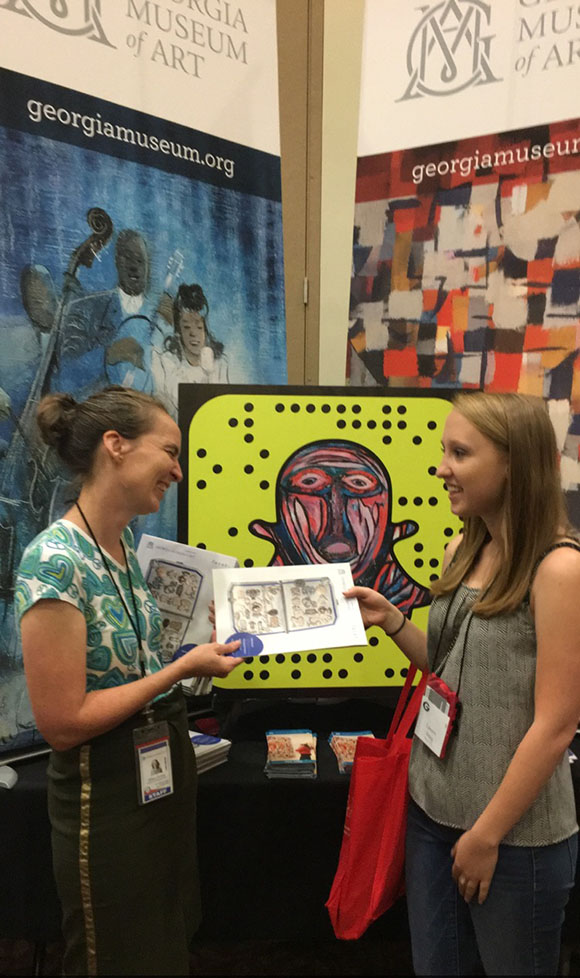
Over the summer, eager “baby dawgs” and their parents pour onto the University of Georgia campus for their first official look at the life of a college student: Freshman Orientation. Recognizable by their red lanyards, nametags and red tote bags, the soon-to-be UGA students walk into the Grand Hall at the Tate Student Center to learn about all of the new opportunities the university has to offer. 

UGA Orientation with student
Lawson Boling (right)
Bright and early twice a week, the museum’s communications team and I head to the Tate Student Center for UGA Freshman Orientation. We grab our cart of supplies from a meeting room, ride the elevator to the fifth floor and make our way to table number 25 in the Grand Hall. Ten minutes later, the Georgia Museum of Art table is ready to go.

We stand at attention and either greet students or let them approach us. Accompanying our table are two large banners, a large display of the museum’s Snapcode for Snapchat and an abundance of brochures and publications. When one of us catches the eye of a parent or student, a simple “Hi, how are you doing?” draws them to the table.

Once I have sparked their interest, I hand them a museum brochure or a copy of Facet, our quarterly publication, then give them a quick rundown about the location, current and upcoming exhibitions, the opportunities for students and the fact that entry to the museum is free (which tends to be the most surprising part).

My favorite, yet most challenging, part of this experience is to call out “Follow us on Snapchat!” to the students passing by the museum’s orientation table. I will either get a laugh and some sincere interest, or be blatantly ignored. The museum team gets a good kick out of it, but it works.

All in all, being present at UGA’s Freshman Orientation has been great. If the new freshmen and their parents did not know the museum existed before, they do now. We have met many parents at orientation with interest in our collection, exhibitions, opportunities for their child or children and questions about that strange poster in the middle of our table. The incoming students love the Snapchat poster and show enthusiasm for opportunities for student involvement at the museum.

Morgan Tickerhoof
Public Relations Intern

Thursday, June 09, 2016

The Georgia Museum of Art and Museums for All

On April 14, 2016, the Georgia Museum of Art at the University of Georgia became the first museum in the state to commit officially to serving low-income families through the Museums for All program. Organized by the Association of Children’s Museums and the Institute of Museum and Library Services (IMLS), Museums for All encourages families of all backgrounds to visit museums regularly and build lifelong museum habits. A study featured in the New York Times concluded that “visiting an art museum exposes students to a diversity of ideas that challenge them with different perspectives on the human condition.” The study showed that students who visited Crystal Bridges Museum of American Art on school tours “demonstrated stronger critical thinking skills, displayed higher levels of social tolerance, exhibited greater historical empathy and developed a taste for art museums and cultural institutions.” In addition, “most of the benefits … observed are significantly larger for minority students, low-income students and students from rural schools.”

Young visitors examine a rare Japanese
three-paneled screen at the Georgia Museum of Art.
With Museums for All, museums with an admission charge offer reduced or free admission to visitors who present an Electronic Benefits Transfer (EBT) card. The Georgia Museum of Art is pleased to join this group of institutions. As part of the state’s flagship land-grant university, the museum has a strong commitment to service and outreach and already offers free admission to all visitors, thereby removing the need to present a card or an ID. About 15 percent of families living in Athens-Clarke County have incomes below the poverty line. By participating in Museums for All, the museum hopes to make low-income visitors aware of this fact and further broaden and diversify its audience.

“I’m pleased to welcome the Georgia Museum of Art into the family of Museums for All participants,” said IMLS director Dr. Kathryn K. Matthew. “As the first museum in Georgia to sign on to the program, the Georgia Museum of Art is leading by example. Through its community outreach and Museums for All participation, the museum will establish its credentials as a true community cornerstone that is accessible to all.”

A full list of participating institutions is available at http://childrensmuseums.org/participating-museums.

For museum hours, location and directions, visit our website.

Hillary Brown
Director of Communications


Thursday, March 10, 2016

Art in the Stacks: "One Hundred American Paintings" Now at Georgia Public Libraries

"One Hundred American Paintings," Georgia
Museum of Art, 2011.
A project in the works for many years, "One Hundred American Paintings" by our former curator of American Art, Paul Manoguerra, is a full-color catalogue of a selection of 100 important works of art from the Georgia Museum of Art’s permanent collection. Published to coincide with the museum’s grand reopening in January 2011 after a 30,000-square-foot expansion, the publication is both a tribute to Alfred Heber Holbrook, the museum’s founder, and a record of his legacy, which began in 1945 when he gave 100 works of American art to the people of Georgia through its flagship university. His gift formed the foundation of the museum’s current collection of more than 10,000 art objects.

As the official state museum of art, outreach programs are an important part of the Georgia Museum of Art. The state of Georgia is made up of 159 counties, some of which are considered to be rural and geographically isolated. Due to our location in North Georgia, some state residents would have to drive more than 250 miles to visit the museum in person. As part of our mission to support and promote teaching, research and service, we developed a program to distribute copies of “One Hundred American Paintings” at no charge to every public library system in Georgia and also surveyed librarians for future planning. So far, this program has helped us reach more residents statewide without requiring them to come to us and we hope that this program will aid public libraries and their patrons in enjoying and learning more about the visual arts. 

“One Hundred American Paintings” was supported by the National Endowment for the Arts and its distribution was funded by the Georgia Council for the Arts and the President’s Venture Fund through the generous gifts of the University of Georgia Partners. Purchase your own copy, with the option of cloth-bound or softcover, by phone at 706.542.0450 or online at http://georgiamuseum.org/learn/publications/one-hundred-american-paintings.

To learn more about our educational and outreach programs or inquire on how you can bring our programs to your local community in Georgia, click here.

Stella Tran
Editor, Department of Communications

Thursday, April 09, 2009

Young Dawgs Program


Sometimes, it's not always clear how the museum participates in community outreach through the University of Georgia, as opposed to its outreach programs that focus on kids and seniors, which have a more state-wide bent. We were recently encouraged to participate in the Young Dawgs program, which provides internships to high school students as a way of preparing them for the workplace. The museum has always had a strong internship program for undergraduates and the occasional graduate student, but this is our first experience with younger kids volunteering, and they've been great. We had the two pictured above, Deylah McCarty (left) and Victoria Slaboda (right) interview one another about the experience, and what they came up with follows.

Victoria Interviews Deylah

Deylah McCarty is a 17-year-old senior at Classic City High School PLC.

Q. What do you want to be when you grow up?

A. An artist and a musician. I would like to open up my own shop to sell my art and be in a band.

Q. What attracted you to interning at GMOA?

A. Well, the art of course. I was also interested in learning how a museum works though. Seeing the business side of the art world. The opportunity to gain more computer experience was an attractive asset to me.

Q. What is the most valuable thing you have gained from interning at GMOA?

A. I learned how to make graphics for the website, which involved learning how to use new computer programs, and also just having work experience has been helpful.

Q. What’s your favorite thing that you have done at GMOA so far?

A. The “Art Of” graphic I made that got put on the front page of the website. I’m really proud of it.

Q. What’s the most interesting part about your internship?

A. Meeting new people, gaining new resources, especially people resources.

Q. You’re working in Public Relations, how do you think what you’ve learned there will be beneficial to your future career goals?

A. I’ve learned that being able to handle the public is really important, no matter what department you work in. Social skills are extremely important to business.

Deylah Interviews Victoria

Victoria Slaboda is an 18-year-old senior at Classic City High School PLC.

Q: As you’ve probably been asked a million times, what do you want to be when you grow up?

A: I plan to be a curator of the European arts.

Q: Why did you choose to intern at GMOA?

A: I love art! I thought it would be a good opportunity to see how a museum is run, and it’s a good link to learn more about being a curator.

Q: So far, what is the most valuable thing you’ve learned there?

A: How to resize photos for the website.

Q: What has been your favorite task so far?

A: I took pictures at the GMOA On the Move Campaign, which got blown up really big and hung up at the kick-off party, and I made a giant red arrow, which was also hung up at the party! For some reason I’m really proud of that arrow…

Q: What’s the most interesting event that has happened?

A: The GMOA kick-off party was very fun, with dancing and music, and I got to meet more of the GMOA employees and make more connections.

Q: You intern in the Public Relations department. How has this been beneficial in regards to your career goals?

A: Well, a curator works with the Public Relations department often, and when you work in a place that is essentially for the public (like a museum), it’s important to have a good relationship with the public. Social skills are always valuable, and business social skills will be good to have as well.
The museum plans to continue participating in the Young Dawgs program, and we'll have a new student from it this summer. Our interactions with our interns are always as educational for us as for them, and, honestly, we wouldn't get nearly as much done without them. Thanks, Victoria and Deylah, for being great kids and a big help!