Showing posts with label Jerry Siegel. Show all posts

Thursday, September 14, 2017

Featured Publication: "Black Belt Color: Photographs by Jerry Siegel"

"Black Belt Color: Photographs by Jerry Siegel" is one of the newest books the museum has published. It accompanies a traveling exhibition of the same name for which we're trying to find venues (please let us know if you're interested in seeing the prospectus). The book focuses on the photography of Selma, Alabama, native Jerry Siegel, who has lived and worked in Atlanta for years but keeps returning to the place where he was born to document its places and people.

A couple of weeks ago, the Bitter Southerner and ArtsATL partnered to produce two great pieces on the book and on Siegel's work. The photo essay at the Bitter Southerner can be found here, if you missed it. Stephanie Dowda interviewed Siegel for ArtsATL here.

Our curator of American art Sarah Kate Gillespie selected the images for "Black Belt Color" and worked on creating some very deliberate pairings and groupings in the book, highlighting the narratives inherent in the images. Our director, William U. Eiland, who is from Sprott, Alabama, not far from Selma, wrote a fantastic essay for it, contextualizing Siegel's work. It also includes a transcription of a long interview with Siegel and a brief essay by the late Mary Ward Brown, a famed Alabama author and a close friend of Siegel's.
Watch the video below for another brief chat with Jerry Siegel, a look inside the book and some close-ups of some of the images it includes. Communications intern Jinsui Li created the video, and she did a great job.


"Black Belt Color: Photographs by Jerry Siegel" includes more than 60 color photographs, including seven fold-out panoramas. Hardcover; 123 pp.; $30 ISBN: 978-1-946657-00-8 You can order it by calling 706.542.0450 or online at the Museum Shop via UGA Marketplace and Amazon.com.

Thursday, June 22, 2017

From the Publications Office: Art of the Press Check

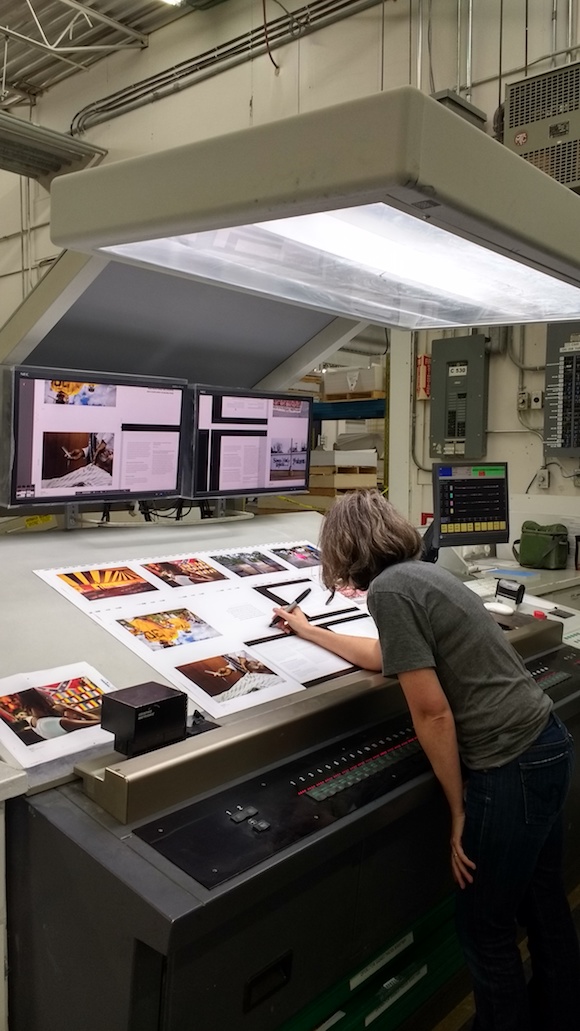
Spreads from "Black Belt Color: Photographs by Jerry Siegel" at press check with Friesens, Canada.

In an ever more digital age, fewer and fewer people understand the printing process and how, exactly, it works. Press checks — where a representative from a publisher tweaks and approves every page in a book coming off a printing press — are less common than they used to be, but for color-critical publications (like exhibition catalogues) they can make a big difference. I traveled all the way up to Altona, Manitoba, Canada, recently to do a press check at Friesens, a printer that the museum has used for years. Friesens prints a lot of art books, but the Georgia Museum of Art’s latest publication, “Black Belt Color: Photographs by Jerry Siegel,” needed some special care.


Most people don’t realize that, even when you get proofs from a printer, those pages aren’t always produced on the same machine that will print the final job. Soft proofing, or proofing on a computer screen only, isn’t recommended for color-critical publications. “Wet proofs,” which do come off the actual press, are less common and much more expensive. Even then, printing is as much an art as a science. Friesens has a color profile that graphic designers apply both to individual images and to the final files for a book, which, in theory, tells the computers that run the press exactly how to match the intended color. But specific papers, even white ones, can have a slightly different tone—one that’s a little more blue or more red—and those tiny differences can affect the final result. The Epson proofs that the publisher typically receives to check color try to match the effects of paper tone, but they’re run on what is essentially a big, fancy inkjet printer.

The big four-color press, on the other hand, stretches the length of a room, with, in the simplest cases, one plate each for cyan, magenta, yellow and black ink (watch this one-minute video to see how it works). Together, those four colors can produce a big section of the visible spectrum, but they can’t capture everything, and sometimes tinkering is necessary on press to match the Epson proofs to the client’s satisfaction.


It’s more complicated than just getting a single image right, though. Books are printed in signatures, or chunks of pages divisible by four, and “Black Belt Color: Photographs by Jerry Siegel” was printed in 16-page signatures, meaning usually groups of 16 images at a time. The larger the signature, the more financially efficient a book can be to print because it means fewer sheets run through the press.

Cyan, magenta, yellow and black can be tweaked from levels of 0 to 100 in columns that run the vertical length of the large sheet of paper. At the same time, too much ink on the page will look muddy, not accurate and it won’t dry, either. If one image out of 16 has sections that seem to have too much red, you can’t just reduce the magenta for the entire press sheet, or other images may be negatively affected. Getting every image on the sheet to reproduce as accurately as possible can require creative thinking as well as a good eye for color and a knowledge of how the process works.

Hillary Brown
Director of Communications

Monday, August 10, 2009

Art Around Georgia


Our friend the photographer Jerry Siegel sent along a press release from the Columbus Museum regarding the exhibition "Now and Then: Snapshots of the South." The exhibition juxtaposes historic and contemporary images addressing a variety of enduring aspects of everyday life in the South, including images that speak to Southerners' longstanding connections with the land and its history, religion, and the celebration of the eccentric, and evokes a unique sense of place as projected through the lens of cameras both past and present. A diverse selection of historic images will originate from the collections of the Eufaula Athenaeum, an impressive private archive of materials assembled by Eufaula native A.S. Williams. One of the largest and most important such collections in the South, the Athenaeum's holdings include thousands of items documenting a broad spectrum of people, places and events in Southern history. Contemporary images will be provided by professional photographer Jerry Siegel. An Alabama native, Siegel is currently one of the Southeast's leading photographers. He has produced several series of fine art photography that reflect his interest in the rural South's culture and landscape. While many of the images in this exhibition are especially influenced by his upbringing in central Alabama's Black Belt region, Siegel shot images for this project during his travels throughout the South. "Now and Then" opened Aug. 1 and will run through Jan. 31, 2010.

This Thursday, Aug. 13, at 6 p.m., the Columbus Museum will feature a symposium that addresses various perspectives on southern life and culture as represented through the art of photography. The guest speakers will include photographer Jerry Siegel; Dr. James C. Cobb, Spaulding Distinguished Scholar from the University of Georgia; and Stephen Rowe, from the Eufaula Athenaeum. The symposium is free and open to the public and should make for an interesting evening. We know that both Jerry and Jim Cobb have tons of great stories.