Showing posts with label publications. Show all posts

Thursday, September 14, 2017

Featured Publication: "Black Belt Color: Photographs by Jerry Siegel"

"Black Belt Color: Photographs by Jerry Siegel" is one of the newest books the museum has published. It accompanies a traveling exhibition of the same name for which we're trying to find venues (please let us know if you're interested in seeing the prospectus). The book focuses on the photography of Selma, Alabama, native Jerry Siegel, who has lived and worked in Atlanta for years but keeps returning to the place where he was born to document its places and people.

A couple of weeks ago, the Bitter Southerner and ArtsATL partnered to produce two great pieces on the book and on Siegel's work. The photo essay at the Bitter Southerner can be found here, if you missed it. Stephanie Dowda interviewed Siegel for ArtsATL here.

Our curator of American art Sarah Kate Gillespie selected the images for "Black Belt Color" and worked on creating some very deliberate pairings and groupings in the book, highlighting the narratives inherent in the images. Our director, William U. Eiland, who is from Sprott, Alabama, not far from Selma, wrote a fantastic essay for it, contextualizing Siegel's work. It also includes a transcription of a long interview with Siegel and a brief essay by the late Mary Ward Brown, a famed Alabama author and a close friend of Siegel's.
Watch the video below for another brief chat with Jerry Siegel, a look inside the book and some close-ups of some of the images it includes. Communications intern Jinsui Li created the video, and she did a great job.


"Black Belt Color: Photographs by Jerry Siegel" includes more than 60 color photographs, including seven fold-out panoramas. Hardcover; 123 pp.; $30 ISBN: 978-1-946657-00-8 You can order it by calling 706.542.0450 or online at the Museum Shop via UGA Marketplace and Amazon.com.

Thursday, August 17, 2017

From the Publications Office: Using the Study Centers


When you're reading a book, you probably don't think too much about where all the materials in it came from or how they were compiled. A large part of the process of creating something visually exciting for you to hold in your hands consists of tracking down material to illustrate the final result. Sometimes (a lot of times, in fact) that means contacting museums and other lenders to get them to supply high-resolution photographs of works of art. But what if you have a book that's mostly text? How do you give it some visual flair? A lot of that is up to the graphic designer, and the Georgia Museum of Art works with many talented freelance designers, who have won countless awards for their projects with us. In the case of "Louise Blair Daura: A Virginian in Paris" (which opens at the end of September and has a large book to accompany it), we were lucky enough to have the Pierre Daura Study Center close at hand.


The study center includes an amazing trove of material produced by both Pierre Daura and his American wife, Louise Blair Daura, the focus of this upcoming exhibition. The book will include her letters home from Paris to her family in Virginia written from 1928 to 1930, giving wonderful and witty insight on the art and social scene of the time. It also makes use of family photographs in the archive, Louise's creative projects (valentines, for example) and even passports, as in the snapshots here. We wanted some of the script font in the book to resemble Louise's actual signature, which can be small or blurry or written in an abbreviated form in the letters. A passport is a perfect place to get a nice, clear signature.


Other times, as with the image above, Louise makes reference in her letters to a drawing, so we needed to pull the actual letters and scan them to extract her sketches. Going through these pages and family photos gives one an even better feel for the daily life of these people than reading about them in a book, but we're doing our best to capture that feel for everyone who reads the final product.

The contents of the archive are listed through the Hargrett Rare Book and Manuscript Library, online. To make an appointment to use the archive, you can call the museum's main line, at 706.542.4662 or email gmoa@uga.edu.

Thursday, June 22, 2017

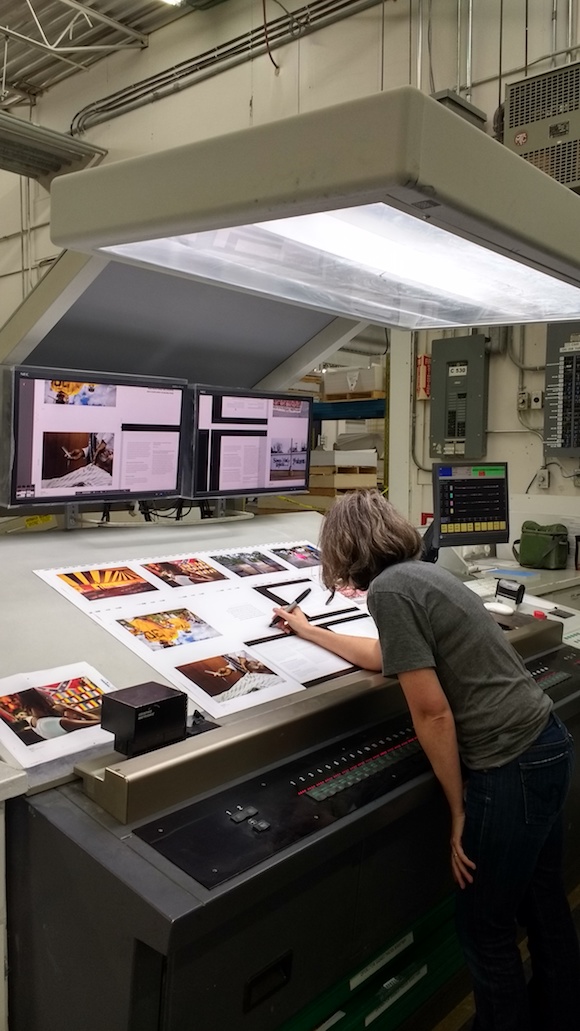
From the Publications Office: Art of the Press Check

Spreads from "Black Belt Color: Photographs by Jerry Siegel" at press check with Friesens, Canada.

In an ever more digital age, fewer and fewer people understand the printing process and how, exactly, it works. Press checks — where a representative from a publisher tweaks and approves every page in a book coming off a printing press — are less common than they used to be, but for color-critical publications (like exhibition catalogues) they can make a big difference. I traveled all the way up to Altona, Manitoba, Canada, recently to do a press check at Friesens, a printer that the museum has used for years. Friesens prints a lot of art books, but the Georgia Museum of Art’s latest publication, “Black Belt Color: Photographs by Jerry Siegel,” needed some special care.


Most people don’t realize that, even when you get proofs from a printer, those pages aren’t always produced on the same machine that will print the final job. Soft proofing, or proofing on a computer screen only, isn’t recommended for color-critical publications. “Wet proofs,” which do come off the actual press, are less common and much more expensive. Even then, printing is as much an art as a science. Friesens has a color profile that graphic designers apply both to individual images and to the final files for a book, which, in theory, tells the computers that run the press exactly how to match the intended color. But specific papers, even white ones, can have a slightly different tone—one that’s a little more blue or more red—and those tiny differences can affect the final result. The Epson proofs that the publisher typically receives to check color try to match the effects of paper tone, but they’re run on what is essentially a big, fancy inkjet printer.

The big four-color press, on the other hand, stretches the length of a room, with, in the simplest cases, one plate each for cyan, magenta, yellow and black ink (watch this one-minute video to see how it works). Together, those four colors can produce a big section of the visible spectrum, but they can’t capture everything, and sometimes tinkering is necessary on press to match the Epson proofs to the client’s satisfaction.


It’s more complicated than just getting a single image right, though. Books are printed in signatures, or chunks of pages divisible by four, and “Black Belt Color: Photographs by Jerry Siegel” was printed in 16-page signatures, meaning usually groups of 16 images at a time. The larger the signature, the more financially efficient a book can be to print because it means fewer sheets run through the press.

Cyan, magenta, yellow and black can be tweaked from levels of 0 to 100 in columns that run the vertical length of the large sheet of paper. At the same time, too much ink on the page will look muddy, not accurate and it won’t dry, either. If one image out of 16 has sections that seem to have too much red, you can’t just reduce the magenta for the entire press sheet, or other images may be negatively affected. Getting every image on the sheet to reproduce as accurately as possible can require creative thinking as well as a good eye for color and a knowledge of how the process works.

Hillary Brown
Director of Communications

Thursday, December 08, 2016

Featured Publication: "Icon of Modernism: Representing the Brooklyn Bridge, 1883–1950"

This catalogue accompanies the exhibition of the same name, on view at the Georgia Museum of Art Sept. 17 – Dec. 11, 2016. It includes essays by curator of American art Sarah Kate Gillespie on the history of the Brooklyn Bridge as a symbol of modernity and on photography of the bridge, by Janice Simon on images of the bridge in the popular press, by Meredith Ward on John Marin's renderings of the bridge and by Kimberly Orcutt on Joseph Stella's paintings of the structure. All images in the exhibition are reproduced full page in full-color and many supplementary images flesh out the discussions.
Watch the video below for a 3-minute reading from the catalogue and to preview the interior pages of the publication.


Full-color images; slipcase; two ribbon markers. Hardcover; 126 pp.; $55.00. ISBN 978-0-915977-95-6. Order through the Museum Shop at 706.542.0450 or online at (Museum Shop via UGA Marketplace) and Amazon.com.


Copyright disclaimer under Section 107 of the Copyright Act 1976: Allowance is made for "fair use" for purposes such as criticism, comment, news reporting, teaching, scholarship, and research. Fair use is a use permitted by copyright statute that might otherwise be infringing.

Monday, September 13, 2010

An Evening on William Bartram


On Friday, September 24, the Oconee Cultural Arts Foundation will host “An Evening on 18th Century Naturalist William Bartram.” This event will last from 6 to 8 p.m. and is free to the public. Two new books will be featured: “The Flower Seeker: An Epic Poem of William Bartram,” by Phillip Lee Williams, and “Bartram’s Living Legacy: The Travels and the Nature of the South,” edited by Dorinda G. Dallmeyer. Landscape artist Philip Juras provided the artwork for both books’ covers, and more of his work will be exhibited that evening in “Searching for Bartram’s Wilderness: Studies from the Field.”

Williams, Dallmeyer and Juras will all be available to speak and autograph books. For more information about this event, visit OCAF, and to learn more about the books go to http://bit.ly/bPOnBc.

The Georgia Museum of Art has its own link to William Bartram. The naturalist’s work was highlighted most recently in the museum’s publication of papers from the Fourth Henry D. Green Symposium of the Decorative Arts, “A Colorful Past,” which can be found in our online gift shop.

Tuesday, March 16, 2010

Foreword Awards

We got great news earlier today. The "Corpus of Early Italian Paintings in North American Public Collections: The South," our three-volume undertaking that has been more than 15 years in the making and was finally, finally published recently, is a finalist in Foreword magazine's Book of the Year Awards, in the art category. Other finalists include books published by the Metropolitan Museum of Art and Hudson Hills Press. The gold, silver and bronze awards won't be announced until May 25, but it's true that, in this case, it really is an honor just to make the finals, especially when more than 1400 books were submitted for the prizes, but it's a testament to the work of many, not least author Perri Lee Roberts, designer Carol Haralson and project editor Cynthia Payne, all of whom spent countless hours poring over its pages. To purchase a copy of the "Corpus" from the Museum Shop, click here, and cross your fingers that we win!

Monday, February 01, 2010

Los Angeles County Museum of Art's new Reading Room


The Los Angeles County Museum of Art has created a new site, called the Reading Room, to give the public access to rare and out-of-print art publications, according to an article in the Los Angeles Times.

Ten rare art catalogues are currently available on the site, such as "Six More," the catalog for LACMA’s 1963 exhibition on L.A. pop; "Billy Al Bengston," a rare 1968 monograph; and the surveys "Late Fifties at the Ferus" (1968). LACMA plans to reprint more of its publications online as well as produce books exclusively for online publication.

In addition to reading the publications, visitors to this new Web site will be able to perform text searches and download the PDF versions of the volumes, but the content is still limited to noncommercial personal or educational uses.

Monday, October 05, 2009

The NYTimes on Authenticity: Frida Kahlo


Frida Kahlo scholars and collectors around the world have jumped into debate right after the publication of a new art book containing never-before-seen Kahlo paintings and diaries. Some Kahlo experts-- most notably relatives of Kahlo’s-- have arrived on the stage to reverse the publishing process as they believe the pieces are counterfeit.
Carlos Noyola, the art and antiques dealer who acquired the collection, says he has proved that it is. There are 1,200 items, worth a fortune if they were Kahlo’s, everything from stuffed hummingbirds, like the one she wears as a necklace in a 1940 self-portrait, to a small notebook of private thoughts and sexually explicit drawings

The Princeton Architectural Press, which published and distributed the art book, will continue to sell it, as the objects are still under study.
While such discrepancies do not prove anything, they do raise significant questions. But Mr. Noyola wonders why the experts dismiss the opinions of those he consulted. He said that he had become the target of a group of powerful interests who wanted to keep their monopoly over Kahlo’s name and the right to study, sell and show her works. “They are slandering us,” he said. “They are terrified that this book will validate the work.”


Click here to access the New York Times article

Thursday, July 30, 2009

Creating a Library


If you read Alexis Richardson's blog posts this summer, you know that she mostly worked on scanning publications for us. Well, her efforts are starting to see fruit. If you visit our library on Issuu, you'll see that we've compiled some of the pages she scanned into several pdf files and uploaded them for reading, searching, embedding and more. Past brochures on Rembrandt, French floral drawings, the sculptures of Andrew T. Crawford and more are up, and we'll continue to add more as we finalize scans. We think it's going to be a great resource for scholarship and publicity.

Monday, July 13, 2009

Lord Love You opening reception invitations


These went out in the mail Friday, and you should be getting yours any day now, but in case you didn't, or you're more of a blog reader than a USPS person, here's the invitation to the opening reception for Lord Love You: Works by R.A. Miller from the Mullis Collection, which opens at the Lyndon House Arts Center in August (click on either of the images to enlarge). The exhibition actually opens on August 8, but the reception will be August 15 from 6 to 8 p.m. and is free and open to the public. We also just sent corrected proofs for the book back to the printer, so that should be delivered (cross your fingers) by August 8. The book, which is hardback, will retail for $25 and is, we believe, the first devoted entirely to Miller's work.

Tuesday, July 07, 2009

Digital Books


This article by Lee Shearer in the Athens Banner-Herald on UGA Press's move toward some digital printing (specifically on-demand printing of books less in demand) reminded us of a couple of related links, neither of which at first would seem to be connected. Art Daily published an article today about the British Library's digitization of the Codex Sinaiticus, the world's oldest surviving Christian bible, which dates from the 4th century. Its physical pages are scattered in the British Library, the Leipzig University Library, the Monastery of St Catherine (Mount Sinai, Egypt) and the National Library of Russia (St Petersburg), so the website the library has created is the only way to see all of them at once, let alone flip through the book. Similarly, the Walters Art Museum in Baltimore posted three high-resolution digitized Korans on Issuu (a two-page spread from one appears above).

Both these projects and the efforts of UGA Press allow us to think about the spread of works of art and books in the digital age. It's true, there's nothing like holding a physical book in your hand, but there are other ways in which digital versions are an improvement, such as the fact that they're vastly easier to search. We don't plan on relying on digital printing or digital distribution any time in the near future (color reproduction isn't there yet for the former, and the latter often doesn't have color at all, as in the case of the Kindle), but we are working on digitizing our entire collection of brochures and smaller booklets, to cut down on the storage space needed and to promote scholarship. Currently, if someone's writing a book on, for example, Earl McCutcheon, and sees that we had an exhibition of his work with a large brochure, it's difficult to go find that brochure, expensive to mail it and hard to find the space to store it. When we're finished, we should be able just to burn a CD or, better still, send a link, plus these publications will be searchable. Hooray for the future!

Monday, June 08, 2009

GMOA in the News

We've gotten a good amount of press over the past few days.

The Athens Banner-Herald ran a nice profile of new curator Lynn Boland on Sunday, which contains some details his fellow staff members probably didn't know, such as the fact that he owns a piece by Daniel Johnston.

Anyway, that profile was picked up by a good number of folks on Twitter, as was the release we sent out about the publication of The Historian's Eye: Essays on Italian Art in Honor of Andrew Ladis, which the Lamar Dodd School of Art publicized on their website (Ladis taught there for many years, and co-editor Shelley E. Zuraw continues to). The books arrive in Athens today after a long journey across the ocean and will be available to purchase within a day or two from our shop.

Monday, May 18, 2009

IPPY Update


Following up on the museum's status as a semifinalist in the Independent Publisher Book Awards for The American Scene on Paper: Prints and Drawings from the Schoen Collection, it turns out we've won a silver medal in the category of "Fine Arts." Here's the article at the IPPY website. We are incredibly proud of all the contributors to this book, from authors to sponsors to designer and printer, and we could not be happier to have received this recognition.

Friday, April 17, 2009

New Discoveries in Georgia Painted Furniture


This publication, which accompanied the exhibition of the same name in January 2008, was so popular that we've given away almost every copy we had printed. We don't doubt that we'll keep getting requests for it, so we've archived the whole thing on Issuu, embedded above. It's not quite the same as with the beautiful paper we printed it on, but it's in the ballpark.

Wednesday, April 08, 2009

Devotional Prints revisited

As promised, here's the upload to Issuu of the booklet we won our honorable mention for from AAM. Flip through it and enjoy.

Tuesday, April 07, 2009

Design Award


We got some great news yesterday. The American Association of Museums (AAM) runs a publications design competition every year, and while we always enter, we rarely come away with anything (2004 honorable mentions for Enchanting Modern: Ilonka Karasz and Armin Landeck and another in 2001 for Essence of Place, most recently). This year, however, we've snagged an honorable mention in the category of "Supplementary materials" (e.g., brochures) for our booklet that accompanied the exhibition Devotional Prints from Germany and the Netherlands, the cover for which is pictured above. AAM hasn't yet posted the full list of winners, but will soon. We thank Giancarlo Fiorenza, our former Pierre Daura Curator of European Art, for organizing the exhibition and writing wonderful text; Scott Sosebee, our graphic designer (and a former Athenian), for doing such a fabulous job, especially with that cover, which really captured the intimacy of the show; and University Printing, for making our vision reality. We don't have many copies left of the booklet, but if we can get a pdf up on Issuu, we'll post it here.

Friday, April 03, 2009

Andrew Ladis's book


As we've just returned the proof for the festschrift in honor of our dear friend and patron, the late Andrew Ladis (The Historian's Eye, which should arrive at the museum for sale June-ish) to the printer, he's been on all of our minds a lot. His book Giotto's O: Narrative, Figuration, and Pictorial Ingenuity in the Arena Chapel is fairly newly out from Penn State Press, and you can find out more about it here on their website and even sample a chapter here. We miss Andrew a lot, and we're sure many of you do too.

Wednesday, March 25, 2009

Publications


Here's a sneak peek at the cover of our next publication, the proofs for which are on their way right now. The Historian's Eye: Essays on Italian Art in Honor of Andrew Ladis is the culmination of the symposium on early Italian art that was held at the museum in early September of 2006. It collects many of the papers that were presented there and serves as a record of the conference in other ways, such as documenting the touching tributes to Dr. Ladis given by his past and current students. The book will retail for $40. Keep checking here to find out when it will be available for purchase.

Tuesday, February 10, 2009

Congratulations, Art!


We mean Art Rosenbaum, of course, the celebrated painter, Lamar Dodd School of Art instructor for many years, and documenter of folk music, who snagged a Grammy Sunday in the "Historical Album" category for his work in that area. Athens blogger Gordon Lamb has a nice post about Art's award, complete with a YouTube video of Art discussing his The Art of Field Recording II, and the Athens Banner-Herald has an article today by Julie Phillips complete with a sampling from The Art of Field Recording I, the set for which he received the Grammy.

Art had a retrospective here at the museum in 2006-2007, which produced an exhibition catalogue, Weaving His Art on Golden Looms: Paintings and Drawings by Art Rosenbaum, that also includes a documentary by his son, Neil Rosenbaum, It's Not What You Think It Is. The documentary covers Art's history, his approach to painting (which he takes from the Old Masters, building up layers of color to produce deeper, more vibrant flesh tones), and his recording work. An excerpt from the documentary can be watched below:


For ordering information for the exhibition catalogue/film, click here.