Showing posts with label google. Show all posts

Thursday, February 10, 2011

Google's Art Project


On February 1, Google unveiled a new feature called Art Project, which allows users to visit and explore some of the world’s most acclaimed museums, including the Van Gogh Museum in Amsterdam, the Uffizi Gallery in Florence, and the National Gallery in London. Art Project uses street view technology, first introduced with Google Maps, that lets the users “walk” around museums and galleries that they otherwise might not be able to visit. If a user sees a work of art that really catches his or her eye, he or she can zoom in to a high-resolution photo of it, read more info about the artist, find more works by that artist, and watch related YouTube videos. Art Project also allows its users to create their own collection, where they can to save specific views of their favorite works, add comments, and share with friends and family.

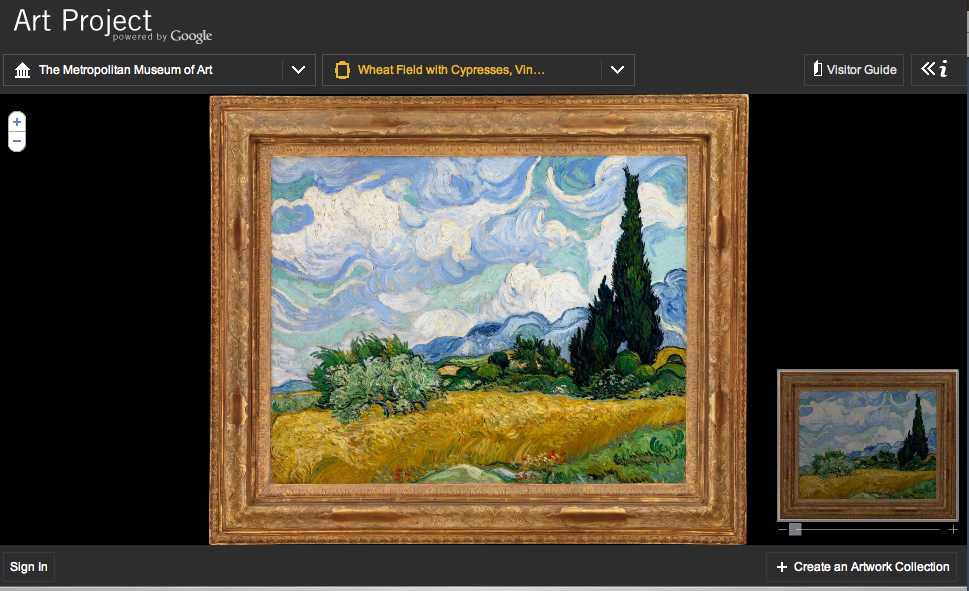
The project is an innovative way to expand viewership for prestigious museums and galleries, especially when the users cannot jet off to Madrid to visit the Museo Reina Sofia whenever they want to. Although Google has allowed for users to finally see up-close works from a huge variety of old masters like James McNeill Whistler, Vincent Van Gogh, Gustave Courbet, Rembrandt, Peter Paul Rubens, and Giotto, it cannot replicate the experience of seeing the great works in person. When zooming in to a high- resolution photograph of Vincent Van Gogh’s “Wheat Field with Cypresses” showcased at the Metropolitan Museum of Art, the painterly strokes depicted don’t measure up to the thickness, weight and texture that would be visible to the human eye. Also, in Art View, Google’s new feature displays all the works in similar dimensions. The pieces are not compared, but all held on the same scale. This is not representative of the museum experience, in which a viewer can be overwhelmed with the grand scale of work.

Although Google Art Project cannot absolutely replicate the museum-going experience, it does increase an audience for the art world. It teaches people who have never gone through a gallery or museum about the origins and evolution of art through depictions of crucial works of art, and hopefully sparks their interest in such a way that they are inspired to visit their own local museums. So, go check out Google’s Art Project, and when you are done wandering around the Gemaldegalerie in Berlin, come experience the real thing at the Georgia Museum of Art!

Monday, April 26, 2010

Google Goggles' New Acquisition

(Picture from www.guardian.co.uk)

Plink has joined Google Goggles! For those who don’t know what in the world Google Goggles is let alone Plink, have no fear: this new program might intrigue and fascinate even the most ardent traditionalists or at least spark debate about the role of docents and the gradual phasing out of basic human communication. In essence, Plink Art is a smartphone application created by Mark Cummins and James Philbin that lets its user take a picture of any well-known work of art and immediately discern its title, artist, which museum or collector houses it, etc. After the work is identified, the application provides a link to allposters.com, in case of adoration and absolute urge to acquire a likeness of the work.

Philbin explains how Plink's technology works: “‘It picks out repeatable elements from the image you take and comes out with a statistical representation of them.’ That process works even at different angles and different lighting conditions" Cummins adds "You can start doing some really interesting things when you have recommendation data, like personalized tours based on your favourite paintings. Museums are very interested in social sharing and Facebook."

Google Goggles, Plinkart’s buyer, is a subsidiary group of Google that works to develop instant recognition programs. That is, you take a picture with your phone of whatever object you want to find out more information on—the application currently recognizes wine, logos, places, artwork, business cards, books, and landmarks—and the application will give you a compiled list of stats, prices, and general information regarding the object or place.

Although you need a smartphone for the Plinkart application (the Google Goggles program is limited to Android phones), the concept is still pretty incredible and is most certainly an idea to watch. Both teams will be working together to develop a search engine that identifies and researches more and more of the objects, scenes, and people that make up our surroundings.


Thursday, October 08, 2009

The Art of Travel

"Oasis" (Image from Bill Guffey's blog)

Bill Guffey, an artist from Kentucky, doesn’t have the time to physically travel the world; yet he has found his own method of travel. Guffey uses Google Street View to visit various locations all over the world. The Daily Mail, a British daily newspaper, covered the story. Guffey states that family commitments and career have made him realize that “his traveling days are numbered.” He has traveled virtually to England, France, Italy, and every state in the United States (except Hawaii), to name a few locations. After some virtual exploration of the world, Guffey then paints pictures based on Google’s images. What’s interesting about his paintings is that he doesn’t focus on popular world landmarks but paints pictures of houses, fields, streets and landscapes. Guffey told The Daily Mail that “Google Street View has really changed everything for [him] because it means [he] can go to all of those places [he] is in love with, sit and paint them as if [he] is really there.” Guffey traveled regularly when he was younger, to Europe and other countries—he thoroughly enjoys traveling and hopes to one day visit the places he has seen virtually. So far, Guffey has painted more than 100 pieces. Check out his Web site and his blog to see them.