Art Daily spotlights GMOA on the Move.
One of the most useful and comprehensive art news websites around, Art Daily is absolutely worth a bookmark.

Wednesday, February 25, 2009


Friday, February 20, 2009
This Sunday: Opening Reception

This Sunday, from 2 to 4 p.m., at the Lyndon House Arts Center, the Friends of the Georgia Museum of Art are co-hosting the opening reception for the annual juried show along with the Lyndon House Arts Foundation. The exhibition is always a highlight of the year, with a great range of art in tons of different media from local artists both new and renowned, and the two co-hosting organizations are partnering to encourage membership in both of them.
Thursday, February 19, 2009
Museum and art news
* New York Times: "Los Angeles Tar Yields Mammoth’s Skeleton."
 * Art Institute of Chicago: Becoming Edvard Munch: Influence, Anxiety, and Myth. From the AIC's web site:
 * High Museum of Art, Atlanta: The Treasure of Ulysses Davis. Perhaps overshadowed by the two "blockbuster" exhibitions -- Chinese terracotta army and the Louvre -- at the High, this exhibition might be the most interesting. From the High's site:
The excavation for a parking garage near the La Brea tar pits here has yielded the site’s first intact mammoth skeleton as well as a trove of other bones that could double the size of the site’s already large collection of fossils from the last ice age.* www.ansa.it: "Rome celebrates Futurism."
Researchers from the George C. Page Museum, at the tar pits in Hancock Park, announced the find on Wednesday, although museum excavators have been reporting online about the recently uncovered fossils for several months.
Most of the material is in 23 crates of tar, clay and mud that were removed in 2007 during the digging of an underground parking garage at the Los Angeles County Museum of Art, which also sits next to the tar pits.
The Italian capital is joining the country's Futurism frenzy, with a host of events celebrating 100 years since the launch of Italy's most famous modern art movement. Nearly 50 separate events have been lined up for coming months, including exhibitions, plays, conferences and installations...
The centrepiece of the capital's planned exhibitions will be a large-scale exhibition at the Quirinale, opening in Rome after a hugely successful run in Paris last year.
The show, which later moves on to London's Tate, invites visitors to re-evaluate the impact the movement had on modern art, concentrating on its origins.
* Art Institute of Chicago: Becoming Edvard Munch: Influence, Anxiety, and Myth. From the AIC's web site:The Edvard Munch of popular imagination—a tortured, bohemian rebel who seemed almost a living version of the famous figure in The Scream—was in fact a myth, carefully constructed during Munch’s lifetime by critics, historians, and the artist himself. Since then, this persona has been reinforced by our collective fascination with his many pictures of existential suffering. But there are many other sides to the artist and his work that have been eclipsed by the traditional emphasis on his supposed emotional imbalance and artistic isolation. In addition to his depictions of death and anxiety, for example, are moody, calm landscapes and pictures of bathers that celebrate the vitality of the human form in nature.Image: Edvard Munch (Norwegian, 1863–1944), Moonlight, 1895. Oil on canvas, 93 x 110 cm (36 5/8 x 43 1/4 in.) The National Museum for Art, Architecture, and Design, Oslo, NG.M.02815 Woll 381
* High Museum of Art, Atlanta: The Treasure of Ulysses Davis. Perhaps overshadowed by the two "blockbuster" exhibitions -- Chinese terracotta army and the Louvre -- at the High, this exhibition might be the most interesting. From the High's site:The first major traveling exhibition of works by Ulysses Davis in more than 25 years premieres at the High...Image: Ulysses Davis, Jesus on the Cross, 1946, Carved cedar, mahogany, toothpicks and paint. High Museum of Art, Atlatna. Purchase with general funds and funds from Friends of the Museum.
Davis was a barber in Savannah, Georgia, who was also a self-taught woodcarver of remarkable talent. He created a body of highly refined sculpture that expresses his humor, dignity and deep faith. The exhibition offers an opportunity for audiences to appreciate Davis' remarkable work, which is rarely seen outside of Savannah.
Friday, February 13, 2009
Family Day: Origami Valentines

You might think that the museum has no events planned these days, but let me reiterate that we certainly do, and our schedule of Family Days in particular has not slowed down. This Saturday, Valentine's Day, provides a lovely opportunity for the last one to be held in our Carlton Street building, after which they will take place at various venues, from the State Botanical Garden of Georgia to the Lamar Dodd School of Art to the Lyndon House Arts Center, as part of GMOA on the Move. From 10 a.m. to noon, families can learn about the art of origami from Hijiri Hattori, outreach coordinator for the Center for Asian Studies (which is cosponsoring the event), then work with volunteers to make folded hearts and boxes and get Valentine's treats in the café. The Red and Black, UGA's student-run newspaper, had an article on the event yesterday, in which the reporter spoke with Hattori and a few members of the museum staff. The event is free and open to the public, but if you can't make it, here's a great YouTube video that explains how to fold an origami heart:
Happy Valentine's Day, everyone!
Wednesday, February 11, 2009
Classic Film Series: Hitchcock

Mark your calendars for tonight, film appreciators! The Georgia Museum of Art will be screening the third film in its four-film series on the films of director Alfred Hitchcock, "Marnie", introduced, once again, by Dr. Janice Simon, Josiah Meigs Distinguished Teaching Associate Professor of Art History in the Lamar Dodd School of Art. "Marnie" will be shown in the M. Smith Griffith Auditorium at the museum's Carlton Street location at 7 p.m. and is free and open to the public.
The long trailer for the film, which is embedded below (unfortunately not in the best quality), gives some idea of its strangeness, even within Hitchcock's oeuvre, although one can certainly see connections to "Psycho" and "Spellbound" in its portrayal of the psychological dramas of its main character, played by Tippi Hedren.
For those interested in examining gender issues in Hitchcock's films, "Marnie" presents particularly fertile ground. Jodi Ramer, for example, includes the film an analysis of the "Hitchcock blonde," and it is, overall, a fun film to probe, as well as a compelling character-based drama with strong Freudian themes.
We hope to see you here tonight for either the film or for our life-drawing class, which meets in the Ed and Phoebe Forio Studio Classroom from 5:30 to 8:30 p.m., sans instruction, and costs $5.
Tuesday, February 10, 2009
Congratulations, Art!

We mean Art Rosenbaum, of course, the celebrated painter, Lamar Dodd School of Art instructor for many years, and documenter of folk music, who snagged a Grammy Sunday in the "Historical Album" category for his work in that area. Athens blogger Gordon Lamb has a nice post about Art's award, complete with a YouTube video of Art discussing his The Art of Field Recording II, and the Athens Banner-Herald has an article today by Julie Phillips complete with a sampling from The Art of Field Recording I, the set for which he received the Grammy.
Art had a retrospective here at the museum in 2006-2007, which produced an exhibition catalogue, Weaving His Art on Golden Looms: Paintings and Drawings by Art Rosenbaum, that also includes a documentary by his son, Neil Rosenbaum, It's Not What You Think It Is. The documentary covers Art's history, his approach to painting (which he takes from the Old Masters, building up layers of color to produce deeper, more vibrant flesh tones), and his recording work. An excerpt from the documentary can be watched below:
For ordering information for the exhibition catalogue/film, click here.
Monday, February 09, 2009
Snite’s ‘Disegno’ transports viewers

Full article text [here]. Excerpts:
There’s something about walking into a gallery filled with old Italian art that can’t fail to please lovers of traditional art. Multiculturalists and postcolonialists would strongly disagree with me if I said that all art museums should be at least partially filled with old Italian art, so I won’t say it. I will say, however, that looking at a 17th- century Italian drawing in a dimly lit gallery provides the classic art museum experience — do it, and you’ll be able to convince yourself that you’re somewhere in Europe, in a venerable museum with giant columns flanking the front doors, no matter where you actually are.Image: Tribune Photo/SANTIAGO FLORES
Aside from assembling an impressive collection of works on paper, “The Art of Disegno,” an exhibition of Italian prints and drawings currently on display at the Snite Museum of Art, offers just such an experience.
The exhibit, which has been organized by the Georgia Museum of Art, features dozens of drawings, prints and other works on paper from the 16th through the 18th centuries. The disegno of the show’s title translates literally as drawing or design, but its meaning in the history of art is a little more subtle; an artist with a mastery of disegno had control of the foundation of art, according to commentators of the time, and with it, the ability to accurately reproduce nature, as all art should strive to do. These masters of disegno included such familiar names as Tiepolo, Parmigianino, Canaletto and Veronese, all of whom are among the many artists represented in the exhibition. ...
All of the works are accompanied by excellent text panels that provide both biographical details about the artists and extensive contextual information about the individual pictures. They add considerably to the sense of the show’s art historical significance and make the exhibition a wonderful opportunity to immerse oneself in the most famous era of Western art.
Antonio Canaletto’s print “View of a Town With a Bishop’s Tomb” “View of a Town With a Bishop’s Tomb,” one of the works featured in “The Art of Disegno: Italian Prints and Drawings from the Georgia Museum of Art” at the Snite, is as meticulously detailed as his more famous cityscapes.
Friday, February 06, 2009
Reimagining the Museum lecture
In looking for some museum studies topics on the internet, I happened to come across an entire lecture (presented as one in an series on "Reimagining the Museum" at Michigan) given by a former mentor and member of my dissertation committee, Ray Silverman, now Professor of Art History and Director of the University of Michigan’s Museum Studies Program. Ray is particularly interested in how African cultures are presented by Western museums.
His lecture, given at the UM Museum of Art back in 2007:
His lecture, given at the UM Museum of Art back in 2007:
Wednesday, February 04, 2009
The closing of the Rose
Many of you have probably been following the decision of the trustees of Brandeis University to shutter the Rose Art Museum and sell off its collection in order to make up a budget shortfall. The Rose's collection includes approximately 6,000 works of art, including paintings by paintings by Robert Rauschenberg, Jasper Johns, Andy Warhol and Roy Lichtenstein, and the trustees' actions have, understandably, provoked considerable controversy. Today's New York Times contains an article by Roberta Smith that expresses the real loss that would be felt if their plan comes to fruition. Smith writes,
What the university’s president, Jehuda Reinharz, and the trustees don’t seem to realize is how their actions stain the reputation of Brandeis itself. He characterized the choice as “painful” and “difficult,” but it had all the earmarks of a desperate quick fix rather than a rational decision. He even said it in no way diminished Brandeis’s commitment to the visual arts, pointing out the university could turn the museum into an arts studio and study center. But the decision was devastating for the university’s art and art history departments, which have always relied heavily on the museum.It is true that, at a time of rarely precedented financial crisis in the United States and abroad, reprioritizing is frequently in order, from the household to the governmental level, but it is also important to recognize the role of university museums. William U. Eiland, director of the Georgia Museum of Art, heads up the professional practices committee of the Association of Art Museum Directors (AAMD), which has expressed "strong objection to Brandeis University's proposed plan to close the Rose Art Museum and sell its collection." Eiland reiterated the centrality of university art museums to the teaching and scholarship missions of those educational institutions and expressed forcefully his feelings that the decision of the Brandeis trustees will result in a terrible loss.
At the museum on Friday, Aliza Sena, a 19-year-old sophomore, said that graduating seniors in art and art history were especially traumatized. “It’s like the school telling them that their degree is fluff,” Ms. Sena said. She transferred this year from Tulane University after deciding that she wanted to major in art rather than business, and the Rose was a major factor in her choice.
“I’m devastated,” she said. “It’s crushing to figure out this school’s priorities, and sad that they can make a decision without consulting anyone knowledgeable. It really makes me reconsider being here.”
Monday, February 02, 2009
Jim Barsness

Coming up this Wednesday, February 4, at 5:30 p.m. in the M. Smith Griffith Auditorium at the museum is the annual Willson Center for Humanities and Arts/Georgia Museum of Art Annual Lecture, which will be delivered by Jim Barsness this year. Barsness was born in Bozeman, Mont., in 1954, and currently teaches as an associate professor in the Lamar Dodd School of Art, University of Georgia. His work was recently featured in "More is More: Maximalist Tendencies in Recent American Painting," organized by the Museum of Fine Arts, Florida State University, Tallahassee; and "New Directions,"organized by the Columbus Museum, Columbus, Ga. Barness will discuss his recent work in the lecture, which is free and open to the public, and is cosponsored by the museum and by the Willson Center.
Wednesday, January 28, 2009
Don't forget: Saboteur tonight!
The Hitchcock film series at the Georgia Museum of Art continues tonight at 7 p.m. in the M. Smith Griffith Auditorium. Professor Janice Simon will introduce Saboteur, which you can watch the original trailer for above. The screening is free and attendees can park in the visitor lot at the museum.
Also at the museum tonight is our Open Studio: Life Drawing, from 5:30 to 8:30 p.m., which costs $5. We hope to see you here!
Monday, January 26, 2009
The Art of Disegno: Italian Prints and Drawings from the Georgia Museum of Art

Another exhibition the museum has organized for a far-off venue is The Art of Disegno: Italian Prints and Drawings from the Georgia Museum of Art, which opened this past week at the Snite Museum of Art, in Notre Dame, Ind. Organized by curators Robert Randolf Coleman, who teaches at Notre Dame, and Babette Bohn, of Texas Christian University, the exhibition comprises just over 50 prints and drawings of exceptional quality produced from the 16th to the 18th century by artists including Titian, Parmigianino, and Piranesi. Most of these works come from the collection of Giuliano Ceseri, which is on long-term loan to the Georgia Museum of Art. Ceseri began collecting drawings while a child in Florence, and although he has never received any formal training in art history, his combination of eye and enthusiasm are unmatched. The Art of Disegno provides a chance to experience the work of masters intimately, seeing both their development (through sketches) and the increasing prevalence of printmaking as a way to distribute art more widely.
The exhibition is on view at the Snite until March 1, 2009, and is accompanied by an exhibition catalogue that reproduces each of the works full page and in color with a discussion by Coleman or Bohn. Giancarlo Fiorenza, who served as in-house curator of the exhibition at GMOA and has since moved on to a teaching position in California, supplies an introduction geared to the layman that explains the importance of disegno (or "drawing") in Renaissance artistic academies. The catalogue is for sale through the Georgia Museum of Art shop or, for wholesale orders, through GMOA's Department of Publications.
Image: Agostino Carracci (Italian, 1557-1602), The Madonna and Nursing Child on a Crescent Moon, 1589. Engraving on white paper, 8 3/16 x 6 1/2 inches (sheet). Georgia Museum of Art, University of Georgia; Extended loan from the collection of Giuliano Ceseri. GMOA 1995.782E
Thursday, January 22, 2009
The American Scene on Paper: Prints and Drawings from the Schoen Collection

The museum may have closed its galleries to the public in preparation for the Phase II renovation and expansion (breaking ground on March 3), but the staff has been busy organizing exhibitions and lending out works of art elsewhere. The American Scene on Paper: Prints and Drawings from the Schoen Collection is an example of these exhibitions organized for other institutions, some of which will eventually be shown here, after the reopening in 2011. Designed as a parallel exhibition to Coming Home: American Paintings, 1930-1950, from the Schoen Collection, which the museum organized with the Mobile Museum of Art in 2003, it features many of the same artists and much of the same subject matter, from portrayals of the plight of the farm laborer to depictions of industry and the growing urban environment. The prints, drawings and watercolors featured in the exhibition represent various manifestations of realism, whether magical, fantastic, social or romantic. Several of the artists moved from abstraction to realism as they searched for a distinctive, national voice. Currently on display at the Gibbes Museum of Art in Charleston, S.C., in a version of the exhibition that comprises about one-third of the works represented in the exhibition catalogue, it shows the diversity of styles and techniques utilized by artists in the United States during the Great Depression and World War II. These artists illustrates the economic realities and social concerns of everyday life and both document a shared past and provided assurance during a difficult present. Artists featured in this exhibition include Paul Cadmus, William Gropper, Joe Jones, Rockwell Kent, Martin Lewis, Millard Sheets and John Sloan.
The American Scene on Paper will be at the Gibbes through March 22, then move to the Columbus Museum, Columbus, Ga., this summer, where it will expand to 101 works of art. The exhibition catalogue, which is now available for purchase from the museum shop or for resale at wholesale prices from the Department of Publications includes all 153 works, each reproduced full page and in color, and is a landmark publication for the museum, a truly important piece of scholarship and documentation. Please check back here for updates on the exhibition and catalogue.
Image: Albert Gold (American, 1916-2006), Lunchbreak at the World's Fair, 1939. Watercolor on paper, 22 1/2 x 30 1/4 inches. Schoen Collection, Miami, Florida.
Tuesday, January 20, 2009
Wyeth's Hupper's Point

As noted over the long weekend, American painter Andrew Wyeth died Friday.
The New York Times article on Wyeth had this bit:
A minority opinion within the art world always tried to reconcile Wyeth with mainstream modernism. It was occasionally argued, among other things, that his work had an abstract component and was linked to the gestural style of artists like Kline, de Kooning and Pollock, for whom Wyeth expressed general disdain. It is true that especially some of the early watercolors of the 30’s and 40’s, in a looser style, inclined toward abstraction.A watercolor in the collection of our museum serves as one example of the "gestural style" found in Wyeth's 1930s and 1940s images. Hupper’s Point, painted plein air in Maine, verges on the abstract, thus revealing an underlying tendency present in many of Andrew Wyeth’s works from the era. A landscape view of the tidal pools along a rocky coastline dissolves into bold compositional forms of grays and purples and browns. Purchased as a contemporary work of art by the Georgia Museum of Art's founder, Alfred Holbrook, Hupper's Point remains a prized object in the collection of the state's official art museum.
Image: Andrew Wyeth (American, 1917-2009), Hupper’s Point, 1944. Watercolor on paper, 21 x 29 inches. Georgia Museum of Art, University of Georgia; Eva Underhill Holbrook Memorial Collection of American Art, gift of Alfred H. Holbrook. GMOA 1946.116
Friday, January 16, 2009
Classic Film Series: Hitchcock

Both the "Athens Banner-Herald" and the "Red and Black" (the UGA student newspaper) recently ran articles about GMOA's Classic Film Series, which consists of four films directed by Alfred Hitchcock. Dr. Janice Simon, Josiah Meigs Distinguished Teaching Associate Professor of Art History in the Lamar Dodd School of Art, will introduce all of the films but the final one, providing artistic and historical context. The films will be shown in the M. Smith Griffith Auditorium at the museum at 7 p.m. on select Wednesday nights, and are free and open to the public (plus, they serve as blue card events for UGA students).
"The 39 Steps," one of Hitchcock's earlier films, made before he moved from England to Hollywood in 1940, has already shown, but there are still three left, and while it is difficult to select only four from among the dozens of films he directed, each of them brings something unique to the table.
"Saboteur" will be shown on Wednesday, January 28. It stars Robert Cummings as Barry Kane, a man accused of sabotage to an aircraft plant who escapes in order to find the real saboteur. Released in 1942, it contains what would come to be one of the director's trademarks: a scene set at or on a national landmark. Hitchcock set scenes in "North by Northwest" (1959) and "Vertigo" (1958) at Mount Rushmore and the Golden Gate Bridge, respectively, but even in 1929, with "Blackmail," which contains a climactic scene set in the British Museum, he was already using this trope. "Saboteur" comes to a head with a fight scene on the Statue of Liberty and is the director's first use of the device in his American films.
It also makes up a nice trilogy with the films he directed immediately before and after it. "Suspicion" (1941), which precedes it, stars Joan Fontaine as a naive woman married to Cary Grant, a con man. Fontaine's character slowly begins to suspect her husband is out to murder her for her money, and the film's suspense largely consists of wondering what steps she will take in response to this knowledge. "Shadow of a Doubt" (1943) is a similar story of family suspicion, this time focusing on a young girl who finds out her favorite uncle is a murderer. While "Saboteur" fits neatly into the classic model of Hitchcock as a director obsessed with the wrongfully accused, it also relates to "Suspicion" and "Shadow of a Doubt" as films that can be seen as influenced by the ongoing world war. "Saboteur" addresses wartime paranoia more explicitly, while the other two films focus on intrafamilial suspicions as a metaphor for the tensions always present inside a country during and in the run-up to war.
Join us for "Saboteur" and mark your calendar for the other two remaining films in the series, "Marnie" (Wed., Feb. 11) and "The Man Who Knew Too Much" (Wed. Feb. 25).
Friday, October 10, 2008
Rings
The Georgia Museum of Art is currently displaying an exhibition titled The Ring Shows: Then & Now and Putting the Band Back Together.
The ring exhibition has inspired a minor run on wedding engagements in the display.
The Athens Banner-Herald has two articles: "Ring show inspires man to surprise fiancée" and "Ring show held surprises."
The ring exhibition has inspired a minor run on wedding engagements in the display.
The Athens Banner-Herald has two articles: "Ring show inspires man to surprise fiancée" and "Ring show held surprises."
Thursday, August 21, 2008
Press
 * August's edition of Southern Living has lots of information on Athens, including bits about the State Botanical Gardens and area shops and restaurants. But the issue also includes a 1/3-page blurb on the award-winning exhibition catalogue for Amazing Grace: Self-Taught Artists from the Mullis Collection.
According to Southern Living's Joe Reda, the "colorful catalogue...is worth browsing. ...[O]ther surprises await."
* The Red & Black has an article on the museum's new/old ring exhibition: "The Ring Shows: Then & Now and Putting the Band Back Together."
* "Art Notes" in the Athens Flagpole also visited the museum. The museum-relevant section:
South of the Border: Perhaps to welcome its new neighbor - the massive and labyrinthine art school - but certainly to mark its expansion, the GMOA has put out a lot of the good stuff from its permanent collection, including some big names - Matisse, Bonnard and Dufy to name a few - as well as some regional favorites and a room of paintings and works on paper from the European Renaissance and Baroque eras. Many of these selected works from the permanent collection will be put on long-term display when the new, 30,000-foot addition to the GMOA is completed in two years' time. Also on view is a traveling exhibition from California, “Everett Gee Jackson/ San Diego Modern: 1920-1955,” that traces the American artist’s career from his Impressionist beginning to his mid-century Modern style. Indeed, one can see the trajectory of much of the first half of the 20th century within Jackson’s oeuvre that bears the traces of the influence of the American Regionalist and Mexican muralists. Accompanying this traveling exhibition is a selection of in-house paintings, prints and drawings from both Mexican muralists David Sisqueros, José Clemente Orozco and Diego Rivera, as well as a wide-range of artists they influenced.
Freshly Picked: Tucked away in one of the museum’s smaller galleries is a collection of new acquisitions donated in honor of late UGA art history professor Andrew Ladis. Reflecting his own extensive collection of art and his intellectual and artistic contributions to the GMOA, there are examples of American paintings, prints and drawings from the 20th century; a delicately-rendered small red-chalk drapery study from a Sienese late-Renaissance artist; and a still from one of Jim Herbert’s black-and-white films, featuring two nude youths who look as if they could have been lifted from classical statuary.
Thursday, July 31, 2008
"Plant-balloon business blossoms into vast collection of art"
Read Lee Shearer's Athens Banner Herald story on museum donor and great friend C.L. Morehead [here].
A bit:
"The Dodd paintings and drawings, along with hundreds of items of Dodd memorabilia, one day will go to the Georgia Museum of Art. So will the African art collection and much of the rest of Morehead's collections.
Morehead's art collection grew out of a friendship with Dodd that developed over decades - as did Morehead's resolve to give it all to his alma mater's art museum, he said."
A bit:
"The Dodd paintings and drawings, along with hundreds of items of Dodd memorabilia, one day will go to the Georgia Museum of Art. So will the African art collection and much of the rest of Morehead's collections.
Morehead's art collection grew out of a friendship with Dodd that developed over decades - as did Morehead's resolve to give it all to his alma mater's art museum, he said."
Monday, July 21, 2008
...and we're open...
for now.
The Georgia Museum of Art has been closed since May for bringing our fire suppression system to state-of-the-art levels. We will again close, likely for more than 18 months, beginning this November as we expand another 30,000 sq. ft.
I was included on Newsmakers with Tim Bryant last Friday on News-Talk 1340 WGAU to talk about the re-opening. Link to the podcast of the interview, which includes U.S. Senate candidate Vernon Jones and Mr. McGuinty, is [here].
 As mentioned in the interview, we open with a special, temporary exhibition organized by the San Diego Museum of Art: Everett Gee Jackson/San Diego Modern, 1920-1955. The display is "the first comprehensive look at Jackson's artistic output since his death in 1995. As a pioneer of progressive art in southern California, Jackson held a lifelong interest in vanguard aesthetics and formalist compositions. The exhibition chronicles his career, from his youth in east Texas to his early training at the Art Institute of Chicago to his extended Mexican sojourn -- where he encountered the influential work of the Mexican muralists -- to his long and distinctive presence in the art community of southern California. During his travels and work, he encountered numerous other American artists, including Jean Charlot, Fritz Winold Reiss and Edward Weston. An exhibiting artist, book illustrator and important teacher, Jackson reflected the broader understanding of 'modernism' in American art in his work." Everett Gee Jackson features about 50 of the artist's paintings and works on paper.
 To go along with the Jackson exhibition, we pulled together From the Collection: The Authority of the Mexican Muralists. Numerous American and Mexican artists were profoundly influenced by the modernist work of José Clemente Orozco, Diego Rivera, and David Siqueiros. Several artists, including Lucienne Bloch, Jean Charlot, and Ben Shahn, in this display worked with Diego Rivera on his mural projects. James Guy studied with Orozco; Harold Lehman worked under the leadership of Siqueiros; Syd Brown, Francis Chapin, and Joseph Marguiles traveled to
 Mexico
Plus, we have put up favorites: from the Kress collection to Pierre Daura to Winslow Homer's Taking Sunflower to Teacher [just back from the Homer watercolors show at the Art Institute of Chicago] to Georgia O'Keeffe to our great American landscapes, and much more.
Images: (1) Everett Gee Jackson (American, 1900-1995), Spring in San Diego, 1931; Oil on panel, 34 1/4 x 29 1/4 inches. Jackson Family Collection. (2) Jean Charlot (American, b. France, 1898-1979), Untitled (Mother with Child on Back), 1941. Watercolor on wove paper, 29 1/16 x 21 3/4 inches (sheet). Georgia Museum of Art, University of Georgia; gift of Mary and Lamar Dodd, Athens, Georgia. GMOA 1973.3180
The Georgia Museum of Art has been closed since May for bringing our fire suppression system to state-of-the-art levels. We will again close, likely for more than 18 months, beginning this November as we expand another 30,000 sq. ft.
I was included on Newsmakers with Tim Bryant last Friday on News-Talk 1340 WGAU to talk about the re-opening. Link to the podcast of the interview, which includes U.S. Senate candidate Vernon Jones and Mr. McGuinty, is [here].
As mentioned in the interview, we open with a special, temporary exhibition organized by the San Diego Museum of Art: Everett Gee Jackson/San Diego Modern, 1920-1955. The display is "the first comprehensive look at Jackson's artistic output since his death in 1995. As a pioneer of progressive art in southern California, Jackson held a lifelong interest in vanguard aesthetics and formalist compositions. The exhibition chronicles his career, from his youth in east Texas to his early training at the Art Institute of Chicago to his extended Mexican sojourn -- where he encountered the influential work of the Mexican muralists -- to his long and distinctive presence in the art community of southern California. During his travels and work, he encountered numerous other American artists, including Jean Charlot, Fritz Winold Reiss and Edward Weston. An exhibiting artist, book illustrator and important teacher, Jackson reflected the broader understanding of 'modernism' in American art in his work." Everett Gee Jackson features about 50 of the artist's paintings and works on paper.To go along with the Jackson exhibition, we pulled together From the Collection: The Authority of the Mexican Muralists. Numerous American and Mexican artists were profoundly influenced by the modernist work of José Clemente Orozco, Diego Rivera, and David Siqueiros. Several artists, including Lucienne Bloch, Jean Charlot, and Ben Shahn, in this display worked with Diego Rivera on his mural projects. James Guy studied with Orozco; Harold Lehman worked under the leadership of Siqueiros; Syd Brown, Francis Chapin, and Joseph Marguiles traveled to Plus, we have put up favorites: from the Kress collection to Pierre Daura to Winslow Homer's Taking Sunflower to Teacher [just back from the Homer watercolors show at the Art Institute of Chicago] to Georgia O'Keeffe to our great American landscapes, and much more.
Images: (1) Everett Gee Jackson (American, 1900-1995), Spring in San Diego, 1931; Oil on panel, 34 1/4 x 29 1/4 inches. Jackson Family Collection. (2) Jean Charlot (American, b. France, 1898-1979), Untitled (Mother with Child on Back), 1941. Watercolor on wove paper, 29 1/16 x 21 3/4 inches (sheet). Georgia Museum of Art, University of Georgia; gift of Mary and Lamar Dodd, Athens, Georgia. GMOA 1973.3180
Wednesday, May 28, 2008
Visit to Toshiko Takaezu
Among the litany of tasks during a recent trip to the New York City area for (the museum's director) Bill Eiland, (assistant director) Annelies Mondi, and yours truly was a visit to the (very rural) New Jersey home and studio of Toshiko Takaezu.
Ms. Takaezu very generously donated several of her own works of art to the Georgia Museum of Art.
A few pictures from the visit:


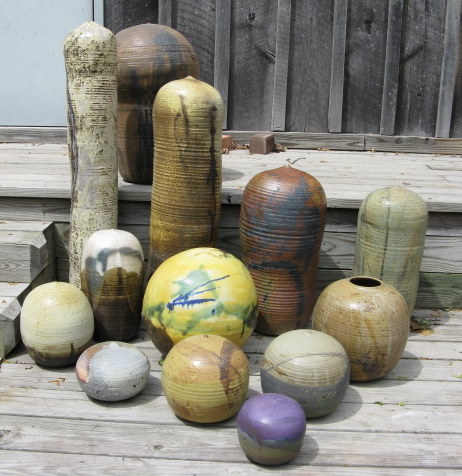


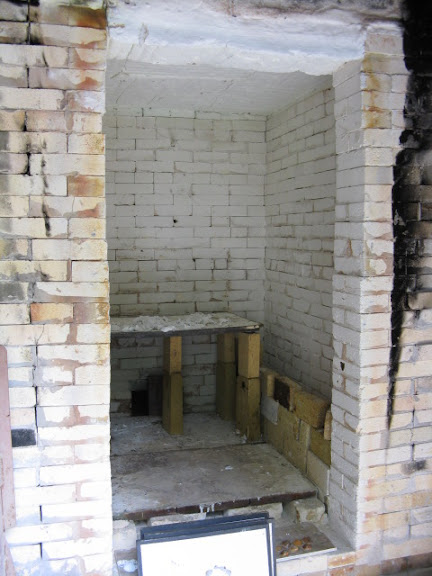
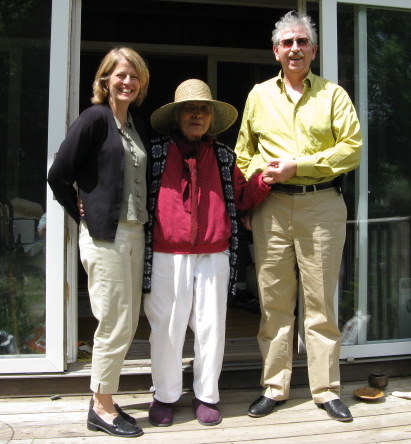
Ms. Takaezu very generously donated several of her own works of art to the Georgia Museum of Art.
A few pictures from the visit:


Subscribe to:
Posts (Atom)