Tuesday, January 26, 2016
"Portrait of Archbishop William Laud" Attracts Controversy
A couple of weeks ago, the museum issued a press release highlighting its acquisitions in calendar year 2015, including a large portrait of Archbishop William Laud by Anthony van Dyck and studio (pictured above in a low-resolution version). The credit line on the image that ended up going out to the press through UGA's News Service deleted the "and studio" part, for space and because they are not art historians (we don't expect them to be!). When read without that caption, the release suggested that the museum believed the painting was by Van Dyck alone, and a high-profile art history blog quickly picked up on that fact.
From that point, other news sites and newspapers wrote their own versions of the story. Some of them contacted us for information. Others did not.
We have created a FAQ that appears below in the interest of accuracy. If you have questions, please leave them in the comments and we will do our best to address them and add both questions and answers to this post.
FAQ
Q. Who painted this portrait of Archbishop Laud?
A. The painting is attributed to Anthony van Dyck and studio. The credit line for the image of our painting that appeared on the news.uga.edu website was edited to remove “and studio.” Our version of the press release, sent through MailChimp, only included an image of the Frederick Frieseke painting the release also promoted. It is unambiguously listed as “Anthony van Dyck and his studio” in the deed of gift in the museum’s files.
Q. Didn’t you edit your press release after the fact?
A. We did, to make the authorship of the painting clearer, but we included a note saying the release had been edited and why, to be as transparent as possible. We assumed, with the original release, that the credit line appearing with the image would make it clear who painted it, but the image and the release have not always appeared together. Lesson learned.
Q. Did the museum know the painting is one of several versions of the same image?
A. Yes. Contrary to the news stories that have appeared, we were fully aware that this painting exists in several versions, including in the collections of the Fitzwilliam Museum in Cambridge, the National Portrait Gallery and the Hermitage in St. Petersburg.
Q. Which is the original?
A. Scholarship tends to agree that the version in the Fitzwilliam is directly by the hand of Van Dyck, but it was not recognized as such until 1982, after cleaning and restoration, when Michael Jaffé made the case that it was by Van Dyck himself. Before that, the Fitzwilliam had catalogued it as “Studio of Van Dyck,” even though the collectors who donated it to the museum (Charles Ricketts and C.H. Shannon) believed it was by Van Dyck alone.
Q. Is the Georgia Museum of Art’s painting a “fake,” as Blouin/ArtInfo says?
A. Absolutely not! There is a big difference between a deliberate forgery and a painting created either as a collaboration between the artist and his studio or by the studio under the supervision of the artist. For example, Gilbert Stuart painted numerous versions of his Athenaeum portrait of George Washington, some with the assistance of his daughters (see, for example, the version at the Philadelphia Museum of Art).
Q. Who gets to say whether or not it’s a Van Dyck?
A. This kind of work is what art historians do: research, comparison, careful argument. Our curator of European art believes strongly that the face and hands are by Van Dyck, with the clothing and drapery having been rendered by his studio, but it is rare that a definitive answer can be found, especially with a 17th-century work. The provenance (or ownership history) for the Georgia Museum of Art’s painting dates back to the mid-17th century.
Bendor Grosvenor, an English art historian, contends on his blog that our painting is only “studio of Van Dyck” at best but admits he has not seen it in person. Making judgments from photographs is difficult.
Erik Larsen’s 1988 catalogue raisonné lists the Hermitage and Fitzwilliam versions of the portrait (cat. nos. 896-97, pages 350-51) but writes that both were created with the artist’s studio. He mentions Jaffé’s article but writes, “Considering that Jaffé is the director of the Museum which owns the painting, his panegyric must be taken with a grain of salt.” Larsen then lists five studio replicas on pages 493-94 and writes that “There exist also a number of copies, both contemporary and later,” i.e., the National Portrait Gallery’s painting. Grosvenor, in the same blog entry, refers to Larsen’s work as “perhaps the most inept catalogue raisonné ever.”
Sammy J. Hardman, in his “Sir Anthony Van Dyck: The English Portraits” (1999, privately printed, cat. no. 103, pages 43-44) believes this version of the portrait may be the original or a prototype for it. He writes, “As compared with the other known portraits of Laud, the work is of excellent quality. X-ray studies of this work show emphatic pentimenti in the head as well as in the hands.” Hardman documents this version as having been sold at Christie’s on March 4, 1927 (no. 58), as a Van Dyck (although previously attributed, in 1876 and 1910, to Henry Stone, a contemporary and known copyist of Van Dyck’s; Hardman calls this an “old family attribution” and “without foundation”).
The 2004 catalogue raisonné of Van Dyck, published by the Paul Mellon Centre for Studies in British Art at Yale University, lists the version in the Fitzwilliam as the original (IV.153, pages 549-550). It then lists some of the “more important” copies but does not include the painting now at the Georgia Museum of Art.
[Edit 1/26/16 11:35 a.m.] Mary Louisa Boyle's "Biographical notices of the portraits at Hinchingbrook" (1876, Victoria press) lists it as "A Copy of Vandyck in Lambeth Palace. / By stone" on pages 61-62.
Q. Did the Georgia Museum of Art buy this painting?
A. We did not. The painting was a gift from Mr. and Mrs. M. Daniel Byrd, of Atlanta. The museum has a very limited budget for acquisitions, especially high-dollar ones. Any news sources that refer to our buying the painting are incorrect.
Q. How do objects come into the museum’s collection?
A. The Georgia Museum of Art has a collections committee that meets monthly to discuss potential accessions, whether through gift or purchase. The committee carefully assesses various factors, including quality, size (storage space is unfortunately limited), condition and whether a given work fits with the collections plan before agreeing to accept a particular object, even if that object is a gift.
Q. Why would you want this painting if you believed it was by Van Dyck and studio instead of by Van Dyck alone?
A. Our collection of European art, especially 17th-century European art, is very small. Even if the painting should turn out to be only studio of the artist, it would still fill a very large gap in our collection. Considering the fact that the National Portrait Gallery and the Hermitage both own copies of the same painting, we feel we are in very good company. In addition, an important part of our role as a university museum is to participate in and share the results of research. We invite any scholars to come study the painting.
Thursday, January 21, 2016
Meet Shawnya Harris, our new Larry D. and Brenda A. Thompson Curator of African American and African Diasporic Art
![]() |
| Shawnya Harris, Larry D. and Brenda A. Thompson Curator of African American and African Diasporic Art |
Harris holds both master’s and doctoral degrees in art history from the University of North Carolina (UNC) at Chapel Hill, and she received her bachelor’s degree in African American Studies from Yale University. It was during Harris's undergraduate years that she decided she wanted to work in museums. The way the university integrated its gallery into the curriculum, combined with the enthusiasm of certain crucial professors for visual arts, hooked her. One of those teachers was Robert Farris Thompson, a specialist in Black Atlantic art, and Harris was inspired by his eclectic way of approaching material, fusing fine with vernacular art in an effort to tell a sweeping, inclusive story.
![]() |
| Robert, one of our preparators, and Shawnya exchanging a laugh. |
Her eyes light up when she talks about what she wants to accomplish in her position at the Georgia Museum of Art. The upcoming reinstallation of the permanent collection, for example, is a way to juxtapose artists of color with their peers, helping them become part of the narrative of art history rather than confining them to their own section in the galleries.
Harris will start teaching at the Lamar Dodd School of Art next academic year, with Introduction to African American Art, a survey course that will allow her to use the museum’s permanent collection. Here, as elsewhere, she plans on conveying what she learned from her own teachers: an enthusiasm for the subject and for the work. To Harris, that is the most important thing she can pass on.
Thursday, January 14, 2016
New Acquisitions: "The Kitten" by Thomas Waterman Wood
![]() |
| Thomas Waterman Wood, The Kitten, also known as Pompey and the Kitten, 1873 |
Genre painting in America from the 19th century can appear deceptively ordinary. One such example is the Georgia Museum of Art's recent acquisition, “The Kitten,” by Thomas Waterman Wood, which we mentioned in our last post on new acquisitions. Our curator of American art, Sarah Kate Gillespie, explains why there is more than meets the eye:
While on its surface it seems to smack of overt sentimentality, one can infer deeper political messages based on Wood’s other works. His most well-known series of paintings, “A Bit of War History” (1865–66), features an African American man as contraband, soldier and veteran and was apparently inspired by the sight of a Kentucky veteran on homemade wooden crutches.
Many of Wood’s subsequent paintings treat politicized subjects, both white and African Americans. When examined in light of Wood’s larger oeuvre and his obvious interest in the politics and shifting social norms of a post–Civil War era, his seemingly innocuous images of African Americans can be read as deliberately reassuring depictions of a newly emancipated population for a white, northern audience. The black man is shown as docile, humane, kind to animals and children—in short, not a threat. When paired with existing works in our collection from the same era that also treat African American subjects (such as George Henry Hall’s “Boys Pilfering Molasses” and Winslow Homer’s “Taking Sunflower to Teacher”), this image helps us begin to tell a more complete story about visualizations of race in the Civil War period.
Check back in the upcoming weeks to learn more about George Henry Hall’s “Boys Pilfering Molasses” and Winslow Homer’s “Taking Sunflower to Teacher.”
Thursday, January 07, 2016
"Samurai: The Way of the Warrior"
![]() |
| Helmet, first half of 17th century |
Earlier this month, our autumn exhibition, "Samurai: The Way of the Warrior," came to a close. During its run, people responded to the show with great excitement and we were thrilled to see many new faces at the museum as well as repeat visitors. There were also many special events that accompanied the exhibition, including a demonstration of Japanese archery by Georgia Kyudo Renmei at our samurai-themed Family Day; an introduction to kendo, the modern Japanese martial art, presented by student organization Kendo at UGA; and a sake tasting hosted by the Consulate General of Japan in Atlanta as a thank you to the donors who helped fund the exhibition.
"Samurai: The Way of the Warrior," organized by Contemporanea Progetti in collaboration with the Stibbert Museum in Florence, Italy, was the most comprehensive presentation of Japanese art of the samurai era in Georgia in nearly 30 years and showcased approximately 100 objects, including full suits of armor, helmets, swords, sword-hilts, saddles, lacquered calligraphy boxes, quivers and bows, incense trays, and foldable chairs. We thank our many corporate, foundation, and individual sponsors for their generous support, and a special thank you goes to Professors Hyangsoon Yi and Masaki Mori at UGA for their help in developing programming for this memorable exhibition highlighting the legendary warrior class of traditional Japan and the artistry and highly skilled craftsmanship of Japanese artisans.
![]() |
| "Samurai: The Way of the Warrior." Tag your photos on Instagram with #georgiamuseumofart. |
Click here for a list of exhibitions now on view at the Georgia Museum of Art.
Tuesday, January 05, 2016
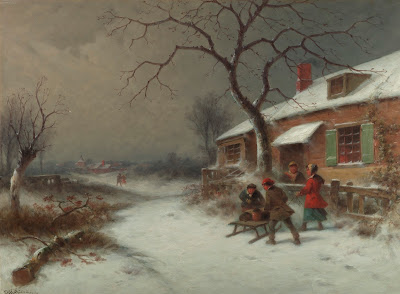
New Acquisitions: "Winter Morning" by George Washington Nicholson
| George Washington Nicholson, Winter Morning, ca. 1880 |
Born in New Jersey, Nicholson trained in Philadelphia, where he learned academic realism at the Pennsylvania Academy of the Fine Arts. In 1866, he traveled to England and France for further training. Nicholson settled in Philadelphia upon his return to the United States, and his reputation was at its height from the mid-1880s through the 1890s. He painted a mural titled “The Old Homestead” that was on display at Wanamaker’s department store in Philadelphia and another, “Washington Crossing the Delaware,” for the Pennsylvania State House in Harrisburg (most likely lost when the building burned in 1897).
Nicholson produced works commissioned by patrons who preferred seascapes, exoticized landscapes of Europe and Northern Africa and scenes of daily life in the American countryside. This snowy country scene is an example of the latter. He painted several variations on the scene, usually featuring a house and human figures in bright clothing to draw the eye, but most of them are smaller than this one. Along with the recent purchase of Thomas Waterman Wood’s “The Kitten,” this painting helps us better tell the story of 19th-century American art by enriching our small collection of genre painting from the era.
Monday, December 14, 2015
New Acquisitions: Burr & Pooler Eight-Day Repeating Brass Painted Clock
The Georgia Museum of Art recently received an eight-day
repeating brass clock, ca. 1850, as a promised gift from the estate of the late Mrs. M.
Smith Griffith. The clock is on display in the galleries and is labeled on the
inside:
EIGHT-DAY REPEATING
BRASS CLOCKS
MADE BY BURR & POOLER
FOR S.W. NICHOLS
CLINTON, GEORGIA
The label was printed by S. Rose, Printer, Macon. Burr &
Pooler was a clock-making firm in Lexington, Connecticut, active from 1838 to
1860. Connecticut, at the time, was the center of American clock manufacturing.
The fact that the label was printed in Macon, Georgia, suggests that the clock
pieces were shipped down to Georgia and the clock was assembled there ca. 1850, a
practice that was common at the time. As Samuel N. Thomas Jr. writes, in his
essay in “Homecoming: The Sixth Henry D. Green Symposium of the Decorative
Arts,” doing so allowed manufacturers to exploit slave labor and to minimize
shipping-related damage.
S.W. Nichols appears to be Simon Wood Nichols, who was a
merchant in the area of Clinton, Georgia, and an investor in local real estate.
This clock was almost certainly made for him to resell, rather than for his
personal use. As a result of technological advancements that allowed for mass
production, by the middle of the 19th century clocks had become affordable for
the average person and a common household good, thus making them a profitable
item for merchants to sell. The advent of the railroad changed perceptions of
time and encouraged households to run their schedules according to the clock.
The clock also reflects aesthetic tastes of the time, with
its sentimental Victorian painting of an Alpine shepherdess and two of her
sheep, which would have been painted on the clock by young women, following the
outline of a print placed on the reverse of the glass. Such a clock would have
often been the focal point of the home, placed centrally on the mantelpiece,
and would have displayed the family’s dedication not only to modern
punctuality, but also to good taste.
Rebecca Stapleford
Publications Intern
Rebecca Stapleford
Publications Intern
Friday, November 06, 2015
19th Century Mourning Embroideries Currently on Display in “Georgia’s Girlhood Embroidery: ‘Crowned with Glory and Immortality’”
Included in the new exhibition “Georgia’s Girlhood
Embroidery: ‘Crowned with Glory and Immortality’” (on view at the Georgia
Museum of Art through Feb. 28, 2016; co-organized by Kathleen Staples and Dale Couch) are three mourning samplers, which are
somewhat unusual. Exhibited just outside the gallery is Mary Jane Smithey’s
silk mourning embroidery picture, which combines watercolor painting with
embroidery done in silk floss on a plain silk background. Smithey’s work is characteristic
of the type of mourning embroideries done during the Federal period and the
decades immediately following. Samplers, on the other hand, were preferred for
instructional, rather than commemorative purposes, yet, as the three examples
in our exhibition show, it was not unheard of for a schoolgirl or even an adult
woman to make an embroidered record of her loss using counted thread techniques
rather than the graceful couched satin stitches that filled out the drawn-on
outlines of most mourning embroideries.
Smithey’s embroidery shows two neoclassical urns, graced by
mourning women, in front of a church in a pastoral landscape. One urn, by which
Mary Jane herself seems to be depicted, honors her father, Robert Scott Smithey;
the other urn, beside which an unidentified women sits, honors her maternal
grandparents, William and Mary Hewlett. Completed around 1825, Smithey’s
embroidery is a typical example of schoolgirl mourning embroideries. Either she
or her instructor would have drawn on the design and painted in the faces and
other details, as well as the background, while Smithey would have embroidered the larger features in
couching stitch, French knots and outline, single, and split stitches using
silk thread for the majority of the design and silk chenille for the leaves.
Smithey’s embroidery reflects both the neoclassical style and the “cult of
mourning” popular in her day. Unlike the memorial embroideries on display as
part of the exhibition, Smithey’s embroidery was made in Richmond, Virginia,
and brought to Georgia by her daughter in 1860.
![]() |
| Mary Jane Smithey's memorial to her father and grandparents |
Caroline Broughton Fabian, a wealthy planter’s daughter from
St. Simons Island, Georgia, also followed popular fashion with her mourning
sampler, dedicated to the memory of George Washington and dated October 8, 1803.
After Washington’s death, it became popular for schoolgirls to commemorate him
in mourning embroideries as an exercise in patriotism. What is unusual about
Fabian’s embroidery is its format. Most Washington memorials were done in the
style of Smithey’s embroidery, instead of as part of a counted thread
instructional sampler. Fabian’s sampler begins with the alphabet, as is usual
for instructional samplers, but then goes on to include the following verse:
Columbia’s fair daughters forever shall mourn
While Genius stands weeping at Washington’s Urn.
Let hope still support you, fair daughters arise
In faith that your Washington’s soar’d to the skies,
Where still as your guardian he’ll ever preside
To virtue and goodness the pole star and guide.
Davida Deutsch identified this verse as being first
anonymously published on July 15, 1800, in the New Hampshire Gazette, and its
appearance on a south Georgia sampler is evidence of the wide diffusion of
ideas and literature in the Federal period. Fabian goes on to note proudly that
it has been 28 years since American independence, and that the sampler was made
in the “State of Georgia.”
![]() |
| Caroline Broughton Fabian's sampler |
The combination instructional sampler/memorial to the
deceased is also found in a sampler by an unidentified maker that combines the
alphabet with an embroidered epitaph to Joseph Smith, who died in 1840 in
Decatur County, located in southwest Georgia. His family’s names are also
included on the sampler (his wife Nancy Ann Smith, his son Francis Marion
Smith, and his daughter Martha Washington Smith) as well as the initials of
some yet to be identified relatives, making this sampler a family record as
well. Smith's epitaph is flanked by two cross-stitched weeping willows, which symbolize mourning. It is probable that either Smith’s wife or his daughter made this
instructional/memorial/family record sampler.
![]() |
| Unidentified family member, memorial to Joseph Smith |
A more elaborate example of the memorial tribute sampler is
the “Tribute to the Memory of Cosmo P. Richardsone,” made in 1852 in Savannah
to honor the late Dr. Richardsone, who was known as the best doctor in Savannah. Upon his death, Henry Rootes Jackson, a politician
and well-known poet, composed a poem in his honor. It
is unknown who copied that poem onto this memorial sampler, but likely suspects
are Richardsone’s widow, Elizabeth, or his daughter Margaret. The careful use
of punctuation, unusual in samplers, suggests that it was copied directly from
the original manuscript, and the use of brightly dyed wool thread
instead of silk is typical of needlework done after 1850.
![]() |
| Unidentified family member, memorial to Cosmo Richardsone |
Monday, October 26, 2015
Gio Ponti: Artist, Architect, Writer, Designer, and Visionary
The Georgia Museum of Art recently acquired four plates and
a platter designed by Gio Ponti (1891–1979) a famous Milanese architect and designer. Ponti worked as the artistic director and designer for the Florentine firm Richard-Ginori, which manufactured ceramics, from 1923 to 1938: this served as the beginning of his long career designing
other household and decorative items, such as furniture, glassware and
silverware. He also designed apartment buildings, palazzos and public buildings
of all types, including business towers and university buildings. He was the
editor and founder of both Domus and Stile magazines, dedicated to Italian
architecture and the decorative arts, and he served as professor of
architecture at Politecnico di Milano University for 25 years.
Typical of Italian decorative arts in the 1920s and 1930s,
Ponti appears to have been inspired by ancient classical artwork, in this case Etruscan.
Benito Mussolini’s Fascist regime encouraged a conscious return to Italy’s
ancient roots, seeking to instill in all Italians a pride in their heritage and
a belief that they were destined to rebuild the ancient Roman Empire. Although
Ponti engaged with the Fascist regime and shared its appreciation for classical
culture, he was essentially apolitical.
Ponti also appears to have been inspired by scenes from
contemporary life, as the charming circus figures on these platters show. Later
in his career, he became known for his sleek, modern designs, such as his
Superleggera furniture and the
Pirelli Tower. An artist
and visionary of extraordinary versatility, Ponti’s life and work will be
highlighted in an upcoming summer 2017 exhibition at the Georgia Museum of Art,
which will focus on his furniture design.
For more information about Gio Ponti and his art: www.gioponti.com.
Rebecca Stapleford
Publications Intern
Rebecca Stapleford
Publications Intern
Wednesday, October 21, 2015
New Exhibition: “Before the March King: 19th-Century American Bands”
![]() |
| "Grandfather of the March King", Patrick Gilmore (1829 - 1892) |
The Georgia Museum of Art opened a new exhibition to the
public last week, “Before the March King: 19th-Century American Bands.” The
exhibition focuses on American bands in the era before the “March King,” John
Philip Sousa, and is open until the beginning of the year (Jan. 3, 2016).
The exhibition features many portraits of famous band
directors, woodwind and brass instruments, non-military local bands and
artifacts such as broadsides advertising performances by local bands and
national events. Famous band directors featured in this exhibition range from cornet
player Alonzo Ford to the “Grandfather of the March King,” Patrick S. Gilmore,
who was an inspiration to Sousa.
![]() |
| Stereoscopic view of a concert hall conducted by Patrick Gilmore in Brooklyn, NY. |
Instruments displayed in the exhibition include bugles,
cornets, euphoniums and over-the-shoulder horns. The exhibition has a variety of
photographic portraits that show the many types of bands that played in the
early to late 19th century, such as military, newsboy and all-female bands. Artifacts
include souvenirs from the National Peace Jubilee in 1869 and the World Peace
Jubilee of 1872 (conducted by Gilmore) and sheet music covers.
![]() |
| An All-Female Band in the 19th-Century |
All the objects in the exhibition come from the collection
of UGA Performing Arts Center director George C. Foreman, who will give a
gallery tour of it this Thursday (October 22). The public is invited to attend this
free event, with champagne, coffee and cake at 5 p.m. and the tour at 6 p.m.
Subscribe to:
Posts (Atom)