Showing posts with label MOMA. Show all posts

Monday, February 14, 2011

Guitars


Art Daily has an article this morning about the new exhibition open at the Museum of Modern Art, New York, "Picasso: Guitars 1912-1914."
The exhibition . . . takes as its point of departure two works given to The Museum of Modern Art by Pablo Picasso in the early 1970s: Guitar, assembled from cardboard, paper, wire, glue, and string in 1912, and a second version made of sheet metal in 1914. Unexpectedly humble in subject and unprecedented in mode of execution, the two Guitar constructions resembled no artwork ever seen before. Within Picasso's long career they bracket a remarkably brief yet intensely generative period of material and structural experimentation.
But did you know the Georgia Museum of Art has one of Picasso's guitar drawings on its wall right now? It won't be up for more than about three months, due to the fragile nature of works on paper, but if you come see us soon, it's on display in the H. Randolph Holder Gallery, devoted to works of European art.

Friday, September 24, 2010

Do Museum Apps Enhance the Experience?


The New York Times recently discussed a new trend developing for museums: iPhone apps. These features, while different from one museum to the next, explore the future possibilities of visitors’ experiences and interactions within the museum environment.

The app for the Museum of Natural History in New York City allows its users to navigate through the exhibits and even provides a Highlights Tour for visitors who are overwhelmed and need to focus their path through the museum. The navigation system also points to facilities such as restrooms, dining areas and shops.

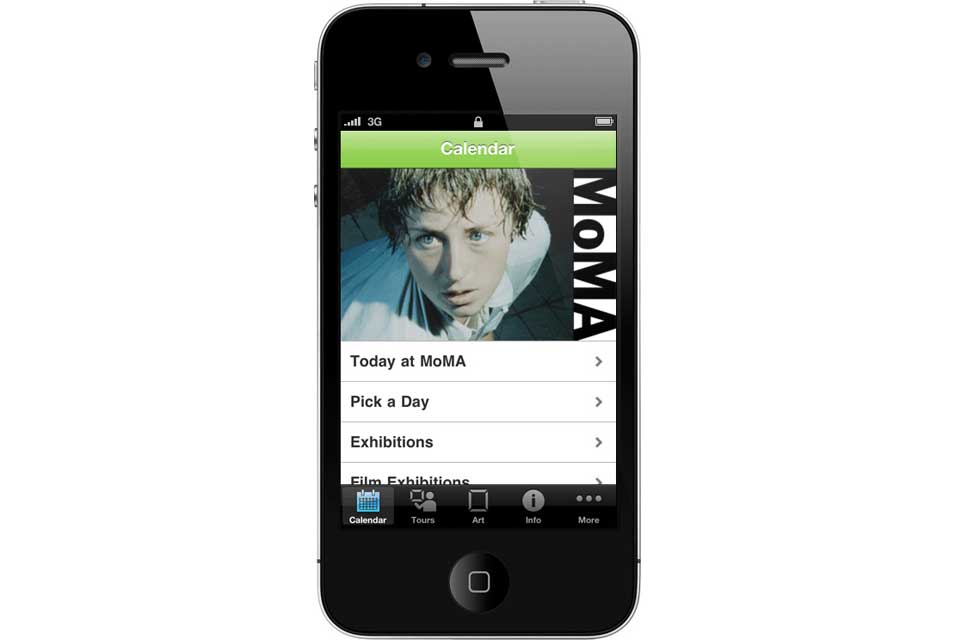
The Museum of Modern Art’s app provides a floor map as well as a floor-by-floor listing of exhibitions, but even more helpful are the Modern Voices audio tours, which provide a more convenient option for information compared with the museum’s audio devices or the written descriptions next to the works.

While these apps are understandable developments in light of the explosion of social media and interactive technology, many museum “purists” would argue that part of the experience is getting lost in museums among the art. What do you think?

To read more about the museum app experience, check out the article.

Friday, August 13, 2010

iPhone Apps


Art Daily has an article this morning about MOMA's new iPhone app, which can be downloaded for free here. GMOA is working on its own iPhone app, which will incorporate elements of a tour, but we're impressed with the features of MOMA's, such as the ability to snap a picture of a work of art and send it as a postcard to a friend. GMOA obviously doesn't have 32,000 works of art, but we hope our app will be fun and useful to you.

Monday, May 03, 2010

Two Minutes of MOMA


We first saw this on Culture Grrl, but we keep going back to it. If you need a two-minute break and want to have art from MOMA's collection flash before your eyes faster than you can intellectually process it, we highly recommend you click above to play.

Monday, April 19, 2010

Don't touch the art!


Most seasoned museum-goers have experienced the cautionary warning from a museum attendant after leaning in too close to scrutinize a painting or sculpture, and visitors would never dream of blatantly touching a work of art on display. These understood standards of behavior don’t seem to resonate with all viewers of performance art. The Museum of Modern Art’s “Marina Abramovic: The Artist Is Present,” on view through May 31, employs a number of nude performers to reenact pieces performed by Abramovic and others in the 1970s.

Having live beings on display as opposed to inanimate objects brings up interesting problems and issues. These performers are works of art for a short span of time and then return to being people. Their protection in the museum setting does not stem from the traditional fear of damage and need for preservation but from concerns of harassment, molestation and damage to their images. Violations by visitors range from inappropriate touching to photography of nude performers (which is forbidden) and stalking on social media such as Facebook. Performers are also subjected to degrading or inaccurate comments about their physical appearance. These interactions and accidents such as stumbling into participants or stepping on their feet usually cannot be prevented.

Despite the risks and discomfort, the performers are often exhilarated by their experiences and have, overall, a positive view of their involvement. An article in the New York Times provides accounts from performers who say “there are plenty of magical moments with strangers, including those who innocently touch bare skin, whisper ‘thank you’ or do improvisational little dances that have the usually stoic performers cracking up.”

One performer, Gary Lai said, “You get immediate feedback. You’re causing a definite reaction in the audience, different from the typical reaction you want in a regular stage performance. This is more about human nature.”

Photograph: Suzanne DeChillo,The New York Times

Wednesday, February 03, 2010

Tino Sehgal at the Guggenheim

There have been a couple of interesting articles in the New York Times about artist Tino Sehgal recently. The latest focuses on his solo exhibition, “Tino Sehgal,” on view at the Guggenheim Museum in New York through March 10.

Visitors to the Guggenheim will first encounter “Kiss,” a living sculpture that involves two figures entwined in an embrace while lying in the middle of the ground floor of the rotunda. “Kiss” is on loan from MoMA.

Sehgal’s other work at the Guggenheim is “This Progress,” made up of a series of encounters and interactions with people serving as interpreters who approach visitors and engage them in conversations about progress.

Sehgal does not allow his works to be photographed or documented in any way. There are no labels, descriptions or catalogues produced for his works, and there are only start dates, no openings, for his exhibitions.

These restrictions may seem odd, but they derive from Sehgal’s belief that the world has too many things. The article states that:

His goal is to create a counter-model: to make something (a situation) from virtually nothing (actions, words) and then let that something disappear, leaving no potential marketable trace.


Unfortunately, in today’s society, it is harder for the artist to ensure this sense of impermanence, a point made blatantly obvious by the photograph of “Kiss” on the New York Times’ Web site, taken with a visitor’s phone.

These restrictions might lead one to believe that Sehgal’s works have no commercial value, but that would be incorrect. He does sell his works; the process is just a bit more complicated. Because he allows no documentation, the contract must be conducted orally with the presence of a witness. During the transaction, the work for sale is described, as well as the rights of the buyer to install the work under the artist’s supervision. Owners of a Sehgal must still adhere to his restrictions once a work is in their possession. If resold, it must be done under the same conditions, and the ban on any form of documentation still stands. If this ban is violated, the work’s authenticity is compromised.

For a more in-depth look at Tino Sehgal, be sure to check out this article as well.

Tuesday, January 12, 2010

The Whitney Tackling Issues of Copyright and Reproduction


Issues of reproduction and copyright surfaced recently at the Whitney Museum of American Art. The inception of a new show dealing with significant past exhibitions brought up the question of whether or not the museum should engage in significant restoration of Claes Oldenburg’s “Ice Bag-Scale C.” Because the work has fallen into disrepair, Carol Mancusi-Ungaro, the Whitney’s associate director for conservation and research, suggested it should be restored to resemble what it looked like in its heyday. According to the Observer,

The bag was meant to subtly inflate and deflate, evoking something like a sleeping creature. It needed extensive restoration before it could be exhibitable.

Although Mancusi-Ungaro saw nothing wrong with this restoration, others on the Whitney’s board thought it sacrilege. Most of the project’s critics believed the process to be equivalent to forgery or creating a replica. If the piece is to resemble what it used to look like 30 years ago, it would need significant restoration. That is, there has been so much decay that restoring this piece might conflict with its integrity. The Observer recounts:

The skin had decayed and the motors never worked properly—it was not in good condition,” said Carol Mancusi- Ungaro . . . . “We had to replace a fair amount of it.

So what counts as a replica, and who dictates legitimate practices? Furthermore, we can ask ourselves how conceptual art enters this debate, “where the idea or gesture is more important than the particular object used to express it,” as with MOMA’s exhibition of Gabriel Orozco’s “Yogurt Caps.” In this particular situation, the original pieces, four yogurt lids attached to a bare wall, were sold to a private collector, but the gallery had an extra set of lids in case a need for them ever arose. Questions regarding whether it would be ethical and legal to use the surrogate and derivative yogurt caps started plaguing the curators.

Thankfully, the Whitney Replication Committee, which consists of Mancusi-Ungaro, the Whitney’s registrar, the collections manager, the in-house legal counsel, and various curators, is ready to address these thorny issues. The committee meets once a month and has been doing so for the past year and a half. In essence, the team works collectively to draft new curatorial, restoration and exhibitional systems to answer the questions contemporary art poses—and, in particular, whether to restore the “Ice Bag.” These questions will arise more and more as the bounds of contemporary art expand into abstract territory. Not only must we ask ourselves how to restore organic matter, but also how we can restore/revive movements, digital image and sound? Must we consider art-historical tenets on issues of originality for our contemporary context? Paulina Pobocha, curatorial assistant to Ann Tempkin, the chief curator at MoMA, offers a different approach to thinking about the matter of the duplicating the yogurt caps and altering or replacing an original piece. “The importance of the work, I think, lies in the gesture more than it does in the actual artifact,” she says. Goodman Gallery director Andrew Richards, who has worked with Orozco, agreed: “It’s not so much the object that matters in this instance—it’s the idea.”

Video of ice bag scale c, you tube: http://www.youtube.com/watch?v=OSBiALLMW7Y


Tuesday, November 17, 2009

MOMA's New Strategy


In a recent article, New York Times writer Ted Loos focuses on innovative museum projects, ingenious and revolutionary in their aim to attract more audiences but preserve older, loyal ones. In particular, Loos delves into the decisions of Ann Tempkin, chief curator of painting at the Museum of Modern Art, essentially to rearrange the sacred assembly and display of part of the modern, high modern and contemporary galleries at MOMA. For one, she got rid of frames: “frames domesticated the paintings in a way that obscured how radical they were.”

In the two years Tempkin has been in her position, she has been trying to break with the past, especially with the permanent collection. She also started exhibiting artists who didn’t make it in the official art schools—less Bauhaus, more Ordinary Art School. Some of the galleries now have more works by female artists than before. Pepe Karmel, chair of the department of art history at New York University, was first shocked by this rearranging and tweaking but finally came to terms with Tempkin’s ordering and even admitted that he was impressed with her inventiveness. He likes that visitors can come back and see something different, but still visit their favorite pieces. Some of the galleries remained untouched. Room 2 on floor 5 is the only place in the world where one can see the development of Cubism all together, so that room will stay intact. All she is doing, Tempkin says, is rearranging furniture and striving for a rhythm of change. Hard times have fallen upon museums, but those that try innovative display systems might have a better chance of thriving.


Thursday, October 01, 2009

Video

CultureGrrl may have taken the week off from blogging, but she's still posted an interesting brief video of Glenn Lowry speaking at MOMA's press breakfast in which he expresses some wonderful things about how museums should work, especially emphasizing what being curatorially driven means and the importance of the collection, which takes precedence over exhibitions. You should go watch it. We also like his hipster jacket.

Tuesday, July 21, 2009

YouTube

Did you know MOMA had a YouTube channel?


This video is part of a series in which the museum's staff tried to convey something about the institution in 30 seconds. There are also sections of the channel devoted to videos about new exhibitions.

The Georgia Museum of Art also has a YouTube channel, but it's much smaller. Still, you can watch our introduction to Second Life and slideshows of the 2008 and 2007 MFA exit shows. Maybe we should add some cartwheeling?