A year ago, with forecasters predicting another Great Depression, museum directors were slashing operating budgets as the value of endowments fell by at least 15%. The results: cancelled exhibitions, redundancy notices and pay freezes for those who survived (a few directors voluntarily cut their own salaries). Even the wealthiest museum was affected. The J. Paul Getty Trust was forced to make a 24% cut in employees, as the value of its endowment shrank to $4.4bn in June 2009, from $5.9bn a year before, a fall of 25%.On the other hand, 1) having $4.4 billion at all seems like rather a lot compared to the amounts much smaller institutions have on hand, and 2) when the stock market recovers, those endowments and institutions seem to have an easier time recovering. Again, it's good news, but please don't forget the difficulties of smaller museums, where laying off staff and cutting programs can have a bigger impact, proportionately.

Showing posts with label economy. Show all posts
Showing posts with label economy. Show all posts
Thursday, January 28, 2010
Economic Recovery for Art Museums
Not that the Art Newspaper isn't correct in that things are starting to look up, a bit, for art museums, but the focus on 25 leading institutions means a focus on 25 of the wealthier institutions in the country. The size of their various endowments means that a percentage drop means a bigger number on which to focus, as in this opening paragraph:


Tuesday, December 01, 2009
STRIKE! Museums in Paris Seek to Impose Change Through Strike


The Centre Pompidou, located in Paris and one of the world’s most visited modern art museums, second only to the Louvre in terms of popularity amongst tourists, has been on strike this week. The staff of the museum, which sees an average of 5.5 million visitors a year, has been on strike since November 24. Museum workers decided to “faire la grève” after they were told the government was only going to replace one out of every two retiring civil servants. On top of this hiatus in museum activity at the Centre, the museum workers’ union threatens to strengthen the strike if certain needs are not met—in other words, if the government does not satiate their demands and reverse its decision. Nicholas Sarkozy, the current French president, ran on a platform of reducing governmental debt by enacting money-saving plans such as this one. To make matters worse, the ministry of culture refuses to respond any questions, leaving everyone in the dark. Due to a communicative impasse, the unions are threatening to expand their strike to the Louvre and other major museums. The staff at the museum of decorative arts are also striking this week. “If we don’t get some response from the ministry, we risk heading toward a total shutdown of French museums,” Roger Martinez, a union representative at Force Ouvriere, said.
Tuesday, November 17, 2009
MOMA's New Strategy

In a recent article, New York Times writer Ted Loos focuses on innovative museum projects, ingenious and revolutionary in their aim to attract more audiences but preserve older, loyal ones. In particular, Loos delves into the decisions of Ann Tempkin, chief curator of painting at the Museum of Modern Art, essentially to rearrange the sacred assembly and display of part of the modern, high modern and contemporary galleries at MOMA. For one, she got rid of frames: “frames domesticated the paintings in a way that obscured how radical they were.”
In the two years Tempkin has been in her position, she has been trying to break with the past, especially with the permanent collection. She also started exhibiting artists who didn’t make it in the official art schools—less Bauhaus, more Ordinary Art School. Some of the galleries now have more works by female artists than before. Pepe Karmel, chair of the department of art history at New York University, was first shocked by this rearranging and tweaking but finally came to terms with Tempkin’s ordering and even admitted that he was impressed with her inventiveness. He likes that visitors can come back and see something different, but still visit their favorite pieces. Some of the galleries remained untouched. Room 2 on floor 5 is the only place in the world where one can see the development of Cubism all together, so that room will stay intact. All she is doing, Tempkin says, is rearranging furniture and striving for a rhythm of change. Hard times have fallen upon museums, but those that try innovative display systems might have a better chance of thriving.
Wednesday, October 28, 2009
The Pop-Up Gallery Trend
You might have noticed that I have been placing special focus in my blog posts recently on how the art world is faring in the contemporary economic tempest. Museums and galleries have gone through fundamental changes, displaying pieces from their permanent collections before seeking out traveling exhibitions or paying good money to borrow important works to bump up attendance. The art world is not only working with, but in some ways benefiting from the steady decline in funding. An article in the Art Newspaper features a new surge in art galleries and impromptu shows going on in poor London neighborhoods, abandoned warehouses and even prime real-estate property that can’t rent or sell otherwise. This pattern vaguely resembles cyclical gentrification patterns: art galleries take up spaces in cheap, abandoned warehouses in poor neighborhoods and establish a cool factor in said neighborhoods; then, young middle-class people start moving in because of cheap real estate and a new vibrant cultural and artistic presence. The current situation is a bit different, however, because these art galleries are not necessarily moving into cheaper, poorer neighborhoods; they are establishing themselves in rich neighborhoods where the real estate is priced too high to sell at the moment. Gallery organizers pay a small price to rent the spaces or nothing at all. Some aspiring art dealers, like James Tregaskes, are even using their empty apartments as galleries. I always pay special attention to the comment section in articles, and this one had particularly interesting takes on the subject. Dr. Krishna Kumari Challe, from Hyderabad, India, writes that the new monetary accessibility of art spaces could also revolutionize foreign art, in particular Indian art, in the West: “This sounds very interesting. Because artists from third world countries should be millionaires & billionaires to organize shows in the West. Only well established artists can have shows there now. Upcoming & new artists can only dream about the shows there. So the exposure of art works of these artists in the West is almost nil! Now they too can have shows at least in London.” These free and cheap galleries have the potential to revolutionize contemporary art by giving more artists with humble pecuniary backgrounds the potential to exhibit. Moreover, the low gallery rent is allowing artists to place less emphasis on drawing in a large audience in hopes of paying off gallery costs. Essentially, this means that with less focus fund raising, artists will place more emphasis on developping a more sincere result. How exciting is that?
Monday, October 19, 2009
An American in Paris
As part of attempts to rejuvenate its archaic structure and blend old artistic traditions with new and emerging art, the Louvre recently commissioned Cy Twombly to paint a ceiling mural on the ceiling of its room of 16th-century bronzes. This project is among several others in the staff of the museum hopes will add a modern edge. Twombly, born in 1928, is an American painter who broke away from the 1950s New York art tradition to create something completely different from the pervasive ideas of Pop Art, Minimalism and Abstract Expressionism. His inspirations stem from Greek sculpture and myths, giving a splendid oxymoronic modern antiquity to his works. The Yale Art Gallery describes his works as
During the Renaissance, it was common for painters to take in apprentices, who would sometimes paint commissioned works themselves. Twombly does just that. He has asked Barbara Crawford, a Southern Virginia University professor to help him paint the canvas that will later be fastened to the ceiling. Twombly was the primary designer of the piece, and Crawford will be its primary executor. The American Scholar describes the painting process:
For the first time since 1953, a living artist’s work will adorn a ceiling of the museum.
Here are a few examples of Cy Twombly's work


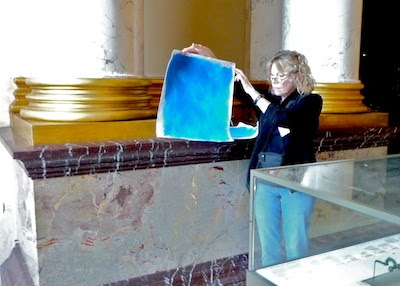
The following pictures document current progress on the Louvre-Cy Twombly collaboration.


an affirmation of a reading of the vigorous, multidirectional lines across its surface as an abstract visual language. Twombly is known for his consistent interrogation of the practice of painting as a vehicle for expression and articulation. Playing the tools of abstraction (line and form) against words and more figurative elements, the artist has developed an abstract vocabulary that is emotionally and visually dynamic.His masterful hybridization of graffiti, painting and drawing has granted him special admiration in Europe.
During the Renaissance, it was common for painters to take in apprentices, who would sometimes paint commissioned works themselves. Twombly does just that. He has asked Barbara Crawford, a Southern Virginia University professor to help him paint the canvas that will later be fastened to the ceiling. Twombly was the primary designer of the piece, and Crawford will be its primary executor. The American Scholar describes the painting process:
Before the work commenced, studies and evaluations were conducted to judge the most effective materials and process to realize Twombly’s vision for the ceiling. Originally there were plans for panels made of fiberglass. The final decision was to have Twombly’s rendering painted in oil on strips of connected canvas, which would in turn be glued to the ceiling in a process known as Marouflage—not unlike a grand version of wallpaper, only overhead, and in a place fit for kings. It’s a process that was used quite commonly in Europe from the 16th to the 19th centuries, gradually falling out of practice in recent years.
For the first time since 1953, a living artist’s work will adorn a ceiling of the museum.
Here are a few examples of Cy Twombly's work


The following pictures document current progress on the Louvre-Cy Twombly collaboration.


Wednesday, September 23, 2009
Polizzotti's Art of Communicating
I think I can safely assume that most of us have read through a museum catalogue only to be discouraged after the first couple of pages by esoteric and idiosyncratic “art talk”. In what seems like an admission that breaks the unspoken understanding between theorists, critics and art intellectuals, Mark Polizzotti, the director of publications and intellectual property at the Museum of Fine Arts, Boston, admits that we are not crazy and that museum catalogues have had a history of being inaccessible to ordinary art appreciators. Polizzotti comments on the nature of esoteric museum catalogues:
Essentially, Polizzotti proposes to intertwine intellectual significance and rigor with popular appeal. The MFA, he comments, has dealt with this problem by publishing books rather than catalogues. Unlike catalogues, which Polizzotti sees as a stand-in for an exhibition and too focused on particularities, books offer a holistic story that incorporates all aspects of a movement or a style, expanding on theories and multidimensional understanding of an exhibition or a piece. “[A book] can discuss art as not just a gathering of objects, but as a tale of the people and historical forces that created, inspired, or otherwise shaped them,” he says.
In the end, it is all about the art of communication. Polizzotti ends his article by asking, “For what use is scholarly excellence if few people ever benefit from it?”
Polizzotti’s ideal of course, is a perfect marriage of intellectual rigor and general accessibility, but he seems more concerned with public opinion than specialized and abstruse material. Catalogues, have an important place in the art world. They can draw attention to lesser-known artists about whom not enough might be known to fill a book. As catalogues tend to be image-focused and can include many different essays featuring a variety of scholars, the focus is less reader-friendly and in some ways leaves less room for narrative. Books tend to have a story and a thesis, which may not always be advantageous for a variety of voices. Ultimately we must keep in mind that while art books and art catalogues differ, both media serve important but different purposes.
The scholarly content had been geared not only to win the approbation of the author’s peers but also to edify, enlighten, and even—dare I say it?—entertain the non-specialist. Such considerations might sound patently vulgar to some. But our warehouse was stacked with old titles, some of them having sat there for decades after returning unwanted from specialty bookstores—assuming they’d even gotten that far. What good were they doing gathering dust, while incurring storage charges for the privilege? And (at the risk of sounding churlish toward my predecessors) why had they been made to appear so awfully dry and forbidding?In order to break away from this pattern, which leads to refused book deals and stunted sales, the general audience’s view of art appreciation and amateur scholarly pursuit must be remedied. Polizzotti suggests moving away from the focus on the “the finer points being made” to instead
imparting some measure of the excitement that led the author to study a given artist or period in the first place, rather than engage in one-upmanship with a handful of colleagues; in short, to recognize that the accessibility of a critical text is just as crucial as its acumen.
Essentially, Polizzotti proposes to intertwine intellectual significance and rigor with popular appeal. The MFA, he comments, has dealt with this problem by publishing books rather than catalogues. Unlike catalogues, which Polizzotti sees as a stand-in for an exhibition and too focused on particularities, books offer a holistic story that incorporates all aspects of a movement or a style, expanding on theories and multidimensional understanding of an exhibition or a piece. “[A book] can discuss art as not just a gathering of objects, but as a tale of the people and historical forces that created, inspired, or otherwise shaped them,” he says.
In the end, it is all about the art of communication. Polizzotti ends his article by asking, “For what use is scholarly excellence if few people ever benefit from it?”
Polizzotti’s ideal of course, is a perfect marriage of intellectual rigor and general accessibility, but he seems more concerned with public opinion than specialized and abstruse material. Catalogues, have an important place in the art world. They can draw attention to lesser-known artists about whom not enough might be known to fill a book. As catalogues tend to be image-focused and can include many different essays featuring a variety of scholars, the focus is less reader-friendly and in some ways leaves less room for narrative. Books tend to have a story and a thesis, which may not always be advantageous for a variety of voices. Ultimately we must keep in mind that while art books and art catalogues differ, both media serve important but different purposes.
Monday, September 21, 2009
Staying Afloat as an Artist Today
LentSpace is a new project going on in New York which developing companies are lending their unfinished project sites to artists and public arts foundations. The artists benefit from the public exposure, and the lenders can make a little bit of money from the renting an otherwise developmentally stagnant space. Eric Konigsberg of the New York Times writes:
The lot is on loan for about three years from developers who had hoped to build there by now — the project will be called LentSpace… the real estate market undoubtedly contributed to “the generous length of time” of the loan
It seems as if many artists and curators have been taking initiatives to help revitalize the arts while contributing to economic betterment. By helping themselves to cheaper venues, not only do they perpetuate the public art culture in New York, but they also help businesses make a little bit of money while their production is on hiatus due to low funds. Similar symbiotic relationships are developing around the world, assuaging the economic pains with smart lending. Earlier this month, I wrote about a similar New York Times’ article reporting on recuperating businesses lending out spaces to artists and curators while waiting for a buying offer to come along. The artists benefits from commercial exposure and cheap rent, while the company lending space benefit from attention, which might lead to a purchase.
Subscribe to:
Posts (Atom)