![]() |
| Kristen Casaletto, Apocalypse, 2008 |
![]() |
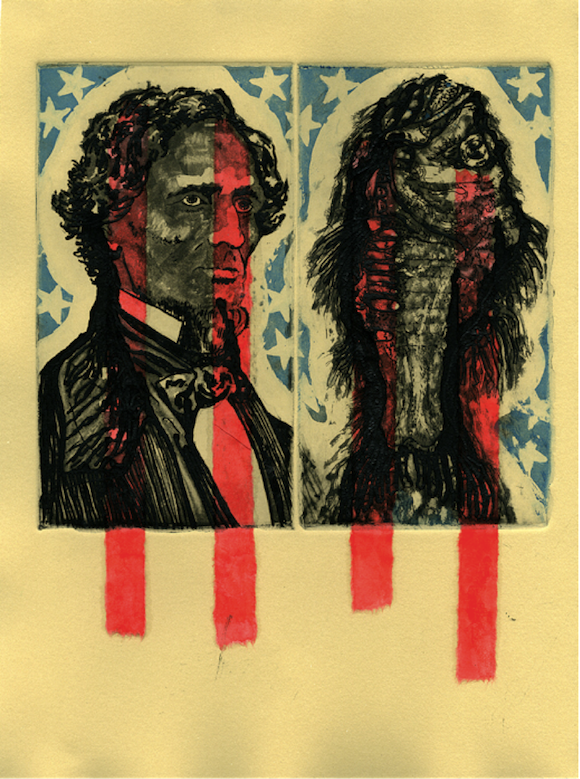
| Kristen Casaletto, Lost Cause: Jefferson Davis / Dead Fish, 2010 |
![]() |
| Kristen Casaletto, Apocalypse, 2008 |
![]() |
| Kristen Casaletto, Lost Cause: Jefferson Davis / Dead Fish, 2010 |

What country do you think is the biggest buyer in the contemporary art market? The United States? England? Perhaps even France? You could continue this guessing game for more than an hour and we are certain you would not have come up with the correct answer: Qatar. The small oil-rich country of Qatar is located in the Middle East and has a population hovering around 1.5 million, thus proving, without a doubt, that you don’t have to be big to be important. Over the past six years it is believed that Qatar has been behind most major sales and commissions of modern art. Just recently, Edward Dolman, the chair of Christie’s auction house of New York, was announced as an executive director in the office of the Sheikh. Dolman will join the board of trustees of the Qatar Museums Authority (QMA), who oversee many of the cultural initiatives of the country. Dolman stated, “Qatar is looking to deliver a series of exciting cultural projects in time for the World Cup in 2022.” The list of purchases and planned exhibitions to take place in Qatar is astounding. The country is planning a Jeff Koons exhibition and recently was part of a $310 million deal involving the purchase of 11 Rothkos. Other major acquisitions include works by Andy Warhol, Roy Lichtenstein, Damien Hirst and William Hoare—quite the major accomplishment for a state that only technically became an independent country in the fall of 1971.


The Saatchi Gallery in London is one of the world’s premier art spaces, showcasing up and coming contemporary artists. Charles Saatchi, art collector and global advertising mogul, opened the gallery in 1985 in North London. Currently, the art house is located in Chelsea in the Duke of York's HQ building. Saatchi’s history features artists from different areas, including US minimalists, Young British Artists (YBA) and contemporary artists from the United States, Britain and China. Many artists who show at the gallery often use the publicity to jump start their careers. On June 2, the largest show since moving to the current location opened with many exciting but still mostly unknown artists from Britain.
Called “Newspeak: British Art Now,” the show predicts what future art in Britain will be. The term “newspeak” comes from George Orwell’s chilling novel 1984, in which the language gets simplified and smaller constantly in order to create a utopian, equal society. The exhibit takes the idea of newspeak and does the exact opposite: the artists are showing how visual language can multiply and be invented by them to “explore issues such as class, consumerism and the phenomenon of instant success culture, often with a distinctly British dry wit” (http://bit.ly/a9bJR6). Artists in the first set of Newspeak include Barry Reigate, Pablo Bronstein and many others.
The Saatchi Gallery strives to reach the largest audience possible, and in the first year of being open in the Chelsea location, over 1.2 million people came to see the progressive shows. The free admission and prime location also help draw the crowds.
If you find yourself in London this summer, be sure to visit the Saatchi Gallery for really exciting and fresh art. For more information on the gallery, please go to http://bit.ly/3OifW.
The Museum of Contemporary Art in Los Angeles (MOCA) recently published a new children’s book on contemporary art called “Breaking the Rules: What is Contemporary Art?” by Susan Rubin. According to MOCA, the book is “the first to make the museum’s world-renowned permanent collection accessible to young audiences.”
“Breaking the Rules” fills a gap in the kind of art presented to young audiences. While art books for children about Andy Warhol and Roy Lichtenstein multiply, texts about the more contemporary artists are few and far between. “Breaking the Rules” expands the canon and includes leading contemporary female artists as well as a multicultural group of some of the most groundbreaking and exciting artists of our time.

The Library of Babel / In and Out of Place is now on view at 176 Zabludowicz Collection in London. This salon-style exhibition, with 217 contemporary works, encourages the viewer to think like a curator. There are no wall texts, essays or audio guides to help visitors through the exhibition.

This week, I’ll be posting a series of installments concerning Chinese contemporary art, its recent history, and why collectors find Chinese contemporary art not only attractive but worth spending immoderate amounts of money on. Many disillusioned types criticize this new obsession, which is both Western and Eastern, as simply a glorified “rush for riches” fueled by the allure of exoticism. Its origins however, prove that the new Chinese art movement and its following are more complex and unusual than anything we’ve seen before.
Chinese contemporary art has been edging its way into our Western consciences—especially in the past 10 or so years. The inundation of Chinese contemporary art into museums, galleries and personal collections, recognizable from its bright colors and prolific Mao imagery, floods our markets and attentions due to the Chinese government loosening cultural policies. Although China keeps a close eye on the art being produced within its borders, its artists have recently reemerged as respectable commentators on contemporary happenings—a major advance from the Cultural Revolution, when they were punished along with many intellectuals by being sent to work in the countryside. Little has been published in the way of edifying Chinese art criticism for English-speaking audiences until very recently, but Artspeakchina, an English-language wiki site, now contains well over 300 articles and a “multi-media timeline of historical and arts events since 1949,” according to ArtDaily, and is growing quickly. Its predecessor, Chinese-art.com, founded by Robert Bernell, also showcases innovative art from China. Like Artspeakchina, Chinese-art has an open-forum wiki setup where Chinese art experts can edit articles, but its medium is that of an online magazine. Chinese-art.com can only be viewed outside of China, as the Chinese government considers it too controversial.
It was in reading about Artspeakchina that I became interested in writing a more in-depth article examining why Chinese art befuddles anthropologists, economists and historians as much as art critics. This topic may seem somewhat esoteric and not necessarily GMOA-pertinent, but it has affected the entire world art market and perplexed, intrigued and piqued museums, galleries, scholars and individuals. This intense global discussion began when China overtook France in art sales, ending that country’s century-long art-market reign. An article in The Economist pointed out that, “When the global art market shrunk by more than a third to €31.3 billion ($43.5 billion), compared with €48.1 billion at its peak two years earlier, the Chinese art market bucked the trend”. But the economic surprise resulting from the Chinese art boom isn’t nearly as interesting as the movement’s genesis.
Tomorrow I’ll post a short history of the movement and its immediate political and artistic predecessor.Stay tuned!


All participants were given a general definition of art, and a label stating the style the works represented. But half were also provided with a definition of that style, a brief history of its origins and information on the goals of the artists who worked in that style.So it's not as though he was throwing half his subjects into a room with Felix Gonzalez-Torres's "Untitled (Public Opinion)" (or any of the artist's other conceptual works) and asking them to respond aesthetically on the rating scale, then giving the other half information on the artist's intentions before having them do the same. Context doesn't hurt with a lot of more traditional representational art, and it's less necessary with some Abstract Expressionist pieces, which can be more intended for gut reactions from the viewer, but with a lot of contemporary conceptual art, the ideas at play can be the most important part of the work. Failing to acknowledge this variety of possibilities when it comes to the relationship between art and education is simplistic, and it's no doubt exactly what will happen in any subsequent articles that pick up on the study. Admittedly, this sort of response is what you'd expect from us, as an institution that takes education as one of the key components of its mission, and there's certainly room for interaction with art on a less intellectual level, but saying contextual knowledge actively harms one's appreciation of art seems pretty harsh!
They were then asked to rate, on a scale of 1 to 7, not only how much they liked the work in question, but how closely it matched their personal conception of a work of art.
. . . This notion was largely supported by Bordens’ findings. “As ratings of the degree to which an artwork matched one’s internal prototype of art increased, liking ratings increased as well,” he writes. “Dada and Outsider art were rated as matching less well with internal concepts of art, and were liked less than Impressionism and Renaissance art.”
. . . “Providing contextual information led to participants perceiving examples of the various styles of art as matching less well with their internal standards than when no contextual information was presented,” Bordens writes. In other words, they were more likely to feel a piece conformed to their personal ideas about art — and thus more likely to enjoy or appreciate it — when it was presented without interpretation.
Bordens presents several possible explanations for this finding, which somewhat contradict a 2005 study by University of Vienna psychologist Helmut Leder. He writes that the contextual information presumably led to “greater conscious processing” of the pieces, which may have “led participants to be more critical.”
“In this experiment, the contextual information was very concrete, and may have encouraged participants to think concretely,” he notes. Newly equipped with a clear, rigid definition of what constitutes a certain type of art, the students were perhaps more likely to judge a particular painting as falling outside of its parameters.
His goal is to create a counter-model: to make something (a situation) from virtually nothing (actions, words) and then let that something disappear, leaving no potential marketable trace.


We have one rule: "We won’t take anything off public display", Mr. Cooper said in a telephone interview. Nor will the museum lend a work likely to be requested for an exhibition anytime soon. “That limited us to looking at things in storage,” Mr. Cooper added. “But there’s quite a bit.Mrs. Obama and the house curator,William Allman, picked works they found using various museum Web sites that constituted a diverse and distinct collection, never seen before in the White House. According to Kerry Brougher, chief curator at the Hirshhorn Museum, “There are some very interesting figures. It’s more interesting and shows a greater diversity of art than I’ve seen.” In an ABC interview, Harry Cooper, a trader of modern and contemporary art at the National Gallery, says the Obamas’ chosen collection has what those in the art world call “wall power.”
"A lot of it is really important and pretty powerful. It has wall power. It looks powerful on the walls. Strong works which are visually arresting.” Cooper described the Obamas’ collection as “really mainstream paintings. “I think there’s a great range of work—both abstract work and figurative work and within the abstraction. There’s very clean geometric paintings as well as more expressive paintings.Of the 45 works, I found the less known ones to be the most intriguing. Where do they come from, why did the first family decide to go with these pieces, and why are they important? I felt compelled to seek out their history and their stories, as they are now entering an important context within the walls of the White House, telling their own story and adding to the new story they are now entering. I picked two artists to talk about, portraitist George Catlin and African American expressionist painter Alma Thomas, both of whom gave voice to an otherwise voiceless community.
Some of my earliest coherent memories are of performing with Jackson, the adrenaline surge etching the moment into my brain. The performing hasn’t stopped yet, and this is the gift I take with me—a fascination with the immediate and electric connection between me and the audience, the delight in events unfolding in real-time, communally. I mark my life with Jackson in performance intervalsAlthough her artistic manifestations involve more performance and less poetry than her father's, her art stays within the same philosophical canon. Both Clarinda and Jackson strive to redefine artistic boundaries and find ways to engage in various forms of conversation with the audience, whether it be through the spoken word or physical movements. Clarinda describes her intentions as a performer:
To me, performance is a form of conversation. I aim to make situations where viewer and viewed are mutually affecting and create experiences that wake up body and mind. I do this through reframing our relationship to architectural space and urban public interaction, with interventions into everyday life and infiltrations into unexpected sites in a wide variety of communitiesIn her latest interactive performance piece, "Cyborg Nation", she wears a costume with a built-in miniature camera, microphone, amplifier, and video projector. The Ciné web site describes the project as an investigation of how “technology both extends and limits our senses by combining remote communication in the form of email and phone messages with one-to-one conversation, providing a twenty-first-century version of the Socratic dialogue." ICE (Ideas for Creative Exploration) presents "Cyborg Nation" in Athens at Ciné. The performance will begin at 7 this evening and last till 9. Admission is free.
Although Russia was virtually free of art censorship in the late 80’s and 90’s, it has more recently become quick to dismiss and destroy pollitical and dissident art. The Russian art pax ended in 1998, When the artist Avdei Ter-Oganian was charged with breaking a prerevolutionary law against provoking religious tension, reactivated just for this case, after he used Orthodox Christian icons in a performance. Faced with a jail term, he fled to the Czech Republic, where he was granted political asylum.
Since then, artists and curators have been under attack by Russian governmental authorities. One case featured in ARTnews centers on two curators on trial for inciting religious hatred. They have been accused of breaking a law passed in 1996 against inciting religious hatred. Andrei Erofeev, the critic, scholar, and former head of the Tretyakov Gallery’s department of current trends, and Yuri Samodurov, the former director of the Andrei Sakharov Museum and Public Center, face fines and/or prison terms of up to five years if they are convicted.
Apparently, one of the witnesses at trial proclaimed that the pieces featuring Christian worshippers praying to Mickey Mouse catalyzed his wife’s premature death. “Such blasphemy took away her will to live,” He said. An orthodox priest also spoke up, calling Erofeev a “servant of Satan." Erofeev and Samodurov aren’t alone in these cultural and societal “crimes." Young artists are stirring up the media and the government with a new wave of actionism, a movement based on political provocation. One group of young people have riled up the local authorities by performing “Monstrations”—flash-mob street parties carrying messages like “Where am I?”, “Return me to Mars!” and “Pigs are humans too." The artists have been charged with mass disturbances, arson, and defacement of private property, all of which they have denied. ARTnews delves into other contemporary cases involving taboo messages leading to jail time and arrests. It seems that the only person who has time to make statements connected to art is Prime Minister Putin. Visiting the gallery of the nationalist painter Ilya Glazunov in June, the former president advised the 79-year-old realist to lengthen Prince Oleg’s sword in a painting of the medieval princes Oleg and Igor. Putin thought the sword looked more like a knife for cutting sausage. Glazunov said he would take the prime minister’s suggestion.

“Brutally frank”, says the blurb, but a recurring note is defensiveness, and the sore spot is "vulgarity". “The snobbery of those who think an interest in art is the province of gentle souls of rarefied sensibility never fails to entertain. Lord forbid that anyone in 'trade' should enter the hallowed portals of the aesthete. I liked working in advertising, but don't believe my taste in art, such as it is, was entirely formed by TV commercials!”