Showing posts with label public art. Show all posts

Thursday, June 16, 2016

The Museum Installs Public Art: The Do Good Fund Teen Photography Workshop


Last Tuesday, June 7, two educators, one preparator and an intern from the Georgia Museum of Art took a break from the galleries to install a new exhibition on an exterior wall of CinĂ©, the local community-based cinema and arts venue in downtown Athens, Georgia (234 W. Hancock Avenue). This installation is the culmination of the Do Good Fund Teen Photography Workshop, in which a group of local teens learned about the art of photography through the Do Good Fund's exhibition of photographs by Southern artists. In response, the young artists created work to influence community engagement. In conjunction with Inside Out, a worldwide outdoor photography project, the display of eleven teen portraits honors the contributions of young adults to our community’s well-being.

Time-lapse video of the installation by Larry Forte

At the museum, we pride ourselves in preserving works of art to ensure their long existence for the public. For this outdoor installation, we faced a number of challenges that rarely threaten an exhibition indoors. The final large-scale photographs were printed on paper and adhered to the public wall space with a homemade wheat paste made from a mixture of flour and water. Although we always understood this installation was ephemeral and to last for one month, torrential rain and wind quickly disintegrated many of the photographs in just one week, with only two photos managing to stay intact.

But not to fret. The damaged work will be replaced in time to celebrate teen artists at the Athens Farmers Market on Wednesday, June 22, across from CinĂ© at Creature Comforts from 4 to 7 p.m. The public is invited to create their own self-portrait and continue the young artists’ message that, together, we add life to the Athens community in all of our beautifully individual ways.

Brittany Ranew
Education Program Specialist

* * *

We are the next wave of thinkers, inventors, and astronauts; the ones who will make Athens proud. We are curious, brave, active, smart, shy, busy, loving, daring and different in many ways. We are the quiet ones with books under desks, the bold ones who stand up for what's right, and some of us aren't quite sure who we in are yet.

In these photos you can see our origins our eyes. 
Together, we add life to the Athens community.
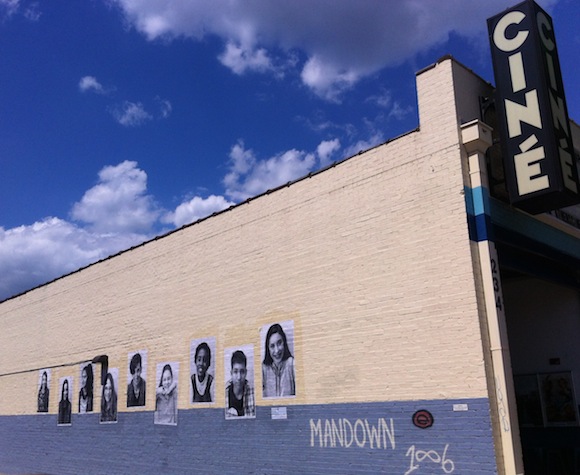


Artists on view (from left to right): Piper, Crystal, Savannah, Eva, Stacy, Jessa, Kamron, Annesly, Tina, Umberto and Angelina

Contributing artists: Don, Madison, Michael and Sofy

Friday, March 06, 2015

1WTC Art

One hundred and seven floors may be empty right now at One World Trade Center, but that doesn't include the walls already filled with art. After the 13-year construction, it's no surprise that the featured art would be carefully considered.  The five American artists were only given one guideline: that the work must be unifying. The artists were picked by consultant Asher Edelman, who said, "The mission was to get people to turn their phones off and look up. It had to be a wake-up call. But not about the building; about itself."

The showpiece is a massive 14.5-by-90-foot mural titled "Union of the Senses" created by Jose Parla.  
Jose Parla 
Below are the other works displayed that provide a playful counterbalance to the building's light-filled spaces, high ceilings and white marble. With the observation deck opening this spring, it is expected that 20,000 people will see the art daily. That's more visitors than the Metropolitan Museum of Art receives. 

Bryan Hunt, "Axis Mundi"
Fritz Bultman, "Gravity of Nightfall"
Fritz Bultman, "Intrusion into the Blue"
Greg Goldberg, "One World Trade Center Series"
Doug Argue, "Isotopic"
Doug Argue, "Randomly Placed Exact Percentages"

Monday, June 06, 2011

A Park with a View

Have you ever walked down railroad tracks because it was a faster route to where you were going or because you wanted the excitement of looking down on other roads, cars and pedestrians? Of course you haven’t, because it’s actually illegal if trains still use the tracks. Fortunately for us, a community-run non-profit in Manhattan has given pedestrians a simple and aesthetically pleasing solution to this legal problem: The High Line.

Friends of the High Line is a community-run, non-profit organization.

In 1934, a high line for trains opened above the streets of Manhattan from the Meat Packing District to West Chelsea to Hell’s Kitchen, because so many deaths were occurring from car-train accidents and pedestrian-train ones on the street level. Raising the trains was a great solution and helped 10th avenue lose its nickname “Death Avenue.” Soon after the line was built, however, the rise of interstate trucking as a means of transportation led to a drop in rail traffic, and the high line was abandoned and left to decay. You can see pictures of the historic line here. In the mid-1980s many property owners lobbied for its demolition, but a large community outcry halted their efforts. The community agreed that something needed to be done with the structure, but what could they do that would allow them to keep and improve the line?

The old train high line running through West Chelsea.

In 1999, a group of New Yorkers founded Friends of the High Line and worked together to figure out a way to turn this dilapidated structure into something useful and community-oriented. Thus, the High Line Project was born. Today, the first phase of the new High Line is complete and is intended for pedestrians, tourists, and city-lovers of all ages. The High Line has become a walkway above the city with observation decks, benches, food carts, gardens, miniature water parks, and even galleries for local artists. You can watch a video of the entire design plan for the High Line here (The High Line Design Video 2008). Everything about the High Line is meant to “reinforce New York City, and in particular, the neighborhood around the High Line, as a vital cultural center.” The City of New York is in full support (even financially) of this environmentally friendly project and so are we. We love the idea of a green, pedestrian-centered art space running through Manhattan as well as repurposing something old in the sake of art. There are also many ways to get involved with the High Line. Construction and upkeep is ongoing. Check out the High Line Youth Corps on their blog! If you’re traveling to New York this summer, don’t miss this exciting and inventive addition. The second phase will be open June 8.

The new and improved High Line is enjoyed by pedestrians, New Yorkers and tourists year-round

Thursday, November 11, 2010

"Art on the Wall"

The Art Factory, a nonprofit arts education organization in Augusta, Ga., has been working with the Augusta Utilities Department on a three-phase project called “Art on the Wall.” This project has been covering the walls of the Highland Avenue Water Department with murals.

The first two phases have been completed. The wall on Highland Avenue (phase one) illustrates a mural of the Savannah River. In the second phase, six artists from the Central Savannah River Area (CSRA) were chosen to create water-themed art for the wall on Wrightsboro Road.

Phase three is currently taking place at the wall on Iris Street and will include four murals. This section has been “a ‘Working Wall’ for students to discover the art of mural painting.” The artists for this wall are local teens from the Boys & Girls Clubs and other organizations. So far, the wall includes fish swimming in water around well-known Augusta locations, such as the Sacred Heart Cultural Center and Sconyers Bar-B-Que.

After the teens are finished with their murals, art students at Augusta State University will complete the project. Click here and here to see more photos of the “Art on the Wall” murals.

The Art Factory aims to “provide the children of the Augusta community with high quality fine arts educational experiences that also promote the development of positive life skills.” Click here to read more about the organization.

Monday, October 11, 2010

Lamar Dodd School of Art Lecture: Donald Lipski


The Lamar Dodd School of Art will host sculptor Donald Lipski as part of the Visiting Artist and Scholar Lecture Series on Tuesday, October 12, at 5:30 p.m. in room S151 of the Dodd’s building on East Campus.

Lipski has exhibited around the world, including at the Metropolitan Museum of Art, the Whitney and the Art Institute of Chicago. He has also received the Guggenheim Fellowship, the National Endowment for the Arts Award, the American Academy of Arts and Letters Academy Award and the Rome Prize.

Lipski’s work often combines unlikely objects and materials to create something new, such as the trumpet and candle seen above. He says, “I strive to both seduce and challenge the viewer, to provoke wonder and delight…to lead him to question, to make his own metaphors.”

He has also gained popularity and acclaim for his public projects. His work is currently on view in a number of locations including the Miami International Airport, Levine Children’s Hospital in Charlotte, N.C., and the Sacramento Airport.

For more information, visit the Lamar Dodd website or Donald Lipski’s website.

Monday, September 27, 2010

Great Art in the Great Outdoors

Stumbling across a van Gogh on your morning constitutional may be a startling thought and a dream come true for many art lovers. If you’re one such aficionado, then you may just have to take a trip to Detroit, where the Detroit Institute of Art is celebrating its 125th anniversary with the outdoor installation of famous paintings by Vincent and such other museum ticket-selling faves as Seurat, Fuseli and Degas.

Well, okay—almost. The pieces in this commemorative public installation, DIA: Inside/Out, are actually life-size waterproof reproductions created just for the occasion. Even so, what a thrill to be walking downtown or along the Detroit RiverWalk and find a beautiful piece of art! DIA will be producing a map of all the sites, should you like to make a day of chasing down these faux masterworks. You can read more about this outdoor exhibit here and here.

Monday, August 16, 2010

StreetSmARTS

The Wall Street Journal—Ariel Zambelich

In January, the San Francisco Arts Commission (SFAC) and the Department of Public Works (DPW) started a program called StreetSmARTS. For years, San Francisco had strict laws against graffiti. Although fines and jail time helped decrease vandalism, graffiti was still very common. With this new program, the city is working with street artists and pays them to paint buildings legally.

The program commissions the city’s well-known street artists to create murals on private property, which is “a proven and effective strategy for making property owners less vulnerable to graffiti vandalism,” according to SFAC. StreetSmARTS is modeled after similar projects in New York, Washington, D.C., and Philadelphia.

Francisco Aquino, a San Francisco graffiti painter and StreetSmARTS artist, says that the program “helped draw a more defined line between vandals and artists in the street art community,” and that “older, more-established street artists view graffiti as art and want to persuade the younger artists to join their ranks and create legal murals.”

Read this article for more information.

Monday, July 26, 2010

Call for Artists

The Duluth Fine Arts League (DFAL) has issued a call for artists for “Living Honorarium,” a public art project conceived by Shirley Fanning Lasseter, former mayor of Duluth, Ga. This project will honor the members and living veterans of its firefighter and police forces.

“So many people are honored when a life is lost, but few while alive . . . . I want people to know we appreciate them now and forever—not just when their jobs are done and life is gone,” said former mayor Lasseter.

Professional artists in the Southeast working in any media are eligible to enter. The winner will receive $50,000. Entries will be installed on an octagonal piece of land in Historic Duluth.

Tuesday, March 16, 2010

Re:Construction

We’ve all had awful experiences with construction sites­. They cause traffic, never seem to end, and are dangerous and not so pretty, but the Alliance for Downtown New York has introduced a public art program called Re:Construction that turns construction sites into works of art.

Construction projects are everywhere in Lower Manhattan, and the poor economy delays completion, causing the sites to become seemingly permanent. The goal of Re:Construction is to make these sites into “canvases for innovative public art and architecture.” The project’s curator is BravinLee Programs, run by Karin Bravin and John Lee.


Photo credit: BravinLee Programs

All of the projects in Re:Construction “bring color, movement and scenic beauty” to the construction sites. Botanizing on the Asphalt (above) by Nina Bovasso covers 400 feet of jersey barriers at Hudson River Park. Fence Embroidery with Embellishment (below) by Katherine Daniels consists of such materials as spools, jar lids and wire mesh. The installation runs 600 feet along a construction fence.


Photo credit: Nina Bovasso

Re:Construction has been ongoing since 2007 when the Lower Manhattan Development Corporation (LMDC) awarded the Downtown Alliance $1.5 million for the project. Check out the Re:Construction Web site for more photos and information.


Thursday, March 11, 2010

Hello Wall

The Hello Wall from wasted spaces on Vimeo.


Flavorpill linked yesterday to this very cool art project that shows good use to be made of social media. Not that determining whether circles are larger or smaller or faster or slower moving is a huge decision, but it at least shows the potential for public interaction with art, which is something we're always trying to promote. It also, tangentially, makes us think about this early Willie Nelson song that made use of advanced technology in its own way.

Thursday, February 11, 2010

Public Art?


Head prep Todd Rivers snapped this photo while in Atlanta. Sure, the stick man doing a little dance with the wheelchaired figure could be a coincidence, put there by nature, but we like to think of it as guerrilla public art, carefully placed by a passerby for maximum aesthetic impact.

Thursday, December 17, 2009

Art Around Athens


Three more Athens-area art events take place tonight. If you read our local paper, you already know about the two cool new bike rack/pieces of public art installed in front of the Classic Center in downtown Athens. Designed by Joshua Jordan and Michael Ely, they're practical and attractive, and BikeAthens is showcasing them from 4 to 6 p.m. this evening. After you've seen them in person, move over to The Globe for the BikeAthens Art Bash, where you can bid on local art inspired by alternative transportation and quaff some of the great beverages available there.

Out in Watkinsville, from 5 to 9 p.m., Main Street Yarns is hosting a dessert social and art reception for "Creepy and Cute at Christmas," an exhibition featuring paintings, shadowboxes, marionettes and more by local artist Cindy Jerrell.

And from 6 to 8 p.m., Georgetown Frames (50 Gaines School Rd.) is having a free holiday open house featuring local holiday arts and crafts, live music and refreshments.

Tuesday, December 08, 2009

Do Artists Have The Legal Right to Protect Their Art from Mutilation and Destruction?


The plaintiff is artist Chapman Kelley, who created the Wildflower Works in Chicago’s Grant Park. His public art project, a 1.5-acre self-sustaining wildlife garden, designed to thrive without watering, fertilizer or insecticides, was intentionally destroyed by the Park District about five years ago. Alex Karan, Kelley’s lawyer, has taken this case pro bono because he worries that the district court “not only denies legal protection to any site-specific public art, but throws into question any artist’s rights,” says Deena Isaacs of the Chicago Reader. The Park District staff notified him, nearly 20 years after the work’s installation, that the garden would be replaced with a more grandiose and extravagant garden, nearing $700,000 in cost and who knows how much more in upkeep. Kelley was especially aggravated when the park did not even let him remove his artwork, to be able to install it somewhere else.

“His lawsuit charges the Park District with breach of contract and violation of his rights under the 1990 federal Visual Artists Rights Act. (The Park District did not return calls for comment.)…Under VARA, artists have the right to protect their work from modification or destruction no matter who owns it, and must be given 90 days to remove any piece that's threatened. But VARA defines an artwork as a painting, drawing, print, sculpture, or photograph original enough to qualify for copyright.”, says the Chicago Reader.

The works qualified as sculpture/drawing under the VARA act umbrella, much to Kelley and Karan’s relief. Ultimately, the court ruled in Kelley’s favor: “For each argument that the City lawyer raised, the court responded with one of the arguments that we had briefed and made clear that they thought the City was dead wrong.”

The Chicago Reader article also mentions Karan’s struggle with advanced cancer, which left him too weak to finish working on the case. The rest of the case was passed on to another young litigator from Kirkland and Ellis, Micah Marcus. The Reader links to Karan’s blog, akaran.wordpress.com, and gives regular updates on his condition.

For more information and detail on the Kelley case, visit the Reader web site

Thursday, November 19, 2009

Death of Jeanne-Claude on Wednesday


Jeanne-Claude, one of the artists behind “The Gates,” died at the age of 74 on Wednesday night due to a brain aneurysm. Jeanne-Claude and her husband, Christo, are best known for wrapping famous structures. Her most notable work, or at least, her most recognizable project to Americans, has to be “The Gates” in Central Park. The show served as a site-specific, public art project that consisted of a series of orange-red gates throughout the park. Atop the gates rested nylon sheets of the same color, hanging midway down the length of each gate. The gates were inspired by and resembled Japanese Torii gates in Kyoto. There were reactions passionately for and against the structures—some thought the gates blocked out the existing natural layout of the park, while others thought it added a refreshing touch of color to an already bleak winter landscape. What, to me, was most interesting about this exhibition was the couple’s blatant refusal to accept any donations (i.e. they raised money without help from big organizations and wealthy donors). Instead, Christo and Jeanne-Claude sold collages and drawings from the 1960s and, with the money raised, were able to put together the entire show without having to solicit help from the city of New York. With this money, they were able to hire 600 paid employees, as well as sell T-shirts and other exhibition paraphernalia. Other projects include the more political and outspoken “Rideau de Fer” (Iron Curtain), a structure constructed in the early 1960s in Paris as a sculptural, silent statement against the Berlin Wall, and their numerous wrapping projects. Their Web site goes into specifics about one of their most important of the latter:
The Reichstag stands up in an open, strangely metaphysical area, The building has experienced its own continuous changes and perturbations: built in 1894, burned in 1933, almost destroyed in 1945, it was restored in the sixties, but the Reichstag always remained the symbol of Democracy. Throughout the history of art, the use of fabric has been a fascination for artists. From the most ancient times to the present, fabric, forming folds, pleats and draperies, is a significant part of paintings, frescoes, reliefs and sculptures made of wood, stone and bronze. The use of fabric on the Reichstag follows the classical tradition. Fabric, like clothing or skin, is fragile, it translates the unique quality of impermanence. For a period of two weeks, the richness of the silvery fabric, shaped by the blue ropes, created a sumptuous flow of vertical folds highlighting the features and proportions of the imposing structure, revealing the essence of the Reichstag.

The endeavors they chose were always grandiose and sometimes impossible, especially because of the daunting physical size of their projects but also because of the monetary mountain they had to overcome by refusing donations. Jeanne-Claude’s artistic presence will be sorely missed.


Here is an interview with Jeanne-Claude and Christo

Frustrated Jeanne-Claude and Christo try to clear up misconceptions about their public personas and their works. The set-up is pretty relaxed, but the language is really stern—I felt like I was getting scolded and couldn’t keep a straight face… Click here for a giggle! And… it is interesting.

Wednesday, November 18, 2009

Stumped


London experienced a mind-blowing display of climate change, environmentally friendly and green messages in Trafalgar Square this November 16. The artist in charge of this project, Angela Palmer, transported exposed tree stumps and buttress roots from a commercially logged tropical forest in the Suhama Forest in western Ghana. After the exhibition in Trafalgar Square, the ghost trees will migrate to Thorvaldsens Plads in Copenhagen while the UN Climate Change Conference takes place December 7-18. These stately remnants serve as a desperate outcry against the perfunctory eradication of rainforests in Ghana (and the rest of the world). In the last 50 years, 90 percent of Ghana’s rainforests have disappeared due to human involvement. Now, the remaining forests are subject to strict regulations, allowing regeneration and sustainable timber industry for the locals. According to Art Daily, Palmer explained, “This is not yet another message about climate change ‘doom and gloom’, it carries a message of hope and optimism for the future.” As you can imagine, this enterprise had to have cost a branch and a root, and fortunately, Palmer did not have to finance it all herself. Deutsche Bank helped carry the heavy load. It’s pretty exciting to know that big businesses are helping diffuse this green message.  

The Financial Times has quite a lengthy article written by the artist documenting the artistic process and her thoughts on the project:

http://www.ft.com/cms/s/2/c376e47c-b461-11de-bec8-00144feab49a.html 

Visit the artist’s Web sites:

http://www.ghostforest.org/

http://www.angelaspalmer.com/

Wednesday, September 30, 2009

American Gothic XXL


Chicago, a city well know for its prolific public art scene, has just added a new sculpture to the mix. Unlike the famous domineering Picasso in the business sector, not far from the Art Institute of Chicago, the new 25-foot-tall sculpture inspired by iconic painting Grant Wood’s "American Gothic", stands as an ironic homage to the clichĂ© of Midwestern lifestyle. "God Bless America", by J. Seward Johnson, is on loan from The Sculpture Foundation, an organization famous for promoting public art. Although the sculpture has been criticized as a knockoff, and a bit trite, people seem to love it! "It speaks to Midwesterners, especially the farmer aspect of it," said Melissa Farrell, an executive assistant at Zeller and the liaison to Johnson's The Sculpture Foundation, which owns the work. Indeed, since being put up in Pioneer Plaza for display last December, God Bless America has become, by most estimates, one of the top public-art attractions in a city that believes, even with a tight budget, in buying and displaying art and boasts several superstars of the genre. These include the Picasso sculpture in Daley Plaza, Calder's Flamingo in Federal Plaza and, surpassing everything in popularity these days, Cloud Gate, commonly known as The Bean, in Millennium Park.

Not only that, but the Chicago-Herald Tribune also says that this exhibition is encouraging people to go to the Art Institute of Chicago, and see the painting on which the sculpture is based. Unlike "Cloud Gate" or the Picasso, which appeal to the cognoscenti and passersby, this photo-op, tongue-in-cheek sculpture has really only garnered a lot of attention from passersby. In fact, Johnson gets mediocre reviews from art critics."It's very successful," Kelley said. "I really like it. It is incredibly well crafted. It's high craftsmanship as a public art piece. It doesn't inspire me as a work of art the way Cloud Gate or the Picasso does. As an art historian, it's not my favorite genre where one artist appropriates another artist's imagery. But to everybody his own right."

Perhaps critics shun this piece, but it’s friendly to the masses, and perhaps encourages aspiring art lovers. So why not?

Thursday, September 24, 2009

Ceci n'est pas criticism


LentSpace, the Canal Street space acting as a temporary public art and sculpture park about which intern Aurelie Frolet wrote earlier this week, has been vandalized, according to Curbed. Spraypainting "this is not art" on something that's clearly a piece of art is a fairly arty gesture in and of itself, though, isn't it?

Monday, September 21, 2009

Staying Afloat as an Artist Today

LentSpace is a new project going on in New York which developing companies are lending their unfinished project sites to artists and public arts foundations. The artists benefit from the public exposure, and the lenders can make a little bit of money from the renting an otherwise developmentally stagnant space. Eric Konigsberg of the New York Times writes:

The lot is on loan for about three years from developers who had hoped to build there by now — the project will be called LentSpace… the real estate market undoubtedly contributed to “the generous length of time” of the loan

It seems as if many artists and curators have been taking initiatives to help revitalize the arts while contributing to economic betterment. By helping themselves to cheaper venues, not only do they perpetuate the public art culture in New York, but they also help businesses make a little bit of money while their production is on hiatus due to low funds. Similar symbiotic relationships are developing around the world, assuaging the economic pains with smart lending. Earlier  this month, I wrote about a similar New York Times’ article reporting on recuperating businesses lending out spaces to artists and curators while waiting for a buying offer to come along. The artists benefits from commercial exposure and cheap rent, while the company lending space benefit from attention, which might lead to a purchase.

Tuesday, July 14, 2009

Public Art and the Media


We were checking out Flavorpill today, and it prompted some thoughts about public art. One of the daily links was to "Play Me I'm Yours," a project by Luke Jerram that involves the set up of numerous pianos around a city, in various states of repair, for the public to play. As the statement on the website says, "Who plays them and how long they remain is up to each community. The pianos act as sculptural, musical, blank canvases that become a reflection of the communities they are embedded into. Many pianos are personalised and decorated." It's a neat work of art and the kind of thing everyone wants in his or her own town, right?

Flavorpill also linked to Heather Tweed's page, actually to show off her fuzzy Anubis sculptures, but poking around there, we found her "Lost not Found: Abscission," which doesn't give a lot of details but appears to be a similar use of public space for an interactive art project: "The artist will be secreting small artworks at various locations across Edinburgh City centre, finders are requested to follow the attached instructions to participate in the project and keep the artwork. Please visit again over the course of the project for updates, participants and final outcome."

So why do our buttons get so happily pushed by this kind of interactive, public art? If you're a member of the media, including bloggers, pieces of this sort are certainly easier to write about. There's more to do than just stand there and contemplate. And there's no entrance fee. But should they take precedence over more traditional gallery installations? Should we stop pointing to the efforts of artists to shake up everyday life and create consciousness about art as a living, evolving thing?

Tuesday, July 07, 2009

Truly Public Art


(image from Getty)

Amy Miller, our shop manager, passed along this great article from NPR about "One and Other," a public art project that makes use of an empty plinth in Trafalgar Square. A total of 18,000 people applied and 2,400 were chosen randomly to do whatever they like for an hour each, night and day, for the next 100 days. Results are being streamed live (and not very choppily) at this link, and photos are being uploaded here, including a guy dressed as a panda and taking cell phone calls. Can we get a plinth?